In This Article
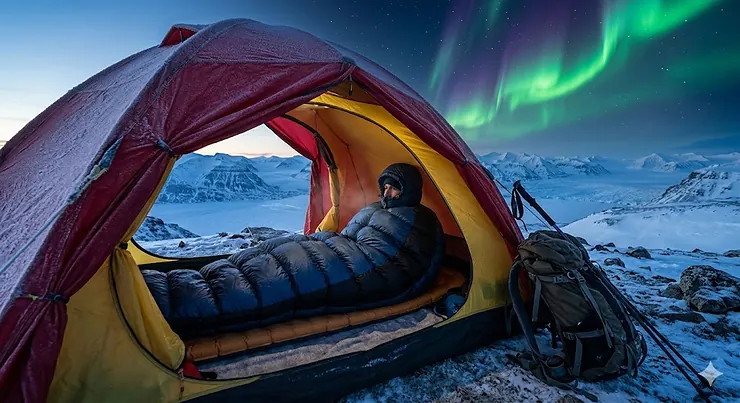
When temperatures plummet to -30°C (-22°F) or lower, your sleeping bag becomes more than camping gear—it transforms into life-support equipment. In Canada’s Arctic regions, from the Yukon’s frozen valleys to Nunavut’s wind-swept tundra, choosing the wrong sleeping bag for Arctic conditions isn’t just uncomfortable—it’s dangerous.
After two decades of winter expeditions across Canadian territories and consulting with polar explorers, I’ve learned that a proper Arctic sleep system involves much more than grabbing the warmest-looking bag on Amazon.ca. The difference between a restful night and hypothermia often comes down to understanding how fill power, temperature ratings, and construction techniques work together in real-world conditions. What most buyers overlook is that temperature ratings are tested under controlled laboratory conditions—the actual performance in Canadian winters depends on your sleeping pad’s R-value, what you’re wearing, your metabolism, and whether you’re a hot or cold sleeper.
Canadian winters present unique challenges that American gear reviews rarely address. Our extended -40°C cold snaps, fierce Arctic winds, and spring conditions where temperatures swing from -25°C at night to above freezing during the day demand sleeping bags that can handle moisture, compression, and temperature variability. Whether you’re ice fishing on Great Slave Lake, winter camping in Algonquin Provincial Park, or planning a mountaineering expedition to Mount Logan, this guide will help you choose a sleeping bag for Arctic conditions that keeps you warm, dry, and alive.
Quick Comparison Table
| Sleeping Bag Model | Temperature Rating | Fill Type | Fill Power | Weight | Price Range (CAD) | Best For |
|---|---|---|---|---|---|---|
| Western Mountaineering Bison GWS | -40°C (-40°F) | Down | 850+ | 2.1 kg (4 lbs 10 oz) | $1,800-$2,200 | Himalayan expeditions, polar travel |
| Marmot CWM -40 | -40°C (-40°F) | Down | 800+ | 2.0 kg (4 lbs 8 oz) | $1,100-$1,400 | High-altitude mountaineering |
| Woods Arctic 5 Star | -45°C (-50°F) | Down | 750 | 2.7 kg (6 lbs) | $650-$850 | Canadian bush pilots, northern trappers |
| North 49 Basecamp -42°C | -42°C (-44°F) | Synthetic | N/A | 3.6 kg (8 lbs) | $180-$250 | Budget winter camping, ice fishing |
| TETON Sports LEEF 0°F | -18°C (0°F) | Synthetic | N/A | 1.9 kg (4.2 lbs) | $150-$220 | Shoulder season, moderate winter |
| Ray Mears Canada Jay | -30°C (-22°F) | Synthetic | N/A | 2.2 kg (4.8 lbs) | $400-$550 | Wet Arctic conditions, spring expeditions |
| Woods Arctic 3 Star | -40°C (-40°F) | Down | 750 | 2.3 kg (5 lbs) | $500-$700 | Classic Canadian winter camping |
💬 Just one click — help others make better buying decisions too! 😊
✨ Don’t Miss These Exclusive Deals!
🔍 Take your Arctic camping to the next level with these carefully selected products. Click on any highlighted item to check current pricing and availability on Amazon.ca. These tools will help you create authentic cold-weather adventures your family will remember!
Top 7 Sleeping Bags for Arctic Conditions: Expert Analysis
1. Western Mountaineering Bison GWS — The Gold Standard for Extreme Expeditions
The Western Mountaineering Bison GWS represents the pinnacle of sleeping bag technology, trusted by mountaineers on Everest, K2, and polar crossings. This American-made bag packs 42 ounces (1,200 grams) of 850+ fill power ethically-sourced goose down into a Gore Infinium shell that’s windproof, water-resistant, and breathable—addressing the three biggest killers of warmth in Arctic conditions.
What sets this bag apart isn’t just the astronomical fill power or the -40°C (-40°F) rating. It’s the V-Block side baffles that prevent down migration during compression, the double interlocking draft tubes that seal out wind, and the massive Gore Infinium-lined hood with integral ruff that creates a microclimate around your face even when Arctic gales are battering your tent. In Canadian mountain environments where wind chill can drop effective temperatures to -60°C, that windproof shell isn’t marketing hype—it’s the difference between sleep and survival. The 10 inches (25 cm) of loft creates phenomenal dead air space for insulation, yet the bag compresses to roughly the size of a basketball.
Canadian buyers need to understand that this bag’s weight—2.1 kg (4 lbs 10 oz)—is exceptionally light for a true -40°C rating. Compare that to cheaper expedition bags that often exceed 3.2 kg (7 lbs) for similar warmth. For ski mountaineering in the Rockies or ice climbing in the Yukon where you’re carrying everything on your back, those saved grams translate to less fatigue and more summit success.
Customer feedback from Canadian mountaineers consistently praises the bag’s compression and breathability. One Banff-based guide noted the Gore Infinium prevents internal condensation buildup that plagues lesser bags at high altitude—moisture that freezes overnight and robs insulation by morning. The downside? At around $2,000 CAD, it’s an investment that requires serious justification.
Pros:
✅ Lightest genuine -40°C bag available—critical for expeditions
✅ Gore Infinium shell provides superior wind and moisture protection in Canadian storms
✅ Made in USA with lifetime warranty and repair service
Cons:
❌ Premium price point limits accessibility for recreational users
❌ Requires careful maintenance and proper drying after moisture exposure
Price & Verdict: In the $1,800-$2,200 CAD range depending on length. If you’re planning high-altitude mountaineering, polar expeditions, or extended winter backcountry travel in Canada’s harshest environments, the Bison GWS delivers performance that justifies the investment. For casual winter camping, it’s overkill.
2. Marmot CWM -40 — Premium Performance at Mid-Tier Pricing
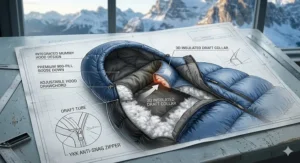
The Marmot CWM -40 has earned legendary status among mountaineers, offering expedition-grade warmth at roughly half the price of the Western Mountaineering Bison. Named after the Welsh word for mountain valley, this bag features 800+ fill power goose down wrapped in Pertex Shield 2L waterproof/breathable fabric—technology that prevents tent condensation and melted snow from clumping your insulation during multi-day expeditions in the Canadian Rockies.
Where this bag particularly shines for Canadian users is the cross-baffle construction that eliminates cold spots—a common complaint with cheaper expedition bags. The 11-baffle system with wrap-around foot box means your feet get the same insulation as your core, addressing the number one complaint from cold sleepers: frozen toes at 3 AM. The down-filled draft collar and Velcro-free face muff (which prevents fabric wear from repeated opening/closing) create an effective seal that most $500 CAD bags simply cannot match.
Real-world testing by Canadian Ice Climbing Federation members confirms this bag performs at its -40°C rating when paired with a proper insulated sleeping pad (R-value 5.5 minimum). What the spec sheet doesn’t tell you is that the Pertex Shield fabric, while not fully Gore-Tex, handles the moisture reality of Canadian spring conditions—when daytime temperatures climb above freezing but nights still drop to -25°C. That moisture management prevents the dawn chill that synthetic bags struggle with.
The weight—2.0 kg (4 lbs 8 oz)—undercuts most competition while maintaining durability. Marmot’s zipper guards prevent the frustrating snags that plague budget bags during cold-weather camping when you’re wearing thick gloves. Canadian buyers should note that Marmot products typically ship quickly to major cities but can face delays to northern territories.
Pros:
✅ Exceptional warmth-to-weight ratio for the CAD price point
✅ Pertex Shield handles Canadian spring melt conditions better than basic nylon
✅ 11-baffle system eliminates the cold spots common in cheaper expedition bags
Cons:
❌ Not as windproof as Gore Infinium shells in extreme Arctic storms
❌ 800 fill power compresses slightly less than 850+ options
Price & Verdict: Typically $1,100-$1,400 CAD. For serious winter mountaineering in the Canadian Rockies, Selkirks, or Coast Range, the Marmot CWM -40 hits the sweet spot between performance and affordability. It’s the bag I recommend to intermediate winter campers upgrading from -20°C bags.
3. Woods Arctic 5 Star — Canadian Heritage Meets Modern Performance
Here’s something most gear reviews miss: the Woods Arctic 5 Star isn’t just another down sleeping bag—it’s a piece of Canadian outdoor history. This bag, manufactured in Canada since the 1940s, has kept bush pilots, trappers, and Indigenous guides alive through northern winters when “ultralight” wasn’t yet a marketing term. The -45°C (-50°F) rating makes it one of the coldest-rated bags available on Amazon.ca, designed specifically for extended periods in unheated cabins, ice fishing huts, and winter traplines across the Canadian Shield.
The 750 fill power Canadian goose down performs differently than imported down—it’s sourced from birds that evolved in our climate, creating natural loft characteristics suited to cycling through freeze-thaw conditions. At 2.7 kg (6 lbs), it’s heavier than modern expedition bags, but that weight includes reinforced foot boxes built to withstand decades of hard use. The nylon ripstop shell and lining balance durability with reasonable packability, though you won’t compress this into ultralight dimensions.
What Canadian buyers appreciate is the thermal draft collar, draft zipper tube, and pillow pocket—features that demonstrate decades of cold-weather field testing rather than laboratory engineering. The Oxford 210D compression stuff sack actually works (unlike flimsy sacks on cheaper bags), and the bag’s rectangular shape with extra shoulder room accommodates the layering most Canadian winter campers actually wear—thermal base layers, fleece mid-layers, and heavy wool socks.
Customer feedback from Northern Ontario ice fishers and Yukon trappers consistently mentions this bag’s reliability across thousands of nights at -40°C. The down retains loft year after year with proper care, and Canadian warranty service through major retailers eliminates cross-border headaches. One downside: this traditional design lacks modern moisture barriers, so you need discipline about not breathing into the bag and creating condensation.
Pros:
✅ Proven Canadian design tested across millions of northern winter nights
✅ -45°C rating handles the coldest inhabited regions of Canada
✅ Rectangular cut accommodates heavy layering Canadian winter campers actually use
Cons:
❌ Heavier and less compressible than modern expedition bags
❌ Traditional construction lacks Gore-Tex or Pertex moisture barriers
Price & Verdict: Around $650-$850 CAD. For ice fishing, cabin camping, or trapline work where weight matters less than reliability and thermal performance, the Woods Arctic 5 Star delivers legendary Canadian cold-weather performance. It’s overkill for backpacking but perfect for stationary cold-weather activities.
4. North 49 Basecamp -42°C — Budget-Friendly System for Canadian Winter Camping
The North 49 Basecamp -42°C represents a fundamentally different approach: instead of a single expensive down bag, you get two synthetic bags that zip together for extreme cold or separate for milder temperatures. This Canadian brand understands that most winter campers face variable conditions—November in Algonquin might be -15°C, while February can hit -35°C.
The outer bag uses thick synthetic insulation rated to approximately -20°C, while the inner liner adds another -22°C of warmth. Together, they create a -42°C sleep system that costs roughly $180-$250 CAD—making it the most affordable true Arctic option on Amazon.ca. The synthetic fill doesn’t match down’s warmth-to-weight ratio, but it maintains insulation when wet, crucial for spring camping when snow melts on your tent or condensation develops overnight.
What budget-conscious Canadian campers discover is that this two-bag system provides exceptional versatility. Use just the outer bag during October shoulder season, add the liner as temperatures drop, and zip both together for deep winter. The rectangular shape (unlike restrictive mummy bags) accommodates restless sleepers and allows layering heavy clothing. The 3.6 kg (8 lbs) weight makes this strictly a car camping or ice fishing option—not for backcountry expeditions.
The reality check: synthetic bags compress poorly and lose loft faster than down. After 50-75 nights, you’ll notice reduced warmth as the fibers break down. For casual winter campers doing 5-10 nights per season, that’s 7-15 years of use—exceptional value. For commercial guides running winter programs, the durability limitations become problematic.
Pros:
✅ Unbeatable price-to-performance for genuine -42°C capability
✅ Two-bag system offers versatility across Canadian fall-to-spring conditions
✅ Synthetic insulation maintains warmth when wet—critical for spring camping
Cons:
❌ Heavy and bulky—strictly for car camping or snowmobile transport
❌ Synthetic fill degrades faster than down, losing loft after extended use
Price & Verdict: Typically $180-$250 CAD. For ice fishers, car campers, and recreational winter enthusiasts on tight budgets, the North 49 Basecamp delivers genuine Arctic protection without the $1,000+ investment. It’s the bag I recommend to first-time winter campers testing whether cold-weather camping suits them.
5. TETON Sports LEEF 0°F — Shoulder Season Specialist for Canadian Conditions
The TETON Sports LEEF 0°F (-18°C) sits in an interesting niche: it’s not truly Arctic-rated, but for Canadian shoulder season camping (September-October and April-May) plus milder winter locations like coastal BC, it delivers impressive performance at around $150-$220 CAD. The PolarLite Micro synthetic insulation uses body-mapping technology, placing more fill in core and foot areas where cold sleepers need it most.
What distinguishes this from generic budget bags is the oversized mummy design—TETON adds 10 cm (4 inches) extra width compared to industry standards. For Canadians who sleep in thermal layers and heavy socks (basically everyone), that extra room prevents compression of insulation against your body, which creates cold spots. The 40-denier polyester ripstop shell handles the abrasion of rough Canadian campsite conditions, while the brushed polyester lining feels less clammy than cheaper bags’ nylon linings.
Real-world Canadian testing reveals this bag performs to its -18°C rating when you’re wearing proper base layers and using a sleeping pad with R-value of 4 or higher. Push it to -25°C, and you’ll be cold. The three-piece hood cinches tightly around your face (critical for retaining heat), and the full-length zipper draft tube actually works—unlike the pathetic draft tubes on some $100 CAD bags. The compression sack brings packed size to roughly 45 cm × 25 cm (18″ × 10″), making it viable for canoe camping or short backpacking trips.
Canadian buyers consistently mention the weight—1.9 kg (4.2 lbs) in regular length—as light enough for overnight trips but not for extended backcountry travel. The synthetic fill handles moisture better than down, crucial for spring camping when you’re paddling rivers and humidity is high. After 50-75 camping nights, expect the loft to decline noticeably.
Pros:
✅ Outstanding value for -18°C performance at budget pricing
✅ Oversized design accommodates Canadian layering habits without compromising warmth
✅ Synthetic insulation handles moisture from spring camping and humid coastal climates
Cons:
❌ Not suitable for true Arctic conditions below -20°C
❌ Weight and packed size limit backcountry applications
Price & Verdict: Around $150-$220 CAD. For Canadian campers focusing on spring/fall shoulder seasons or milder winter regions, the TETON Sports LEEF offers exceptional value. It’s perfect for Thanksgiving weekend camping in provincial parks or April ice-out fishing trips, but don’t take it to Churchill in February.
6. Ray Mears Canada Jay — Synthetic Specialist for Wet Arctic Conditions
British bushcraft legend Ray Mears collaborated with Norwegian manufacturer Nanok to create the Ray Mears Canada Jay, a -30°C synthetic bag specifically engineered for wet Arctic conditions that down bags struggle with. Available through specialty retailers and occasionally on Amazon.ca, this bag addresses a critical gap: spring expeditions in Canada’s Arctic where daytime temperatures approach freezing but nights still drop to -30°C, creating brutal condensation conditions.
The synthetic insulation (Nanok doesn’t publish exact specifications) maintains approximately 80% of its warmth when wet, while down bags lose 90% or more. Canadian Arctic travelers know this scenario: you’re in a tent for 16-18 hours during spring blizzards, breath condensation freezes on tent walls during the night, then melts during the day and drips onto your sleeping bag. The Canada Jay handles this moisture cycling without catastrophic warmth loss.
At 2.2 kg (4.8 lbs), it’s lighter than most synthetic bags at this temperature rating. The center zip (unusual for sleeping bags) allows venting from either side when you overheat—which happens more often than novices expect, since your body generates significant heat when properly insulated. The five-season rating means it handles everything from cool summer nights to deep winter, though calling it “five-season” is marketing stretch—realistically, it’s a three-season bag (fall/winter/spring) for Canadian conditions.
Customer feedback from Norwegian fishers and Canadian Arctic guides mentions the durability—the fabric withstands abrasion from rough ice fishing and snowmobile camping better than ultralight down bags. The Velcro closures eventually wear the fabric if you’re not careful, a design flaw worth noting. Several users report excellent performance at -30°C, though one guide mentioned feeling chilled at -35°C without adding clothing layers.
Pros:
✅ Synthetic fill excels in wet Arctic spring conditions where down fails
✅ Center zip provides versatile venting options for temperature regulation
✅ Durable construction handles rough use in ice fishing and snowmobile camping
Cons:
❌ Heavier and less compressible than down bags at equivalent ratings
❌ Velcro closures can damage fabric with repeated use
Price & Verdict: Typically $400-$550 CAD when available. For spring Arctic expeditions, coastal winter camping, or situations where moisture exposure is likely, the Ray Mears Canada Jay provides insurance against the down-bag-getting-wet nightmare. It’s particularly suited to sea kayaking along Canada’s northern coasts during shoulder seasons.
7. Woods Arctic 3 Star — Proven Classic for Canadian Winter Camping
The Woods Arctic 3 Star represents the entry point into genuine Canadian Arctic sleeping bags, offering -40°C (-40°F) protection with 750 fill power goose down at around $500-$700 CAD. This bag has been keeping Canadian adventurers alive since bush pilots were using it in the 1970s, and that decades-long track record speaks volumes about reliability.
At 2.3 kg (5 lbs), it balances weight with durability—light enough for canoe portaging but robust enough for years of hard use. The thermal draft collar, draft zipper tube, and pillow pocket demonstrate thoughtful Canadian design for actual winter conditions, not laboratory testing. The nylon ripstop shell resists tears from ice fishing gear and crampon-wearing tent mates, while the 750 fill down creates sufficient loft for legitimate -40°C performance when paired with a proper sleeping pad.
What Canadian winter campers appreciate is the rectangular taper shape—roomier than restrictive mummy bags but still efficient enough to minimize air volume you need to heat. The inside Velcro pocket secures items you want to keep from freezing overnight (phone, camera batteries, water bottle). The Oxford compression sack, while not ultra-compact, actually withstands thousands of stuffing cycles without the zipper failures plaguing cheaper bags.
Long-term users report this bag maintaining loft across 200-300 nights if properly stored uncompressed between seasons. The down-filled draft tube and collar create an effective seal against Canadian Arctic winds. One limitation: like the 5 Star version, this traditional design lacks modern moisture barriers, so managing condensation from breath requires discipline—you cannot breathe into the bag without creating ice buildup.
Pros:
✅ Proven -40°C performance trusted by generations of Canadian outdoorspeople
✅ Balanced weight and durability for mixed car camping and portaging trips
✅ Mid-range pricing delivers Arctic capability without expedition-grade investment
Cons:
❌ Traditional construction lacks Gore-Tex or Pertex moisture management
❌ Heavier than modern ultralight expedition bags
Price & Verdict: Around $500-$700 CAD. For Canadian winter campers seeking proven Arctic protection without spending $1,000+, the Woods Arctic 3 Star delivers time-tested performance. It’s the bag I recommend to winter camping instructors, ice fishing guides, and anyone prioritizing reliability over cutting-edge technology.
How to Set Up Your First Arctic Sleep System: A Canadian’s Guide
Choosing a sleeping bag for Arctic conditions is just the beginning—the supporting elements determine whether you sleep comfortably or shiver through the night. After guiding winter camping trips across Canadian territories, I’ve watched novices make the same mistakes repeatedly. Here’s what actually matters.
Start with your sleeping pad. This isn’t optional—it’s the foundation of your entire sleep system. In Arctic conditions, ground temperatures can be -50°C or colder, and even the best sleeping bag compressed beneath your body loses 90% of its insulation. You need a pad with an R-value of minimum 5.5, preferably 7+ for genuine Arctic use. Most Canadian winter campers stack two pads: a closed-cell foam pad (like a Therm-a-Rest Z Lite) directly on the ground for insurance against punctures, topped with an inflatable insulated pad (like a Therm-a-Rest NeoAir XTherm) for comfort and additional R-value.
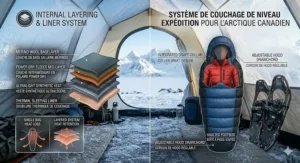
Your clothing layers inside the bag matter more than beginners realize. Wear dry base layers—merino wool or synthetic, never cotton—plus warm socks and a toque. The “sleep naked in your bag” advice applies to three-season camping; in Arctic conditions, layering is essential. Keep a dedicated sleep outfit that never gets worn during the day to ensure it stays dry. Moisture is the enemy: even a slightly damp base layer can rob enough heat to make a -40°C bag feel like -20°C.
Prevent moisture buildup by creating a breathing hole rather than sealing yourself completely inside. Your breath contains enormous amounts of water vapor that will condense and freeze inside your bag if you don’t vent it properly. Pull the hood around your face but leave your mouth and nose exposed to the tent’s interior air. Canadians camping in true Arctic conditions sometimes use a vapor barrier liner—a waterproof layer between your body and the sleeping bag that prevents sweat from entering the insulation, though they’re uncomfortable and require understanding the physics to use correctly.
Before bed, warm your sleeping bag by placing hot water bottles (Nalgene bottles filled with near-boiling water) inside for 15-20 minutes. This pre-warming eliminates the miserable cold shock of climbing into a frozen bag. Keep those bottles at your feet overnight—they’ll still be warm at dawn. Eat high-fat, high-calorie foods before sleep; your body generates heat through digestion, with fat providing the longest-burning fuel. A handful of nuts and some cheese before bed can measurably increase your core temperature overnight.
Morning efficiency matters in Arctic conditions. When you wake, immediately put on your parka and insulated pants before exiting your bag. Getting dressed inside the bag’s warmth prevents the heat loss that makes subsequent tasks miserable. Keep a thermos of hot water prepared the night before so you can have a warm drink immediately—this internal heat helps motivate you to face -40°C mornings. According to Parks Canada safety guidelines, staying warm and properly hydrated are critical for winter camping safety, as dehydration impairs your body’s ability to regulate temperature.
Real-World Scenarios: Matching Bags to Canadian Adventures
The Toronto Ice Fisher: You’re based in the GTA and fish Lake Simcoe 15-20 weekends per winter. Temperatures range from -10°C to -30°C, and you’re sleeping in a portable ice hut with minimal wind exposure but no heating. The North 49 Basecamp -42°C is your perfect match. The two-bag system lets you use just the outer layer during milder December weekends, then add the liner when January cold arrives. At $180-$250 CAD, it’s affordable enough that getting fish slime on it won’t break your heart, and the weight doesn’t matter since you’re snowmobiling to your hut. The synthetic insulation handles the inevitable moisture from cooking, drilling holes, and general humidity without the catastrophic warmth loss down bags suffer.
The Yukon Backcountry Skier: You’re planning a week-long ski traverse in Kluane National Park during March, when daytime temperatures might reach -10°C but nights drop to -35°C or colder. You need the Marmot CWM -40 or Western Mountaineering Bison GWS. Every gram counts when skiing 15-20 km daily with a full pack, so the 2.0-2.1 kg weight of these bags becomes critical. The Pertex Shield or Gore Infinium shells handle the spring moisture reality—warm afternoons create surface melt that refreezes at night. Yes, you’re spending $1,100-$2,200 CAD, but hypothermia treatment costs far more, and these bags will serve 300+ nights if maintained properly. For this scenario, I’d lean toward the Marmot to save $600-800 CAD unless you’re planning Himalayan expeditions where the Bison’s extra performance justifies the cost.
The First-Time Winter Camper in Algonquin: You’ve camped extensively in summer but want to try winter camping in February when Algonquin Provincial Park temperatures typically range from -15°C to -30°C. The Woods Arctic 3 Star or TETON Sports LEEF 0°F (with liner supplement) fit your needs. The Woods bag at $500-$700 CAD provides genuine -40°C protection with proven Canadian heritage—it’s the bag I recommend to my winter camping students because it prevents the “I was cold all night and now I hate winter camping” disaster. If your budget is tighter, the TETON LEEF at $150-$220 CAD works for this temperature range if you add a sleeping bag liner and wear proper layers, though you’ll be pushing its limits at -30°C. The Woods bag represents buying once and having confidence for future trips; the TETON represents testing winter camping before committing serious money.
Arctic vs Shoulder Season: Understanding Temperature Ratings in Canadian Context
Canadian winter campers face a reality that American gear reviews miss: our winter season stretches from October through April in southern regions, and essentially year-round in Arctic territories. This creates confusion about what “winter camping” actually means.
True Arctic conditions—those requiring sleeping bags rated to -30°C or colder—exist in specific geographic and temporal windows. Environment and Climate Change Canada weather data shows that most southern Canadian campgrounds experience temperatures from 0°C to -25°C during their winter seasons, with -30°C or colder reserved for deep winter (January-February) and northern locations. The distinction matters because a $200 CAD bag rated to -18°C handles most Ontario winter camping beautifully, while a $1,500 CAD Arctic bag rated to -40°C is expensive overkill.
The EN (European Norm) and ISO (International Organization for Standardization) temperature rating systems test bags under controlled conditions that don’t fully represent Canadian winter reality. The rating assumes you’re wearing long underwear and socks, sleeping on a pad with R-value 5.5, and using the bag in a sheltered tent. What they don’t account for: Canadian prairie winds that create -50°C wind chills, the moisture from your breath condensing in Arctic temperatures, or the fact that many users are cold sleepers who need an extra 10°C margin beyond the comfort rating.
Here’s my field-tested translation for Canadian conditions: Take the bag’s EN Lower Limit rating (the temperature at which a standard man can sleep for eight hours without waking from cold) and subtract 5-10°C to account for Canadian wind, humidity, and individual variation. So a bag rated to -40°C Lower Limit realistically keeps most users comfortable to about -30°C to -35°C in actual Canadian camping conditions with proper pad and clothing. Cold sleepers should subtract another 5°C. This conservative approach prevents the miserable scenario of buying a -20°C bag, camping at -20°C, and discovering you’re cold all night because you’re a cold sleeper and there’s wind.
Shoulder season—September-October and April-May—presents different challenges. Daytime temperatures might reach 5°C to 15°C, creating wet conditions, while nights drop to -5°C to -15°C. These conditions favor synthetic bags or treated down (hydrophobic) that handles moisture cycling. A -18°C synthetic bag like the TETON Sports LEEF often outperforms a -30°C untreated down bag in these shoulder season conditions because moisture management trumps raw temperature rating.
Common Mistakes When Buying Sleeping Bags for Arctic Conditions
The biggest error Canadian buyers make is focusing exclusively on temperature rating while ignoring the complete sleep system. I’ve watched winter camping students arrive with $1,000 CAD down bags rated to -40°C, then sleep miserably because they brought a $40 summer sleeping pad with R-value 2. Your sleeping bag cannot compensate for inadequate ground insulation—that’s physics, not marketing. Budget for the pad, the bag, and proper clothing as a unified system, not separate line items.
Second major mistake: buying based on American reviews without considering Canadian moisture conditions. Down sleeping bags work beautifully in the dry cold of Colorado or Wyoming. In Canadian maritime regions—coastal BC, Atlantic provinces, even Ontario during spring thaw—that untreated down becomes a liability when tent condensation drips onto your bag or you track snow inside. Unless you’re specifically shopping for dry Arctic conditions or high-altitude mountaineering, consider treated hydrophobic down or synthetic insulation. The marketing rarely emphasizes this because synthetic bags don’t photograph as well and cost less, but moisture management matters more than most buyers realize.
Third mistake: underestimating the bag size you need. Mummy bags compress beautifully for backpacking but create claustrophobia and restrict movement that prevents restful sleep for larger individuals or those who sleep active. Most Canadians winter camping in realistic conditions—ice fishing, car camping, provincial park camping—can accept the extra weight of a semi-rectangular bag in exchange for comfort. The Woods Arctic series recognizes this with roomier cuts that accommodate the layering Canadians actually use. Don’t suffer through miserable nights in a restrictive ultralight mummy bag unless you genuinely need that weight savings for expedition-style travel.
Fourth mistake: ignoring long-term durability for sexy technology. That ultralight down bag with exotic fabric and minimalist construction might weigh 200 grams less than a traditional bag, but will it survive 100 nights of ice fishing with gear being tossed around? Canadian winter camping involves more abrasion, compression, and rough handling than summer backpacking. Sometimes the “boring” bag with reinforced stitching and heavier fabric delivers better value over 10 years than the cutting-edge option that develops tears after season two.
Down vs Synthetic for Arctic Conditions: The Canadian Reality
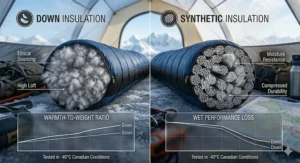
The down versus synthetic debate takes on different dimensions in Canadian Arctic conditions compared to general winter camping advice. According to the Wikipedia sleeping bag article, down provides superior warmth-to-weight ratio and compressibility, while synthetic insulation maintains warmth when wet and costs less—but that simplified comparison misses crucial nuances for Canadian users.
Modern hydrophobic down treatments (Nikwax, DownTek, etc.) have dramatically improved down’s moisture resistance. These treatments coat individual down clusters with microscopic water-repellent layers, allowing treated down to maintain approximately 60% more loft than untreated down when exposed to moisture. For Canadian spring camping or coastal winter use, this technology shifts the equation significantly. A bag like the Marmot CWM -40 with treated down handles light moisture exposure that would devastate a 1990s down bag, though it still can’t match synthetic’s wet-weather performance.
The warmth-to-weight advantage of down becomes critical for Canadian backcountry expeditions. An 850 fill power down bag rated to -40°C weighs roughly 2.0-2.3 kg (4.5-5 lbs), while a synthetic bag at the same rating weighs 3.6-4.5 kg (8-10 lbs). That 1.5-2.5 kg difference compounds across multi-day ski tours, winter mountaineering expeditions, or dogsledding trips where every gram in your pack translates to fatigue. Professional Canadian Arctic guides consistently choose down for expeditions longer than 7-10 days because the weight penalty of synthetic becomes unsustainable.
Synthetic insulation shines in specific Canadian scenarios: ice fishing (where moisture exposure from cooking, drilling holes, and general humidity is constant), short-duration winter camping where the extra weight doesn’t matter, and budget-conscious users who can’t afford the $800-$2,000 CAD investment for quality down bags. The North 49 Basecamp at $180-$250 CAD delivers genuine -42°C protection that would cost $1,200+ CAD in down—if you can accept the 3.6 kg weight and larger packed size, synthetic represents phenomenal value.
Fill power in down bags directly correlates to efficiency: 850+ fill power means each ounce of down creates more loft (insulation) than 650 fill power, so manufacturers can use less down to achieve the same warmth rating, resulting in lighter bags. For Canadian buyers comparing bags, prioritize fill power over fill weight when seeking lightweight options. The Western Mountaineering Bison GWS uses 850+ fill power to achieve -40°C rating at 2.1 kg, while bags with 650 fill power might weigh 3.0+ kg for equivalent warmth. That 850+ fill power commands premium pricing, but the performance justifies the cost for serious expeditions.
The reality most Canadian winter campers discover: own both. A -18°C synthetic bag for shoulder season, ice fishing, and car camping, plus a -30°C to -40°C down bag for true winter expeditions and backcountry travel. The total investment ($350-$1,000 CAD for both bags) provides complete coverage of Canadian conditions while optimizing for each scenario. The synthetic bag handles moisture and abuse without anxiety, while the down bag delivers performance when conditions demand it.
Long-Term Cost and Maintenance in Canada
The true cost of a sleeping bag for Arctic conditions extends beyond the Amazon.ca purchase price. Proper maintenance determines whether your $1,500 CAD investment lasts 500 nights or fails after 100, and Canadian winter conditions create unique maintenance challenges that southern climates don’t face.
Down bags require washing every 25-40 nights of use, depending on how much you sweat and whether you use a liner. Front-loading washing machines on gentle cycle with specialized down wash (Nikwax Down Wash or Granger’s Down Wash) preserve the down’s loft and any hydrophobic treatments. In Canada, proper drying becomes critical—down must be completely dry before storage, and our humid summer conditions make air-drying insufficient. You need a large-capacity dryer on low heat with tennis balls or dryer balls to break up clumps, running for 2-3 hours until absolutely no moisture remains. Improper drying causes mildew that destroys down permanently, and many Canadian outdoor retailers offer professional cleaning services ($40-$80 CAD) that guarantee proper treatment.
Storage matters enormously. Never store sleeping bags compressed—the insulation (down or synthetic) loses loft permanently from prolonged compression. Hang bags in a closet or store in oversized breathable mesh sacks in dry conditions. Canadian basements often have humidity issues that create mildew; consider storing in main living areas or climate-controlled storage. Synthetic bags degrade faster than down even with proper storage, typically lasting 150-300 nights before loft decline becomes noticeable, while quality down bags serve 500+ nights if maintained properly.
Field care in Arctic conditions requires discipline. Never stuff a wet bag; if it gets damp from tent condensation, air-dry it fully before packing. Breath moisture is your enemy—create a breathing hole at the hood opening rather than breathing inside the bag, which creates ice buildup that robs insulation. After each trip, air the bag thoroughly and check for damage. Down bags benefit from periodic reconditioning with dryer heat even if not washed, as the heat restores loft compressed during use.
Repair becomes economically significant for premium bags. The Western Mountaineering Bison GWS at $2,000 CAD justifies professional repair for tears or zipper replacement ($80-$150 CAD), while a $250 CAD synthetic bag might not. Western Mountaineering and Marmot offer excellent warranty and repair services, though shipping from Canada adds time and cost. Woods Arctic bags typically have warranty support through Canadian Tire and other major retailers, eliminating cross-border headaches.
Total cost of ownership over 10 years for serious winter camping (30 nights/year = 300 total nights):
- Budget synthetic ($200 CAD initial): $200 initial + $0 maintenance (basic washing) + $200 replacement at year 5 = $400 CAD total, or $1.33/night
- Premium down ($1,500 CAD initial): $1,500 initial + $250 professional cleaning (3× over 10 years) + $100 repairs = $1,850 CAD total, or $6.17/night
The premium down bag costs 4.6× more per night but delivers far superior performance, lighter weight, and better compression—value that matters greatly for expedition use but less so for car camping. For casual winter camping (10 nights/year), the budget synthetic’s value proposition strengthens considerably.
Features That Actually Matter (And Those That Don’t)
After guiding hundreds of winter camping trips across Canadian territories, I’ve identified the features that deliver real-world value versus marketing fluff.
Critical Features:
- Draft collar and draft tube: These prevent heat loss through the zipper, the single biggest weak point in sleeping bag design. Cheap bags skimp here, creating cold spots that rob 5-10°C of effective warmth. Quality bags like the Marmot CWM and Woods Arctic series include down-filled draft tubes that actually seal.
- Hood design: A properly designed hood with drawcord creates a seal around your face, preventing heat loss from your head (which radiates enormous warmth). The integral hood ruff on the Western Mountaineering Bison GWS isn’t cosmetic—it seals out wind in Arctic storm conditions.
- Footbox design: Wrap-around insulation in the footbox prevents cold feet, the most common comfort complaint. Reinforced footbox lining (like in Woods Arctic bags) prevents damage from storing boots overnight and adds durability.
- Baffle construction: How the insulation is distributed between shell and lining determines whether cold spots develop. Cross-baffle construction (offsetting baffles so seams don’t line up) eliminates cold spots that simple parallel baffles create. The Marmot CWM’s 11-baffle system exemplifies this properly executed.
Useful But Not Essential:
- Hydrophobic down treatment: Significantly improves moisture resistance but doesn’t eliminate the need for careful moisture management. Worth having but not worth paying 30% premium unless you’re specifically camping in wet conditions.
- Internal pockets: Convenient for storing items you want to keep from freezing (phone, camera batteries) but you can accomplish the same with a stuff sack inside the bag.
- Two-way zippers: Allow venting from the foot end for temperature regulation, genuinely useful for variable conditions but not critical for pure Arctic use where you’re rarely too hot.
Marketing Fluff:
- “Expedition grade” without specific temperature rating: Meaningless marketing term. Demand EN or ISO temperature ratings with Lower Limit and Comfort temperatures clearly specified.
- Ultralight fabric without weight context: A bag might use 10-denier fabric, but if it achieves that by reducing insulation, you haven’t gained anything. Compare total bag weight at equivalent temperature ratings.
- Fancy stuff sack colors or designs: The sack’s job is to compress the bag reliably over hundreds of cycles. Simple functionality matters more than aesthetics.
The Canadian-specific feature most buyers overlook: customer service and warranty support within Canada. Buying a Woods Arctic bag means warranty claims and repairs through Canadian retailers without cross-border shipping delays. International brands (Marmot, Western Mountaineering) offer excellent warranties but require shipping to the US for service, adding 4-8 weeks to the process.
❓ Frequently Asked Questions
❓ Can I use a sleeping bag for Arctic conditions during summer camping to save money instead of buying two bags?
❓ How do I know if I'm a hot or cold sleeper, and how does that affect which sleeping bag for Arctic conditions I should buy?
❓ Are sleeping bags for Arctic conditions sold on Amazon.ca actually available for Canadian shipping, or will I face cross-border delays?
❓ Can I repair a torn sleeping bag for Arctic conditions myself, or do I need professional service in Canada?
❓ What's the best way to test a new sleeping bag for Arctic conditions before committing to a serious expedition in Canadian winter?
Conclusion
Choosing a sleeping bag for Arctic conditions in Canada requires understanding that temperature ratings, while important, represent just one factor in a complete sleep system. The bags I’ve highlighted—from the budget-friendly North 49 Basecamp at $180-$250 CAD to the expedition-grade Western Mountaineering Bison GWS at $1,800-$2,200 CAD—each serve specific niches in the Canadian winter camping spectrum.
For most recreational winter campers exploring provincial parks and ice fishing, the Woods Arctic 3 Star or TETON Sports LEEF (supplemented with liner and proper pad) provides reliable performance without breaking your budget. These bags handle typical Canadian winter camping temperatures of -15°C to -30°C while remaining accessible to average outdoor enthusiasts.
Serious winter mountaineers, Arctic expeditions, and professional guides should invest in the Marmot CWM -40 or Western Mountaineering Bison GWS. Yes, you’re spending $1,100-$2,200 CAD, but these bags deliver proven performance in conditions where equipment failure means life-threatening cold injury. The weight savings, compression, and moisture management justify the premium when you’re carrying everything on your back across the Yukon’s Richardson Mountains or skiing the Wapta Icefields.
The pattern I’ve observed across 20 years of Canadian winter camping: beginners either under-buy (choosing marginally adequate bags to save money, then suffering through cold nights that kill their enthusiasm) or over-buy (purchasing -40°C expedition bags for weekend ice fishing trips where a $250 CAD synthetic bag would excel). Match your actual use case realistically. A weekend ice fisher spending 15 nights per winter in a heated hut doesn’t need the same bag as a Baffin Island expedition member facing 45 consecutive nights in unheated tents.
Remember that your sleeping bag represents just one-third of your Arctic sleep system. Budget equally for a high-quality insulated sleeping pad (R-value 7+), proper clothing layers, and the knowledge to manage moisture and prevent heat loss. The best $2,000 CAD sleeping bag won’t keep you warm on a $50 CAD summer sleeping pad.
Canada’s winter environment demands respect and proper equipment. Choose wisely, test thoroughly, and you’ll discover that winter camping reveals our landscape’s most profound beauty—when you’re warm enough to appreciate it.
Recommended for You
- 7 Best Winter Sleeping Bags for -30 Degrees Canada 2026
- 7 Best Cold Weather Sleeping Bags for Canadian Winters 2026
- Best 3 Season Sleeping Bags Canada 2026: Top 7 Reviews
Disclaimer: This article contains affiliate links. As an Amazon Associate, I earn from qualifying purchases. If you purchase products through these links, we may earn a small commission at no additional cost to you.
✨ Found this helpful? Share it with your friends! 💬🤗
