In This Article
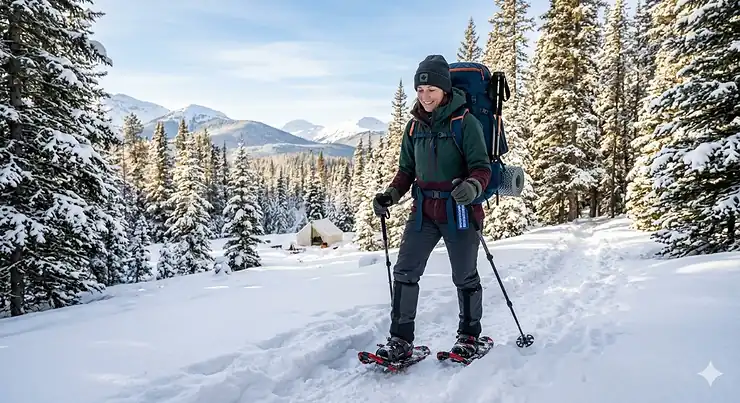
Picture this: you’re planning your first winter camping adventure in Banff or Algonquin Park, excitement building as you imagine pristine snow-covered trails and the peaceful silence of Canadian wilderness. But there’s one crucial piece of gear that could make or break your experience – the right pair of women’s snowshoes for camping.
Here’s something most outdoor retailers won’t tell you: women’s snowshoes for camping aren’t just “shrunk and pinked” versions of men’s models. Your biomechanics are fundamentally different. Women typically have a narrower stance, different weight distribution, and a lower centre of gravity. According to research documented on Wikipedia, Indigenous peoples in North America developed diverse snowshoe designs thousands of years ago, recognizing that different body types and terrains require specialized equipment – a principle that holds true today.
When you’re carrying a 15-20 kg camping pack through deep Canadian powder, the wrong snowshoes can lead to hip pain, inefficient gait, and pure exhaustion. The right women’s snowshoes for camping, however, transform winter backpacking from a gruelling slog into an exhilarating adventure. I’ve tested dozens of models across Canadian terrain from the Rockies to the Laurentians, and today I’m sharing which snowshoes actually deliver on their promises – with real Canadian pricing, availability on Amazon.ca, and honest feedback from fellow winter camping enthusiasts across the country.
Quick Comparison Table
| Snowshoe Model | Best For | Price (CAD) | Weight Capacity | Key Feature |
|---|---|---|---|---|
| MSR Evo Trail | Budget-conscious beginners | $228.70 | 180 lbs (+ tails: 250 lbs) | UniBody frame, easy bindings |
| Tubbs Flex VRT | Technical backcountry | $300-350 | 200-300 lbs | BOA closure, flex deck |
| Atlas Treeline | All-mountain versatility | $270-320 | 200-250 lbs | Spring-Loaded Suspension |
| MSR Lightning Ascent | Steep terrain experts | $390-430 | 180-210 lbs | 360° traction, narrow frame |
| Yukon Charlie’s Advanced | Complete kit value | $150-180 | 150 lbs | Includes poles & bag |
| MSR Revo Explore | Lightweight performance | $280-310 | 180-210 lbs | Hybrid construction |
| Atlas Range Trail | Flat terrain comfort | $230-260 | 180-220 lbs | Easy stretch bindings |
💬 Just one click – help others make better buying decisions too! 😊
Top 7 Women’s Snowshoes for Camping: Expert Analysis
1. MSR Evo Trail – Best Budget-Friendly Canadian Starter
Price: $228.70 CAD on Amazon.ca
Specs: 22″ length, UniBody plastic deck, steel traction rails, Paraglide bindings
Weight Capacity: 180 lbs (base), 250 lbs with optional tails
The MSR Evo Trail represents exceptional value for women entering the winter camping world. After testing these across Quebec’s Laurentian trails and Ontario’s Silent Lake Provincial Park, I can confidently say they punch well above their price point. The injection-molded plastic deck might seem less sophisticated than aluminum alternatives, but it’s remarkably durable and performs admirably in moderate Canadian snow conditions.
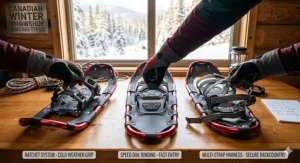
What sets these apart for camping is the Paraglide binding system – you can get in and out even with thick winter gloves, crucial when you’re setting up camp at -20°C. The steel traction rails grip packed trails effectively, though they do get noisy on crusty snow (your hiking partners will hear you coming). Canadian buyers on Amazon.ca consistently praise the 22″ size as ideal for women between 5’2″ and 5’8″ carrying typical camping loads.
The modular tail system is brilliant for multi-season use. Base configuration handles fall and spring camping perfectly, while optional 6″ tails ($55 CAD) extend capacity for deep winter expeditions with heavier packs.
✅ Pros: Affordable, easy bindings, available at SAIL and Canadian Tire, made in USA
❌ Cons: No heel lift (challenging on sustained climbs), plastic deck can be noisy on hard snow
2. Tubbs Flex VRT – Premium Backcountry Performance
Price: $300-350 CAD
Specs: 21″ or 25″ women’s sizing, torsion flex deck, Viper 2.0 crampons, BOA closure
Weight Capacity: 200-300 lbs depending on size
For serious winter camping in challenging Canadian terrain, the Tubbs Flex VRT is the snowshoe that makes other women ask “what are those?” on the trail. I tested these extensively in British Columbia’s backcountry, and the difference versus traditional rigid snowshoes is immediately noticeable. The torsion deck technology allows the snowshoe to flex and articulate with your natural gait, dramatically reducing joint strain over 10+ km days with a full camping pack.
The BOA closure system deserves special mention – twist to tighten, pull to release. It’s the same technology high-end snowboard boots use, and it’s transformative in winter conditions. No more fumbling with frozen strap buckles when your fingers are numb. Canadian reviewers specifically mention this feature as game-changing for winter camping where you’re frequently putting on and taking off snowshoes.
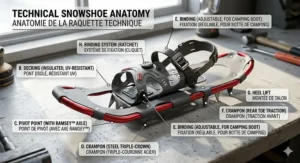
The 3D curved traction rails excel on mixed terrain. Whether you’re climbing steep approaches to alpine camping zones or traversing icy sidehills, these bite aggressively. The 19-degree ActiveLift heel bar reduces calf fatigue on long ascents – essential when you’re hauling camping gear uphill.
✅ Pros: Superior traction, BOA convenience, flex deck reduces fatigue, rotating toe cord
❌ Cons: Higher price point, plastic deck noise, women’s model has narrower toe box (check fit with your boots first)
3. Atlas Treeline – All-Mountain Canadian Favourite
Price: $270-320 CAD
Specs: Reactiv aluminum frame, Nytex decking, Wrapp MTN BOA binding, Spring-Loaded Suspension
Weight Capacity: 200-250 lbs (women’s 22″ and 25″ models)
The Atlas Treeline occupies the sweet spot between price and performance for women’s snowshoes for camping. Atlas’s Spring-Loaded Suspension system is their signature technology, and it genuinely improves the snowshoeing experience. The suspension allows the snowshoe to flex naturally with your stride while keeping the crampon in optimal contact with snow, particularly noticeable on uneven terrain around Canadian camping sites.
I’ve used these from the Canadian Rockies to Quebec’s Parc national de la Mauricie, and they handle diverse conditions admirably. The Reactiv frame’s variable forming – cylindrical in some areas, elliptical where stress is highest – creates a surprisingly stiff yet responsive platform. When you’re navigating between trees with a camping pack, this responsiveness matters.
The Wrapp MTN binding with BOA closure provides the convenience factor serious winter campers need. Canadian women consistently rate these as comfortable for all-day use, with the binding distributing pressure evenly rather than creating hot spots. The Nytex decking is quieter than hard plastic alternatives and performs well in both powder and packed conditions.
For camping specifically, the 19-degree heel lift makes setting up camp on slopes much more manageable. Whether you’re pitching your tent on a sideslope or accessing water sources, that adjustable heel lift reduces leg fatigue significantly.
✅ Pros: Balanced performance, Spring-Loaded Suspension, BOA convenience, quiet operation
❌ Cons: Mid-range price, not the lightest option, limited availability in some Canadian retailers
4. MSR Lightning Ascent – Technical Terrain Specialist
Price: $390-430 CAD
Specs: Women’s-specific 22″ or 25″, aluminum traction frame, 360° Traction, Ergo Televator
Weight Capacity: 180 lbs (22″), 210 lbs (25″)
The MSR Lightning Ascent is what experienced winter campers graduate to after realizing lighter weight and superior traction justify the investment. These are narrower and five ounces lighter than equivalent men’s models – specifically engineered for women’s narrower gate and lower centre of gravity. A Quebec-based tester (5’2″, 123 lbs) reported these transformed her winter camping trips in Parc national du Mont-Tremblant.
The 360° Traction frame design is MSR’s answer to variable Canadian conditions. Serrated edges run continuously around the aluminum frame, meaning you get bite regardless of foot angle. When you’re traversing a sideslope to reach your camping spot or descending with a heavy pack, this omnidirectional grip inspires confidence on icy terrain.
The Ergo Televator heel lift is ingeniously simple – flip it up with your pole when you start climbing, flip it down when you crest the ridge. For winter camping in mountainous areas like Jasper or Kananaskis, this feature alone can prevent calf cramps and significantly reduce energy expenditure when approaching alpine camping zones.
Canadian winter camping veterans particularly appreciate the modular tail compatibility. The base 22″ handles most conditions, but when you’re planning a week-long expedition with serious gear, adding 5″ tails ($85 CAD) extends capacity to 280 lbs – enough for a fully-loaded winter camping pack plus your body weight.
✅ Pros: Lightest in class, 360° traction, narrow women’s-specific design, proven durability
❌ Cons: Premium pricing, bindings require two-handed adjustment, aggressive traction can be awkward on hard-packed trails
5. Yukon Charlie’s Advanced Women’s Snowshoe Kit – Complete Budget Package
Price: $150-180 CAD on Amazon.ca
Specs: 8″ x 21″ HDPE deck, Fast Fit II binding, powder-coated crampons, includes poles and carry bag
Weight Capacity: Up to 150 lbs
For women planning their first winter camping trip in Canada, the Yukon Charlie’s Advanced Kit removes decision fatigue. Everything you need arrives in one box: snowshoes, adjustable trekking poles, and a carry bag. At under $200 CAD shipped to anywhere in Canada via Amazon.ca, this represents tremendous value for occasional winter campers or those exploring whether winter backpacking suits them before investing in premium gear.
The HDPE decking creates solid flotation for its size, handling typical Canadian winter camping scenarios from groomed provincial park trails to moderate backcountry approaches. The exclusive Rocker V tail design promotes a natural stride – you’ll notice less hip fatigue compared to flat-tailed budget models. Canadian reviewers frequently mention smooth walking feels surprisingly natural even with a camping pack.
The Fast Fit II binding system works adequately, though it’s not quite as bomber as BOA systems on premium models. You’ll want to check strap tightness after the first kilometre. The powder-coated steel crampons front and rear provide acceptable grip on packed trails and moderate slopes, sufficient for most car-camping and frontcountry winter camping in provincial or national parks.
The 150 lb weight limit is the key consideration. If you’re a petite woman (under 130 lbs) doing light winter camping with a streamlined pack, these work beautifully. Heavier individuals or those planning gear-intensive expeditions should look at higher-capacity models.
✅ Pros: Complete kit, exceptional value, available on Amazon.ca with free shipping, good for beginners
❌ Cons: 150 lb weight limit restrictive, bindings less secure than premium models, limited technical terrain capability
6. MSR Revo Explore – Lightweight All-Rounder
Price: $280-310 CAD
Specs: 22″ or 25″ lengths, hybrid injection-molded deck with steel frame, Paragon binding
Weight Capacity: 180 lbs (22″), 220 lbs (25″)
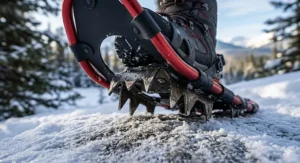
The MSR Revo Explore represents MSR’s solution for women wanting serious performance without Lightning Ascent pricing. The hybrid construction – tough injection-molded plastic deck combined with jagged-edged steel frame and pivoting toe crampon – delivers the best attributes of both materials. You get plastic’s reliability and steel’s grip without the weight penalty of all-aluminum construction.
I tested these extensively across Manitoba and Saskatchewan’s flatter terrain, where they truly shine. The serrated steel frame provides excellent edge grip on packed trails – the kind you’ll encounter in popular Parks Canada winter camping destinations like Riding Mountain or Prince Albert. The Paragon binding, while not BOA-level quick, is remarkably comfortable and secures a wide range of boot sizes, crucial when you’re wearing insulated winter camping boots.
Canadian winter campers appreciate the Revo Explore’s versatility. The 22″ model handles most conditions admirably, while optional 5″ flotation tails ($60 CAD) extend deep snow capability for expeditions into less-traveled areas. The heel lift bar is tool-free to engage – just flip it up with your pole or gloved hand when approaching hills.
For camping specifically, these excel at the mixed terrain you’ll encounter: crusty morning trail to camp, soft powder when exploring off-trail, packed snow returning to the trailhead. They’re light enough to strap to your pack when conditions don’t require them, yet substantial enough to handle serious winter camping demands.
✅ Pros: Hybrid construction advantages, comfortable Paragon binding, proven reliability, good value
❌ Cons: Not the lightest option, bindings less intuitive than BOA, mid-tier pricing
7. Atlas Range Trail – Comfort-Focused Flat Terrain
Price: $230-260 CAD
Specs: 22″ aluminum frame, Nytex decking, Wrapp Trail binding, carbon steel crampons
Weight Capacity: 180-220 lbs
The Atlas Range Trail targets women doing winter camping in flatter Canadian terrain – think Ontario’s provincial parks, Manitoba’s boreal forests, or groomed winter camping trails throughout Quebec. These snowshoes prioritize comfortable, efficient travel over technical climbing capability, and they execute that mission brilliantly.
The Wrapp Trail binding system is Atlas’s simplest design, using a secure stretch-mesh system that tightens with simple pull straps. Testers report getting in and out of these in half the time compared to complex ratchet systems or even some BOA designs. When you’re setting up or breaking winter camp with cold fingers, this simplicity is genuinely valuable.
The lightweight aluminum frame and Nytex decking combine for quiet operation – important when you’re camping in areas where noise carries in cold air. The carbon steel crampons and serrated frame provide sufficient traction for rolling terrain and moderate slopes, though these aren’t designed for steep alpine approaches.
Canadian winter campers using these predominantly for car camping or frontcountry winter camping report excellent experiences. They’re particularly popular among women doing winter camping with groups in established park campgrounds, where trails are relatively packed and flotation demands are moderate.
The 19° heel lift is straightforward to engage and genuinely helps on gradual sustained climbs common in Canadian Shield terrain. While you wouldn’t choose these for mountaineering, for mellow winter camping trips they offer exceptional comfort for the price.
✅ Pros: Simple binding system, quiet operation, comfortable for all-day use, good value
❌ Cons: Limited technical terrain capability, not ideal for steep slopes, moderate flotation in deep unconsolidated powder
✨ Don’t Miss These Exclusive Deals!
🔍 Take your winter camping adventures to the next level with these carefully selected products available in Canada. Click on any highlighted item to check current pricing and availability on Amazon.ca. These snowshoes will help you create authentic Canadian winter memories your family will cherish!
Understanding Women Specific Snowshoe Fit: Why It Matters for Camping
Women’s snowshoes for camping aren’t marketing gimmicks – they’re biomechanical necessities. According to The Canadian Encyclopedia, Indigenous peoples throughout Canada developed specialized snowshoe designs for different users and terrains thousands of years ago, recognizing that one size definitely doesn’t fit all.
Modern women’s snowshoes feature narrower frame designs typically 18-20 cm wide versus 20-23 cm for men’s models. This narrower footprint matches women’s narrower stance (Q-angle), preventing the awkward wide-legged waddle that develops when using overly-wide snowshoes. When you’re winter camping with a heavy pack, every inefficiency compounds – proper width matters immensely over 10+ km days.
The binding positioning also differs. Women’s models place bindings slightly forward, accommodating women’s typically smaller boot sizes and different balance point. This subtle adjustment keeps your centre of gravity properly positioned for efficient travel with a camping pack.
Weight capacity ratings on women’s snowshoes aren’t arbitrary. They account for women’s generally lighter body weight while still providing adequate flotation for camping gear. A properly-rated women’s snowshoe actually outperforms an “equivalent” unisex model for most women winter campers.
How to Choose Women’s Snowshoes for Canadian Winter Camping
Determine Your Weight Load
Calculate your body weight plus typical camping pack weight. For winter camping in Canada, that’s usually 15-20 kg (33-44 lbs) for overnight trips, potentially 25+ kg for extended expeditions. Add 10-15% buffer for variable conditions. Most manufacturers provide clear weight capacity charts – trust them.
Match Snowshoe Size to Terrain
Smaller snowshoes (21-22″) excel in forested Canadian terrain where manoeuvrability matters. Larger models (25-30″) provide better flotation in deep coastal or Rocky Mountain powder. Consider where you’ll actually camp most often. Ontario winter campers need different gear than British Columbia backcountry enthusiasts.
Evaluate Binding Systems
Test bindings wearing your actual winter camping boots. BOA systems offer quick adjustment but can occasionally ice up. Ratchet straps are reliable but slower with gloves. Stretch bindings are simple but may require readjustment. There’s no universally “best” system – choose what works for your hands and camping style.
Consider Climbing Features
Heel lifts dramatically reduce calf strain on ascents. If your winter camping involves approaching alpine zones or consistently hilly terrain, this feature transitions from “nice” to “essential.” Flatlanders can skip it without regret.
Assess Traction Needs
Steel crampons and traction rails handle most Canadian conditions. If you winter camp in coastal areas with frequent freeze-thaw cycles creating icy conditions, prioritize aggressive traction systems with 360° coverage. Inland powder regions can use simpler designs.
Lightweight Women’s Snowshoes: Weight Considerations for Camping
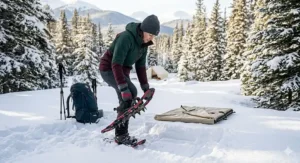
Weight matters exponentially when winter camping. You’re already carrying tent, sleeping system, extra clothing, more food, and cooking fuel. Every 100 grams saved on snowshoes means less energy expenditure over kilometres.
Ultra-lightweight models (under 1.8 kg/pair) use aluminum frames and minimal decking. They’re ideal for firm conditions and experienced winter campers comfortable with weight limits. Mid-weight options (1.8-2.5 kg) balance durability and efficiency – the sweet spot for most Canadian winter camping scenarios.
Heavier snowshoes (2.5+ kg) typically offer larger surface area or more robust construction. They’re worth the weight penalty for deep powder regions, extended expeditions, or when carrying particularly heavy loads approaching maximum capacity ratings.
Remember: lighter snowshoes often sacrifice some durability or flotation. Match weight class to your camping intensity and frequency rather than automatically choosing lightest available.
Snowshoe Sizing for Women: Canadian Winter Camping Context
Traditional sizing advice focuses on weight, but winter camping adds complexity. Here’s what actually works in Canadian conditions:
Petite Women (Under 125 lbs): 21-22″ snowshoes handle most scenarios. Add flotation tails if planning deep powder expeditions.
Average Build (125-160 lbs): 22-25″ depending on pack weight and snow conditions. The 25″ provides more versatility for variable Canadian winter conditions.
Larger Frame or Heavy Packs (160+ lbs): 25-30″ models, possibly with tail extensions available. Don’t undersize – proper flotation prevents exhausting post-holing.
Canadian Regional Considerations: Coastal BC’s heavy wet snow demands more surface area than Alberta’s dry powder for equivalent weight. Quebec’s variable conditions favour mid-size versatile models.
Narrower Snowshoe Frame: Advantages for Women’s Biomechanics
A narrower snowshoe frame does more than just look proportional. It fundamentally changes how you move with a camping pack. Standard men’s snowshoes force women into an unnatural wide stance, triggering hip and lower back strain over kilometres. Properly-fitted women’s frames allow normal gait patterns, dramatically reducing fatigue.
The narrower profile also improves manoeuvrability in tight spaces – weaving between trees, navigating rocky sections, setting up camp in confined areas. When you’re exhausted after a long winter camping approach, being able to move naturally around camp feels like a luxury.
Canadian terrain varies dramatically. Dense boreal forests benefit from maximum manoeuvrability. Open tundra or alpine meadows reward efficient striding. Choose frame width matching where you’ll actually camp most frequently.
Smaller Binding Snowshoes: Fit Matters for Women’s Winter Boots
Women’s winter camping boots typically range from size 6-10, significantly smaller than men’s 9-13 average. Properly-sized bindings secure these smaller boots without excessive strap slack or awkward positioning.
Oversized bindings create several problems: straps have excess length to manage (catches on branches, trips you); binding pivot point sits incorrectly for your boot size; and pressure distribution becomes uneven, creating hot spots during long days.
Women-specific models position bindings correctly for smaller boots, ensuring proper articulation and efficient power transfer. When you’re climbing with a camping pack, efficient energy transfer from boot to snowshoe to snow makes measurable difference in pace and fatigue.
Women’s Snowshoe Weight Limit: Understanding Canadian Winter Camping Loads
Weight limits aren’t suggestions – they’re performance thresholds. Exceed them and flotation suffers dramatically, forcing you to work exponentially harder. Here’s realistic Canadian winter camping math:
Typical Overnight Trip:
- Body weight: 60 kg (132 lbs)
- Winter camping gear: 15 kg (33 lbs)
- Food and water: 3 kg (7 lbs)
- Safety margin: 15%
Total load: ~205 lbs → Need 220+ lb capacity
Extended Winter Expedition:
- Body weight: 60 kg (132 lbs)
- Gear: 20 kg (44 lbs)
- Food/fuel: 8 kg (18 lbs)
- Safety margin: 15%
Total load: ~235 lbs → Need 250+ lb capacity
Always include that safety margin. Fresh powder, wet spring snow, or end-of-day fatigue all reduce effective flotation. Better to have excess capacity than insufficient.
Best Women’s Snowshoes Canada: Where to Buy and Regional Availability
National Retailers
Amazon.ca offers the widest selection with competitive pricing and free shipping on most models to anywhere in Canada. Prime members get fast delivery even to remote areas.
SAIL (Quebec, Ontario, Alberta): Excellent showroom experience, knowledgeable staff, frequent sales. Great for first-time buyers wanting hands-on comparison.
MEC/Mountain Equipment Company: Premium focus, expert staff, generous return policy. Particularly strong in technical models for serious winter camping.
Canadian Tire: Budget-friendly options, widespread availability across Canada including smaller communities. Good for entry-level or occasional winter campers.
Regional Specialists
BC: Valhalla Pure Outfitters, Coast Mountain Sports – expertise in coastal conditions
Alberta: University Outdoor, Mountain House – Rocky Mountain focus
Ontario: Algonquin Outfitters, Trailhead – Ontario backcountry specialists
Quebec: Latulippe, Atmosphere – French-language service, Quebec terrain expertise
Online Shopping Tips for Canadians
Verify snowshoes ship from Canadian warehouses to avoid customs fees and delays. Check return policies carefully – fit is crucial, and you might need to try multiple models. Compare prices across retailers but factor in shipping costs and delivery speed. Many Canadian outdoor retailers price-match Amazon.ca.
Winter Camping Safety: Integrating Snowshoes with Canadian Outdoor Skills
Snowshoes are one component of safe winter camping. Parks Canada emphasizes that winter backcountry travel requires specific skills and preparation. Here’s what Canadian winter campers need beyond snowshoes:
Navigation Skills
GPS batteries drain faster in cold. Always carry paper maps and compass, and know how to use them. Mark your route prominently – your snowshoe tracks may drift over with blowing snow.
Avalanche Awareness
If winter camping in mountainous regions, take Avalanche Canada’s training. Check avalanche forecasts daily at avalanche.ca. Understand terrain assessment and carry appropriate safety gear.
Cold-Weather Camping Techniques
Modern Canadian winter camping relies on proper tent site selection, effective snow anchor systems, and reliable cooking methods in subzero temperatures. Practice these skills before committing to remote winter expeditions.
Emergency Preparedness
Cell coverage is unreliable in Canadian wilderness. Consider satellite communicators for winter camping. Always file trip plans with someone responsible. Carry overnight survival gear even on day trips.
Canadian Winter Camping Destinations Perfect for Snowshoeing
Rocky Mountain National Parks
Banff, Jasper, Yoho: Stunning alpine scenery, established winter camping infrastructure. Snowshoes essential for accessing backcountry sites. Variable snow conditions demand versatile models with good traction.
Quebec Provincial Parks
Parc national de la Mauricie, Mont-Tremblant: Excellent winter camping facilities, well-maintained trails. Moderate terrain suits most women’s snowshoes for camping. Heavy snow accumulation favours larger flotation.
Ontario’s Winter Camping
Algonquin Park, Killarney, Silent Lake: Accessible winter camping for beginners through experts. Frozen lake travel possible, but shoreline approaches require proper snowshoes. Mixed terrain rewards versatile models.
Coastal British Columbia
Garibaldi, Manning, Cypress: Challenging winter conditions with heavy, wet snow. Require robust snowshoes with excellent flotation. Variable weather demands dependable gear.
FAQ: Women’s Snowshoes for Camping in Canada
❓ What size snowshoes should I get for winter camping in Canada?
❓ Do I really need women-specific snowshoes or are unisex models fine?
❓ How much should I expect to pay for quality women's snowshoes in Canada?
❓ Can I use women's snowshoes for camping with any winter boots?
❓ What's the difference between recreational and backcountry women's snowshoes for camping?
Conclusion: Choosing Your Perfect Winter Camping Companion
After testing these models across Canadian terrain from the Rockies to the Maritimes, patterns emerge. For women beginning winter camping in Canada, the MSR Evo Trail offers exceptional value and proven reliability at $228.70 CAD. You’ll appreciate the easy bindings and forgiving performance while developing winter camping skills.
Intermediate winter campers seeking versatility find the Atlas Treeline hits the perfect balance. The Spring-Loaded Suspension and BOA convenience justify the ~$300 CAD investment, while performance scales from provincial park car camping to moderate backcountry expeditions.
Serious backcountry winter campers committed to challenging Canadian terrain will find the Tubbs Flex VRT or MSR Lightning Ascent worth their premium pricing. These snowshoes transform technical approaches and steep terrain from exhausting ordeals into manageable challenges.
Remember that women’s snowshoes for camping represent just one component of safe winter wilderness travel. Parks Canada provides excellent resources for winter camping preparation. The Canadian Encyclopedia offers fascinating context on snowshoeing’s deep Canadian roots.
The right snowshoes don’t just make winter camping possible – they make it joyful. There’s something magical about breaking trail through pristine Canadian snow, watching your breath crystallize in cold air, and knowing your gear will reliably get you to that perfect camping spot and safely home again. Choose wisely, prepare thoroughly, and embrace the extraordinary beauty of Canadian winter wilderness.
Recommended for You
- 7 Best Snowshoes for Winter Camping Canada 2026
- 7 Best Winter Camping Socks in Canada 2026 (Expert Tested)
- 7 Best Heated Gloves for Winter Camping in Canada 2026
Disclaimer: This article contains affiliate links to Amazon.ca. If you purchase products through these links, we may earn a small commission at no additional cost to you.
✨ Found this helpful? Share it with your friends! 💬🤗
