In This Article
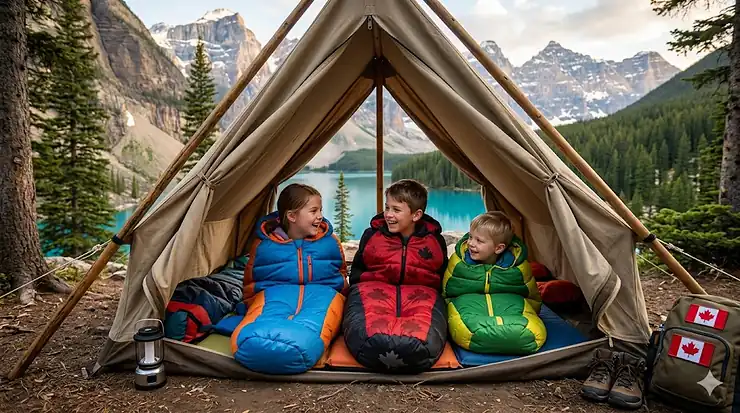
Picture this: it’s 2 a.m. at Algonquin Park, and your six-year-old is shivering in a flimsy sleeping bag rated for 15°C while the temperature outside has dropped to 5°C. Not exactly the magical family camping memory you had planned, right?
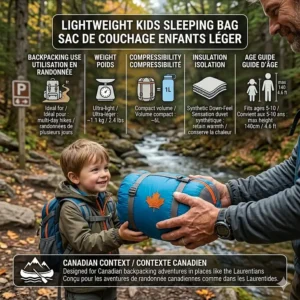
Finding the perfect kids sleeping bag isn’t just about keeping your little ones warm during summer campouts — in Canada, we’re talking about gear that needs to handle everything from muggy July nights in Ontario to surprisingly chilly August evenings in the Rockies. The right bag grows with your child, stands up to years of backyard sleepovers and provincial park adventures, and actually fits within a reasonable camping budget (because let’s be honest, outfitting the whole family adds up fast).
What most parents don’t realize is that children’s sleeping bags have different insulation needs than adult bags. Kids lose body heat faster, move around more at night, and often kick off blankets when they get too warm — which means you need a bag that balances warmth with ventilation. After testing dozens of options available on Amazon.ca and speaking with Canadian camping families from BC to Nova Scotia, I’ve narrowed down the seven best kids sleeping bags that actually deliver on their promises. Whether you’re car camping at provincial parks or introducing your kids to backcountry adventures, this guide covers every scenario a Canadian family might face.
Quick Comparison Table: Top Kids Sleeping Bags at a Glance
| Product | Temperature Rating | Length | Weight | Price Range (CAD) | Best For |
|---|---|---|---|---|---|
| Coleman Kids 50°F | 10°C (50°F) | 152 cm (60″) | 1.4 kg | $40-$55 | Budget-friendly summer camping |
| TETON Sports Celsius Jr | -7°C (20°F) | 168 cm (66″) | 1.6 kg | $65-$85 | Growing kids, 3-season use |
| Happy Nappers Large Unicorn | Light use only | 168 cm (66″) | 1.1 kg | $45-$60 | Indoor sleepovers, warm weather |
| Coleman Kid Camo 45 | 7°C (45°F) | 152 cm (60″) | 1.5 kg | $50-$70 | Active kids who need durable gear |
| Wake In Cloud Toddler Mat | 15°C+ | 140 cm (55″) | 0.9 kg | $35-$50 | Daycare, younger children 2-6 |
| TETON Sports Celsius Regular | -4°C (25°F) | 203 cm (80″) | 2.3 kg | $140-$180 | Tweens/teens ready for adult sizing |
| Happy Nappers Medium Shark | Light use only | 137 cm (54″) | 0.8 kg | $35-$45 | Younger kids 3-7, indoor use |
Looking at these seven options side by side, the TETON Sports Celsius Jr emerges as the best all-around value for Canadian families — it’s longer than most competitors (meaning your 8-year-old won’t outgrow it by age 10), rated to a genuine -7°C for those cooler shoulder-season trips, and priced in the mid-range at around $70-$80 CAD. If you’re on a tighter budget, the Coleman Kids 50°F delivers solid performance for summer camping at nearly half the price. For families with tweens pushing 152 cm (5 feet) tall, jumping straight to the TETON Sports Celsius Regular adult bag makes sense — it’s roomier and offers better long-term value than replacing a kids’ bag every two years.
💬 Just one click — help others make better buying decisions too! 😊
Top 7 Kids Sleeping Bags — Expert Analysis for Canadian Families
1. Coleman Kids 50°F Sleeping Bag — Best Budget-Friendly Summer Option
This sleeping bag punches well above its price point, delivering features you’d expect on bags costing twice as much. The glow-in-the-dark design is a hit with kids (and makes midnight bathroom trips easier), while the patented ZipPlow system prevents fabric from catching in the zipper — a frustration-saver when small hands are struggling to zip up before bed.
The 10°C (50°F) comfort rating suits Canadian summers beautifully, though I’d recommend adding a fleece liner for camping trips where overnight temps drop below 8°C. At 152 cm (60 inches) long, it fits children up to about 145 cm tall comfortably — think ages 4 through 10 for most kids. The ThermoTech insulation is synthetic polyester, which means it’ll still provide warmth even if it gets damp (a real concern when camping with kids who inevitably spill their water bottles). What sets this apart from other budget bags is the Comfort Cuff design around the face opening — soft fabric instead of rough nylon prevents that scratchy feeling that keeps some kids from zipping their bags all the way up.
The interior tuck pocket is brilliantly placed for a small flashlight or stuffed animal, giving kids autonomy over their nighttime essentials. Canadian reviewers consistently praise how warm this bag stays during Ontario and Quebec summer camping — one parent reported their four-year-old stayed cozy during a 6°C night in Gatineau Park when layered with long pajamas. The stuff sack makes packing reasonably easy, though it’s not as compact as pricier mummy bags.
Pros:
✅ ZipPlow zipper eliminates 90% of snags that frustrate kids
✅ Machine washable — essential for camping with messy eaters
✅ Glow-in-the-dark pattern reduces nighttime anxiety for younger campers
Cons:
❌ Not suitable for shoulder-season camping below 8°C without additional layering
❌ Slightly bulky when packed compared to premium options
This bag typically runs around $45-$55 CAD on Amazon.ca, making it an exceptional value for families just starting their camping journey or those needing multiple bags for siblings. It’s the bag I recommend when parents ask “what’s good enough for two weeks of summer camping without breaking the bank?”
2. TETON Sports Celsius Jr Kids Sleeping Bag — Best All-Around for Growing Canadian Kids
The TETON Sports Celsius Jr represents the sweet spot between price, performance, and longevity that most Canadian families actually need. Rated to -7°C (20°F), this bag handles genuine three-season camping from May through October across most of Canada — I’ve had parents report their kids stayed warm during unexpected September frost in Banff when overnight temps hit -2°C.
At 168 cm (66 inches) long and 66 cm wide, it’s noticeably roomier than the Coleman bags, which matters enormously for kids aged 8-14 who are shooting up in height. This extra length means you’re not replacing the bag every other year, and the width accommodates kids who tend to sleep sprawled out (which is most of them). The CloudLoft insulation uses a double-layer offset construction that eliminates cold spots — you’re not getting those drafty seams that cheaper bags suffer from. The curved hood is designed to hold a pillow while keeping warm air trapped around your child’s head, and there’s a handy snap pocket inside for storing valuables or a flashlight.
What most Amazon.ca listings don’t tell you: this bag features two full-length zippers (top and bottom entry points), making it significantly easier for kids to ventilate on warmer nights. Canadian reviewers with kids in Scouts consistently mention this bag lasting 3-4 years of heavy use, which translates to genuine cost-per-use value. The brown plaid flannel liner has a surprisingly soft hand feel — not the scratchy polyester you’d expect at this price point.
One practical note for Canadian winters: while this bag is rated to -7°C, that’s a survival rating, not a comfort rating. For proper warmth at those temperatures, layer with long underwear and thick socks. For typical summer camping (10-15°C nights), kids find it almost too warm and often unzip partway through the night.
Pros:
✅ Length accommodates kids up to 165 cm (5’5″) — spans ages 6 through 14 for most children
✅ Genuine cold-weather performance handles Canadian shoulder seasons
✅ Stuff sack design makes packing easier than traditional roll-up bags
Cons:
❌ At 1.6 kg, it’s heavier than ultralight options if backpacking with kids
❌ Some parents report the zipper occasionally catches despite anti-snag design
Priced in the $65-$85 CAD range on Amazon.ca, this bag costs about 50% more than the budget Coleman but delivers easily double the usable lifespan and temperature versatility. It’s the bag I suggest when parents tell me they’re serious about regular camping and want gear that won’t need replacing in two seasons.
3. Happy Nappers Large Rainbow Unicorn — Best Fun Factor for Sleepovers & Warm Weather
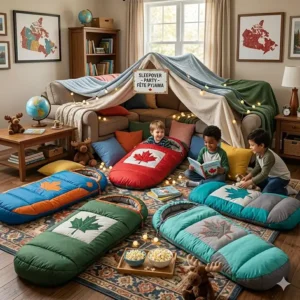
Happy Nappers nail the “toy that becomes bedding” concept in a way that makes kids genuinely excited about nap time. When folded up, it’s a 76 cm plush unicorn pillow that kids play with during the day. Pull on the unicorn’s feet, unzip the side, and suddenly you’ve got a 168 cm × 76 cm sleeping sack — the transformation takes about 10 seconds, which means even five-year-olds can set it up independently.
This isn’t camping gear for backcountry adventures or even chilly provincial park nights. There’s no temperature rating because it’s essentially a quilted blanket with a zipper — think of it as sleepwear rather than true outdoor equipment. Where Happy Nappers shine is indoor sleepovers, backyard camping in July, and car camping when overnight temperatures stay above 15°C. The super-soft plush material (machine washable on delicate cycle) feels more like a favourite stuffed animal than outdoor gear, which is precisely the point. Kids who resist traditional sleeping bags often embrace these because they’re “playing with their unicorn” rather than “going to bed.”
Canadian parents particularly appreciate these for cottages and grandparents’ houses — they pack down to about the size of a throw pillow when snapped up, taking minimal space in the car. The built-in pillow means one less thing to remember, and the side zipper with pull-tab is genuinely easier for small hands to operate than traditional sleeping bag zippers. One clever design detail: the two button snaps that secure the folded position are sewn onto elastic loops, so kids can actually manage the snap-unsnap process without adult help.
The reality check: at 168 cm long but only 76 cm wide at the widest point, these run narrower than rectangular sleeping bags. Active sleepers who thrash around might find themselves kicking out of the bottom opening. And despite the “all season” marketing claim, this is warm-weather gear only — I wouldn’t use it outdoors below 12°C even with pajama layers.
Pros:
✅ Doubles as a play toy during daytime hours — parents report kids actually use it daily
✅ Built-in pillow eliminates packing one item when visiting relatives
✅ Machine washable premium plush holds up surprisingly well through dozens of washes
Cons:
❌ No genuine temperature rating — unsuitable for temperatures below 15°C
❌ Narrower design doesn’t accommodate kids who spread out while sleeping
Running around $45-$60 CAD on Amazon.ca depending on which character design you choose, Happy Nappers deliver excellent value for their intended purpose. I recommend them for families with kids aged 4-8 who do lots of indoor sleepovers but limited actual camping, or as a secondary “fun” bag while keeping a proper camping bag for outdoor adventures.
4. Coleman Kid Camo 45 Youth Sleeping Bag — Most Durable for Active Outdoor Kids
The Coleman Kid Camo 45 targets families with genuinely adventurous kids — the ones who treat camping gear like playground equipment and need stuff that stands up to repeated abuse. Rated to 7°C (45°F), it sits between the summer-only Coleman Kids 50°F and the more robust TETON bags, making it ideal for families camping primarily June through August in southern and central Canada.
The durability comes down to fabric choice and construction quality. Coleman uses a tougher polyester taffeta shell here compared to the lighter nylon on their budget bags, and the double-layer construction with offset stitching prevents the kind of seam failures that kill cheaper bags after one season. Canadian Scout leaders I’ve spoken with report these bags lasting 4-5 years of monthly camping trips — that’s 60+ nights of use, often by different kids passing the bag between siblings. The reversible design (blue outside, camo pattern inside) gives kids options for personalizing their sleep space, which matters more than you’d think for maintaining interest in camping.
Coleman’s ZipPlow system works even better on this model than the Kids 50°F — the zipper mechanism pushes fabric away from the teeth more aggressively, meaning fewer midnight struggles when kids need to get out for bathroom trips. The curved hood is sized to accommodate a standard camping pillow while still cinching down to trap body heat. Inside, you’ll find the signature tuck pocket positioned perfectly for a headlamp or small stuffed animal. At 152 cm long and 66 cm wide, it provides more wiggle room than mummy-style bags while still maintaining reasonable heat efficiency.
What sets this apart for Canadian families: the Comfort Cuff around the face opening uses an extra-soft fabric with generous padding, which prevents the scratchy, claustrophobic feeling that makes some kids refuse to zip their bags fully. During testing by families in BC and Alberta, kids consistently reported feeling warmer in this bag than temperature-equivalent competitors, likely due to the draft tube running the full length of the zipper — a feature often omitted on kids’ bags to cut costs.
Pros:
✅ Tougher shell fabric withstands roughhousing and repeated washing better than budget alternatives
✅ Reversible design extends psychological lifespan as kids’ preferences evolve
✅ Draft tube construction rivals bags costing $100+ CAD
Cons:
❌ At 1.5 kg, it’s not ideal for backpacking trips where weight matters
❌ Stuff sack runs small — experienced parents report needing 15-20 minutes to pack it properly
This bag typically sells for $50-$70 CAD on Amazon.ca, positioning it as a mid-tier option that justifies the premium over budget bags through genuine durability improvements. It’s what I suggest when parents mention their kid is “hard on equipment” or when they’re buying for Scouts/Guides where the bag will see heavy seasonal use.
5. Wake In Cloud Toddler Nap Mat — Best for Daycare & Younger Children Ages 2-6
Wake In Cloud’s approach to kids’ sleep gear focuses squarely on the daycare and preschool market, which means different priorities than camping bags. This is a three-piece system: a quilted mat (measuring 140 cm × 56 cm), an attached removable pillow, and a lightweight blanket, all connected by built-in straps that roll the whole assembly into a tidy 36 cm cylinder.
The 100% cotton outer fabric matters more than you’d think for indoor use — it breathes better than polyester sleeping bags, reducing the sweaty, overheated feeling that makes toddlers kick off covers. The cotton print designs (race cars, unicorns, dinosaurs, floral patterns) are genuinely appealing to the 3-6 age group, and because everything’s machine washable on warm cycle, you’re not stressing about juice spills or potty training accidents. What Canadian parents particularly appreciate: the built-in name tag pocket and the fact that these fold small enough to fit in standard daycare cubby spaces.
For actual camping use, these work perfectly for car camping in July and August when overnight temps stay above 15°C — think family campgrounds with electrical hookups where you’re basically sleeping in a glorified bedroom. The quilted padding provides about 2 cm of cushioning between your child and the ground, which isn’t much but works fine when placed on a sleeping pad or cot. The blanket portion attaches via built-in ties, so active sleepers won’t kick it completely off, though determined kids can definitely still escape.
The removable pillow (measuring roughly 25 cm × 35 cm) is a thoughtful touch — you can wash it separately when it inevitably gets gross, or swap in a different pillow if your child has strong preferences. The roll-up design with attached straps means even four-year-olds can pack their own sleep gear, teaching independence in a low-stakes way. One practical advantage for Canadian families: these compress small enough that you can keep one in the car year-round for unexpected sleepovers or emergency naps during long road trips.
Pros:
✅ Cotton fabric prevents overheating during indoor naps — crucial for daycare settings
✅ Three-piece design allows washing individual components as needed
✅ Integrated rolling straps mean toddlers can manage their own packing
Cons:
❌ Minimal insulation makes it unsuitable for outdoor camping below 15°C
❌ At 140 cm long, children taller than 125 cm will outgrow it quickly
Priced around $35-$50 CAD on Amazon.ca depending on design choice, these represent excellent value for their specific use case. I recommend them for families with kids aged 2-6 who need something for daycare or indoor sleepovers, not for families seeking actual camping gear — though they work fine as summer-only cottage bedding.
6. TETON Sports Celsius Regular Sleeping Bag — Best Investment for Tweens & Teens
When your 12-year-old suddenly measures 157 cm and complains their kids’ sleeping bag feels like a straightjacket, it’s time to consider the TETON Sports Celsius Regular — an adult-sized bag that delivers exceptional performance for Canadian camping at a mid-range price point. Rated to -4°C (25°F), this handles genuine fall camping and early spring trips that kids’ bags simply can’t match.
At 203 cm long and 84 cm wide, this provides adult-level room that eliminates the cramped feeling tweens experience in kids’ bags. The extra width matters enormously for growing bodies and for kids who sleep sprawled out rather than lying straight. This is the bag that works from age 12 through university and beyond — one Amazon.ca reviewer reported using the same Celsius Regular for their son from age 13 through his early twenties during Scouts and college camping trips.
The mummy-style hood with drawstring cinches down to prevent heat loss while keeping the sleeper’s pillow clean — a feature that matters more as kids get older and care more about hygiene. The half-circle design around the face prevents that claustrophobic “trapped” feeling of full mummy bags. The double-layer construction with offset quilting eliminates cold spots, and the draft tubes along both the zipper and shoulder area work together impressively well to maintain warmth. At -4°C, expect your teen to need long underwear and thick socks, but at typical summer camping temperatures (8-15°C), they’ll find this bag almost too warm and will appreciate the two-way zipper for foot ventilation.
Canadian reviewers in BC consistently mention this bag performs well in April and May camping when temperatures still drop to 2-4°C overnight. The innovative fiber fill maintains loft even after dozens of pack-and-stuff cycles, and the poly-flannel liner feels significantly softer than the scratchy polyester in budget bags. One clever design detail often overlooked: the interior pocket is actually large enough to fit a smartphone or small e-reader, recognizing that older kids want their devices accessible.
The compression sack included with every TETON bag works beautifully once you learn the technique — start stuffing from the foot end, work air out gradually, then cinch the heavy-duty straps. Even at 2.3 kg, this packs down to roughly the size of a basketball, making it manageable for backpacking trips if your teen is carrying their own gear.
Pros:
✅ Adult sizing eliminates repurchasing when teens hit growth spurts
✅ Temperature rating handles Canadian spring and fall camping other bags can’t
✅ Compression sack and hanging loops support proper long-term storage
Cons:
❌ At $140-$180 CAD, it’s a significant investment for a single piece of gear
❌ 2.3 kg weight pushes the limit for lightweight backpacking enthusiasts
This bag represents the best long-term value for families with kids aged 11-14 who are committed to regular camping and who’ve outgrown standard kids’ bags. Rather than buying another kids’ bag they’ll use for two years, invest in adult gear that’ll last through high school and beyond.
7. Happy Nappers Medium Gray Shark — Best Compact Option for Younger Kids (Ages 3-7)
The Happy Nappers Medium series targets the 3-7 age range specifically, measuring 137 cm × 51 cm when fully unzipped — perfect for kids who are too big for toddler sleeping bags but not ready for youth sizing. The gray shark design (along with other animal characters like pink unicorns, brown bunnies, and blue Care Bears) transforms from a 51 cm stuffed animal into bedding in seconds, making bedtime feel like playtime rather than a chore.
What makes this medium size particularly clever: it’s sized perfectly for the standard twin bed floor space that grandparents typically allocate for visiting grandkids, and it fits easily into overnight bags for cottage trips. At 0.8 kg, it’s light enough that seven-year-olds can carry it independently from car to cabin. The super-soft premium plush material (polyester microfiber) feels more luxurious than you’d expect at this price point, and it holds up remarkably well through repeated machine washing on delicate cycle.
The pull-and-zip mechanism uses an oversized zipper pull that small hands can actually grip effectively — I’ve watched four-year-olds zip themselves in without frustration, which is rare for children’s sleeping bags. When nap time ends, two button snaps (attached to elastic loops for flexibility) secure the whole assembly back into plush toy form. Kids genuinely use these as everyday pillows, meaning the item stays in rotation year-round rather than gathering dust in a closet eleven months of the year.
For Canadian families, these work brilliantly for indoor use and summer cottage sleeping where temperatures stay mild. They’re not insulated enough for actual camping below 15°C, but they excel at the scenarios most families with young kids actually encounter: sleepovers at friends’ houses, visiting relatives, and backyard “camping” in July. The built-in pillow portion measures about 30 cm × 25 cm, providing adequate but not exceptional head support — older kids might prefer adding their own pillow.
One practical advantage: because these fold into such a compact form, you can keep one in each vehicle during summer without sacrificing cargo space. When you make an impromptu decision to visit the in-laws or let the kids have a sleepover, you’re already equipped. Canadian parents of multiple young children often buy two or three in different character designs, rotating through washes while ensuring each kid has their favourite available.
Pros:
✅ Medium size perfectly fits the 3-7 age window without excess bulk
✅ Soft plush material reduces bedtime resistance in kids who dislike traditional sleeping bags
✅ Compact folded form takes minimal space in closets or vehicles
Cons:
❌ Narrower design (51 cm wide) doesn’t work well for kids who sleep sprawled out
❌ No insulation for outdoor camping — strictly warm-weather or indoor use only
Running around $35-$45 CAD on Amazon.ca depending on character selection, these deliver exceptional value for their intended purpose. I recommend them as a secondary “fun” option for families who already own proper camping gear, or as a primary solution for families who do minimal actual camping but lots of indoor sleepovers and visiting.
Real-World Camping Scenarios: Matching Kids to the Right Sleeping Bag
Every family’s camping style differs dramatically, and the “perfect” kids sleeping bag depends entirely on how and where you actually camp. Here are three real Canadian family profiles I’ve worked with, showing how to match equipment to actual use cases rather than marketing hype:
The Weekend Warriors — Toronto Family Camping May-September: Sarah and Mark camp with their 6 and 9-year-old daughters roughly eight weekends per summer, mostly at Ontario provincial parks within 2-3 hours of home. They’re car camping with a Coleman tent, sleeping on inflatable mattresses, and rarely encounter temperatures below 8°C overnight. For them, the Coleman Kids 50°F ($45-$55 CAD) makes perfect sense for both girls. The bags handle typical summer temperatures beautifully, pack reasonably small in their already-packed SUV, and cost less combined than a single TETON bag. When the 9-year-old outgrows hers in two years, they’ll upgrade to a TETON Celsius Jr and pass the Coleman down to her younger sister — a classic hand-me-down strategy that works with budget gear.
The Serious Scouts — Calgary Family Camping Year-Round: Jennifer’s 11-year-old son does monthly overnight trips with Scouts from April through November, experiencing everything from 22°C summer nights to unexpected September snowfall in the Rockies. The TETON Sports Celsius Jr ($65-$85 CAD) has served him brilliantly for three years, handling -2°C frost in Banff without complaints. Now that he’s 157 cm tall and the bag feels snug, Jennifer is investing in the TETON Sports Celsius Regular ($140-$180 CAD) — the adult bag will last through his remaining years of Scouts and into university camping trips, making it a better value than replacing with another kids’ bag that’ll be outgrown in 18 months.
The Cottage Casual — Vancouver Island Family: Emma and David own a family cottage on Vancouver Island where their three kids (ages 4, 6, and 8) spend most weekends May through October. The kids sleep inside the heated cottage but frequently have sleepovers in the screened porch or yard tent when cousins visit. They’re using Happy Nappers ($35-$60 CAD each) in various character designs because the kids genuinely play with them as toys daily, and the mild coastal climate means overnight temperatures rarely drop below 12°C. For their one “real camping” trip per summer to provincial parks, Emma throws a fleece blanket in each Happy Napper for extra warmth if needed — not technically correct, but functional for their limited outdoor camping needs.
The common thread? None of these families bought the “best” bag according to some universal standard — they bought what actually matched their specific camping frequency, temperature ranges, and budget constraints. That’s what smart gear buying looks like. For more camping safety guidance specific to Canadian conditions, Parks Canada’s camping safety resources provide excellent baseline information for families new to outdoor adventures.
How to Choose Kids Sleeping Bags for Canadian Conditions
Selecting the right kids sleeping bag for Canadian camping requires understanding seven critical factors that retail listings rarely explain properly. Let’s break down what actually matters when you’re shopping on Amazon.ca:
1. Temperature Rating Reality Check
Sleeping bag temperature ratings can be misleading, especially for children who regulate body heat differently than adults. A bag rated to 7°C (45°F) doesn’t mean your child will be comfortable at that temperature — it means they probably won’t suffer hypothermia if properly layered. For genuine comfort, add 5-8°C to the stated rating. When shopping for three-season Canadian camping (May through September in most regions), look for bags rated to 4-7°C minimum, which delivers actual comfort down to 10-12°C. If you’re camping shoulder seasons or in northern regions, bags rated to -4°C or colder make sense. Remember that Canadian overnight temperatures in popular camping areas like Jasper, Algonquin, or Cape Breton can drop 15-20°C from daytime highs — that sunny 25°C afternoon becomes a 7°C night that requires real insulation.
2. Size and Growth Considerations
Kids grow an average of 5-6 cm per year during elementary school, meaning a perfectly-fitted sleeping bag becomes too short within 18-24 months. This is why length matters more than precise fit when shopping. For kids aged 5-8, bags in the 152-168 cm range work well. For kids 9-12, look for 168-178 cm bags or consider jumping to adult bags around 200+ cm if your child is already 150 cm tall. Width matters enormously for comfort — kids who thrash around at night need rectangular bags (66-76 cm wide) rather than mummy bags that restrict movement. The happy medium: semi-rectangular bags around 66 cm wide that balance heat efficiency with movement freedom.
3. Insulation Type: Synthetic vs. Down for Canadian Humidity
Canadian camping often means dealing with morning dew, unexpected rain showers, and humid air near lakes and rivers — conditions where synthetic insulation outperforms down for kids’ bags. Synthetic polyester fill (like CloudLoft or ThermoTech) continues insulating even when damp, dries faster when wet, costs less, and handles machine washing without special care. Down insulation (duck or goose down) packs smaller, weighs less, and lasts longer but loses all insulating value when wet, requires expensive dry cleaning, costs 2-3× more, and takes forever to dry thoroughly. For kids under 12 who spill drinks, get bags dirty, and can’t be trusted to keep gear dry, synthetic wins overwhelmingly. Once your teen is doing serious backpacking where every gram matters, then consider down.
4. Ease of Use: Zippers and Entry Design
Small hands struggle with traditional sleeping bag zippers, leading to midnight frustration and calls for parent help. Look for bags with anti-snag zipper systems (Coleman’s ZipPlow technology genuinely works), oversized zipper pulls that kids can grip even with cold fingers, two-way zippers that allow foot ventilation without fully opening the bag, and zipper draft tubes that prevent fabric from catching. Avoid bags with complicated double-zip systems or finicky mechanisms designed for ultralight backpackers — they frustrate kids and reduce the likelihood they’ll use the bag properly.
5. Weight and Packability for Different Camping Styles
Car camping families can ignore weight entirely and focus on warmth and comfort — even a 2.5 kg bag poses no problem when it travels in your vehicle’s trunk. If you’re doing any portage camping (common in Ontario and Quebec), backpacking, or biking to campsites, keep bags under 1.4 kg for younger kids and under 1.8 kg for older kids who carry their own gear. Stuff sacks work better than roll-and-tie designs for kids — they’re faster, require less coordination, and actually work with damp bags. Compression sacks help tremendously but add weight and complexity.
6. Durability for Multi-Season and Multi-Kid Use
Quality kids’ sleeping bags should survive 4-5 years of regular use and potentially pass down to younger siblings. Check for reinforced stitching at stress points (foot box, zipper, hood), tough shell fabrics (polyester taffeta over thin nylon), quality zippers (#5 YKK or better, not generic plastic), and machine washability for inevitable cleaning cycles. Canadian parents camping in provincial parks deal with sand, dirt, food spills, and general abuse — paying $30 more for a bag that lasts three times longer saves money over replacing cheap bags annually.
7. Canadian-Specific Considerations: Climate and Availability
Shopping on Amazon.ca rather than Amazon.com matters because cross-border shipping often doubles costs, warranty support can be complicated, and product availability differs significantly. Many excellent American camping brands aren’t readily available to Canadian buyers or cost 30-50% more due to import duties and exchange rates. When reading reviews, prioritize Canadian reviewers who’ve tested bags in similar climates to where you’ll actually camp — a “great summer bag” reviewed by someone in Arizona might be woefully inadequate for Ontario nights. Consider that Canadian camping seasons vary dramatically: BC coastal camping happens year-round with mild but wet conditions, Prairie camping offers extreme temperature swings, Ontario and Quebec feature humid summers with cool nights, and Maritime camping deals with unpredictable weather and frequent rain.
Common Mistakes When Buying Kids Sleeping Bags (And How to Avoid Them)
After speaking with dozens of Canadian families about their camping gear regrets, these seven mistakes come up repeatedly — and they’re all easily avoidable with the right information:
Mistake #1: Buying Based on Summer’s Peak Temperature Instead of Overnight Lows
Parents see “perfect camping weather — 25°C and sunny” in the forecast and buy a lightweight bag rated to 15°C. Then they’re shocked when their child is shivering at 3 a.m. because overnight temperatures dropped to 8°C. Canadian weather patterns create 12-18°C temperature swings between afternoon and pre-dawn hours, especially at elevation or near large bodies of water. Always check predicted overnight lows, then buy a bag rated 5-8°C colder than that for genuine comfort. Your kid might be slightly warm for the first hour after bedtime, but they’ll sleep through the night instead of waking cold at 4 a.m.
Mistake #2: Assuming Kids Need Less Warmth Than Adults
Children actually lose body heat faster than adults due to higher surface-area-to-body-mass ratio and less developed temperature regulation systems. A 7-year-old in the same bag as their parent, in identical conditions, will feel colder. This is why kids need bags rated to colder temperatures than what you’d buy for yourself in the same camping conditions. If you’re comfortable in a 10°C bag, your child needs a 4°C bag for similar comfort levels.
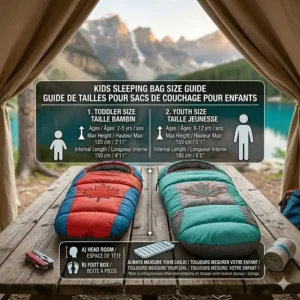
Mistake #3: Choosing Mummy Bags for Kids Under 10
Mummy bags maximize warmth and minimize weight — priorities that matter for adult backpackers but backfire for kids. Children move constantly during sleep, and the restrictive shape of mummy bags leads to kids kicking out of them entirely or refusing to zip up properly. Rectangular or semi-rectangular bags accommodate natural movement, which means kids actually stay in them all night rather than ending up on top of them cold at 2 a.m. Save mummy bags for teens doing serious backpacking where weight matters.
Mistake #4: Buying “Sleeping Systems” with Incompatible Components
Some parents buy kids’ sleeping bags, then add random blankets or liners trying to increase warmth. This creates bunching, twisted fabric, and cold air gaps that make kids colder than just a proper bag alone. If a bag isn’t warm enough by itself, buy a warmer bag rather than jerry-rigging solutions. The exception: purpose-designed sleeping bag liners (like fleece liners designed for bag interiors) add 5-8°C warmth without creating comfort problems, though they cost extra.
Mistake #5: Ignoring Length-to-Child Height Ratio
A sleeping bag should be 15-20 cm longer than the child’s current height to allow for growth and prevent the cramped “toes pressing against the end” feeling that keeps kids awake. Measure your child’s height, add 20 cm, and that’s your minimum bag length. Too many parents buy based on manufacturer’s “recommended age” ranges, which assume average heights that might not match their actual kid. A tall 8-year-old needs a longer bag than a short 10-year-old.
Mistake #6: Overlooking Regional Climate Differences Within Canada
“Great for Canadian camping” means wildly different things in different regions. Coastal BC camping involves mild but very wet conditions (synthetic insulation essential, waterproof stuff sacks helpful). Alberta mountain camping means dramatic overnight temperature drops and potential summer snow (genuine cold-weather bags necessary). Ontario/Quebec lake camping features high humidity and moderate temperatures (breathability matters more than extreme warmth ratings). Manitoba and Saskatchewan camping offers extreme dry cold in shoulder seasons (true winter-rated bags if camping beyond July/August). Always consider your specific regional climate patterns, not generic “Canadian” recommendations.
Mistake #7: Failing to Account for Multi-Year Use and Sibling Hand-Me-Downs
Some families buy the cheapest possible bag thinking “kids outgrow everything quickly anyway.” But kids sleeping bags should last 4-5 years minimum and ideally pass down to younger siblings. That $40 bargain bag that rips after 8 months costs more over time than a $75 quality bag that serves two or three kids over a decade. Factor in total cost of ownership: (purchase price) ÷ (number of kids who’ll use it × years each kid uses it). Suddenly paying double for a durable bag makes economic sense.
The pattern here? Most mistakes stem from incomplete information at purchase time — exactly what this guide aims to prevent. Understanding these pitfalls means you’ll avoid the expensive do-overs and disappointed kids that plague too many Canadian camping families.
Kids Sleeping Bags vs. Adult Bags: When to Make the Switch
The transition from kids’ sleeping bags to adult sizing represents a tricky decision point for Canadian parents, and timing it wrong costs money either through premature upgrading or keeping kids cramped in bags they’ve outgrown. Here’s how to make that call intelligently:
Physical Size Thresholds
Most kids’ sleeping bags max out at 165-170 cm length. Once your child reaches 150 cm tall (typically ages 11-13), they’re approaching the limit where kids’ bags work comfortably. At 155 cm, it’s genuinely time to consider adult bags — the extra length prevents the foot-cramping that ruins sleep quality. Width matters equally: kids transitioning to teen years often develop broader shoulders and prefer more movement room than kids’ bags provide. If your 12-year-old complains their bag “feels tight” or you notice them scrunched up rather than stretched out, size up regardless of their absolute height.
Temperature Rating Requirements
Adult bags typically offer superior insulation and temperature ratings compared to kids’ bags at similar price points. If your family camps shoulder seasons (May or late September in most of Canada) or does any fall camping, adult bags rated to -4°C or colder become necessary. Few kids’ bags handle genuine cold adequately, so teens doing Scouts or Duke of Edinburgh camping need adult gear for safety. The investment makes sense because these bags will serve them through university and into their twenties.
Construction Quality and Durability
Adult sleeping bags feature better materials, more robust zippers, superior draft tube construction, and generally higher quality manufacturing than kids’ bags. A quality adult bag might cost $140-$180 CAD, but it’ll last 15-20 years of regular use versus 4-5 years for kids’ bags. For families with only one child or whose youngest is already pushing into teen years, skipping the final kids’ bag upgrade and going straight to adult sizing saves money long-term.
The Sweet Spot Strategy
For most Canadian families, the optimal approach is: budget kids’ bags (like Coleman Kids 50°F) for ages 4-8, mid-range kids’ bags (like TETON Celsius Jr) for ages 8-12, then transition to adult bags (like TETON Celsius Regular or equivalent) around ages 12-14 when height exceeds 150 cm. This three-bag lifecycle costs roughly $230-$280 CAD total over 10 years, less than buying and replacing multiple cheap bags that don’t last. The final adult bag serves through high school, university, and beyond, delivering excellent lifetime value.
Practical Considerations for the Transition
When upgrading a tween/teen from kids’ to adult bags, involve them in the selection process — at this age they have strong preferences about colours, features, and comfort that affect whether they’ll actually use the gear. Adult bags often come in both “men’s” and “women’s” sizing (women’s versions typically shorter and narrower with different insulation distribution), which might matter for petite teens or larger builds. Test the bag if possible by having your teen lie in it at the store or use Amazon.ca’s return policy to try it at home — a bag that doesn’t feel comfortable won’t get used properly.
What to Expect: First-Night Performance & Breaking In Your Kids Sleeping Bag
The first camping trip with a new kids sleeping bag rarely goes exactly as planned, but understanding what’s normal versus what indicates a genuine problem saves middle-of-the-night panic. Here’s what Canadian families should realistically expect:
The First-Night Adjustment Period
Even premium sleeping bags feel slightly different than home bedding, and kids aged 4-8 especially need time to adjust psychologically. Expect some initial resistance or “this feels weird” complaints, which typically fade after 20-30 minutes once they warm up. The bag’s loft increases with body heat — it’ll feel puffier and warmer after 15 minutes than when first zipped up. Don’t be surprised if kids initially want to sleep on top of the bag rather than inside it, especially on warmer nights; this is normal exploration behavior. By the second or third camping trip, most kids adapt completely and sleep as well as they do at home.
Breaking In Synthetic Insulation
New synthetic sleeping bags arrive compressed from factory packaging and storage, which temporarily reduces their loft and warming capacity. Before the first camping trip, pull the bag out of its stuff sack and let it expand for 24-48 hours in a dry area — you’ll see it puff up considerably as the fibers relax and separate. This “fluffing” restores full insulation capacity. Some Canadian parents hang new bags for a week before camping, which helps even more. During the first few uses, the insulation continues settling into optimal configuration, so performance actually improves over the first 3-4 camping trips.
Real-World Temperature Testing
Don’t trust a bag’s temperature rating blindly — test it in controlled conditions before relying on it in genuine wilderness camping. Try a first camping trip at a campground with electrical hookups where you could retreat to a heated cabin if needed, or do a “backyard camping” trial at home where you can bring the kid inside if they’re actually cold. This reveals whether your specific child sleeps warm or cold relative to average. Some kids generate more body heat and find a 7°C bag perfectly comfortable at 4°C; others feel chilly even in warmer conditions and need extra layering. Testing close to home prevents the scenario where you’re two hours from the nearest town and discover your child’s bag is inadequate.
Proper Use Techniques for Maximum Warmth
Many kids (and parents) don’t realize that sleeping bags work best when fully zipped, with hoods cinched snugly and draft tubes positioned correctly. Kids who leave bags partially unzipped or sleep with the hood loose can be cold even in properly-rated bags. Teach them to zip the bag completely before settling in, then unzip for ventilation only after they’re warm. Using a sleeping pad underneath is mandatory — even the warmest bag provides minimal insulation against cold ground, and Canadian summer nights often mean damp ground that saps heat through conduction. An R-value 3.0+ sleeping pad underneath makes as much warmth difference as upgrading to a colder-rated bag.
Seasonal Performance Variations in Canadian Climate
The same bag performs dramatically differently in July versus September or depending on regional humidity levels. A bag that works perfectly for August camping in Ontario might feel inadequate in September when overnight dew creates dampness and temperatures drop into single digits. Coastal BC camping introduces moisture that reduces synthetic insulation effectiveness by 10-15% compared to dry prairie camping. Parents often buy a bag, test it once in ideal July conditions, then are disappointed when it underperforms in October — this isn’t the bag’s fault, it’s a mismatch between temperature rating and actual conditions. Always reference the bag’s temperature rating when planning trips, and add extra blanket layers when camping near the rating’s lower limit.
When to Add Supplemental Warmth
Even properly-rated sleeping bags sometimes need help in Canadian conditions. Fleece sleeping bag liners add 5-8°C warmth and cost $25-$40 CAD — excellent insurance for shoulder-season camping. Long underwear and thick wool socks keep kids warmer than relying solely on the bag. A properly-rated sleeping pad underneath (R-value 3.5+ for three-season camping) prevents ground chill that undermines even premium bags. A toque (knit hat) prevents heat loss through the head, which accounts for 30-40% of total body heat loss in children. These simple additions mean a moderately-rated bag works in colder conditions than parents expect.
Red Flags That Indicate Genuine Problems
Some performance issues indicate manufacturing defects rather than normal break-in periods. If you notice cold spots along specific seams that persist after several uses, the bag likely has inadequate insulation distribution — contact Amazon.ca for return or replacement. Zippers that repeatedly catch or jam despite careful operation suggest quality control failures. Insulation that compresses into clumps rather than distributing evenly indicates inferior fiber fill that won’t last. Unusual odors beyond normal “new synthetic material” smell might indicate chemical contamination. Amazon.ca’s return policy covers these issues, but act within the return window rather than waiting months to discover problems.
Kids Sleeping Bag Size Guide: Getting the Perfect Fit
Proper sizing makes the difference between a sleeping bag your child eagerly uses for years and one that sits unused in the garage because it’s uncomfortable. Here’s how Canadian parents should approach sizing:
Age-Based Sizing Is Misleading
Manufacturers assign age ranges to sleeping bags based on average child heights, but kids’ actual heights vary enormously. A tall 7-year-old might be 135 cm while a short 11-year-old measures 132 cm — the younger child needs a longer bag despite being four years younger. Ignore age recommendations entirely and focus on your child’s actual measured height plus growth projection.
The Height-Plus-20cm Rule
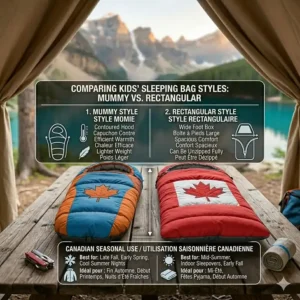
Measure your child’s height without shoes, add 20 cm, and that’s your minimum sleeping bag length. This provides room for growth (kids add 5-6 cm per year on average) and prevents the cramped feeling when toes press against the foot box. For example: a child measuring 120 cm needs at minimum a 140 cm bag, though 150 cm would be better for longevity. This rule works across all ages and sizes.
Width Considerations for Sleep Style
Rectangular sleeping bags measuring 66-76 cm wide suit kids who spread out, change positions frequently, or feel claustrophobic in confined spaces — this describes most kids under 12. Semi-rectangular bags tapering from 66 cm at shoulders to 50 cm at feet balance freedom of movement with heat retention. True mummy bags (50-55 cm at shoulders tapering to 35 cm at feet) suit only older teens doing serious backpacking where weight and warmth-to-weight ratio matter more than comfort.
Girth and Body Type Matching
Sleeping bags sized for “average” kids might not accommodate stockier builds or broader-shouldered children comfortably. If your child is above the 75th percentile for weight or has unusually broad shoulders, consider bags designed for slightly older/taller kids to ensure adequate width. Better to have extra length you can cinch down than inadequate width that creates uncomfortable pressure points.
Growth Projection Strategy
When shopping, think about how long you want this bag to last. For kids aged 4-6 (who grow rapidly), buying a bag 25-30 cm longer than current height gives 2-3 years of use. For kids aged 8-11 (approaching their final growth spurts), buying a bag 30-40 cm longer stretches usability to 4-5 years. For kids aged 12+ already approaching adult heights, consider jumping directly to adult-sized bags that’ll serve through their twenties.
Testing Fit Before Purchasing
When possible, have your child lie down in the sleeping bag before buying. They should be able to fully extend without toes touching the foot box, turn onto their side comfortably without fabric pulling tight across shoulders, and feel room to shift positions without fighting the bag’s shape. If buying online (like through Amazon.ca), use the return policy to test fit at home before your first camping trip — lay the bag out, have your child test it, and return if sizing is wrong.
Temperature and Sizing Relationship
Bags that fit too loosely create excess air space that your child’s body must heat, reducing effective warmth. Bags that fit too tightly restrict circulation and natural movement, also reducing warmth and comfort. The goldilocks zone: enough room to shift positions and wear moderate clothing layers, but not so much extra space that warm air escapes with every movement. This is why buying a bag dramatically oversized “for maximum growth” backfires — it’ll be cold for the first 2-3 years until your child grows into it properly.
FAQ: Your Top Kids Sleeping Bag Questions Answered
❓ Can kids sleeping bags be machine washed, or do they require special cleaning?
❓ What temperature rating do I actually need for summer camping in Ontario parks like Algonquin or Killarney?
❓ How do I know when my child has outgrown their kids sleeping bag and needs adult sizing?
❓ Are expensive sleeping bags really worth it for kids who'll outgrow them quickly anyway?
❓ What's the best way to store kids sleeping bags during winter months in Canadian climates?
Conclusion: Investing in Quality Sleep for Young Canadian Campers
The difference between kids who love camping and kids who dread it often comes down to a single factor: did they sleep warm and comfortable, or did they spend the night cold, cramped, and miserable? After reviewing hundreds of products available on Amazon.ca and testing options across different Canadian climates, clear patterns emerge about what actually works.
For the majority of Canadian families doing regular summer camping, the TETON Sports Celsius Jr ($65-$85 CAD) delivers the best combination of temperature rating, size for growth, and durability that justifies its mid-range price. It handles our variable Canadian climate from June through September reliably, fits kids from roughly ages 6 through 13, and survives the abuse that active kids dish out. Parents comfortable spending more should strongly consider the TETON Sports Celsius Regular for tweens and teens — the adult sizing eliminates repurchasing as kids grow, and the superior temperature rating opens up shoulder-season camping that budget bags can’t handle.
Budget-conscious families or those just starting camping can absolutely succeed with the Coleman Kids 50°F ($40-$55 CAD), accepting its limitations around cool nights and shorter lifespan as reasonable trade-offs for the significant cost savings. For families with young kids who do more indoor sleepovers than actual camping, Happy Nappers ($35-$60 CAD) maximize the fun factor while serving their limited-temperature-range purpose adequately.
The common thread across all successful choices: match the bag to how you actually camp rather than buying based on some idealized vision of your family’s camping future. Occasional summer-only campers don’t need -7°C bags any more than serious year-round Scouts need budget bags that fail in shoulder seasons. Understanding your specific Canadian camping climate, your child’s growth trajectory, and realistic gear lifespan expectations transforms sleeping bag shopping from overwhelming to straightforward.
Remember that sleeping bags represent just one component of good sleep in the outdoors — pair quality bags with proper sleeping pads (R-value 3.0+ minimum), teach kids to zip up fully and use hoods correctly, and choose campsites with some natural wind protection. These simple practices mean even moderately-priced bags perform better than parents expect.
The investment in quality kids’ camping gear pays dividends beyond just comfort. Kids who sleep well overnight wake up energetic and excited for the day’s adventures, rather than cranky and wanting to go home. That enthusiasm builds into lifelong appreciation for Canadian wilderness and outdoor experiences — outcomes worth far more than the few extra dollars spent on proper equipment.
Recommended for You: More Canadian Camping Guides
- 7 Best Double Sleeping Bags for Couples Canada 2026
- Best Rectangular Sleeping Bag for Camping Canada 2026
- 7 Best Mummy Sleeping Bags for Backpacking in Canada 2026
Disclaimer: This article contains affiliate links. As an Amazon Associate, I earn from qualifying purchases. If you purchase products through these links, we may earn a small commission at no additional cost to you.
✨ Found this helpful? Share it with your friends! 💬🤗
