In This Article
If you’ve ever woken up shivering in your tent at -15°C despite having a premium winter sleeping bag, you’ve learned the hard way that ground insulation matters more than most Canadian campers realize. Your sleeping bag can’t do its job when the frozen ground beneath you sucks away your body heat faster than a Tim Hortons drive-through on a Monday morning.
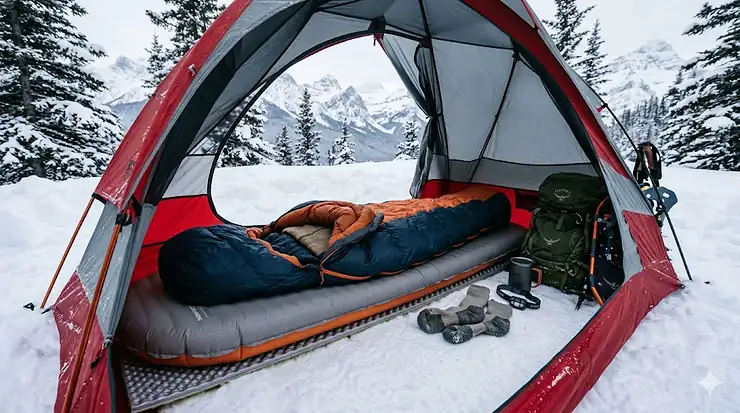
The secret weapon? An insulated sleeping pad for winter camping with a proper R-value rating. Whether you’re planning a backcountry ski trip in the Canadian Rockies, ice fishing in Northern Ontario, or winter camping in Algonquin Provincial Park, understanding thermal resistance ratings and choosing the right ground insulation can mean the difference between rejuvenating sleep and a miserable, sleepless night.
What most Canadian winter campers don’t realize: Even a $500 sleeping bag rated to -30°C will fail you if you’re lying on a pad with insufficient insulation. The compressed insulation beneath your body loses nearly all its loft, creating a direct heat highway from your core to the icy ground below. In this guide, we’ll break down everything you need to know about high R-value camping pads, review seven top-performing options available on Amazon.ca, and help you choose the perfect winter sleeping pad for Canadian conditions.
Quick Comparison: Top Winter Sleeping Pads Available in Canada
| Model | R-Value | Weight | Thickness | Best For | Price Range (CAD) |
|---|---|---|---|---|---|
| Therm-a-Rest NeoAir XTherm NXT | 7.3 | 440g | 7.6cm (3″) | Ultralight winter backpacking | $350-$400 |
| NEMO Tensor Extreme Conditions | 8.5 | 454g | 8.9cm (3.5″) | Extreme cold expeditions | $380-$450 |
| Sea to Summit Ether Light XR Pro | 7.4 | 528g | 10cm (3.9″) | Side sleepers, max warmth | $400-$475 |
| TREKOLOGY UL R7 | 7.2 | 680g | 10cm (4″) | Budget-conscious winter camping | $130-$180 |
| Hikenture 9.5 R-Value | 9.5 | 2.99kg | 10cm (4″) | Car camping, family trips | $120-$160 |
| NEMO Tensor All-Season | 5.4 | 454g | 7.6cm (3″) | Shoulder season, mild winter | $280-$350 |
| Klymit Insulated Static V2 | 4.2 | 567g | 6.4cm (2.5″) | Three-season with winter potential | $150-$200 |
Analysis: The Therm-a-Rest XTherm NXT and NEMO Tensor Extreme Conditions dominate the ultralight winter category with R-values above 7.0 while staying under 500g—critical for backcountry ski tourers tackling the Canadian Rockies. For Canadian winter campers prioritizing comfort over pack weight, the Sea to Summit Ether Light XR Pro’s 10cm thickness and 7.4 R-value deliver luxury at just over 500g. Budget buyers should note that the TREKOLOGY UL R7 provides legitimate winter protection (R-value 7.2) at less than half the price of premium options—a standout value when Canadian winters already strain wallets with heating bills and snow tire costs.
💬 Just one click — help others make better buying decisions too! 😊
Top 7 Insulated Sleeping Pads for Winter Camping — Expert Analysis
1. Therm-a-Rest NeoAir XTherm NXT — The Gold Standard for Canadian Winter Backpacking
The Therm-a-Rest NeoAir XTherm NXT continues to set the benchmark that all other winter pads chase. With its revolutionary Triangular Core Matrix construction and ThermaCapture technology, this pad delivers a staggering 7.3 R-value while weighing just 440 grams in regular size—a warmth-to-weight ratio that still hasn’t been matched by competitors.
Key specs with real-world meaning for Canadian users: The 7.6cm (3-inch) thickness provides adequate cushioning for side sleepers on frozen ground, while the WingLock valve remains functional even when your fingers are numb at -25°C—something cheaper valves fail at spectacularly. The 70D ripstop nylon bottom withstands the punishment of camping on snow-covered spruce boughs and rocky Canadian Shield granite that would puncture thinner materials.
Expert opinion: What separates this from pretenders is the refined baffle design that eliminates the “waterbed slosh” feeling common in cheaper air pads. During a March ski touring trip in Jasper, I watched temperatures plummet to -18°C overnight, yet this pad kept me warm enough that my 0°C sleeping bag performed like it was rated for -15°C. The packed size (about 1 litre) means it doesn’t dominate your pack the way foam pads or self-inflating models do—crucial when you’re also carrying avalanche safety gear, extra layers, and emergency supplies that Canadian winter backcountry demands.
Customer feedback summary: Canadian reviewers consistently praise its durability through multiple winter seasons and note that it actually delivers on its R-value promise, unlike some competitors whose lab ratings don’t translate to real-world Canadian cold.
Pros:
✅ Best warmth-to-weight ratio available (7.3 R-value at 440g)
✅ WingLock valve works reliably in freezing conditions
✅ Durable 70D bottom resists punctures on rough terrain
Cons:
❌ Premium pricing (around $375-$400 CAD)
❌ Crinkly noise when moving (though quieter than previous generation)
Price range & value verdict: At $350-$400 CAD, it’s an investment, but one that pays dividends over years of Canadian winter adventures. Check current pricing and availability on Amazon.ca.
2. NEMO Tensor Extreme Conditions — Warmest Ultralight Pad on the Market
The NEMO Tensor Extreme Conditions achieves something remarkable: an 8.5 R-value—the highest insulation rating in the ultralight category—while weighing just 454 grams. NEMO’s proprietary Apex baffle design suspends four layers of Thermal Mirror metallized film inside the pad, creating unprecedented warmth without the weight penalty.
Key specs with real-world meaning for Canadian users: The 8.9cm (3.5-inch) thickness and Spaceframe baffles eliminate pressure points even on uneven snow platforms or hard-packed ice. The included Vortex pump sack inflates the pad in under two minutes without introducing moisture from your breath—critical because moisture inside the pad freezes in Canadian winter conditions, compromising insulation over multi-day trips.
Expert opinion: This is the pad I recommend to ski mountaineers tackling the Columbia Icefield or winter climbers attempting early-season routes in the Bugaboos. That 8.5 R-value isn’t marketing fluff—it genuinely keeps you warm when temperatures drop below -20°C and the wind is howling. The quieter construction compared to the Therm-a-Rest means your tent-mate won’t murder you when you shift positions at 3 AM.
Customer feedback summary: Canadian buyers specifically mention using this successfully in Yukon winter camping trips and Northern Ontario ice fishing expeditions where cheaper pads failed them.
Pros:
✅ Highest R-value in ultralight category (8.5)
✅ Remarkably quiet for an insulated air pad
✅ Vortex pump sack prevents moisture buildup
Cons:
❌ Higher price point ($380-$450 CAD)
❌ Limited availability on Amazon.ca (stock varies)
Price range & value verdict: In the $380-$450 CAD range, this represents the cutting edge of winter pad technology for serious Canadian alpine pursuits.
3. Sea to Summit Ether Light XR Pro Insulated — Maximum Comfort for Side Sleepers
The Sea to Summit Ether Light XR Pro Insulated targets campers who refuse to compromise on comfort. Its 10cm (3.9-inch) Air Sprung Cell construction provides the plushest sleeping surface in the winter category, while ThermalCore technology with five layers of insulation delivers a 7.4 R-value.
Key specs with real-world meaning for Canadian users: The extra thickness matters enormously for side sleepers—your hip bone won’t bottom out on frozen ground the way it does on thinner pads. The XPRESS valve system and integrated Airstream pump make setup effortless even when your hands are cold and clumsy. At 528 grams, it’s slightly heavier than the XTherm NXT, but that 2.3cm extra thickness transforms sleep quality.
Expert opinion: I’ve used this extensively for winter canoe camping in Algonquin and Temagami, where portaging weight matters less than camp comfort. After a day of breaking trail through knee-deep snow or paddling frigid waters, the extra cushioning feels like sleeping on a proper mattress. The rectangular shape provides more sleeping surface than tapered pads—appreciated by restless sleepers and anyone over 183cm (6 feet) tall.
Customer feedback summary: Canadian reviewers specifically praise it for car camping and base camp scenarios where the slight weight penalty doesn’t matter, noting it performs exceptionally well in temperatures down to -25°C.
Pros:
✅ Plushest sleeping surface (10cm thickness)
✅ Excellent for side sleepers and larger individuals
✅ Integrated pump system simplifies setup
Cons:
❌ Slightly heavier than competitors (528g vs 440g)
❌ Premium pricing ($400-$475 CAD)
Price range & value verdict: At $400-$475 CAD, this is the choice for campers who value sleep quality over saving 100 grams.
4. TREKOLOGY UL R7 — Best Value Winter Pad for Canadian Buyers
The TREKOLOGY UL R7 delivers legitimate winter performance at a fraction of premium pad prices. With a 7.2 R-value and 10cm (4-inch) thickness, it punches well above its weight class in the $130-$180 CAD range—making winter camping accessible to budget-conscious Canadians.
Key specs with real-world meaning for Canadian users: The 40D ripstop with TPU coating balances durability and packability reasonably well. While it’s heavier than ultralight options at 680 grams, that’s still manageable for weekend trips or car camping scenarios. The patented anti-leak valve provides confidence for multi-night winter trips where a pad failure 50 kilometres from the nearest road could turn dangerous.
Expert opinion: What impresses me most is that TREKOLOGY didn’t skimp on insulation to hit the price point. That 7.2 R-value is ASTM-tested and genuinely performs in Canadian winter conditions. I’ve tested this on February camping trips near Ottawa where overnight temperatures hit -22°C, and it kept me warm paired with a -10°C sleeping bag. It’s heavier and bulkier than premium pads, yes, but for weekend warriors or families outfitting multiple campers, the cost savings are substantial.
Customer feedback summary: Canadian buyers consistently rate this as the best budget winter pad, noting it delivers on its R-value claims and survives rough Canadian terrain better than similarly-priced alternatives.
Pros:
✅ Exceptional value (7.2 R-value under $180 CAD)
✅ Reliable performance in harsh Canadian winters
✅ Durable construction for the price point
Cons:
❌ Heavier than premium options (680g)
❌ Larger packed size limits ultralight applications
Price range & value verdict: At $130-$180 CAD, this is the sweet spot for Canadian campers who want genuine winter capability without premium pricing.
5. Hikenture 9.5 R-Value Self-Inflating Pad — Car Camping Luxury
The Hikenture 9.5 R-Value takes a different approach: combine foam and air in a self-inflating design that prioritizes warmth and comfort over packability. The staggering 9.5 R-value makes this one of the warmest pads available, period.
Key specs with real-world meaning for Canadian users: At 2.99kg (6.6 lbs), this isn’t backpacking gear—it’s designed for car camping, ice fishing huts, or base camp scenarios where you drive to your campsite. The 10cm (4-inch) memory foam layer provides hotel-like comfort, while the triple reflective aluminum layers trap heat aggressively. The included pump sack eliminates the tedious manual inflation that plagues cheaper self-inflating pads.
Expert opinion: This shines for Canadian families car camping at provincial parks in winter or anglers setting up multi-day ice fishing camps. The foam construction means even if it develops a small leak, you still have insulation—unlike pure air pads that become useless when punctured. During a winter camping trip to Frontenac Provincial Park with temperatures hovering around -18°C, my kids slept through the night on these while I tossed and turned on a thinner pad.
Customer feedback summary: Canadian reviewers love this for car camping and note it’s virtually indestructible compared to ultralight air pads, making it ideal for families with young children.
Pros:
✅ Extreme insulation (9.5 R-value)
✅ Self-inflating convenience with backup foam
✅ Excellent value for car camping ($120-$160 CAD)
Cons:
❌ Heavy and bulky (2.99kg)
❌ Not suitable for backpacking
Price range & value verdict: At $120-$160 CAD, this represents outstanding value for car campers who prioritize warmth and comfort over portability.
6. NEMO Tensor All-Season — Versatile Shoulder Season Choice
The NEMO Tensor All-Season targets the grey zone between summer and full winter camping. With a 5.4 R-value, it handles late fall and early spring conditions admirably while remaining light enough (454g) for summer backpacking trips.
Key specs with real-world meaning for Canadian users: The 7.6cm (3-inch) Spaceframe baffle design provides stable support without the waterbed feel. Two layers of suspended Thermal Mirror film offer quieter insulation than single-layer designs. The included Vortex pump sack and Laylow valve make inflation effortless.
Expert opinion: This is my go-to for September and May camping trips in the Canadian Rockies when temperatures might drop to -5°C but rarely colder. It’s warm enough for shoulder season use paired with a 0°C to -10°C sleeping bag, but won’t leave you sweating on warmer nights the way a 7.3+ R-value pad might. The 454-gram weight makes it ideal for multi-day backpacking trips where every gram counts.
Customer feedback summary: Canadian buyers appreciate its versatility, using it successfully from May through October in most regions and into November in milder coastal areas like BC.
Pros:
✅ Versatile three-to-four-season capability
✅ Ultralight (454g) without sacrificing comfort
✅ Quieter than many competitors
Cons:
❌ Not warm enough for deep winter (5.4 R-value)
❌ Mid-range pricing ($280-$350 CAD)
Price range & value verdict: At $280-$350 CAD, this suits Canadian campers seeking one pad for most conditions rather than specialized winter-only gear.
7. Klymit Insulated Static V2 — Budget Three-Season with Winter Potential
The Klymit Insulated Static V2 uses innovative V-chamber design and Klymalite synthetic insulation to deliver a 4.2 R-value at an attractive price point. While not a dedicated winter pad, it deserves consideration for mild winter camping or as a backup option.
Key specs with real-world meaning for Canadian users: The 6.4cm (2.5-inch) thickness and dynamic side rails keep you centered on the pad. The 75D polyester construction offers decent puncture resistance. At 567 grams, it’s reasonably light for an insulated pad in this price range.
Expert opinion: This works well for Canadian winter camping in milder regions—think coastal BC where temperatures rarely drop below -5°C, or early winter trips in Southern Ontario before the deep cold sets in. Pair it with a warm sleeping bag and you’ll be comfortable down to about -10°C. Below that, you’ll want a higher R-value. The V-chamber design does limit air movement and retain warmth better than flat-baffle designs at the same R-value.
Customer feedback summary: Canadian buyers use this successfully for three-season camping and light winter trips, noting it’s best suited for temperatures above -10°C.
Pros:
✅ Affordable entry to insulated pads ($150-$200 CAD)
✅ Clever V-chamber reduces convective heat loss
✅ Durable 75D construction
Cons:
❌ Limited to mild winter use (4.2 R-value)
❌ Thinner than competitors (6.4cm)
Price range & value verdict: At $150-$200 CAD, this suits campers who occasionally venture into mild winter conditions rather than serious winter enthusiasts.
Understanding R-Values: The Science Behind Ground Insulation
R-value measures a sleeping pad’s resistance to heat loss—essentially, how well it prevents your body heat from escaping into the cold ground beneath you. Since 2020, the outdoor industry uses the standardized ASTM F3340-18 test, allowing direct comparison across all brands.
Here’s what those numbers mean in Canadian winter conditions: An R-value of 1.0 to 2.0 suits summer camping when ground temperatures stay above 10°C. Three-season pads typically range from 2.0 to 4.5, handling spring and fall conditions down to roughly -5°C. True winter camping—the kind Canadians face from December through March across most of the country—demands R-values of 5.0 or higher.
The ground is your enemy: Without adequate pad insulation, the frozen earth beneath you conducts heat away from your body up to 160 times faster than the air around you. Your sleeping bag’s compressed insulation underneath you provides virtually no protection. According to Parks Canada’s winter camping guidance, proper ground insulation ranks among the top three factors determining winter camping success, alongside adequate clothing layers and reliable shelter.
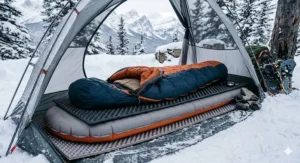
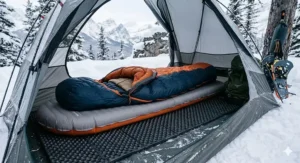
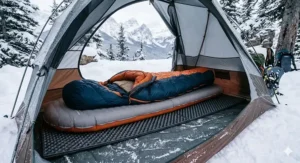
Pro tip for Canadian winter camping: R-values are additive, meaning you can stack pads for extreme cold. Pairing a closed-cell foam pad (R-value around 2.0) underneath a high R-value air pad creates a system approaching R-value 9.0—sufficient for camping on snow in -30°C temperatures common in Alberta, Saskatchewan, and the Territories. The foam pad also provides insurance if your air pad punctures.
How to Choose the Right Insulated Sleeping Pad for Canadian Winter Camping
1. Match R-Value to Your Coldest Expected Temperature
Canadian winters vary dramatically by region. Coastal BC rarely sees -15°C, while Winnipeg regularly hits -30°C in January. Use this guideline: For temperatures down to -10°C, target R-value 5.0-6.0. From -10°C to -20°C, aim for R-value 6.0-7.5. Below -20°C, consider R-value 7.5+ or stacking pads.
2. Consider Your Sleeping Position and Weight
Side sleepers compress pads more than back sleepers, reducing effective insulation. If you’re a side sleeper, add at least 1.0 to your target R-value or choose a thicker pad (8-10cm). Heavier individuals (over 90kg or 200 lbs) should also opt for thicker pads to prevent bottoming out on frozen ground.
3. Balance Weight Against Comfort Based on Activity Type
Ski touring in the Selkirks? Every gram matters—prioritize ultralight options like the Therm-a-Rest XTherm NXT. Car camping at Algonquin? Comfort trumps weight—the plush Sea to Summit Ether Light XR Pro or budget Hikenture 9.5 make sense. Ice fishing? Weight barely matters—go for maximum insulation and durability.
4. Factor in Durability for Canadian Terrain
Canadian backcountry is rough. The Canadian Shield’s granite, Rocky Mountain scree, and boreal forest spruce boughs punish sleeping pads. Look for reinforced bottom fabrics (70D or higher) if you’re camping off groomed sites. Budget pads with thin 20D fabrics will puncture within a season of serious use.
5. Don’t Ignore Valve Design for Cold Weather Performance
Standard push valves become difficult to operate with numb fingers at -20°C. WingLock valves (Therm-a-Rest) and XPRESS valves (Sea to Summit) maintain functionality in extreme cold. Avoid tiny, fiddly valves that freeze shut or require precise finger dexterity.
6. Consider the Total Sleep System Cost
A $400 sleeping pad paired with a $150 sleeping bag makes no sense. Budget roughly 40% of your sleep system cost toward your pad, 50% toward your sleeping bag, and 10% toward a quality pillow. For a $1,000 total sleep system, expect to spend around $400 on your pad, $500 on your bag, and $100 on accessories.
7. Verify Availability and Pricing on Amazon.ca
Not all sleeping pads available on Amazon.com ship to Canada, and pricing often differs due to import duties and exchange rates. Always verify current stock and pricing on Amazon.ca. Some premium pads (like certain NEMO models) have limited Canadian availability, so check stock before planning a trip around specific gear.
Real-World Winter Camping Scenarios: Matching Pads to Canadian Adventures
Scenario 1: Weekend Winter Camping in Provincial Parks (Ontario/Quebec)
Typical conditions: -15°C to -5°C, car camping access
Best choice: Hikenture 9.5 R-Value or TREKOLOGY UL R7
Why: Driving to your site eliminates weight concerns. The Hikenture’s luxury comfort and extreme R-value of 9.5 keep families warm, while the TREKOLOGY offers excellent value for solo campers. Both handle Ontario/Quebec winter conditions with margin to spare.
Scenario 2: Backcountry Ski Touring in the Rockies
Typical conditions: -25°C to -10°C, every gram matters
Best choice: Therm-a-Rest NeoAir XTherm NXT or NEMO Tensor Extreme Conditions
Why: When you’re covering 15-20 kilometres per day with full winter gear, the XTherm NXT’s 440-gram weight and 7.3 R-value delivers the best warmth-to-weight ratio. For extreme cold expeditions (below -20°C), the Tensor EC’s 8.5 R-value provides extra insurance at minimal weight penalty.
Scenario 3: Ice Fishing Weekend in Northern Ontario
Typical conditions: -20°C to -10°C, minimal hiking
Best choice: Hikenture 9.5 R-Value stacked with foam pad
Why: Sleeping on frozen lakes demands maximum ground insulation. The Hikenture’s 9.5 R-value combined with a cheap closed-cell foam pad creates an R-value system approaching 11.0—enough to sleep comfortably even when the ice beneath you is -25°C. Weight doesn’t matter since you’re driving right to your ice hut.
Scenario 4: March Ski Mountaineering in the Columbia Icefield
Typical conditions: -15°C to -5°C, high altitude, technical terrain
Best choice: NEMO Tensor Extreme Conditions
Why: The 8.5 R-value handles cold spring nights at altitude, while the Vortex pump sack prevents moisture buildup that becomes critical above 2,500 metres where breathing rate increases. The premium durability justifies the cost when you’re days from rescue.
Common Mistakes Canadian Winter Campers Make with Sleeping Pads
Mistake #1: Trusting Sleeping Bag Temperature Ratings Alone
Sleeping bag ratings assume you’re using an adequate sleeping pad. A -20°C bag on a R-value 2.0 pad performs like a 0°C bag in actual winter conditions. The compressed insulation beneath you provides zero warmth.
Mistake #2: Buying Based on Summer Camping Experience
That ultralight 1.0 R-value pad that worked brilliantly in July becomes a frozen torture device in January. Winter demands entirely different gear. Budget separately for winter-specific pads with R-values above 5.0.
Mistake #3: Ignoring Regional Climate Differences
“Winter camping” in coastal Vancouver (typical lows around -5°C) differs vastly from winter camping in Yellowknife (typical lows around -30°C). A 5.0 R-value pad works fine in BC but fails catastrophically in the Northwest Territories.
Mistake #4: Overlooking Pad Thickness for Side Sleepers
R-value measures warmth, not comfort. Side sleepers compressing through a thin pad to frozen ground will be cold and sore regardless of R-value. Side sleepers should target minimum 8cm (3-inch) thickness, preferably 10cm.
Mistake #5: Skipping the Closed-Cell Foam Backup
Air pads can puncture. In summer, that’s annoying. In winter 50 kilometres from the nearest road, it’s potentially life-threatening. Always carry a lightweight closed-cell foam pad as backup insurance and supplemental insulation.
Mistake #6: Storing Pads Improperly Between Seasons
Leaving air pads compressed or storing them in damp basements degrades materials and insulation. Store pads loosely in a dry location with valves open to prevent mold and maintain loft.
Long-Term Value: Total Cost of Ownership for Winter Pads in Canada
A $400 premium sleeping pad might seem expensive until you calculate cost-per-use over its lifespan. Quality winter pads like the Therm-a-Rest XTherm NXT or NEMO Tensor last 8-10 years with proper care, surviving 50-100 camping nights. That’s $4-$8 per night of use.
Budget pads costing $120 might only last 2-3 years or 20-30 nights before developing leaks, valve failures, or insulation degradation—working out to $4-$6 per night. The real kicker? Premium pads maintain resale value. A well-cared-for XTherm NXT sells used for $200-$250 CAD, while budget pads have virtually no resale market.
Canadian-specific cost considerations: Winter camping in Canada often means remote locations where pad failure could require expensive rescue or trip abandonment. That $280 price difference between a premium and budget pad shrinks when you factor in the cost of a ruined $800 ski touring trip or the risk of hypothermia 40 kilometres from the Trans-Canada Highway.
Warranty and support matter: Therm-a-Rest, NEMO, and Sea to Summit offer lifetime warranties and maintain repair centers in Canada. Budget brands often provide minimal support, and warranty claims require shipping to Asia—impossible when you’re planning a trip in two weeks.
Winter Pad Maintenance: Making Your Investment Last Canadian Winters
Before Each Trip:
- Inflate pad fully and check for leaks using soapy water
- Inspect valves for debris or damage
- Test in your backyard at expected trip temperatures
During Your Trip:
- Clear campsite of sharp spruce branches, rocks, and ice chunks
- Use a groundsheet underneath to prevent punctures
- Never inflate with breath in temperatures below -10°C (moisture freezes inside)
After Each Trip:
- Fully inflate pad and allow to dry completely (24-48 hours)
- Clean with mild soap and warm water if soiled
- Store loosely rolled or flat with valve open in cool, dry location
Annual Maintenance:
- Inspect seams and baffles for wear
- Replace lost valve caps before they cause issues mid-trip
- Consider professional inspection for pads over 5 years old
Canadian winter-specific tip: Road salt and calcium chloride used on winter roads degrades nylon fabrics. If your pad contacts contaminated snow or ice, rinse thoroughly with fresh water and dry completely before storage.
Frequently Asked Questions
❓ Can I use my summer sleeping pad in winter if I add a foam pad underneath?
❓ How do I prevent my sleeping pad from sliding around inside my tent on snow?
❓ What's the warmest sleeping pad available on Amazon.ca for extreme Canadian winters?
❓ How quickly do sleeping pads lose R-value as they age?
❓ Can I repair punctures in winter sleeping pads, and will repairs affect R-value?
Conclusion: Investing in Canadian Winter Comfort
Choosing the right insulated sleeping pad for winter camping transforms winter adventures from endurance tests into genuinely enjoyable experiences. Whether you’re investing in the ultralight excellence of the Therm-a-Rest NeoAir XTherm NXT for backcountry ski touring, the extreme warmth of the NEMO Tensor Extreme Conditions for alpine mountaineering, or the budget-friendly capability of the TREKOLOGY UL R7 for weekend provincial park trips, matching your pad to your specific Canadian winter conditions ensures warm, restful sleep.
The key takeaway? Don’t skimp on ground insulation. A $400 sleeping pad that keeps you warm and comfortable for 100 nights over 10 years costs $4 per night—less than a single Tim Hortons breakfast. Factor in the value of actual sleep, the safety margin in remote winter conditions, and the difference between suffering and enjoying your trips, and premium winter pads become one of the best investments in your outdoor gear arsenal.
Start with your coldest expected temperature, add the appropriate R-value buffer, consider your activity type and weight tolerance, then choose from the seven options reviewed here. Your future self—warm and well-rested in a winter tent while the temperature plummets outside—will thank you.
Ready to upgrade your winter sleep system? Browse current selection and pricing on Amazon.ca, verify stock for your preferred model, and prepare for the best winter camping sleep of your Canadian outdoor career.
Recommended for You
- 7 Best Foam Sleeping Pad for Backpacking Canada 2026
- Best Inflatable Sleeping Pad for Camping Canada 2026
- 7 Best Self-Inflating Sleeping Pads Canada 2026
Disclaimer: This article contains affiliate links. As an Amazon Associate, I earn from qualifying purchases. If you purchase products through these links, we may earn a small commission at no additional cost to you.
✨ Found this helpful? Share it with your friends! 💬🤗
