
In This Article
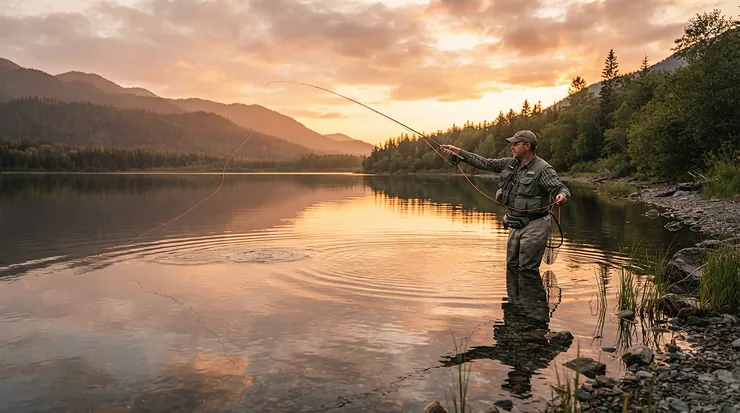
Every angler knows one particular kind of misery. You’ve found the seam in the current, the light is turning gold, a fish rolls twice, and a cloud of mosquitoes decides your left ear is the best restaurant in the province.
The bug jacket vs head net for fishing question sounds minor. It isn’t. Pick wrong and you spend dawn swatting instead of casting. Pick right and the insects become a faint hum you stop noticing by your third cast.
The honest answer is “it depends,” but it depends on things you can actually measure. Canada has 161 species of black flies, and Algonquin Park’s own guidance notes that covering up with clothing such as a bug jacket, plus repellent, offers some deterrent. Some biting insects land on you first, then crawl under clothing if they can. That detail matters for everything below.
It’s October 2026 as I write this, so the season is winding down. That makes it the cheapest time to plan: you can compare gear calmly instead of buying in a panic at the boat launch in late May. Below you’ll find seven real products, honest analysis of what their specs mean on the water, and decision tools matched to how you fish.
What Is Bug Jacket vs Head Net for Fishing?
Bug jacket vs head net for fishing is the choice between two insect barriers: a mesh jacket (often with a hood and mitts) that shields your head, torso and arms, or a featherweight net that drapes over your hat to protect only your face and neck. The right pick depends on pest type, temperature and how much you cast.
Quick Comparison: Jacket or Net at a Glance
| Factor | Bug jacket | Head net | Best For |
|---|---|---|---|
| Coverage | Head, torso, arms (mitts optional) | Face and neck only | Swarm conditions: Ben’s InvisiNet Bug Jacket & Mitts |
| Weight | Roughly 113 g and up | Roughly 11-40 g | Ultralight carry: Sea to Summit Nano Mosquito Headnet |
| Casting freedom | Sleeves and hem can brush gear | Arms completely free | Active casters: Ben’s InvisiNet Head Net |
| Heat in warm weather | Warmer, even with mesh | Much cooler | Hot-day shorelines: Sea to Summit Ultra-Fine Mesh Mosquito Head Net |
| Price (CAD) | About C$35-C$130 | About C$10-C$30 | Budget buyers: Lifesystems Mosquito & Midge Head Net |
Look at the table as a trade of coverage against freedom. A jacket wins when insects are crawling, biting through thin shirts and going for your wrists. A net wins when the problem is mainly your face and you want your arms and ventilation untouched. Most anglers who fish across a whole season end up owning one of each, because the pests change from May to September.
💬 Just one click — help others make better buying decisions too!😊
Top 7 Bug Jackets and Head Nets for Fishing: Expert Analysis
The seven picks below cover budget, mid-range and premium options, plus a youth jacket for family trips. Everything is judged on specs, translated into on-water meaning, and cross-checked against whatever real review evidence I could verify. Where reviews were thin, I say so rather than guess.
1. Ben’s InvisiNet Bug Jacket & Mitts — full-body mesh at feather weight
The standout here is the whole outfit weighing about 113 g (4 oz). That’s less than a fishing reel’s spare spool in many tackle bags, so it can live in a vest pocket all season.
The jacket has a fully enclosed hood, elasticized cuffs and hem, and included mitts. The front pocket doubles as a stuff sack. The netting is reinforced with nylon at the waist and shoulders, which is where a pack or vest rubs.
Those elasticized openings matter more than the mesh itself. Black flies and other crawlers go looking for gaps, so a sealed cuff and hem does more work than a finer weave with loose edges.
Based on the spec sheet, this suits shoreline and boat anglers who sit through swarms rather than wade and cast constantly. Be realistic about the mitts, though: you can’t tie a fine tippet knot in them, so plan on removing them for rigging.
On the retailer listings I checked, customer review volume was minimal. Treat claims about visibility and durability as the manufacturer’s until a larger review pool builds.
Pros:
- ✅ Whole kit weighs roughly 113 g
- ✅ Sealed hood, cuffs and hem
- ✅ Reinforced shoulders and waist
Cons:
- ❌ Mitts block fine knot-tying
- ❌ Thin verified review history
Price: around the C$35-C$45 range; check current price. For full coverage at this weight, the value is hard to beat.
2. The Original Bug Shirt Company Elite Edition — Canadian-made, with a face zip you can adjust
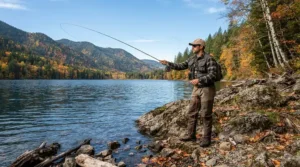
The standout is the double-slider zipper around the face mesh. You can open it to the eyes for tying on lures, down to the chin to eat, or tuck the mesh away when the bugs ease off.
The shirt uses a densely woven polyester microfibre with black no-see-um mesh panels where fabric hangs away from your skin. It adds ribbed cuffs with elastic adjusters, a hood drawcord, a waist drawcord, and a zippered pocket that doubles as a stuff sack. It’s made by a family-owned Canadian company, and the original design dates to 1989.
On the water, the woven body means bugs can’t bite through the fabric, which a thin mesh jacket can’t promise as readily. That matters on a windy bank where mesh presses against skin.
Reviewers consistently praise the protection and durability. Common complaints are oversized sizing and warmth inside, especially in nylon versions. Testers have worn it comfortably into the low-to-mid 20s °C over a t-shirt, so it suits cool mornings better than humid afternoons.
Pros:
- ✅ Bite-proof woven fabric body
- ✅ Adjustable face zip and hood
- ✅ Made in Canada, repairable design
Cons:
- ❌ Runs large; check the size chart
- ❌ Gets warm in hot weather
Price: typically in the C$90-C$130 range depending on fabric and size; check current price. It’s the premium pick, but heavy users spread the cost over many seasons.
3. Bushline Youth Bug-Resistant Pullover Jacket — kid-sized mesh with a see-everything hood
The standout is the larger-mesh hood. It’s designed for better visibility and head movement without giving up bug protection, which matters when a ten-year-old keeps whipping around to watch a bobber.
The body uses fine nylon mesh. It’s a pullover style with adjustable cuffs at the waist and wrists and a mesh stuff bag. It’s sized for ages 6 to 16.
For family trips, this solves a real problem: kids won’t wear what restricts their view. A larger-mesh hood is a sensible trade, though bigger openings generally mean less exclusion of the very smallest biters. For no-see-um country, check how it fares before relying on it alone.
I found no meaningful review consensus. One buyer comment noted a sizing mix-up with an adult size arriving instead of a child’s small, so confirm size on the listing and on delivery. Bushline is a Canadian Tire house label, so check current availability on amazon.ca before planning around it.
Pros:
- ✅ Sized for ages 6 to 16
- ✅ Wide-mesh hood for visibility
- ✅ Adjustable cuffs seal wrists and waist
Cons:
- ❌ Larger hood mesh may admit tiny biters
- ❌ Sizing needs a careful check
Price: around C$30; check current price. It’s a sensible, low-risk way to protect young anglers.
4. Ben’s InvisiNet Head Net — 1.0 mm pores that nearly disappear
The standout is the near-invisible screen: a 20-denier knit with rhombus-shaped pores about 1.0 mm across. It weighs 0.7 oz (about 20 g) and packs into a pull-string sack.
An elasticized crown holds it on your head or over a fishing cap, and the roomy cut leaves space for a hat brim. That’s the key to comfort: the brim holds mesh away from your face so it doesn’t touch your nose or lips.
Black flies, at roughly two to six millimetres, are far larger than 1.0 mm pores, so the net blocks them. No-see-ums are the smallest biters, so a finer mesh is the safer choice if they’re your main problem.
Verified customer reviews were scarce. Among ultralight-gear forum posters, a recurring view is that standard mosquito netting is far easier to live with than finer no-see-um netting, which suggests Ben’s mid-fine weave is a sensible compromise.
Pros:
- ✅ Very high visibility through the screen
- ✅ Weighs only about 20 g
- ✅ Fits over caps and hats
Cons:
- ❌ Not the finest mesh for no-see-ums
- ❌ Limited verified review history
Price: under C$25; check current price. It’s an easy value pick.
5. Sea to Summit Ultra-Fine Mesh Mosquito Head Net — 310 holes per cm² for tiny biters
The standout is the fine hexagonal mesh: 2,000 holes per square inch (310 per cm²) in soft 15-denier mono-filament nylon. Sea to Summit says it keeps out no-see-ums, sand-flies and midges.
It weighs 23 g, with black mesh for visibility, an elasticized drawcord and a stuff sack. A finer weave typically costs some airflow, so expect it to feel slightly warmer than coarser nets on still days.
This is the one to reach for near marshy shorelines, river mouths and evening dock sessions where midges swarm. Sea to Summit’s own standard head nets use a coarser mesh, and some reviewers of those wider-weave models said the holes were too large for gnats. That gap is exactly why the ultra-fine version exists.
I found no verified reviews for this specific model, so there’s no review consensus to report. The spec sheet is its main evidence.
Pros:
- ✅ Very fine mesh blocks midges
- ✅ Light at roughly 23 g
- ✅ Black mesh helps visibility
Cons:
- ❌ Less airflow than coarser nets
- ❌ No verified reviews found
Price: around the C$20-C$25 range; check current price. It’s strong value for small-insect territory.

6. Sea to Summit Nano Mosquito Headnet — about 11 g and fits in a pocket
The standout is weight: roughly 11 g (some retailers weigh it at 13 g), packed to about 6 × 4 × 3 cm. You can forget it’s in your jacket until you need it.
It uses a 15D Ultra-Vis polyester mesh at 80 holes per cm², with a neck drawcord and cord lock. A treated version exists at some retailers, so check the listing for exactly which variant you’re buying.
That 80 holes per cm² is fine for mosquitoes and larger flies but not designed for the tiniest midges. Use it as an emergency layer, not your only defence in no-see-um country.
A small retailer sample gave it a very high rating (about 4.95 across 19 votes), though that’s a small base. Reviewers of Sea to Summit’s wider net line also note the mesh can bump your chin in wind, which a stiff-brimmed hat fixes.
Pros:
- ✅ Roughly 11 g, packs tiny
- ✅ Good see-through visibility
- ✅ Cord lock for secure fit
Cons:
- ❌ Not for no-see-ums
- ❌ Mesh may brush chin in wind
Price: roughly the C$20-C$30 range; check current price. It’s the best emergency net in the group.
7. Lifesystems Mosquito & Midge Head Net — roomy, mid-fine and budget-friendly
The standout is the midge-rated weave at a low cost: black multi-filament polyester with 1,001 holes per square inch (about 155 per cm²). That sits between the Nano and the ultra-fine Sea to Summit.
It weighs 40 g and measures 33 × 46 cm, with a toggled drawcord at the rim. That extra room is helpful over wide-brimmed hats, though it also adds a little weight and bulk compared with the ultralight options.
For anglers who want some midge resistance without paying for the finest weave, this is the middle path. It’s British-made gear, so check current availability and listing details on amazon.ca.
I found no verified customer reviews to summarise, so I can’t report a review trend. The spec sheet and price are the case for it.
Pros:
- ✅ Midge-rated mesh at low cost
- ✅ Roomy over wide-brimmed hats
- ✅ Simple, durable drawcord closure
Cons:
- ❌ Heavier than ultralight rivals
- ❌ No verified reviews found
Price: under C$20; check current price. It’s the budget pick.
Top 7 at a Glance
| Product | Type | Weight | Key feature | Price range (CAD) | Best For |
|---|---|---|---|---|---|
| Ben’s InvisiNet Bug Jacket & Mitts | Jacket + mitts | ~113 g | Sealed hood, cuffs, hem | C$35-C$45 | Swarm conditions |
| The Original Bug Shirt Company Elite Edition | Bug shirt | Not verified | Woven body, adjustable face zip | C$90-C$130 | Frequent anglers |
| Bushline Youth Bug-Resistant Pullover Jacket | Youth jacket | Not verified | Wide-mesh hood | ~C$30 | Young anglers |
| Ben’s InvisiNet Head Net | Head net | ~20 g | 1.0 mm pores | Under C$25 | Casual casters |
| Sea to Summit Ultra-Fine Mesh Mosquito Head Net | Head net | 23 g | 310 holes/cm² | C$20-C$25 | Midge country |
| Sea to Summit Nano Mosquito Headnet | Head net | ~11 g | 80 holes/cm² | C$20-C$30 | Emergency carry |
| Lifesystems Mosquito & Midge Head Net | Head net | 40 g | ~155 holes/cm² | Under C$20 | Budget buyers |
The jackets cost more and weigh more, but they protect your arms and torso, where deer flies and black flies often attack. The nets cost less and weigh almost nothing, so the smartest purchase is often one jacket for the worst weeks and one net as a daily backup. If you’re buying only one item, the mesh density of the net or the sealing of the jacket should drive the choice, not the brand.
Staying Bug-Free While Fishing: Setup, Maintenance and First-30-Days Mistakes
Staying bug-free while fishing starts at home, not at the water. Try your gear on in the living room with your actual hat, polarized glasses and fishing shirt. If you can’t comfortably look down at your knot, you’ll take the gear off the first time it matters.
Setup checklist
- Pair a Ben’s InvisiNet Head Net or Sea to Summit Nano Mosquito Headnet with a stiff-brimmed cap so mesh stays off your face.
- Tuck the net’s drawcord under a collared shirt so wind can’t lift it.
- With a jacket such as the Original Bug Shirt Company Elite Edition, pull the cuffs snug before you pick up the rod.
- Wear light-coloured outer layers. Algonquin Park notes some black flies are attracted to dark colours.
Maintenance schedule
Rinse mesh after salty or muddy trips and let it hang dry. Many nets recommend hand washing and air drying, so skip the dryer. Check seams and snagged mesh each spring, and patch small holes with fabric repair tape before they run.
First-30-days mistakes
The classic mistake is loosening the cuffs “just for a minute” to tie a knot. Bugs find the gap within seconds. The second is buying the wrong size, especially with the oversized-running Original Bug Shirt Company Elite Edition. The third is leaving your gear in the truck on “not so bad” days. Keep it in your vest and decide at the water.
Shoreline and Dock Insect Exposure: Three Real-World Scenarios
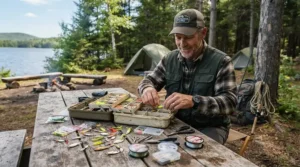
Shoreline and dock insect exposure isn’t uniform. Algonquin Park notes that black flies develop in moving water, so river mouths and outflows tend to be worse, while mosquitoes favour still, marshy edges. Here’s how three common profiles map to gear.
Scenario 1: The weekend bank angler (budget C$50, boreal Ontario, black fly season)
You fish riverside banks from mid-May into June, usually for four to six hours. Black flies peak in daytime, so cover matters more than airflow. The Ben’s InvisiNet Bug Jacket & Mitts fits the budget, and the sealed hem and cuffs deal with crawlers.
Scenario 2: The cottage dock angler at dusk (budget C$30, 20 evenings a season)
Mosquitoes peak at dawn and dusk, and you’re mostly stationary with a drink in the cup holder. A Sea to Summit Nano Mosquito Headnet plus repellent on exposed skin covers it. You get airflow, and your arms stay free.
Scenario 3: A parent and nine-year-old on a public dock (budget C$60)
The child wears the Bushline Youth Bug-Resistant Pullover Jacket and you wear a Ben’s InvisiNet Head Net. The wide-mesh hood keeps the child’s vision open, and the parent’s lighter kit leaves room for helping with line and hooks. Always check repellent guidance for kids separately.
Casting Mobility With Bug Gear: Problems and Fixes
Casting mobility with bug gear fails in predictable ways. Here are the common problems and what to do about each.
Problem 1: Sleeves snag the reel or fly line
Fix: Choose snug cuffs. The ribbed, elastic-adjusted cuffs on the Original Bug Shirt Company Elite Edition and the elasticized cuffs on Ben’s InvisiNet Bug Jacket & Mitts reduce loose fabric near the reel.
Problem 2: The net blows into your face
Fix: Pair it with a stiff brim and tuck the drawcord under your collar. Some users of Sea to Summit’s wider net range report mesh bumping their chin in wind, so a brimmed hat is the practical remedy.
Problem 3: Visibility drops
Fix: Black mesh generally gives better see-through than white or olive. One user of a Sea to Summit net reported still seeing clearly through binoculars and a camera, which is a good sign for tracking a rising fish.
Problem 4: Mitts block knot-tying
Fix: Take them off for rigging, then put them back on to cast. Apply repellent to hands carefully and keep it off lines and plastics, since DEET can damage synthetic materials.
Problem 5: Overheating
Fix: Choose vented or no-see-um mesh panels, as on the Original Bug Shirt Company Elite Edition, and switch to a net when the day heats up.
How to Choose: Bug Jacket vs Head Net for Fishing, Step by Step
- Identify your main pest. If black flies or deer flies dominate, lean toward a jacket. If mosquitoes at dusk are the problem, a net plus repellent often works.
- Check mesh density. Around 80 holes per cm² (like the Sea to Summit Nano Mosquito Headnet) suits mosquitoes. Choose 310 holes per cm² (the Sea to Summit Ultra-Fine Mesh Mosquito Head Net) for midges.
- Match coverage to how you fish. Constant casting favours a net; sitting or drifting favours a jacket.
- Weigh the heat. Warm-weather anglers often prefer nets because jackets hold more warmth.
- Check fit and sizing. Read size charts, especially for the oversized-running Original Bug Shirt Company Elite Edition.
- Pick colours wisely. Light outer layers reduce attraction for dark-seeking flies.
- Decide on budget. Spend more for gear you’ll use dozens of times a season.
Quick decision framework
If you fish mostly at dusk from a dock, choose a net. If you wade rivers in spring, choose a jacket. If both, buy one of each and stop agonising.
Head Net vs Full Jacket for Anglers: The Honest Written Comparison
Head net vs full jacket for anglers is a decision about where you’re actually getting bitten. A net protects the part of you that bugs find most irritating, your face and ears. A jacket protects the rest.
Where the net wins
Nets weigh 11-40 g, cost little, and leave your arms free. They are ideal for hot afternoons, travel and as a spare in your vest. Their limit is that they don’t stop bites on your neck below the drawcord or your wrists unless you add sleeves and repellent.
Where the jacket wins
A jacket works when bugs are swarming, crawling or biting through thin shirts. Algonquin Park notes that insect repellent is less effective against deer and horse flies than against other biters, which is a strong argument for a physical barrier. A jacket also reduces your repellent use, which matters if you’re fishing with synthetic fly lines or plastic lures.
Where repellent fits
Health authorities describe DEET as the longest-lasting repellent against mosquito bites, and HealthLinkBC notes that DEET products in Canada go up to 30%, while icaridin is available up to 20%. Repellent is a layer, not a replacement: apply it to exposed skin and combine it with mesh.
| Option | Coverage | Cost | Drawback | Best For |
|---|---|---|---|---|
| Repellent only | Exposed skin | Low | Less effective against deer/horse flies; reapply | Light conditions |
| Long sleeves and hat | Arms, scalp | Low | Biters get through thin fabric | Mild days |
| Head net (e.g., Ben’s InvisiNet Head Net) | Face, neck | Low | No arm protection | Casters |
| Jacket (e.g., Ben’s InvisiNet Bug Jacket & Mitts) | Head, torso, arms | Medium | Heat, bulk | Swarms |
The table shows that no single option covers everything. Repellent plus a net is the best budget combination, while a jacket plus repellent on exposed hands handles the worst conditions. If you only buy one, buy the item that closes your biggest gap.
Best Bug Protection for Fishing: Match the Gear to the Pest and the Month
The best bug protection for fishing changes through the season. Here’s how the main pests behave, according to Canadian sources.
- Black flies: Typically most prevalent from mid-May to late June, and mostly a daytime problem. Cottage Life notes their main biting times are early morning and late afternoon, peaking toward sunset.
- Mosquitoes: Abundant from May to September in most of Canada, with peak activity from dusk to dawn, and present from mid-spring to autumn frost.
- Deer flies and horseflies: Peak in early summer, and they often bite around the head, so a hat and covered neck help. Motion draws them in.
- Stable flies: Peak in the warmest part of summer.
- Wasps: Active late summer to early fall, which matters for autumn shoreline anglers.
Gear mapped to pest
| Pest | Best layer | Example |
|---|---|---|
| Black flies | Sealed jacket | Ben’s InvisiNet Bug Jacket & Mitts |
| Mosquitoes | Net plus repellent | Sea to Summit Nano Mosquito Headnet |
| Midges/no-see-ums | Ultra-fine mesh | Sea to Summit Ultra-Fine Mesh Mosquito Head Net |
| Deer flies | Hat plus net | Ben’s InvisiNet Head Net |
The takeaway: match mesh density and coverage to the pest, not to brand reputation.
Layering for Early-Morning Fishing: Build the System From the Skin Out
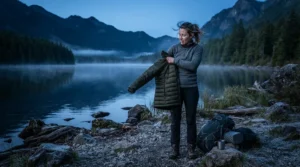
Layering for early-morning fishing matters because dawn is exactly when mosquitoes peak and the air is coldest. Here’s how to build it without overheating by 10 a.m.
- Base layer: Moisture-wicking, so sweat doesn’t chill you.
- Mid layer: A fleece for cold starts, easy to remove as the sun climbs.
- Bug layer outermost: Mesh over your clothing, such as Ben’s InvisiNet Bug Jacket & Mitts or the Original Bug Shirt Company Elite Edition, lets you shed layers underneath without breaking the seal. A rain shell worn over mesh would block ventilation, so use it only when needed.
- Head: A stiff-brimmed cap or toque under a net such as the Sea to Summit Nano Mosquito Headnet.
Choose lighter outer colours where possible. For a shoulder-season dawn, I’d weigh a net plus repellent first, then add a jacket only if bugs press hard. One tester wore the Original Bug Shirt Company Elite Edition comfortably into the 20s °C with only a t-shirt underneath, so cool mornings are well within its range.
Common Mistakes When Buying Bug Protection for Fishing
- Buying on price alone. A C$10 net with a coarse weave won’t stop gnats. Read mesh density first.
- Ignoring sizing. Reviewers report the Original Bug Shirt Company Elite Edition runs large, and one Bushline Youth Bug-Resistant Pullover Jacket buyer reported a size mix-up.
- Choosing dark clothing. Some black flies are attracted to dark colours.
- Relying on repellent alone. Repellent is less effective on deer and horse flies.
- Forgetting your hands. Mitts or repellent on wrists and hands close the gap.
- Skipping the fit test. If you can’t see your knot, you won’t wear the gear.
Long-Term Cost & Maintenance
Total cost of ownership is where the pricier gear can win. Use a simple hypothetical: if you fish 25 outings a season and a C$20 net lasts three seasons, that’s 75 outings, or well under C$0.30 each. A C$100 woven shirt used over eight seasons is about 200 outings, or roughly C$0.50 each. Real durability varies, so treat these as planning examples rather than promises.
| Product | Price range (CAD) | Use case | Value take |
|---|---|---|---|
| Lifesystems Mosquito & Midge Head Net | Under C$20 | Casual midge protection | Excellent entry value |
| Ben’s InvisiNet Head Net | Under C$25 | Daily cap-net | Strong value |
| Ben’s InvisiNet Bug Jacket & Mitts | C$35-C$45 | Swarm days | Best full-coverage value |
| The Original Bug Shirt Company Elite Edition | C$90-C$130 | Frequent anglers | Best long-term durability |
Cost per use favours the cheap nets for casual anglers and the Original Bug Shirt Company Elite Edition for heavy users. The mid-priced jacket is the best hedge if you’re unsure how buggy your waters get. Maintenance is cheap either way: rinse, hang dry and patch snags early.
Safety, Regulations and Repellent Compatibility in Canada
Health Canada’s Pest Management Regulatory Agency reviews every active ingredient before an insect repellent can be sold in Canada, so stick to approved products. Public health sources say DEET above 30% isn’t sold here, and icaridin is available up to 20%. HealthLinkBC adds that Public Health Agency of Canada guidance prefers icaridin for children aged 6 months to 12 years.
For anglers, a few practical rules follow:
- Apply repellent to exposed skin only, not under clothing.
- Avoid combination sunscreen-repellent products, since sunscreen may need reapplying more often.
- Keep DEET off synthetic materials, including mesh, fly lines and plastic lures, because it can damage them.
- For children’s heads and faces, Quebec’s public health guidance suggests applying repellent to their hat or cap rather than directly on the face.
- For tick protection, DEET or icaridin products are the recommended options.
This is general information, not medical advice. Check product labels and ask a pharmacist about children, pregnancy or sensitive skin.
FAQ
❓ Is a bug jacket too hot for summer fishing?
❓ Can you wear a head net over a fishing hat and polarized glasses?
❓ What mesh size stops black flies and no-see-ums?
❓ Do I still need bug spray if I wear a head net?
❓ How much should I spend on a bug jacket or head net in Canada?
Conclusion
So, bug jacket vs head net for fishing? Think of it as a toolbox rather than a rivalry. A net handles the face-and-neck problem for pennies and grams. A jacket handles crawling, biting swarms when conditions turn nasty.
If you want one purchase, match it to your main pest. For black-fly rivers in spring, Ben’s InvisiNet Bug Jacket & Mitts offers sealed full-body cover at a modest cost. For frequent anglers who want durability, The Original Bug Shirt Company Elite Edition is the long-haul pick. For young anglers, Bushline Youth Bug-Resistant Pullover Jacket covers ages 6 to 16.
For nets, Ben’s InvisiNet Head Net is the easy everyday choice. Sea to Summit Ultra-Fine Mesh Mosquito Head Net is the one for midges, Sea to Summit Nano Mosquito Headnet is the best pocket spare, and Lifesystems Mosquito & Midge Head Net is the budget option. Pair whichever you choose with approved repellent on exposed skin and a stiff-brimmed hat.
Since it’s October, now is a calm moment to compare, buy and test the fit before the next spring hatch. Your future dawn self, casting instead of swatting, will thank you.
✨ Ready to bug-proof your next trip?
🎣 Click any highlighted product above to check current pricing and availability, and get set before the first mosquitoes of next season arrive. Your best fishing days deserve zero distractions! 🦟
Recommended for You
- Bug Pants For Hiking: 7 Proven Picks For Canada In 2026
- No-See-Um Mesh Jacket: 7 Best Bite-Blocking Picks, Canada 2026
- Blackfly Protection Jacket: 7 Best Picks For Canada (2026)
Disclaimer: This article contains affiliate links. As an Amazon Associate, I earn from qualifying purchases. If you purchase products through these links, we may earn a small commission at no additional cost to you.
✨ Found this helpful? Share it with your friends! 💬🤗
