In This Article
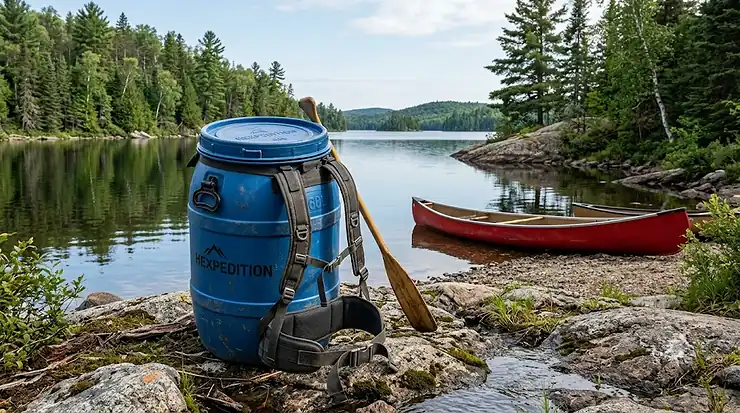
If you’ve ever watched a fully loaded 60L canoe barrel bob menacingly in a swamped canoe — and then sighed with relief that your food was bone dry inside — you already understand why the 60L canoe barrel is a non-negotiable piece of kit for Canadian wilderness tripping. From the shield lakes of Quetico to the winding rivers of Algonquin and the remote paddling corridors of northern Manitoba, the humble blue barrel has earned its place as the backbone of backcountry food storage in Canada.
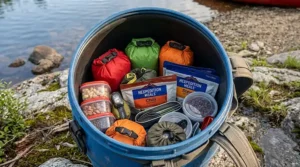
A 60L canoe barrel is a cylindrical, hard-sided HDPE (high-density polyethylene) container, typically holding around 60 litres (roughly 16 US gallons) of gear or food, sealed with an airtight, gasketed lid that keeps water, critters, and odours firmly in their place. It’s part storage system, part portage pack (when combined with a harness), part camp table, and part bear deterrent — all in one remarkably rugged package.
This guide is your complete roadmap to choosing the right 60L canoe barrel for your 2026 season. Whether you’re a first-time family tripper planning a Killarney loop, a seasoned Quetico veteran looking to upgrade, or a group organiser trying to figure out how many barrels you need for a week-long expedition, you’ll find answers here. I’ve researched what’s actually available on Amazon.ca in 2026, dug into real buyer feedback, and added the kind of practical commentary the product pages simply won’t give you. All prices are in CAD.
Quick Comparison: Top 60L Canoe Barrels & Harnesses on Amazon.ca (2026)
| Product | Weight (Empty) | Dimensions (H × W) | Price Range (CAD) | Best For |
|---|---|---|---|---|
| RBW 60L Canoe Barrel (Blue) | 4.2 kg (9.2 lbs) | 62 × 39 cm | $80–$110 | All-round tripping |
| RBW 60L Canoe Barrel (Red) | 4.2 kg (9.2 lbs) | 62 × 39 cm | $85–$115 | Visibility & ID in camp |
| North49 60L Canoe Barrel | ~4.5 kg | 62 × 40 cm | $70–$100 | Budget-conscious buyers |
| Darrell’s Barrels 60L Standard | ~2.8 kg (6 lbs) | 62 × 40 cm | $65–$95 | Lightweight build |
| Darrell’s Barrels 60L Lightweight | ~2.8 kg (6 lbs) | 62 × 40 cm | $70–$100 | Max weight savings |
| RBW Expedition Barrel Harness | 1.28 kg | Fits 20/30/60L | $90–$130 | Long portages, tall paddlers |
| Level Six Bad HASS Harness | Not listed | Fits 30/60L | $95–$135 | Canadian-made, premium comfort |
What the table above tells you: The weight difference between a standard barrel (around 4.2 kg) and Darrell’s lightweight version (2.8 kg) might look modest at first glance — but multiply that by four barrels on a group trip and you’ve shed over 5 kg from your total load before packing a single item. For paddlers dealing with frequent portages or anyone managing a dodgy knee, that gap matters enormously. On price, the North49 and Darrell’s models offer genuine value under $100 CAD, while the RBW and Level Six options command a slight premium that is fully justified by fit, finish, and long-term durability.
💬 Just one click — help others make better buying decisions too! 😊
✨ Don’t Miss These Exclusive Deals!
🔍 Take your canoe tripping to the next level with these carefully selected products. Click on any highlighted item to check current pricing and availability on Amazon.ca. These tools will help you keep food dry, gear protected, and portages manageable on every Canadian adventure!
Top 7 60L Canoe Barrels & Harnesses: Expert Analysis
1. Recreational Barrel Works 60L Canoe Barrel (Classic Blue)
The RBW 60L is effectively the benchmark against which every other canoe barrel in Canada is measured — and for good reason. It measures 62 cm tall × 39 cm wide (approximately 24⅜ in × 15.5 in) and weighs 4.175 kg (9.2 lbs) when empty, with an airtight lid designed for rugged backcountry travel. That airtight seal is the feature that actually changes your trip: your pasta, your spice kit, and your emergency chocolate bar stay completely dry even if the barrel goes overboard — which it absolutely will, at least once.
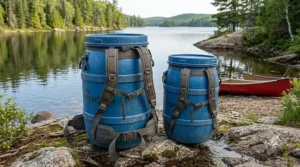
What most buyers overlook is the barrel’s shape. The 39 cm width is narrow enough to sit comfortably side by side in a typical Canadian canoe without forcing you to compromise your paddling posture, while the 62 cm height means you can stack a full week’s worth of food for two paddlers without resorting to a second barrel. In my experience, the RBW 60L is the sweet spot for two-person trips of five to eight days — it holds enough, fits the canoe well, and pairs perfectly with RBW’s own harness systems.
Canadian buyers love this barrel because it’s trusted by outfitters from Temagami to the Yukon. Customer feedback consistently highlights the quality of the lid gasket and the durability of the metal locking ring.
✅ Airtight and watertight lid with quality gasket
✅ Industry-standard sizing — compatible with most Canadian harnesses
✅ Floats when sealed, adding safety margin on open-water crossings
❌ Heavier than HDPE lightweights at 4.2 kg empty
❌ Classic blue colour makes it easy to mix up with other group members’ barrels
Price range: around $80–$110 CAD — excellent value for a barrel that will outlast several canoe seasons without complaint.
2. Recreational Barrel Works 60L Canoe Barrel – Red Edition
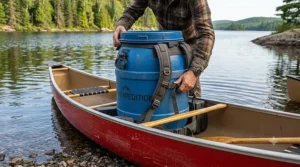
The RBW Red 60L is the same 16 US gallon / 60-litre barrel, measuring 62 cm tall × 39 cm wide and weighing 4.175 kg (9.2 lbs) empty, now available in red for easier camp identification. That might sound like a marketing gimmick, but anyone who’s paddled with a group of four people all carrying identical blue barrels knows the moment of campsite chaos when nobody can remember whose food is whose.
The red barrel earns its slightly higher price purely through practicality: it’s instantly distinguishable in a canoe loaded with gear, on a portage trail piled with equipment, and around a campsite at dawn when you’re still half-asleep and desperately searching for the coffee. For family trips or club outings where multiple barrels are in play, I’d recommend colour-coding deliberately — one red, one blue — as a simple organisational system that pays dividends all trip long.
Everything else is identical to the classic blue version: same lid, same gasket, same locking ring, same fit with RBW harnesses. It’s not a different product — it’s just smarter colour management.
✅ Identical quality to the standard RBW 60L
✅ Colour-coding eliminates campsite confusion on group trips
✅ Same industry-standard dimensions and harness compatibility
❌ Marginally more expensive than the blue version
❌ Red may fade after multiple seasons of UV exposure
Price range: approximately $85–$115 CAD — worth the small premium if you’re tripping with others.
3. North49 60L Canoe Barrel
The North49 60L Canoe Barrel is designed to fit standard 60L harnesses, which is exactly the kind of spec that matters when you’re buying components from different brands. The frustration of purchasing a barrel that doesn’t fit your harness is real — and the North49 sidesteps it cleanly.
This is the barrel I’d recommend to first-time buyers who are still figuring out their system and don’t want to commit to premium pricing before they’re sure canoe tripping is “their thing.” The build quality is solid for the price, the lid gasket provides reliable waterproofing under normal tripping conditions, and the standard dimensions mean it’ll work with virtually any harness you find on Amazon.ca.
What the North49 doesn’t have is the fine-tuned lid mechanism and gasket quality of the RBW lineup. Under extended submersion or particularly punishing whitewater, some users note that the seal isn’t quite as confidence-inspiring. For flatwater tripping — which describes the vast majority of Ontario and Quebec canoe routes — that distinction rarely matters in practice.
✅ Competitive pricing under $100 CAD
✅ Fits standard 60L harnesses from multiple brands
✅ Good entry point for newer trippers
❌ Lid gasket quality slightly below RBW standard
❌ Customer feedback from Canadian reviewers is more limited than for RBW
Price range: around $70–$100 CAD — ideal for budget-conscious paddlers who don’t want to skimp on waterproofing.
4. Darrell’s Barrels 60L Standard Canoe Barrel
Darrell’s Barrels’ first product is a 60L watertight and airtight plastic container designed to keep food and gear protected from the elements and animals. What makes Darrell’s genuinely interesting is the backstory: these barrels are produced in France from BPA-free virgin HDPE and sold by a Canadian company that entered the market specifically to challenge the default choices.
The standard Darrell’s 60L is food-safe, floats when sealed, and has been put through waterproof submersion testing to verify its performance. The lid secures via a galvanised clamp with a gasket in the rim — a slightly different mechanism than the RBW screw-ring system, but one that users report works reliably. Side-mounted carry handles and a gasket-sealed galvanised clamp/band lid make it easy to manoeuvre in and out of canoes.
Where Darrell’s earns extra marks is in the weight department: at approximately 2.8 kg (6 lbs) empty, it’s noticeably lighter than the RBW at 4.2 kg — a difference of nearly 1.4 kg per barrel that compounds quickly on multi-barrel group trips.
✅ Significantly lighter than RBW at ~2.8 kg empty
✅ BPA-free, food-grade virgin HDPE — safe for direct food contact
✅ Competitive pricing with solid value proposition
❌ Galvanised clamp mechanism requires more steps to open than RBW
❌ Newer brand with a shorter Canadian track record than RBW
Price range: $65–$95 CAD — a strong value option if weight savings are a priority.
5. Darrell’s Barrels Lightweight 60L Canoe Barrel (Blue, HDPE)
The Darrell’s Lightweight 60L is a food-safe barrel produced in France from durable BPA-free HDPE, weighing approximately 2.8 kg (6 lbs), measuring 62 × 40 × 40 cm (24.5 × 16 × 16 in). It’s watertight even under light submersion and floats when sealed, making it suitable for canoe tripping, portage, and backcountry food storage.
Darrell’s pitches this as roughly 30% lighter than your average canoe barrel, which is a meaningful claim. In head-to-head terms: one RBW 60L barrel adds 4.175 kg to your base weight, while a Darrell’s Lightweight brings that to 2.8 kg — so if you’re running four barrels on a family trip, you’ve already saved 5.5 kg before loading a single item of food. On a 2 km portage through Canadian Shield terrain, that’s the difference between manageable and brutal.
The spec sheet also won’t mention this, but: the wider 40 cm diameter (compared to RBW’s 39 cm) means slightly different fit with some harnesses, so confirm compatibility before purchasing. Overall, the Darrell’s Lightweight is a smart pick for anyone prioritising weight savings on multi-day group expeditions in Algonquin, Killarney, or La Vérendrye.
✅ Lightest option on this list at ~2.8 kg empty
✅ Floats and waterproof under light submersion
✅ BPA-free food-grade plastic, safe for direct food storage
❌ Slightly wider (40 cm) than RBW, may not fit all harnesses perfectly
❌ “Lightweight” construction may be marginally less crush-resistant than standard
Price range: $70–$100 CAD — excellent for weight-conscious paddlers and group organisers.
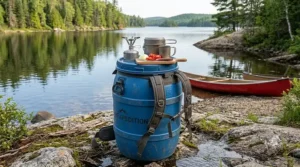
6. RBW Expedition Barrel Harness (Adjustable 30L/60L/20L)
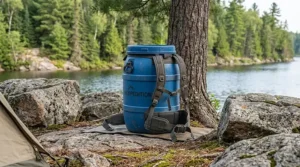
The Expedition Barrel Harness by Recreational Barrel Works is designed to portage 60L, 30L, or 20L barrels comfortably and securely. It features extra-comfortable padded shoulder straps, a hip-belt, an easy-to-reach shoulder-strap tension adjustment strap, and moveable buckle and attachment points designed to accommodate taller paddlers.
Here’s what the product page won’t tell you: the adjustable attachment points for shoulder strap adjusters are a genuinely big deal for taller Canadians. Most barrel harnesses are designed for an average torso length, which leaves taller paddlers — anyone over about 185 cm — hunched forward with the barrel pulling them backwards across every portage. The RBW Expedition solves this with extra-long adjustment straps and a higher attachment geometry that keeps the load closer to your centre of gravity. That’s not a gimmick; it’s basic biomechanics that makes a 20 kg loaded barrel feel significantly more manageable.
A webbing strap across the top of the barrel secures your load and also serves as a place for extra clothing layers or your PFD while on the portage. That PFD storage trick alone has saved me at least two extra trips on long portage chains.
✅ Excellent adjustment range — genuinely fits tall and short paddlers
✅ Compatible with all three RBW barrel sizes (20L, 30L, 60L)
✅ PFD storage strap adds practical portage efficiency
❌ Heavier harness at 1.28 kg than some competitors
❌ Best experienced with RBW barrels — fit with other brands may vary
Price range: $90–$130 CAD — a worthy investment that will outlast multiple barrels.
7. Level Six Bad HASS Adjustable Barrel Harness
Level Six is a genuinely Canadian paddlesports brand, and the Bad HASS harness is their flagship barrel system — tested, as they proudly note, on kilometres of actual Canadian portages. The Bad HASS features a fully integrated harness system, air mesh padding throughout, a structured shoulder harness and waist belt for maximum portage comfort, double bar-tacked reinforced ballistic nylon straps, and 100% diamond grid reinforced polyester webbing. It’s fully adjustable for compatibility with both 30L and 60L barrels.
The air mesh padding is the detail worth dwelling on. On warm Canadian summer portages — and July in Quetico can be genuinely hot — a harness that breathes reduces the miserable sweated-through-shirt experience that most barrel harnesses produce. The ballistic nylon construction also gives me confidence that this harness will still be functional a decade from now, even after being dragged across rocky portage trails, submerged accidentally, and stored in a damp garage between seasons.
The Level Six Bad HASS is available on Amazon.ca, which makes it accessible without needing to order from specialty paddling retailers with uncertain shipping timelines. For Canadian buyers who want a domestically-developed harness with premium build quality, this is the top pick.
✅ Genuine Canadian brand, tested on Canadian portage routes
✅ Air mesh padding — breathable for summer use
✅ Ballistic nylon construction for long-term durability
❌ Higher price point than entry-level harnesses
❌ Barrel sold separately (as with all harnesses on this list)
Price range: $95–$135 CAD — premium pricing, premium performance.
How to Pack Your 60L Canoe Barrel: A Practical Guide for Canadian Conditions
Getting the barrel is only half the job — how you pack it determines whether your portages are controlled and efficient or a chaotic scramble at the put-in. Here’s what works after many seasons of Canadian tripping:
Step 1 — Pack dense items first, at the bottom. Canned goods, hard cheeses wrapped in wax paper, heavy spice containers, and cast iron (if you still bring it) go to the bottom. This keeps the centre of gravity low when the barrel is upright in the canoe and prevents damage to lighter items.
Step 2 — Use the barrel cooler insert for perishables. The RBW Barrel Cooler keeps frozen and fresh food cold longer and is sized perfectly for either a 60L, 30L, or 20L barrel. This is a genuine game-changer for family trips where you want real food for the first three days. Freeze solid food items the night before departure and they’ll hold for 48–72 hours in a well-packed cooler insert.
Step 3 — Use barrel buckets for organisation. Mixing all your food loose into a 60L barrel is a recipe for frantic searching at 7 am in the rain. Separate containers for breakfast, lunch, and dinner items — with clearly labelled lids — saves enormous time and frustration.
Step 4 — Canadian climate tip: summer moisture. Humidity inside a sealed barrel can cause food packaging to sweat and become sticky. Use resealable bags for dry goods and consider silica gel packets for items like crackers or granola. In shoulder-season paddling (May or September in Ontario), temperatures can swing 15–20°C overnight, which creates condensation inside even a sealed barrel — something most product pages never mention.
Step 5 — Secure the lid properly every single time. The metal locking ring needs a full rotation to seal. Half-engaged lids are the most common cause of wet food — and they always fail at the worst possible moment (mid-rapid, heavy rain, accidental capsize).
Portage tip: When loading your harness, have a second person help you get the barrel onto your back before tightening the adjustment straps. A 20–22 kg loaded barrel is genuinely difficult to shoulder solo without proper technique, and the back-and-forth fumbling wastes energy you’ll need for the trail itself.
60L vs. 30L Canoe Barrel: Which Size Do Canadian Trippers Actually Need?
This is the question I get most often, and the honest answer depends almost entirely on your group size and trip length — not on which size looks more impressive at the outfitter.
| Scenario | Recommended Size | Why |
|---|---|---|
| Solo paddler, up to 5 days | 30L | A 60L is overkill for one person’s food |
| Duo, 4–6 days | 60L (1 barrel) | Fits a week’s food for two comfortably |
| Duo, 7–10 days | 60L + 30L | Second barrel for overflow and gear |
| Family of 4, 5–7 days | 2 × 60L | One per pair of paddlers |
| Group of 6+, 7+ days | 3–4 × 60L | Distributed load, multiple portage carriers |
The data interpreted: The most common mistake Canadian buyers make is underestimating how much food a 60L barrel can hold — or overestimating how much a 30L can. A solo paddler carrying a heavy, half-empty 60L barrel is wasting energy and back strain on every portage. A family of four with a single 30L is having a miserable culinary experience by day three. Size correctly and you avoid both problems.
Weight is the other factor. A 60L barrel loaded with a week’s food for two paddlers will typically weigh 18–22 kg. Combined with the barrel’s own weight of approximately 4.2 kg (RBW standard), you’re approaching the upper limit of what most people can portage comfortably without a properly fitted harness. If your portages are long or numerous, invest in the harness before you invest in the second barrel.
The table above tells a clear story: group trips standardise on 60L for efficiency — one barrel per two paddlers, carried by whoever draws the short straw on any given portage. Solo trippers almost always find the 30L sufficient unless they’re on extended expeditions.
Canadian Canoe Tripping Regulations: What Your Barrel Needs to Do
This section matters more than most gear blogs acknowledge. Across Canada’s national and provincial parks, food storage regulations are increasingly strict — and a 60L canoe barrel plays a direct role in compliance.
Parks Canada’s “Bare” Campsite Program requires campers to store all food and scented items in a hard-sided vehicle, trailer or motorhome, or a campground food storage locker when available. In backcountry canoe zones where neither option exists, a sealed, hard-sided barrel is your best practical option — though Parks Canada does not currently certify canoe barrels as “bear-proof” in the same way that dedicated bear canisters are certified.
Parks Canada recommends storing all food and other attractants in bear-resistant food-storage facilities where provided, or suspending them between two trees at a minimum of four metres off the ground and one metre from tree trunks. In practice, most experienced Canadian trippers use a sealed 60L barrel as their primary deterrent and bear bag their barrel on overnight stops in high-bear-activity zones.
In BC Parks’ Bowron Lake Canoe Circuit, bear-proof caches are required to be used at all times when you are not actively paddling to a new site or cooking — a route where a properly sealed barrel is standard equipment. Provincial requirements vary, so always check your specific route before departing. The Parks Canada visitor guidelines are the authoritative source for national park regulations.
For Ontario Parks routes, the Ontario Parks bear storage blog provides park-by-park guidance on which sites have storage lockers available and which require you to bring your own containment. The 60L canoe barrel, properly sealed, satisfies most provincial park food storage requirements when lockers aren’t available — but verify before you go.
What Real Canadian Paddlers Wish They Knew Before Buying
After reviewing community feedback from Canadian paddling forums and buyer reviews, a few recurring insights stand out that the product listings never mention:
The harness is not optional — it’s part of the product. Many first-time buyers purchase a 60L barrel and assume they’ll “figure out the harness later.” On your first portage with a 20 kg barrel and no harness — held awkwardly under one arm or balanced on a shoulder — you will immediately understand why every experienced Canadian tripper treats these as a matched set. Budget for both in your initial purchase.
Barrel organisation is a skill, not an afterthought. The paddlers who are happiest with their barrel systems are invariably the ones who pack deliberately: food grouped by day, labelled containers, a dry bag inside the barrel for items that must stay absolutely dry (electronics, first aid), and a small barrel bucket for frequently accessed snacks. The paddlers who are miserable are the ones who threw everything in at random.
The lid requires practice. The metal locking ring on standard canoe barrels is straightforward once you know the trick — one hand holds the lid in place while the other drives the ring clockwise — but multiple buyer reviews mention a learning curve in the first season. Practice at home before your trip and you’ll avoid the lakeside fumbling that reveals you as a first-timer.
Cold temperatures affect the gasket. This is a Canadian-specific consideration that no Amazon listing mentions: in cold temperatures (below 5°C, common in May and September shoulder-season paddling across most of Canada), the rubber gasket on standard barrel lids can stiffen slightly and create a less reliable seal. Always inspect and flex your gasket before a cold-season trip, and consider applying a thin coat of silicone grease to maintain pliability.
Storage between seasons matters. Store your barrel with the lid off or just resting on top (not sealed). Sealing an empty barrel for winter storage traps moisture and odours, which makes for a deeply unpleasant season-opening experience. Store in a cool, dry place away from UV exposure, which degrades HDPE over time.
✨ Don’t Miss These Exclusive Deals!
🔍 Check current pricing and availability on Amazon.ca for all the barrels and harnesses reviewed above. Canadian Prime members receive free shipping, and many of these products qualify — no minimum order required.
Real-World Canadian Tripper Profiles: Matching Barrel to Paddler
Profile 1 — The Algonquin Family of Four
Sarah and Tom paddle Algonquin every August with their two kids (ages 9 and 12). They do 5–7 day loops, portaging 10–15 times per trip with distances up to 2 km. Budget: around $400–$600 CAD total for their new barrel system.
Recommendation: Two Darrell’s Barrels Lightweight 60L barrels plus two North49 or RBW standard harnesses. The weight savings from the Darrell’s Lightweight (2.8 kg vs. 4.2 kg) add up to nearly 3 kg across two barrels — meaningful when managing four people’s packs on a busy portage trail. The second barrel holds overflow gear and provides a dedicated cooking station in camp.
Profile 2 — The Solo Quetico Tripper
Marcus paddles solo in Quetico every May — cold, remote, and demanding. His trips run 10–12 days with portages up to 4 km. He needs reliable waterproofing above all else.
Recommendation: One RBW 60L Classic Blue with the RBW Expedition Harness. The RBW system’s proven track record in demanding conditions, combined with the Expedition harness’s taller-paddler adjustment (Marcus is 190 cm), makes this the most conservative and reliable choice for remote solo tripping. Augmented by a 30L barrel for extra capacity.
Profile 3 — The Weekend Group Canoe Club
A Winnipeg canoe club runs six-person, weekend trips in Manitoba’s Whiteshell Provincial Park multiple times a summer. They need efficiency, durability, and standardised kit.
Recommendation: Three RBW 60L Classic Blue barrels with Level Six Bad HASS harnesses. Standardising on one barrel model eliminates compatibility headaches. The Level Six harness’s Canadian build quality and air mesh padding suit high-frequency use across a Manitoba summer, and the ballistic nylon construction will hold up to multiple users across multiple seasons.
How to Choose the Best 60L Canoe Barrel in Canada: 5 Key Criteria
1. Lid seal quality. This is the most critical criterion and the one that separates good barrels from great ones. Test the lid gasket by filling your barrel halfway with water, sealing it, and laying it on its side for 30 minutes. Any brand worth buying will pass. RBW has the most established reputation; Darrell’s Barrels and North49 both pass this test under normal conditions.
2. Compatibility with your harness. The standard 39–40 cm diameter fits most harnesses, but check the specific harness specifications before combining brands. RBW barrels pair most reliably with RBW harnesses; the Darrell’s 40 cm width fits Level Six and most universal harnesses.
3. Weight vs. durability trade-off. Lighter HDPE barrels (Darrell’s at 2.8 kg) are more comfortable to portage but may be marginally less crush-resistant than heavier options. If your paddling involves lots of rocky shorelines, rough loading/unloading, or stacking heavy equipment on top of the barrel, the extra material in a heavier barrel is meaningful insurance.
4. Trip length and group size. Refer to the 60L vs. 30L table above. Over-buying on barrel capacity is as problematic as under-buying — an oversized, half-loaded barrel is harder to portage than a properly loaded smaller one.
5. Canadian shipping and availability. All products on this list are available on Amazon.ca. Prime members get free shipping nationwide; non-Prime orders above $35 CAD typically qualify for free standard shipping. Note that remote northern addresses (many postal codes in NWT, Nunavut, and Yukon) may have extended delivery times and additional shipping charges — plan ahead if you’re in a remote area.
FAQ
❓ Is a 60L canoe barrel bear-proof for Canadian national parks?
❓ What's the best 60L canoe barrel harness combo for long portages in Canada?
❓ Can I use a 60L canoe barrel for a family canoe trip in Ontario?
❓ How do I keep my canoe barrel lid gasket in good condition through Canadian winters?
❓ Does the 60L canoe barrel float if the canoe capsizes?
Conclusion
The 60L canoe barrel is one of those pieces of Canadian paddling kit that seems straightforward until you’ve spent a season with the wrong one — or the right barrel paired with the wrong harness. Get it right and your food stays dry, your portages are manageable, and your campsite is organised. Get it wrong and you’ll be spending three hours fishing soggy oats out of a leaking barrel at a rain-soaked campsite on day two.
For most Canadian paddlers, the RBW 60L Classic Blue paired with the RBW Expedition Harness or the Level Six Bad HASS is the benchmark system — proven, compatible, and built for the full spectrum of Canadian conditions from Algonquin’s cottage-country routes to the remote rivers of the far north. Budget-conscious buyers will find genuine value in the Darrell’s Barrels Lightweight 60L, which undercuts the RBW on both price and pack weight without a meaningful sacrifice in waterproofing performance.
Whatever you choose, invest in a quality harness from the start, practice your packing system at home before your first trip, and always confirm the lid is sealed before you push the canoe off the dock. The wilderness is waiting — and your pasta should stay dry.
✨ Don’t Miss These Exclusive Deals!
🔍 Click any highlighted product to check current pricing and availability on Amazon.ca. These products will help you keep every Canadian canoe trip fed, dry, and organised from put-in to take-out!
Recommended for You
- Best 30L Canoe Barrel Canada 2026: 7 Top Picks Reviewed
- Canoe Barrel vs Dry Bag: 7 Best Options for Canadian Paddlers in 2026
- Compression Dry Bag vs Regular Dry Bag: 7 Best for Canoe Camping in Canada 2026
Disclaimer: This article contains affiliate links. As an Amazon Associate, I earn from qualifying purchases. If you purchase products through these links, we may earn a small commission at no additional cost to you.
✨ Found this helpful? Share it with your friends! 💬🤗
