
In This Article
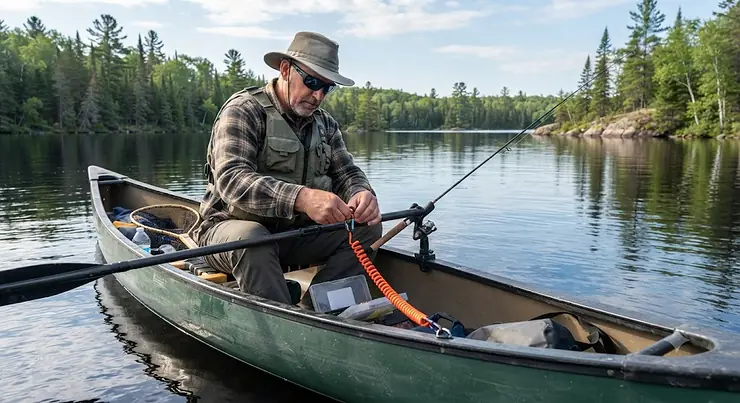
Somewhere around your third lost paddle, you stop calling it bad luck and start calling it a pattern. Maybe it slid off your lap while you fought a smallmouth bass. Maybe a gust caught the blade and walked it right off the gunwale while you weren’t looking. Either way, you were suddenly stranded mid-lake with a fishing rod in one hand and absolutely nothing to get yourself back to shore. A paddle leash for canoe fishing solves this specific, maddening problem: it’s a short tether — usually elastic or coiled — that clips your paddle to your canoe so it can float within arm’s reach instead of floating away entirely.
This guide breaks down seven real, currently available leashes, from a Victoria, BC-built classic to budget multi-packs that outfit an entire family canoe for less than a tank of gas. We’ll also dig into coiled vs straight leash design, how the lessons from kayak fishing paddle management apply to canoes, and where gear tethers for anglers fit into your broader setup. Every product mention here reflects real specifications and aggregated review sentiment — not fabricated hands-on testing — so you can make a decision based on facts, not marketing copy.
Quick Comparison Table
| Leash | Design | Length (stretched) | Best For | Price Range (CAD) |
|---|---|---|---|---|
| Scotty #130 Safety Leash | Flexcoil | ~1.8 m (6 ft) | All-around durability | C$27–C$35 |
| YakGear Baja Paddle Leash | Straight sleeve/bungee hybrid | 1.2–1.5 m | Two-piece paddles | C$25–C$35 |
| Wilderness Systems Rod/Paddle Leash | Bungee webbing | ~0.6 m (2 ft) | Tight canoe cockpits | C$20–C$28 |
| Booms Fishing T02 | Coiled, steel-core | Up to 2 m | Budget multi-use tethering | C$25–C$30 (3-pack) |
| Pelican Paddle Leash | Coiled | ~1.2 m | Casual, occasional paddlers | Under C$18 |
| OCEANBROAD D-Ring Leash | Bungee, multi-pack | 1.5–2.1 m | Outfitting a whole crew | C$15–C$22 |
| YakGear Coiled Paddle Leash | Solid rubber coil | ~1.5 m (60 in) | Cold-weather reliability | C$18–C$26 |
Looking at this table, the pattern that jumps out is that price doesn’t map neatly onto quality here — a lot of these leashes use similar bungee or coil physics, and the real differences show up in hardware quality, coil memory, and how they attach to your specific paddle shaft. The Scotty #130 Safety Leash and YakGear Baja Paddle Leash sit at the upper end because of hardware (swivel snaps, reinforced sleeves) rather than raw stretch length. Budget picks like the OCEANBROAD D-Ring Leash earn their spot not because they’re worse engineering, but because multi-packs let you tether paddles, nets, and tackle boxes all at once for not much more than a single premium leash costs.
💬 Just one click — help others make better buying decisions too!😊
Top 7 Paddle Leashes for Canoe Fishing: Expert Analysis
1. Scotty #130 Safety Leash — the workhorse Canadian anglers already trust
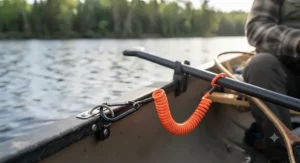
Built by Scotty Manufacturing, a company that got its start in Victoria, BC back in 1952 making salmon lures, this leash has been a staple of the Canadian fishing accessory market for decades. The self-retracting flexcoil stretches to roughly 1.8 metres (6 feet) and secures items up to 3.8 cm (1.5 inches) in diameter, which covers the vast majority of canoe paddle shafts and most fishing rod butts too.
What sets it apart on paper is the hardware: two Scotty swivel snaps instead of a single carabiner, which means less line twist when the leash is under tension from wind or current. Based on the spec comparison against sleeve-style leashes, the flexcoil design also stays out of your lap when not in use, coiling back into a compact bundle rather than dangling loose. Reviewers consistently report that it reliably catches a dropped paddle before it clears the gunwale, and a recurring complaint in user feedback is that the plastic coil-to-clip junction can eventually pull loose under repeated hard yanks — a known failure point that some owners reinforce with a stainless crimp as cheap insurance.
Pros:
- ✅ Dual swivel snaps reduce tangling and line twist
- ✅ Trusted Canadian manufacturer with 70+ years in fishing gear
- ✅ Compact flexcoil keeps slack out of your paddling stroke
Cons:
- ❌ Coil-to-clip junction can loosen under repeated hard stress
- ❌ Sits at the higher end of the price range for a single leash
At around C$27–C$35, the Scotty #130 Safety Leash costs more than most coiled competitors, but for paddlers who’ve already lost one paddle and don’t want a repeat, the swivel-snap hardware alone tends to justify the premium.
2. YakGear Baja Paddle Leash — best hybrid design for two-piece paddles
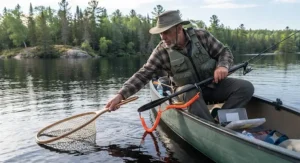
The YakGear Baja Paddle Leash takes a different structural approach than most of this list. Instead of a pure coil, it uses a core of flexible 6 mm (¼-inch) nylon bungee overwrapped in a nylon sleeve, giving it the stretch of a bungee with the abrasion resistance of webbing. It comes in two lengths — one stretching from 91 cm to 119 cm (36 to 47 inches), the other from 122 cm to 152 cm (48 to 60 inches) — so you can size it to your seating position rather than settling for one-size-fits-all.
In practice, that sleeve construction means there’s no oversized buckle banging against your hull every time a gust of wind sets your paddle rocking, which matters more than it sounds like it should when you’re trying to hold a position over a weed bed without spooking fish. What most buyers overlook about this model is that the boat-side loop threads directly through a pad eye or seat strap rather than relying on a clip, which is one less failure point but also one more thing to thread correctly before you launch. Aggregated reviews note the sleeve holds up well against sun exposure over multiple seasons, with occasional mentions of the Velcro paddle-end losing grip strength after a couple of years in saltwater conditions.
Pros:
- ✅ No large buckle to rattle or spook fish
- ✅ Two length options for different seating setups
- ✅ Sleeve construction resists UV and abrasion well
Cons:
- ❌ Velcro attachment can loosen with saltwater exposure over time
- ❌ Threaded loop setup is less “grab and go” than a clip
Priced in the C$25–C$35 range depending on length, the YakGear Baja Paddle Leash is a smart pick if your canoe paddle breaks down into two pieces and you want a leash that won’t clank around the joint.
3. Wilderness Systems Rod/Paddle Leash — best short leash for tight canoe seating
At just 0.6 metres (2 feet), the Wilderness Systems Rod/Paddle Leash is the shortest option on this list, and that’s precisely the point. It’s built from nylon webbing wrapped around a bungee core with swivel snap hooks on both ends, adjustable via a hook-and-loop attachment that fits shafts and rod handles up to 3.8 cm (1.5 inches) thick, and it comes in a hi-visibility orange that’s genuinely easier to spot against dark canoe hulls.
Here’s what to weigh: a short leash like this keeps your paddle tight against the hull rather than trailing loosely in the water where it can drag or tangle around your feet — a real annoyance in a canoe’s narrower footprint compared to a kayak cockpit. The tradeoff is reach; if you need to set your paddle down and stand slightly to net a fish, 2 feet of slack won’t always give you the range a longer coil would. Reviewers note the swivel hooks on both ends specifically prevent the self-tangling that plagues single-clip leashes, which is a small detail that pays off over a full day on the water.
Pros:
- ✅ Dual swivel hooks prevent self-tangling
- ✅ Hi-viz colour is easy to spot in low light
- ✅ Compact 2-foot length keeps gear tight to the hull
Cons:
- ❌ Limited reach compared to longer coiled options
- ❌ Hook-and-loop attachment needs periodic re-tightening
Sitting around C$20–C$28, this leash suits anglers running smaller canoes or anyone who values a tidy, close-tethered setup over maximum stretch.
4. Booms Fishing T02 Heavy Duty Coil Lanyard — best budget steel-core coil for multi-use tethering
The Booms Fishing T02 Heavy Duty Coil Lanyard ships in a 3-pack, which changes the math on this whole category — instead of buying one leash for your paddle, you can outfit your paddle, your primary rod, and a landing net for one purchase. Inside the coil sits a genuine 7×7-strand steel wire core rated to roughly 23 kg (50 lb) of tensile strength, stretching from about 51 cm to 2 metres (20 to 79 inches) when fully extended.
Based on the spec comparison, that steel-wire core is the standout feature here — most coiled leashes in this price bracket rely on plain rubber or elastic cord that degrades with UV exposure, while a wire-reinforced coil holds its memory shape and resists overstretching for longer. Ball-bearing swivel ends are a genuine upgrade too, since they let the leash rotate freely under tension instead of twisting into knots, which is exactly the kind of detail Amazon listings tend to bury in a bullet list without explaining why it matters. A common thread in aggregated reviews is that the coil tension feels “just right” — strong enough to snap a rod back but not so aggressive that it yanks gear out of your hand mid-cast. Some buyers note the included carabiner, while functional, is on the lighter side compared to marine-grade stainless hardware.
Pros:
- ✅ Steel-wire core resists UV degradation and overstretch
- ✅ Ball-bearing swivels prevent coil tangling
- ✅ 3-pack covers paddle, rod, and net in one purchase
Cons:
- ❌ Included carabiner is lighter-duty than stainless alternatives
- ❌ Requires a separate rod tie strap (sold separately) for rod use
At roughly C$25–C$30 for three units, the Booms Fishing T02 Heavy Duty Coil Lanyard delivers some of the best cost-per-tether math on this entire list.
5. Pelican Paddle Leash — best ultra-budget pick for occasional paddlers
If you canoe a handful of weekends a season and don’t want to overthink accessory spending, the Pelican Paddle Leash covers the basics without ceremony. It’s a coiled, stretchable design in orange, built specifically for kayak and stand-up paddleboard paddles but functionally identical in use on a canoe paddle shaft of similar diameter.
Here’s the honest trade-off: at this price point, you’re not getting steel-reinforced cord or swivel-snap hardware — you’re getting a simple, functional coil that does the one job it’s designed for. Reviewers consistently describe it as “does what it says” rather than remarkable, which, for an accessory this inexpensive, is a fair outcome. What most first-time buyers overlook is that ultra-budget coils like this one tend to lose elasticity faster under constant sun exposure than premium alternatives, so it’s better suited to a boat that lives in a garage between trips than one that sits rigged on a dock all summer.
Pros:
- ✅ Genuinely low-cost entry point into paddle leashes
- ✅ Simple coil design with no fiddly attachment steps
- ✅ Bright orange colour is easy to locate in a gear bag
Cons:
- ❌ Elastic coil likely degrades faster under constant UV exposure
- ❌ No swivel hardware, so some twisting is expected over time
Priced under C$18, the Pelican Paddle Leash makes sense as a low-commitment starter leash or a spare tucked in a dry bag for backup.
6. OCEANBROAD Kayak Paddle Leash with D-Ring — best multi-pack for outfitting a whole crew
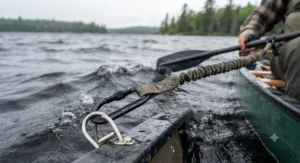
Family canoe trips or guided outings with multiple paddlers create a specific problem: everyone needs a leash, and buying premium single units for four people gets expensive fast. The OCEANBROAD Kayak Paddle Leash with D-Ring solves that directly, sold in 1, 2, or 4-piece packs with a stretchable bungee body running roughly 1.5 to 2.1 metres (5 to 7 feet) and a D-ring attachment point instead of a simple loop.
The D-ring is worth calling out specifically: it gives you a more secure, rotating connection point than a basic sewn loop, which matters when four different people with four different paddling styles are all putting stress on their tethers simultaneously. On paper, this means less wear concentrated at a single stitch point over a season of shared use. Aggregated customer sentiment points to solid value for the multi-pack pricing, with some buyers noting that the bungee material, while stretchy enough for casual use, isn’t quite as robust as the wire-core options further up this list — a reasonable trade given the price gap.
Pros:
- ✅ D-ring attachment distributes stress better than a plain loop
- ✅ Multi-pack options (1, 2, or 4) suit group trips
- ✅ Genuinely budget-friendly per-unit cost
Cons:
- ❌ Bungee material is less robust than wire-reinforced coils
- ❌ Not ideal as a sole leash for frequent, hard-use paddling
At C$15–C$22 depending on pack size, the OCEANBROAD Kayak Paddle Leash with D-Ring is the practical choice for outfitting an entire canoe or a season of guest paddlers.
7. YakGear Coiled Paddle Leash — best no-wire coil for cold Canadian conditions
The YakGear Coiled Paddle Leash takes a deliberately different engineering approach: instead of a wire-reinforced coil, it’s molded from solid rubber with no internal wire at all, stretching from 61 cm at rest to a full 152 cm (24 to 60 inches) extended. That “no wire” detail solves a specific, real problem — wire-core coils can develop stubborn kinks or, in cold weather, become more brittle at the point where wire meets clip.
What the spec sheet won’t tell you outright, but the engineering implies, is that solid rubber handles temperature swings more gracefully than wire-and-rubber composites, which is relevant if your canoe fishing season runs into cool spring or late-fall conditions common across much of Canada. The connection hardware is a 360-degree swivel hook on the boat side and an adjustable 3.8 cm (1.5-inch) Velcro strap on the paddle side. Reviewers highlight the “full memory coil” language as accurate in practice — it retracts cleanly rather than staying stretched out and floppy after repeated use, a known annoyance with cheaper elastic coils.
Pros:
- ✅ Solid rubber coil avoids wire-fatigue and cold-weather brittleness
- ✅ 360-degree swivel hook resists tangling
- ✅ Strong coil memory keeps it retracted between uses
Cons:
- ❌ Shorter unstretched length than some straight-sleeve alternatives
- ❌ Velcro strap needs occasional readjustment on tapered shafts
Sitting in the C$18–C$26 range, the YakGear Coiled Paddle Leash is a smart pick for anyone paddling shoulder-season waters where a wire-core coil’s cold-weather stiffness becomes a real annoyance.
Paddle Leash vs Traditional Paddle Management: Benefits Compared
Before leashes were common accessories, canoe anglers relied on paddle clips, foam holders wedged under the thwarts, or simply laying the paddle across their lap and hoping. Here’s how a dedicated paddle leash for canoe fishing actually stacks up against those older habits.
| Method | Keeps Paddle Retrievable if Dropped | Frees Both Hands for Fishing | Setup Effort | Cost |
|---|---|---|---|---|
| Paddle leash (e.g. Scotty #130, Booms Fishing T02) | Yes | Yes | Low, one-time | C$15–C$35 |
| Foam paddle clip | No | Partial | Low | C$10–C$20 |
| Lap/gunwale resting | No | No | None | Free |
The gap here isn’t subtle. A foam clip keeps your paddle organized while you’re not using it, but the moment it slips loose in a gust or a wake, it’s gone the same way it would be without any system at all — clips hold position, not connection. Resting a paddle across your lap or the gunwales works fine right up until you need both hands to fight a fish, at which point the paddle becomes the thing you’re least paying attention to. A leash is the only one of the three that actually solves the “what happens when it falls” problem rather than just reducing how often it happens.
Price Range & Value Analysis
Paddle leashes cluster into three rough price bands, and understanding what changes between them helps you avoid paying for hardware you don’t need — or under-buying for conditions where you do.
| Price Band | What You Typically Get | Example Picks |
|---|---|---|
| Under C$18 | Basic elastic coil, single clip | Pelican Paddle Leash |
| C$18–C$28 | Reinforced coil or sleeve, better hardware | YakGear Coiled Paddle Leash, Wilderness Systems Rod/Paddle Leash |
| C$27–C$35+ | Swivel hardware, hybrid sleeve construction, multi-packs | Scotty #130, YakGear Baja, Booms Fishing T02 (3-pack) |
The value calculation isn’t purely “spend more, get more” — it’s about matching hardware to how often you’re on the water. An angler who paddles three or four weekends a year gets a reasonable return from an entry-level coil, since UV degradation and hardware fatigue simply won’t accumulate fast enough to matter. Someone fishing weekly through spring, summer, and fall is putting real cyclical stress on swivel points and coil memory, and that’s exactly the use case where the jump to swivel-snap hardware or a wire-reinforced core like the Booms Fishing T02 pays for itself in fewer replacements over a two- or three-season span.
✨ Don’t Miss These Exclusive Deals!
🔍 Take your canoe fishing setup to the next level with these carefully selected paddle leashes. Click on any highlighted product to check current pricing and availability on Amazon.ca. A few dollars now can save you an entire trip’s worth of frustration later!
Practical Usage Guide: Setting Up, Maintaining, and Optimizing Your Leash
Buying the leash is the easy part. Getting real value out of it comes down to installation and habits, and this is exactly the kind of practical detail that doesn’t show up on an Amazon product page.
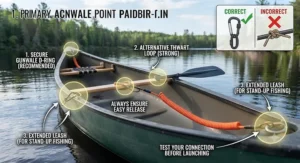
Start with attachment point selection: most canoes don’t come with a dedicated pad eye near the paddler’s seat, so your options are threading the leash through a seat strap, an existing thwart lashing point, or installing a small D-ring with marine-grade adhesive backing or a through-bolt kit. Whichever you choose, mount it close enough that the leash reaches your paddle’s natural resting position without stretching to its limit on every stroke — constant maximum-stretch use is what shortens a coil’s working life fastest.
For maintenance, rinse coiled and bungee leashes with fresh water after any trip in brackish or salt-influenced water; grit works its way into coil folds and accelerates wear on both rubber and steel-wire cores alike. Check swivel hooks and carabiners for corrosion or stiffness every few outings — a swivel that’s stopped swiveling defeats the entire point of the hardware. Store leashes out of direct sun between trips if you can, since UV exposure is the single biggest factor in premature elastic breakdown, more so than mechanical wear from normal use.
The most common first-30-days mistake is simply mis-sizing the attachment: a leash rigged too short fights your paddling stroke and gets annoying fast, while one rigged too long lets the paddle drag in the water on every recovery stroke. Take five minutes on your first outing to test the reach at full paddling extension before you ever cast a line, and adjust the mounting point rather than fighting the leash length itself.
Real-World Scenarios: Matching the Right Leash to Your Canoe Fishing Style
Different canoe fishing setups call for genuinely different leash priorities, and it helps to see how that plays out for a few common paddler profiles.
Consider a solo angler running a 4.3-metre solo fishing canoe on quiet Ontario lakes two or three times a month, budget-conscious and mostly paddling calm mornings before work. For that profile, a straightforward coil like the Pelican Paddle Leash or the budget-friendly OCEANBROAD Kayak Paddle Leash with D-Ring covers the actual risk level without overspending on hardware that won’t see enough cycles to matter.
Now picture a family that takes an annual week-long canoe trip into a provincial park, with two adults and two kids paddling separate canoes, fishing casually between portages. Here, the math favours a multi-pack over premium single units — the OCEANBROAD multi-pack or the 3-piece Booms Fishing T02 set lets you tether every paddle and a couple of rods for less than the cost of two premium single leashes, and consistency across the group means less confusion about which leash belongs where.
Finally, think about a dedicated weekly angler fishing moving water and larger lakes through spring, summer, and fall, targeting bass and pike from a stable fishing canoe with a stand-assist bar. That’s sustained, repeated stress on hardware across a full season and variable temperatures, which is precisely the case for the Scotty #130 Safety Leash or the wire-core Booms Fishing T02 — the swivel hardware and reinforced cores earn their keep through consistent, heavy cycling rather than sitting mostly unused in a gear bag.
How to Choose a Paddle Leash for Canoe Fishing
Picking the right paddle leash for canoe fishing comes down to a handful of decision points, each worth weighing against how and where you actually paddle.
- Match length to your seating position. A leash mounted too far from your resting paddle grip will constantly feel taut; measure the distance before ordering.
- Pick coil vs sleeve based on your paddle style. Coiled leashes retract neatly but can feel springy mid-stroke; sleeve or straight leashes trail more loosely but interfere less with paddling rhythm.
- Check the maximum diameter rating. Wider two-piece paddle shafts or thicker fishing rod butts need leashes rated for at least 3.8 cm (1.5 inches).
- Prioritize swivel hardware if you fish often. Swivel snaps or 360-degree hooks prevent the slow twisting that shortens a leash’s usable life under frequent use.
- Consider multi-packs for more than one item. If you’re tethering a paddle, a rod, and a net, a 3-pack like the Booms Fishing T02 is more economical than three separate premium leashes.
- Factor in your climate. Paddlers fishing into cool shoulder seasons benefit from wire-free coils like the YakGear Coiled Paddle Leash, which resist cold-weather stiffening.
- Don’t ignore attachment method. Velcro-strap attachments are faster to swap between paddles; threaded-loop or D-ring systems are more secure but slower to install.
Learn more about safe paddling fundamentals in CBC’s beginner’s guide to canoeing, which covers stroke basics that make a properly leashed paddle even more effortless to manage.
Coiled vs Straight Leash Design: Which Actually Wins on the Water
This is one of the most genuinely debated questions among canoe anglers, and the honest answer is: it depends on your paddling motion more than on any objective superiority of one design.
Coiled leashes — like the Scotty #130, Booms Fishing T02, and YakGear Coiled Paddle Leash — retract into a compact bundle when not under tension, which keeps slack line out of your feet and off your fishing line. The tradeoff is that a coil under constant stretch (say, mounted too far from your paddling hand) fights back with a persistent spring tension that some paddlers find fatiguing over a long day. Coils also have a working lifespan tied to elastic memory; stretch them past their rated range repeatedly and they gradually lose snap-back.
Straight or sleeve-style leashes — the YakGear Baja Paddle Leash is the clearest example here — trail more loosely and don’t fight your stroke the same way, since there’s no coil actively pulling back. What most buyers overlook is that this comes with a different downside: loose slack can drift into the water and tangle around a rudder, a fishing line, or your own ankle if you’re not managing it consciously. Sleeve leashes also tend to be bulkier when not in use, since there’s no coil to compact them.
Based on the spec comparison across both categories, the practical rule of thumb is this: if you paddle with a smooth, continuous stroke and want the leash to disappear from your attention, a coil suits you. If you switch frequently between paddling and fishing, set the paddle down often, or use a two-piece paddle where clean sleeve routing matters, a straight or hybrid leash like the YakGear Baja Paddle Leash tends to feel less intrusive.
Kayak Fishing Paddle Management: What Canoe Anglers Can Borrow
Kayak anglers have been refining paddle-tethering habits for longer than most canoe anglers, largely because a kayak’s low seating position makes a dropped paddle even harder to recover than it is from a canoe’s higher gunwale. A few of those habits translate directly.
The first is mounting position discipline: kayak fishing paddle management typically favours a leash point mounted just behind the paddler’s hip, close enough to reach blind. That same logic applies in a canoe — mounting your leash near your kneeling thwart or seat strap, rather than at the bow or stern, keeps the reach short and the retrieval instinctive rather than something you have to think about mid-fight with a fish.
The second borrowed habit is redundancy. Many kayak anglers run a paddle leash and a separate rod leash simultaneously rather than assuming one tether covers all their gear, which is exactly the logic behind multi-packs like the OCEANBROAD Kayak Paddle Leash with D-Ring or the 3-piece Booms Fishing T02 set — cover the paddle and the rod independently rather than juggling one leash between two jobs. The third crossover point is quick-release awareness: kayak anglers who paddle moving water tend to avoid leashes that can’t be released one-handed under load, a consideration equally relevant for canoe anglers running rivers rather than flat lake water.
Gear Tethers for Anglers: Beyond Just the Paddle
A paddle leash solves one specific loss risk, but it’s worth thinking about gear tethers for anglers as a category rather than a single purchase. Rods, nets, pliers, and tackle boxes all share the same basic failure mode as an unleashed paddle: a wobble, a strike, or a gust, and they’re gone.
Rod leashes deserve particular attention if you’re fishing actively rather than just trolling, since a hooked fish putting sudden tension on a rod is one of the more common ways gear ends up in the water. Products like the Booms Fishing T02, when paired with a separate rod tie strap, do double duty as both paddle and rod tethers, which is part of why multi-packs make more financial sense than they first appear to. Net tethers matter more than most anglers assume too — a long-handled net balanced across gunwales is an easy target for a stiff breeze, and a short bungee tether to a thwart costs almost nothing to add.
The broader principle worth internalizing is this: anything you’d genuinely mind losing on the water is worth a few dollars of elastic cord and five minutes of setup. Reviewers across nearly every product in this category consistently cite the same regret pattern — buying a tether only after losing the item it would have saved.
Common Mistakes When Buying and Using a Paddle Leash
A few recurring errors show up again and again in aggregated customer feedback across this whole product category, and most of them are easy to avoid once you know to look for them.
The first is buying based on stretched length alone without checking the diameter rating — a leash that stretches to 2 metres is useless if its clip won’t close around your paddle’s thicker grip section. The second is mounting the attachment point too far from the paddling hand, which creates constant tension and accelerates wear on coil-style leashes specifically. The third is skipping fresh-water rinses after brackish or coastal trips, which lets grit work into swivel joints and shortens hardware life dramatically faster than normal wear would. The fourth mistake is assuming a single leash covers both paddle and rod duty when actively fishing — as noted above, dedicated tethers for each item prevent the awkward tug-of-war that happens when both are clipped to one line. Finally, many buyers underestimate UV exposure as a factor, storing leashes rigged and exposed on a dock or roof rack between trips rather than in shade, which is consistently the fastest way to age out elastic cord regardless of how well it was engineered.
Safety, Regulations & Compliance for Canadian Paddlers
A paddle leash isn’t just a convenience item — it directly supports a legal safety requirement in Canada. Under the Small Vessel Regulations, human-powered vessels including canoes are required to carry certain minimum safety equipment, and a spare paddle is a commonly recommended (and in some categories required) item precisely because a lost paddle can leave you unable to safely return to shore. Transport Canada’s Safe Boating Guide lays out the full minimum equipment list for pleasure craft under 6 metres, which includes a Canadian-approved PFD for every person aboard and a sound-signalling device at minimum.
A paddle leash reduces the odds you’ll ever need that spare paddle in the first place, but it doesn’t replace it — a leash can still fail under extreme load, and Transport Canada’s guidance exists precisely for that failure scenario. For a broader rundown of what’s mandatory before you launch, MEC’s overview of mandatory paddling gear is a useful checklist covering PFDs, sound signals, and additional items required based on your specific vessel length and paddling location. Provincial requirements around fishing licences and catch limits are separate from federal boating safety rules, so it’s worth checking your provincial fishing regulations alongside Transport Canada’s equipment list before any canoe fishing trip.
Frequently Asked Questions
❓ What is the best paddle leash for canoe fishing?
❓ Do I need a paddle leash for canoe fishing?
❓ Coiled vs straight leash design — which is better for canoe fishing?
❓ How long should a canoe paddle leash be?
❓ Can I use a kayak paddle leash for canoe fishing?
Conclusion
A paddle leash for canoe fishing is one of those accessories that feels optional right up until the moment it isn’t. Every product on this list solves the same core problem — keeping your paddle attached to your boat instead of drifting toward the horizon — but they solve it through genuinely different engineering choices, from the Scotty #130‘s swivel-snap hardware to the YakGear Coiled Paddle Leash‘s wire-free, cold-resistant coil.
If you’re fishing often and want hardware built to last multiple seasons, lean toward the Scotty #130 Safety Leash or Booms Fishing T02. If you’re outfitting a family trip or just want a reliable backup without overspending, the OCEANBROAD or Pelican options cover the basics honestly and affordably. Whichever you choose, pair it with the broader safety habits Transport Canada recommends, rinse it after salty or gritty trips, and mount it close enough to your paddling hand that you forget it’s even there — until the day it saves your paddle, and possibly your whole trip.
Recommended for You
- Best Canoe Seat Cushion for Comfort: 7 Top Picks (2026)
- Kayak Paddle Under $150 CAD: 7 Solid Picks That Won’t Sink Your Budget (2026)
- Kayak Paddle for Touring: 7 Top Picks for Canada (2026)
Disclaimer: This article contains affiliate links. As an Amazon Associate, I earn from qualifying purchases. If you purchase products through these links, we may earn a small commission at no additional cost to you.
✨ Found this helpful? Share it with your friends! 💬🤗
