
In This Article
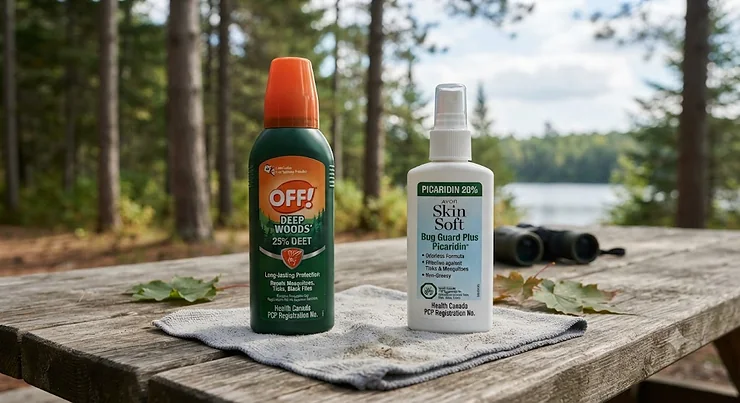
Somewhere between the third mosquito bite of the evening and the fourth attempt to read a tick off your ankle in bad light, most Canadians ask the same question: DEET vs Picaridin insect repellent — does it actually matter which one you grab off the shelf? It’s a fair question, because the two ingredients dominate almost everything sold at Canadian Tire, Shoppers, and Amazon.ca, and the marketing on both sides can get a little breathless. So let’s cut through it. DEET is the old reliable — the ingredient your dad’s Muskol has used since before you were born. Picaridin, sold in Canada under the name icaridin, is the newer synthetic that trades a bit of raw brute force for a nicer feel on skin and zero damage to your fishing line. Neither one is a scam, and neither one is magic. Both are reviewed and registered by Health Canada, both hold up in independent lab testing, and both will do the job if you use them properly. What follows is a deep, honestly-sourced comparison of seven real repellents you can actually buy in Canada this season, broken down by strength, comfort, and who each one is really built for.

Quick Comparison: DEET vs Picaridin at a Glance
Before diving into all seven products, here’s the short version for anyone standing in an aisle with a mosquito already circling.
| Factor | DEET | Picaridin (Icaridin) |
|---|---|---|
| Health Canada max for adults | 30% | 20% (standard ceiling sold here) |
| Typical protection window | 5–8 hours at 25–30% | 5–12 hours at 20%, brand-dependent |
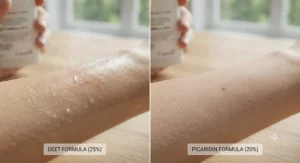
| Feel on skin | Can feel greasy; strong odour | Odourless, non-greasy |
| Damage to plastics/synthetics | Yes — can melt sunglasses, watch faces, some fabrics | No |
| Best for | Deep bush, heavy tick pressure, budget shoppers | Sensitive skin, kids’ gear, travel, daily wear |
The takeaway from that table isn’t “one wins.” It’s that DEET still edges out on raw availability and price at the higher end of its concentration range, while Picaridin wins on comfort and practicality for anyone who’s tired of their sunglasses fogging with a chemical haze. If you’re outfitting a whole family or rotating gear between a canoe trip and a backyard barbecue, that plastic-safety difference alone might decide it for you.
💬 Just one click — help others make better buying decisions too!😊
Top 7 DEET and Picaridin Repellents: Expert Analysis
Every product below is a real, currently sold repellent available in Canada, drawn from a mix of DEET and picaridin/icaridin formulas so you can see the two ingredients side by side rather than in the abstract. We’ve grouped budget, mid-range, and premium picks across both camps.
1. Watkins Great Outdoors 30% DEET Lotion — Canadian heritage brand at max legal strength
The standout here is simple: this is one of the few 30% DEET lotions made by a Canadian company that’s been formulating household goods since 1868, and that legacy shows up in the no-nonsense label. At Health Canada’s adult ceiling of 30% DEET, this lotion is built for the kind of bush trip where reapplying every two hours isn’t an option. Real-world meaning: 30% DEET typically buys 6 to 8 hours of mosquito protection under normal sweat and activity levels, and the lotion format (versus spray) tends to rub in more evenly on arms and necks without the wind-blown waste you get with aerosols. Based on the spec sheet, this is squarely an adult product — it’s explicitly not for children under 12 — so it’s not the bottle you toss in the family cooler bag. Reviewers on retailer sites consistently describe it as more effective than mainstream aerosol brands and note it holds up through a full evening at the trailer, though a handful mention the classic DEET smell lingering on clothing after washing. What most buyers overlook about lotions like this one is that the thicker formula actually resists sweat-off better than thin sprays, which matters more than the percentage number alone when you’re portaging or splitting firewood.
Pros:
- ✅ Full 30% DEET — Health Canada’s adult maximum strength
- ✅ Lotion format resists sweat and rain better than sprays
- ✅ Trusted heritage Canadian manufacturer since the 1800s
Cons:
- ❌ Not approved for children under 12 years old
- ❌ Strong DEET odour persists on skin and fabric
Priced in the mid-C$10s to around C$20 depending on size, this sits at the budget-to-mid range and delivers strong value if you only need adult-strength protection for a handful of trips a season.
2. OFF! Deep Woods 25% DEET Aerosol (255g) — best all-round mid-strength spray
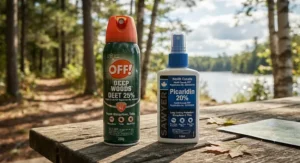
The standout advantage on this one is the 360-degree aerosol nozzle, which sprays right-side up or upside down — genuinely useful when you’re coating the backs of your knees without contorting on a canoe seat. At 25% DEET, OFF! Deep Woods sits just under the Canadian ceiling, and the brand’s own testing claims up to 8 hours of mosquito defence and roughly 7 hours against ticks. In practice, that gap between DEET concentrations of 25% and 30% is smaller than the marketing suggests — Health Canada’s guidance notes protection duration plateaus well before 50%, so 25% is arguably the sweet spot for most weekend outdoor use rather than a compromise. This is the pick for someone who wants strong, familiar-brand protection without hunting down a specialty retailer; it’s sold everywhere from Canadian Tire to Amazon.ca to the corner pharmacy. Aggregated reviewer sentiment across major Canadian retailers is largely positive, with buyers repeatedly praising the “non-greasy, powder-dry” finish and 360° spray pattern, though a recurring complaint involves the fragrance-free formula still carrying a faint chemical smell some find unpleasant in enclosed tents.
Pros:
- ✅ 360° aerosol works upside down for full-body coverage
- ✅ Widely available at nearly every Canadian retailer
- ✅ Non-greasy, fast-drying finish rated highly by users
Cons:
- ❌ Aerosol cans classified as hazmat, limiting shipping options
- ❌ Faint chemical smell noted by some reviewers even fragrance-free
At around C$14 to C$20 for the full 255g can, OFF! Deep Woods is a solid mid-range value pick, especially if you’re buying one bottle to cover a whole camping trip.
3. Muskol Pump 30% DEET — the classic Canadian max-strength option
Muskol’s standout is brand recognition — this is the bottle most Canadians picture the second someone says “bug spray,” and it’s held that spot at cottages and campsites for decades. At the same 30% DEET ceiling as the Watkins lotion, Muskol’s pump spray format applies a more controlled, targeted mist than a full aerosol, which some users find easier to manage in windy conditions along a lakeshore. What the spec sheet won’t tell you, but decades of Canadian outdoor use suggest, is that Muskol’s reputation for “deep woods” reliability is really about consistency — it’s been reformulated and re-tested over the years but has kept its concentration steady rather than chasing gimmick claims. Reviewers frequently mention using it specifically for canoe trips and fishing, citing long-lasting protection through humid, buggy evenings; a smaller but consistent thread of feedback flags that the pump mechanism can clog if the nozzle isn’t rinsed after use in sandy or dusty environments.
Pros:
- ✅ 30% DEET — matches Health Canada’s adult maximum
- ✅ Iconic, widely trusted Canadian outdoor brand
- ✅ Pump spray offers more controlled application than aerosol
Cons:
- ❌ Pump nozzle can clog without regular rinsing
- ❌ Not suitable for children per Health Canada DEET age limits
Typically priced from around C$10 for smaller travel sizes up to the mid-C$20s for larger bottles, Muskol remains one of the most cost-effective max-strength DEET options on Amazon.ca.
4. Natrapel 12-Hour Picaridin 20% Eco-Spray — longest claimed picaridin protection window
The headline feature is right in the name: a 12-hour protection claim against mosquitoes and ticks, which is among the longest window advertised for any 20% picaridin product sold in Canada. The Eco-Spray pump delivers a continuous, even mist without aerosol propellants, meaning it’s airline-friendly and doesn’t rely on a gas canister that can fail in cold weather. Based on the spec comparison, a 12-hour claim at 20% picaridin lines up with EPA registration data showing 20% picaridin can protect for 8 to 14 hours depending on activity and sweat — so this isn’t an inflated number, it’s within the documented range for the concentration. This is the pick for people who want to spray once at breakfast and not think about bugs again until dinner, particularly parents managing a full day at the trailer with kids who won’t sit still for reapplication. Aggregated review sentiment across Canadian retailers is strongly positive, with repeat buyers specifically citing zero ticks found after regular use in wooded properties in Atlantic Canada; a few reviewers note the eco-spray pump requires a firmer pump action than standard aerosol triggers.
Pros:
- ✅ Longest claimed protection window among picaridin sprays here
- ✅ Odourless, non-oily formula safe on gear and fabric
- ✅ Aerosol-free pump is TSA-friendly for travel
Cons:
- ❌ Pump action feels stiffer than trigger or aerosol sprays
- ❌ Higher price point than basic DEET aerosols
Expect to pay in the C$15 to C$25 range depending on bottle size, putting Natrapel at the premium end of picaridin options but with a protection window that can justify the extra cost for full-day outings.
5. Sawyer Picaridin 20% Lotion — best skin feel for sensitive users
Sawyer’s standout is texture: this is a lotion, not a spray, and it’s specifically formulated to be non-oily and safe for use on the face and scalp — something DEET labels explicitly warn against. At 20% picaridin, it matches the concentration ceiling most commonly found in Canada and has been independently recognized by outlets like Wirecutter as a top pick in its category, which speaks to consistent third-party testing rather than manufacturer claims alone. What most buyers overlook about lotion-format repellents is that they allow for precise application around ears, hairlines, and other awkward zones where spray drift either wastes product or risks getting into eyes. This is the pick for anyone with reactive or easily irritated skin, since fragrance-free, non-oily formulas tend to produce fewer complaints in that population than alcohol-based sprays. Aggregated reviewer sentiment consistently highlights the “silky, non-greasy” application and effectiveness against biting flies specifically, an insect group where some users report DEET underperforming; a recurring criticism is that lotion requires more careful, deliberate rubbing-in compared to a two-second spray, which can feel slower when bugs are already swarming.
Pros:
- ✅ Non-oily lotion safe for use on face and scalp
- ✅ Independently recognized as a top pick by reviewers
- ✅ Fragrance-free formula suited to sensitive skin
Cons:
- ❌ Slower to apply than spray formats
- ❌ Twin-pack pricing runs higher than single spray bottles
Sawyer’s picaridin lotion typically lands in the C$15 to C$20 range for a twin pack, a fair mid-to-premium price for a product built specifically around comfort and skin tolerance.
6. OFF! Deep Woods DEET-Free Icaridin 20% Spray (118 mL) — familiar brand, DEET-free formula
The standout feature is brand crossover — this lets someone loyal to the OFF! name switch to icaridin without abandoning a product line they already trust, which matters more for repeat-purchase habits than people give it credit for. At 20% icaridin, the label claims up to 7 hours against mosquitoes and 8 hours against ticks, numbers that track closely with independent field trials on picaridin at the same concentration. Here’s what to weigh: because this is a smaller 118 mL travel-oriented bottle, it’s better suited to day trips and travel kits than a full week at a remote cabin, where you’d want a larger refill on hand. This is the pick for someone packing a carry-on for a trip to cottage country or planning a single-day hike who doesn’t want to commit to a full-size bottle. Aggregated feedback is mixed-positive: many reviewers appreciate the non-greasy feel typical of icaridin formulas, but a segment of Canadian buyers online have noted this particular size can be harder to find in-store compared to the brand’s DEET lineup, pushing more shoppers toward ordering it directly through Amazon.ca.
Pros:
- ✅ DEET-free 20% icaridin from a widely trusted brand
- ✅ Compact, travel-friendly 118 mL size
- ✅ Non-greasy finish typical of icaridin formulas
Cons:
- ❌ Smaller bottle means more frequent repurchasing for long trips
- ❌ Less consistently stocked in physical Canadian stores
At roughly C$10 to C$16 for the compact size, this is a reasonably priced entry point into icaridin for someone who already trusts the OFF! name.
7. Care Plus Icaridin 20% DEET-Free Repellent — budget-friendly European import
The standout advantage is value: this European-formulated icaridin spray consistently lands at a lower price point than most North American picaridin brands while still delivering the same 20% concentration and a claimed 12-hour window against mosquitoes and ticks, with 10 hours against black flies. Real-world meaning: black flies are a genuinely miserable, under-discussed pest across much of rural Ontario and Quebec in early summer, so a repellent that explicitly tests against them (rather than just mosquitoes) is worth noting for anyone heading north in June. Studies referenced by some Canadian retailers suggest 20% icaridin performs at least as well as 30% DEET in comparative testing, which — if accurate for this formulation — makes Care Plus a compelling budget alternative to premium picaridin brands. This is the pick for cost-conscious buyers who still want DEET-free protection rather than defaulting to a cheaper but less-studied “natural” spray. Aggregated online reviews are largely favourable, with repeat customers specifically citing reliability against ticks during dog walks and general outdoor chores; the more limited North American review pool (compared to Sawyer or Natrapel) means there’s simply less aggregated data to draw from, which is worth being upfront about rather than overselling.
Pros:
- ✅ Lower price point than most 20% picaridin competitors
- ✅ Claimed 10-hour protection specifically against black flies
- ✅ DEET-free formula with a European manufacturing pedigree
Cons:
- ❌ Smaller North American review pool than bigger-name brands
- ❌ Less widely stocked in Canadian brick-and-mortar stores
Generally priced under C$20, Care Plus is one of the more budget-friendly ways to get into 20% icaridin without stepping down to a lower-tested “natural” alternative.
Top 7 Products Comparison Table
| Product | Active Ingredient | Concentration | Claimed Protection | Best For |
|---|---|---|---|---|
| Watkins Great Outdoors Lotion | DEET | 30% | 6–8 hrs | Adults, backcountry trips |
| OFF! Deep Woods Aerosol | DEET | 25% | up to 8 hrs | All-round mid-strength use |
| Muskol Pump | DEET | 30% | up to 8 hrs | Cottage and canoe country |
| Natrapel 12-Hour Eco-Spray | Picaridin | 20% | up to 12 hrs | Full-day outings, families |
| Sawyer Picaridin Lotion | Picaridin | 20% | 8–10 hrs | Sensitive skin, face/scalp use |
| OFF! DEET-Free Icaridin Spray | Icaridin | 20% | 7–8 hrs | Travel, brand loyalists |
| Care Plus Icaridin | Icaridin | 20% | up to 12 hrs | Budget-conscious buyers |
Looking at this table, the picaridin/icaridin entries claim protection windows that match or exceed the DEET products despite a lower legal concentration ceiling in Canada — which tells you the two ingredients simply don’t scale the same way. Muskol and Watkins both max out Health Canada’s 30% DEET limit, so if you specifically want the strongest DEET formula sold here, those two are functionally tied. Meanwhile, anyone prioritizing comfort over raw strength should look at Natrapel or Sawyer, both of which post longer claimed windows without the skin-feel trade-offs of DEET.
Benefits vs Traditional Alternatives
| Factor | DEET/Picaridin Sprays | Citronella Candles/Coils | Bracelets & Wearables |
|---|---|---|---|
| Effectiveness | High, tested at 5–12+ hrs | Low, works only in still air | Very low, minimal real protection |
| Health Canada registration | Yes (both actives) | Some products only | Rarely registered as repellents |
| Portability | High (pocket-sized bottles) | Low (needs flat, wind-free surface) | High but low efficacy |
| Cost per use | Moderate | Low upfront, ongoing replacement | Low upfront, frequent replacement |
The analysis here is blunt: candles and coils can reduce mosquito pressure in a small, still radius, but a gust of wind at a lakeside dock erases most of their benefit, and Health Canada does not recognize citronella houseplants as effective at all. Wearable bracelets test poorly in independent lab conditions because the active ingredient simply can’t diffuse far enough to create a protective zone around exposed skin. If you’re weighing cost per use over a full season, a single bottle of DEET or picaridin spray that lasts 5 to 12 hours per application beats the ongoing candle or coil replacement cost by a wide margin, especially for anyone spending multiple evenings outside per week.
Practical Usage Guide: Getting the Most Out of Any Repellent
Buying the right bottle only solves half the problem — application technique accounts for a surprising amount of real-world performance variance. First, apply repellent after sunscreen, never before or mixed together, since sunscreen needs to bond to skin first and combining the two in a single product can reduce both ingredients’ effectiveness. Second, spray or rub into a light, even layer rather than soaking one arm and skipping the other — Health Canada’s guidance emphasizes “apply sparingly,” and more product doesn’t mean more protection past a certain saturation point. Third, reapply based on the label’s stated window, not by feel; sweating, swimming, and heavy rain will shorten any repellent’s working life regardless of concentration. A common first-30-days mistake is spraying DEET directly onto sunglasses, watch faces, or synthetic rain gear, which can visibly degrade plastics and certain fabrics within minutes — this is one of the clearest practical reasons picaridin appeals to people who rotate expensive gear. Finally, wash treated skin with soap and water once you’re back indoors rather than leaving repellent on overnight; it’s not required for safety at approved concentrations, but it does prevent residue buildup on pillowcases and bedding.
Real-World Scenarios: Matching the Product to the Person
The weekend cottage-goer in Muskoka: Someone spending two or three evenings a month on a dock, dealing with moderate mosquito pressure and the occasional tick after a walk in the brush, doesn’t need maximum-strength anything. A mid-range 25% DEET aerosol like OFF! Deep Woods or a 20% icaridin spray like Care Plus covers this use case without overkill, and the lower per-application cost matters more here than squeezing out an extra hour of protection.
The parent with two kids under 10: Health Canada’s guidance steers families toward icaridin for children over 6 months, given DEET’s stricter concentration caps and reapplication limits for kids aged 2 to 12. A bottle like Natrapel 12-Hour or the OFF! DEET-Free Icaridin Spray lets a parent use one product across the whole family (adjusting frequency for younger kids) rather than juggling two separate formulas.
The backcountry hiker in tick country: Someone spending 8+ hours in dense brush in a region with high blacklegged tick activity — increasingly common across Ontario, Quebec, and the Maritimes — benefits from Health Canada’s adult maximum: 30% DEET products like Watkins or Muskol, paired with permethrin-treated clothing for an added non-skin layer of protection.
How to Choose Between DEET and Picaridin
- Check who’s using it. Health Canada caps DEET at 10% for children aged 2 to 12 and limits application to three times daily, while icaridin has more flexible age guidance starting at 6 months — a meaningful factor if you’re buying for a family rather than yourself.
- Think about your gear. If you’re wearing expensive sunglasses, a GPS watch, or synthetic rain shells, picaridin’s lack of plastic damage is a genuine practical advantage, not just a marketing point.
- Match strength to exposure time. A quick backyard barbecue doesn’t need 30% DEET; a full day of bushwhacking might. Buying the strongest available product “just in case” often means paying for protection you won’t use.
- Consider skin sensitivity. Reviewers across both ingredient categories report fewer skin complaints with picaridin than with high-concentration DEET, particularly for repeated daily use over a work season.
- Factor in smell tolerance. DEET’s odour is distinctive and, for some people, genuinely unpleasant in enclosed spaces like tents or vehicles; picaridin’s near-odourless profile solves this outright.
- Look at format, not just ingredient. Lotions apply more precisely around the face; sprays and aerosols cover large skin areas faster — pick the format that matches how you’ll actually use it.
- Don’t ignore price per application. A cheaper bottle with a shorter protection window can cost more over a season than a pricier one that needs reapplying less often — do the math based on your actual outdoor hours, not just shelf price.
Common Mistakes When Buying Insect Repellent
A frequent misstep is assuming higher percentage always means better protection — Health Canada’s own guidance and independent lab data both show that DEET concentrations above roughly 30% to 50% don’t meaningfully extend protection time, they just front-load it faster. Another common error is buying a combination sunscreen-and-repellent product; health authorities generally advise against these because sunscreen needs frequent reapplication while repellent doesn’t, leading to either over-application of repellent or under-application of sunscreen. Shoppers also frequently overlook expiry dates — active ingredients in repellents do degrade over time, and a bottle that’s been sitting in a garage for three summers may not deliver its labelled protection window. Finally, a subtle but real mistake is choosing a repellent based on scent preference alone; fragrance-free doesn’t always mean odour-free in practice, and the only way to know how a specific formula smells to you is to test a small amount before committing to a full-size bottle for a big trip.
DEET vs Picaridin: Which Repellent Lasts Longer?
This is the single most searched comparison between the two, and the honest answer is: it depends heavily on concentration, not just ingredient. A systematic review published in the Journal of Travel Medicine examined the available field and laboratory trials comparing the two actives directly and found little consistent difference in protection duration when both were applied at matched concentrations, though some evidence pointed toward picaridin holding up slightly better in certain formulations. Separately, a field study conducted in Cambodia and published through the National Center for Biotechnology Information found that 20% picaridin performed equally well as 20% DEET against several mosquito species, with both delivering strong protection rates over a five-hour observation window. What this means practically for a Canadian shopper: don’t assume “picaridin” or “DEET” alone tells you which bottle will outlast the other. A 20% picaridin spray and a 20% DEET spray are likely to perform similarly; the meaningful gap only opens up when comparing a low-concentration product from one category against a high-concentration product from the other — like comparing a 7% DEET FamilyCare spray to a 30% DEET or 20% picaridin formula.
Skin-Feel and Odour: Why Comfort Changes Compliance
Here’s an angle that rarely gets enough attention: the “best” repellent is the one you’ll actually reapply on schedule, and comfort drives that behaviour more than any spec sheet. DEET’s characteristic solvent-like smell and its tendency to feel slightly oily on skin are cosmetic issues on paper, but in practice they’re a leading reason people skip reapplication or apply too little to avoid the sensation. Picaridin’s near-neutral scent and non-greasy finish remove that friction point entirely, which is likely part of why Health Canada and public health bodies increasingly highlight icaridin as the preferred option for children — kids are notoriously unwilling to sit still for anything that smells strong or feels sticky. Reviewers across nearly every picaridin product in this roundup mention the “no smell” quality unprompted, while DEET reviews more frequently include some variation of “smells like this always did” — accurate, but not exactly a selling point for repeat use.

Active Ingredient Efficacy: What the Research Actually Shows
Beyond the travel-focused reviews already discussed, broader entomological research consistently classifies DEET and icaridin as the two most reliable synthetic repellents currently available, ahead of plant-based alternatives like citronella and even oil of lemon eucalyptus in most controlled comparisons. Laboratory arm-in-cage testing — where treated and untreated skin is exposed to a controlled mosquito population — has repeatedly shown both ingredients achieving protection rates above 90% within their labelled application windows. The gap between lab results and real-world experience usually comes down to application thickness, sweat, and water exposure rather than any inherent weakness in either chemical. It’s also worth noting that neither ingredient’s efficacy is meaningfully affected by which specific pest is biting — both perform comparably against mosquitoes, ticks, and biting flies, though picaridin has shown a slight edge against biting flies specifically in some field comparisons, a detail several manufacturers in this roundup highlight directly on their packaging.
Health Canada Repellent Guidelines and Age Restrictions
Every product recommended in this article is registered under Health Canada’s Pest Management Regulatory Agency, which reviews all active ingredients sold as personal insect repellents in the country before they reach store shelves. According to Health Canada’s official guidance on personal insect repellents, DEET is capped at 30% for adult use, limited to 10% for children aged 6 months to 2 years with only one application per day, and capped at 10% with up to three applications daily for children aged 2 to 12. Products containing DEET should not be used continuously for more than a month on children under 12, and no chemical repellent — DEET or icaridin — is recommended for infants under 6 months, where physical barriers like mosquito netting remain the safer choice. Icaridin products carry more flexible age guidance starting at 6 months but are still not recommended below that age. These aren’t arbitrary numbers; they reflect ongoing safety reviews specific to the Canadian market, which is part of why Canada’s DEET ceiling (30%) is notably lower than the up-to-100% concentrations available in some other countries.
Safety, Ticks, and Why This Choice Matters More Than It Used To
Insect repellent used to feel like a comfort purchase — something you grabbed to avoid itchy bites, not a genuine health decision. That’s shifted. Tick populations and the diseases they carry have expanded significantly across Canada in recent years, and public health reporting has tracked a sharp rise in Lyme disease cases alongside newer concerns like anaplasmosis, particularly across Ontario, Quebec, and the Maritimes. CBC News reporting on the trend has documented how warming winters are allowing tick populations to survive and expand into regions that historically saw little tick activity, meaning the “I don’t need repellent where I live” assumption is increasingly outdated for a growing number of Canadians. That context reframes the DEET-vs-picaridin decision: this isn’t just about comfort at a barbecue anymore, it’s genuinely relevant personal protective equipment for a growing share of the country, which is exactly why Health Canada continues to actively review and update guidance on both ingredients rather than treating the file as settled.
Long-Term Cost and Maintenance Considerations
Thinking beyond a single bottle, the real cost comparison between DEET and picaridin products comes down to application frequency multiplied across a season. A 30% DEET product reapplied every 6 to 8 hours during heavy outdoor use might get you through roughly 15 to 20 applications per 100 mL bottle, while a 20% picaridin product claiming up to 12 hours could stretch that same bottle further simply by needing fewer reapplications per day. Over a full summer of regular cottage or trail use, that difference can offset picaridin’s typically higher per-bottle price. There’s also a secondary cost worth factoring in: DEET’s tendency to degrade plastics and certain synthetic fabrics means repeat exposure can shorten the usable life of sunglasses, watch bands, and rain gear, a maintenance cost that rarely shows up in anyone’s mental math until a favourite pair of sunglasses fogs over for good.
Features That Actually Matter (And Those That Don’t)
Concentration percentage matters, but only up to a point — chasing the highest number available past 30% DEET or beyond 20% picaridin buys diminishing returns rather than meaningfully longer protection. Spray format versus lotion format matters more than most shoppers assume, since application precision affects real-world coverage more than a few percentage points of active ingredient. On the other hand, scent additives, “tropical” or “summer” fragrance variants, and decorative packaging genuinely don’t matter for efficacy — they’re comfort features at best and, for some users with fragrance sensitivities, a downside. Claims like “kills mosquitoes” should also be treated with skepticism; both DEET and picaridin work by disrupting insect sensory detection, not by killing anything, and any label implying otherwise is overselling the mechanism.

FAQ
❓ Is picaridin as effective as DEET?
❓ Which lasts longer, DEET or picaridin?
❓ Is picaridin safe for kids in Canada?
❓ Does DEET damage clothing or gear?
❓ Can I use DEET and picaridin at the same time?
Conclusion
If there’s one honest takeaway from putting DEET vs Picaridin insect repellent side by side, it’s that Canadians are lucky to have two genuinely effective, Health Canada-reviewed options rather than one clear winner and one compromise. DEET remains the cheaper, higher-availability choice with a longer safety track record, and products like Watkins, OFF! Deep Woods, and Muskol deliver Health Canada’s maximum adult strength at reasonable prices. Picaridin, sold here as icaridin, closes the effectiveness gap almost entirely while solving DEET’s biggest everyday annoyances — the smell, the greasy feel, and the risk to gear — and options like Natrapel, Sawyer, and Care Plus make that upgrade accessible at a range of price points. The right choice really does come down to who’s using it, what gear is at risk, and how many hours you’ll actually spend outside — not which ingredient wins an internet argument.
Recommended for You
- DEET Bug Spray for Camping: 7 Best Picks for Canada (2026)
- 7 Best Bug Spray for Canoe Trips in 2026 (Tested; Compared)
- 7 Best Permethrin Treatment Kits for Camping Gear in 2026
Disclaimer: This article contains affiliate links. As an Amazon Associate, I earn from qualifying purchases. If you purchase products through these links, we may earn a small commission at no additional cost to you.
✨ Found this helpful? Share it with your friends! 💬🤗
