In This Article
Picture this: it’s 2 a.m. at Algonquin Provincial Park, your brand-new sleeping bag is rated for “5°C comfort,” and the temperature has just plunged to -3°C. You’re curled into a ball like a cold shrimp, wondering where things went wrong. Sound familiar? You’re not alone. This sleeping bag buying guide exists precisely because the gap between marketing claims and real Canadian campsite performance is wider than most people expect.
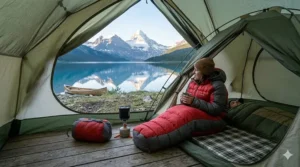
Canada’s camping seasons are brutally unforgiving. A July evening in Banff can swing from 18°C (64°F) at sunset to below zero by dawn. Spring thaws in Ontario bring damp, penetrating chill. And if you’re one of the many Canadians who extends their season deep into October — or embraces winter camping entirely — getting your sleeping bag selection wrong isn’t just uncomfortable; it’s a genuine safety issue.
This sleeping bag buying guide covers everything you need to make a confident, informed purchase on Amazon.ca in 2026: temperature ratings decoded in Celsius, down versus synthetic insulation explained honestly, how to build a complete camping sleep system, and seven real products — with verified Canadian availability — reviewed with the specificity that Amazon product pages simply won’t give you. Whether you’re a first-time camper picking up your debut sleeping bag or a seasoned backcountry traveller reassessing your sleeping gear investment, this guide is built for Canadian conditions, Canadian budgets (in CAD), and the Canadian camping experience.
As a practical reference: a sleeping bag buying guide is a curated resource that helps you match temperature ratings, insulation types, bag shapes, weight, and price to your specific camping style — cutting through marketing noise to help you buy once and buy right.
Quick Comparison: 7 Best Sleeping Bags on Amazon.ca at a Glance
| Product | Type | Temperature Rating | Weight | Best For | Price Range (CAD) |
|---|---|---|---|---|---|
| MalloMe Multi-Season Sleeping Bag | Rectangular/Semi | +5°C to -5°C | ~1 kg (2.2 lbs) | Beginners, summer car camping | $35–$60 |
| Coleman Brazos 20°F Sleeping Bag | Rectangular | -7°C (20°F) | ~1.8 kg (4 lbs) | Budget 3-season, casual campers | $65–$95 |
| TETON Sports LEEF 0°F Mummy Bag | Mummy | -18°C (0°F) | ~1.4 kg (3 lbs) | Cold-weather, value backpacking | $85–$135 |
| Sportneer 3-4 Season Sleeping Bag | Semi-Rectangular | -10°C (14°F) | ~1.1 kg (2.4 lbs) | Versatile 3-season use | $70–$110 |
| Naturehike Ultralight Envelope Bag | Envelope | 0°C to +10°C | ~0.8 kg (1.8 lbs) | Lightweight backpacking | $80–$130 |
| KingCamp Extra Wide Flannel Bag | Rectangular XL | -5°C (23°F) | ~2.3 kg (5 lbs) | Car campers, bigger builds | $90–$145 |
| Coleman Polara 3-in-1 Sleeping Bag | Convertible | -7°C to +10°C | ~1.6 kg (3.5 lbs) | All-season versatility | $155–$220 |
The comparison above reveals a clear market segmentation. Budget bags in the $35–$95 CAD range dominate car camping needs for most Canadians doing three-season trips from May to September. The mid-range sweet spot ($85–$145 CAD) is where serious performance begins — particularly for anyone camping north of Toronto or at higher elevations in the Rockies. And if versatility across Canadian seasons is your priority, the Coleman Polara’s modular system justifies its premium price by effectively replacing two or three single-purpose bags.
💬 Just one click — help others make better buying decisions too! 😊
✨ Don’t Miss These Exclusive Deals!
🔍 Take your camping sleep system to the next level with these carefully selected sleeping bags. Click on any highlighted item to check current pricing and availability on Amazon.ca — your best night’s sleep under the Canadian stars starts here!
Top 7 Sleeping Bags on Amazon.ca: Expert Analysis
1. MalloMe Multi-Season Camping Sleeping Bag
The MalloMe is the ideal first sleeping bag for the Canadian camper who wants dependable warmth without a steep learning curve or a steep price tag.
Key specs: synthetic hollow-fibre fill rated down to around -5°C (23°F) comfort, a semi-rectangular cut measuring approximately 76 × 183 cm (30 × 72 in), and a weight hovering around 1 kg (2.2 lbs). What does that mean in practice? The temperature rating works reliably for May through September camping in southern and central Canada — think Muskoka lakes, Prince Edward Island coastal sites, or BC’s Okanagan. Push it past mid-October in most provinces and you’ll feel the limits.
In my experience, the MalloMe’s greatest strength isn’t the specs — it’s the entry-point confidence it gives first-time campers. You won’t toss and turn worrying whether you spent $400 CAD on the right bag. The full-length, anti-snag zipper is notably smooth for this price tier, and the integrated compression bag makes packing genuinely easy, even for those still figuring out how to organise a pack.
Canadian buyer feedback highlights consistent praise for the softness of the lining and straightforward machine-washability — a real convenience when you’re shaking out pine needles from your Algonquin weekend. A handful of Canadian reviewers note it runs slightly small; taller campers (over 183 cm/6 ft) should size up.
✅ Lightweight and packable for day hikes with overnight camps
✅ Machine washable — no special care needed
✅ Great value entry point, Prime-eligible on Amazon.ca
❌ Not suitable for below -5°C — not your bag for fall shoulder season camping
❌ Lacks a draft collar, which costs warmth on genuinely cold nights
At the $35–$60 CAD range, the MalloMe is arguably the best value sleeping gear investment for a first-timer. It’s not a forever bag, but it’s an excellent starting point.
2. Coleman Brazos 20°F Sleeping Bag
Coleman has been outfitting Canadian campers for generations, and the Brazos 20°F continues that tradition with a dependable, no-fuss approach to cold-weather comfort.
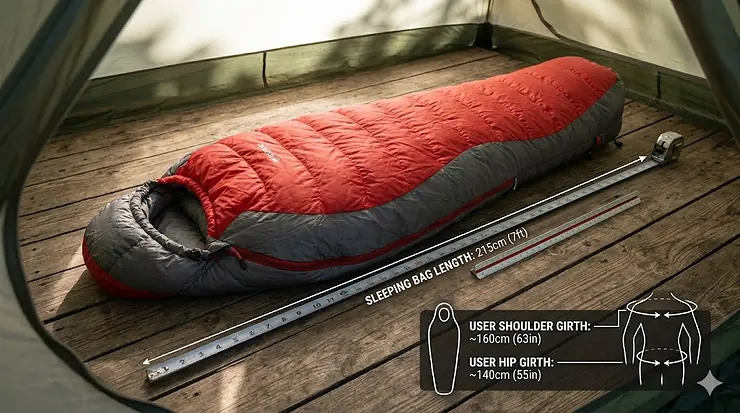
Rated to -7°C (20°F), this rectangular bag uses synthetic fill and features a no-snag zipper, an integrated stuff sack, and cotton-flannel-style inner lining. That flannel inner is the detail most buyers overlook: it’s noticeably softer and warmer against skin than standard polyester liners, especially during that first chill when you slide in on a cold night. The rated -7°C is a “lower limit” figure — for true comfort at that temperature, most Canadians will want to add a light liner or thermal base layer, particularly cold sleepers.
What most Canadian buyers overlook about the Brazos is its reputation for durability. This bag regularly appears in reviews from campers who’ve used it for five-plus years of family camping without zipper failures or significant insulation degradation — a sign the stitching quality is genuinely above average for its price class. It’s also one of the few bags at this price point that is fully machine washable, which matters enormously when you have kids bringing mud into every campsite.
Canadian reviewers specifically praise it for car camping at Ontario and Quebec provincial parks, where night temperatures dip sharply even in August. It isn’t a backpacking bag — at 1.8 kg (4 lbs), it’s best paired with a vehicle.
✅ Flannel-style lining adds genuine warmth and comfort
✅ Proven long-term durability — rare at this price point
✅ Widely available on Amazon.ca with Prime shipping
❌ Too heavy for backpacking — strictly a car camping companion
❌ Large packed size; storage and transport space required
In the $65–$95 CAD range, the Coleman Brazos delivers serious value for Canadian families who camp regularly at provincial parks. Check current pricing on Amazon.ca.
3. TETON Sports LEEF 0°F Mummy Sleeping Bag
If you’re serious about shoulder-season camping in Canada — October in Québec, September in the Rockies, early June on Lake Superior — the TETON Sports LEEF earns its place as one of the most capable cold-weather bags in its price tier.
The LEEF’s standout feature is its mummy shape combined with a -18°C (0°F) rating, synthetic fill construction, and an adjustable hood that seals the bag’s warm air around your head — the area where most campers lose 30–40% of their body heat. That adjustable hood isn’t decorative; on a -10°C night in Jasper, it’s the difference between sleeping and shivering. The bag weighs approximately 1.4 kg (3 lbs) and packs compressibly for a synthetic bag, making it genuinely viable for multi-night canoe tripping.
What the spec sheet won’t tell you is that the TETON LEEF runs slightly warm relative to its rated temperature — a comment echoed consistently by Canadian buyers across multiple reviews. If you’re a cold sleeper, that’s reassuring. If you tend to sleep hot, you may find yourself venting the side zipper on nights above -5°C. The mummy shape can feel restrictive if you’re a restless sleeper accustomed to rectangular bags; give yourself a couple of nights to adjust.
TETON Sports is an American brand but ships reliably to Canada via Amazon.ca, and the bag qualifies for Prime delivery in most provinces. It’s particularly popular with canoe campers along Ontario’s river systems who need cold-weather confidence without the premium price of a dedicated down bag.
✅ Serious cold-weather performance (-18°C) at a very accessible price
✅ Adjustable mummy hood provides critical heat retention
✅ Better compressibility than most synthetic bags in this class
❌ Mummy shape may feel claustrophobic for new campers
❌ Runs warm — pairing with a liner in extreme cold may be overkill
At the $85–$135 CAD range, the TETON Sports LEEF is the best sleeping gear investment for Canadians who push into shoulder-season camping. Check current pricing on Amazon.ca.
4. Sportneer 3-4 Season Sleeping Bag
The Sportneer earns its place on this list through sheer versatility — it’s the sleeping bag equivalent of a Swiss Army knife, covering the widest range of Canadian camping conditions in one package.
Rated to approximately -10°C (14°F) with synthetic fill, a semi-rectangular cut, and dual-zipper construction (including a bottom ventilation zipper), the Sportneer weighs around 1.1 kg (2.4 lbs). That bottom zipper isn’t a gimmick: being able to stick your feet out on a warm July night at Fundy National Park — while keeping the top sealed — is genuinely useful for a bag used across multiple seasons. The water-resistant outer shell also performs better in light drizzle than many competitors at this price point.
What I find most impressive about the Sportneer is the value it provides for Canadians who camp across radically different environments. A single bag that works from BC’s Gulf Islands in summer through Algonquin in early October is a real cost and storage win for families with limited gear closets (hello, every condo in Vancouver and Toronto). The semi-rectangular cut splits the difference between a restrictive mummy and a drafty rectangular bag, giving enough room to roll over while still trapping warmth efficiently.
Canadian buyers report strong satisfaction on Amazon.ca, frequently noting the quality of the compression sack and the fact that the bag dries quickly after morning condensation — a practical virtue on rainy Vancouver Island trips.
✅ Dual-zipper design adapts to wide temperature range
✅ Water-resistant outer shell handles light rain exposure
✅ Lighter than its warmth rating suggests — good for mixed hiking/camping
❌ The lining softness doesn’t match the flannel-inner Coleman bags
❌ Hood insulation is minimal compared to true winter bags
At the $70–$110 CAD range, the Sportneer is a top-tier pick for Canadian campers who refuse to buy separate summer and fall bags. Check current pricing on Amazon.ca.
5. Naturehike Ultralight Envelope Sleeping Bag
Naturehike has earned a cult following among ultralight backpackers, and their envelope-style bag fills a specific — but important — gap in the Canadian camping market: the lightweight, packable option for summer backcountry travel.
Coming in at around 0.8 kg (1.8 lbs) with a compression-stuffed packed size small enough to strap to the outside of a daypack, this bag is built for July and August backpacking in Canada’s mountain and coastal regions where overnight lows stay above 0°C. The synthetic fill and ripstop outer shell handle mild moisture contact better than down at this weight class, making it sensible for the Pacific Northwest’s famously damp summer conditions.
The honest caveat is this: the Naturehike is not a bag for cold nights. Rated comfort to roughly 5°C (41°F), it loses warmth quickly below that threshold — a risk on surprise cold snaps common in alpine zones. The spec sheet won’t warn you that a single cloud-free night at altitude can drop temperatures by 10°C faster than expected. Pack a lightweight liner if you’re camping above 2,000 metres (6,600 ft) in the Rockies or Cascades.
Where the Naturehike shines is weight-sensitive summer itineraries: the Stein Valley in BC, the Long Range Traverse in Newfoundland, or Keji trails in Nova Scotia. It’s available on Amazon.ca with Prime shipping and is particularly popular with Canadians using lightweight camping setups. For its weight class, it provides remarkable comfort.
✅ Ultralight at ~0.8 kg — the best pack-weight option in this guide
✅ Ripstop shell handles light moisture better than pure down at this weight
✅ Compact enough to add to existing backpacks without weight penalty
❌ Not suitable for temperatures below ~3°C without a liner
❌ Envelope shape sheds warmth faster than mummy designs — not for cold sleepers
At the $80–$130 CAD range, the Naturehike is the best sleeping bag choice for summer backcountry travellers in Canada. Check current pricing on Amazon.ca.
6. KingCamp Extra Wide Flannel Sleeping Bag
Let’s be direct: a lot of sleeping bags assume the buyer is a 75 kg (165 lb) person of average height. The KingCamp addresses those who don’t fit that profile — and does so with genuine comfort.
At approximately 91 × 216 cm (36 × 85 in), the KingCamp’s XL rectangular cut offers significantly more interior space than standard bags, making it the go-to recommendation for larger builds, couples sharing body heat, or anyone who’s spent a night in a regular bag feeling like a sausage casing. The 100% cotton flannel interior is exceptionally soft — warmer to the touch than synthetic liners from the first moment you slide in — and the -5°C (23°F) rating with synthetic fill makes it a credible three-season car camping bag across most of Canada.
The weight (~2.3 kg/5 lbs) and packed bulk make the KingCamp firmly a car camping product. Don’t attempt to backpack with it. But for drive-in provincial park sites — which is, let’s be honest, how the majority of Canadian families camp — the bulk is irrelevant. It fits easily across a standard queen camping air mattress or a cot.
Canadian reviewers specifically praise the KingCamp for family camping situations where a larger individual was perpetually uncomfortable in standard bags. The flannel interior also regulates moisture better than polyester liners on clammy summer nights, a practical virtue many underestimate.
✅ Genuinely XL dimensions — rare at this price range
✅ Flannel interior exceptional for comfort and warmth feel
✅ Solid -5°C rating for most Canadian three-season camping
❌ Too heavy and bulky for any form of backpacking
❌ Flannel lining takes longer to dry after washing
At the $90–$145 CAD range, the KingCamp is the definitive pick for larger campers or anyone who prioritises interior space over packability. Check current pricing on Amazon.ca.
7. Coleman Polara 3-in-1 Sleeping Bag
The Coleman Polara is the most interesting sleeping bag in this guide — and the one that challenges the conventional wisdom that you need multiple bags for Canadian seasons.
Its design is a convertible system: an outer synthetic shell bag (rated to approximately -7°C/20°F) contains a zip-out fleece inner quilt (rated for warmer conditions around +10°C/50°F). Use them together for cold nights, the shell alone for shoulder-season conditions, or the fleece insert solo as a camp blanket or summer bag. It’s genuinely three bags in one modular package, and Coleman’s execution of the concept is clean enough that reconfiguring takes less than 90 seconds.
What most Canadian buyers overlook about the Polara is its long-term cost efficiency. If you camp from May through October across different elevation and latitude zones — say, summer Gulf Islands camping and October Algonquin canoe tripping in the same year — the Polara replaces what would otherwise be two or three separate bags. The $155–$220 CAD price tag initially stings, but the cost-per-use math over a Canadian camping career is compelling. Think of it as a sleeping gear investment rather than a single-product purchase.
Canadian reviewers on Amazon.ca consistently rate the Polara highly for exactly this versatility. A common note: the fleece inner runs warmer than expected, so even conservative campers find the system genuinely adaptable. It’s Prime-eligible on Amazon.ca and ships to all provinces.
✅ Genuinely three bags in one — outstanding seasonal versatility
✅ Best long-term value in this guide on a cost-per-use basis
✅ Clean execution — switching configurations is quick and intuitive
❌ Premium price point may be difficult to justify for occasional campers
❌ Combined packed size is larger than a single-purpose bag
At the $155–$220 CAD range, the Coleman Polara is the smartest sleeping gear investment for Canadian campers who camp across multiple seasons and elevations. Check current pricing on Amazon.ca.
Understanding Sleeping Bag Temperature Ratings: A Canadian Camper’s Field Guide
Temperature ratings are the single most misunderstood element of any sleeping bag buying guide, and getting this wrong costs you cold, sleepless nights. Here’s what the labels actually mean.
The ISO 23537 Standard: What It Is and Why It Matters
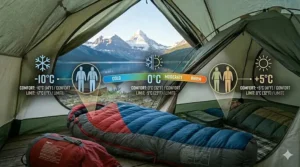
Most reputable sleeping bags sold on Amazon.ca are tested against the ISO 23537 international standard (which replaced the earlier European EN 13537 in 2017). This standard uses a heated thermal mannequin fitted with 15–20 temperature sensors, placed inside the sleeping bag on a standardised sleeping mat in a climate-controlled room. The test runs until the system reaches thermal equilibrium, and the result produces three ratings:
- Comfort Rating: The temperature at which a “standard” adult woman can sleep in a relaxed position. Use this for cold sleepers and Canadian shoulder-season camping.
- Lower Limit Rating: The temperature at which a “standard” adult man sleeping in a curled position won’t wake from cold. This is the most commonly advertised figure — but it’s the threshold, not the comfort zone.
- Extreme Rating: The temperature at which the bag provides survival-level warmth only. Hypothermia risk exists at this rating — never camp to this limit intentionally.
The EN 13537 Wikipedia reference notes that there’s no legal obligation for brands to conform to the standard — which is exactly why you should prioritise bags that explicitly state ISO 23537 compliance. Budget bags that advertise vague “good to -10°C” claims without an ISO stamp are often off by 5–8°C in real conditions.
Canadian Climate Rule of Thumb
Add a 5°C buffer. If the lowest overnight temperature you expect is -5°C, buy a bag rated to -10°C comfort. Canada’s campsite temperatures vary with altitude, proximity to water, cloud cover, and wind in ways that a single temperature forecast doesn’t capture. Waking up to an unexpected cold front at Yoho National Park is exactly the kind of experience that teaches this lesson the hard way.
How Sleeping Pad Affects Everything
Here’s what the spec sheet won’t tell you: your sleeping bag works in concert with your sleeping pad. Cold ground conducts heat away from your body up to 25 times faster than cold air, and no sleeping bag’s insulation on its bottom loft can compensate for an inadequate pad. Look for a sleeping pad with an R-value of at least 2 for summer camping and 4+ for Canadian shoulder-season or winter use. The bag and the pad together form your sleep system — buying a -18°C sleeping bag and laying it on a foam camping mat is like buying a fuel-efficient car and forgetting to fill the tank.
Down vs. Synthetic Sleeping Bag: The Honest Canadian Breakdown
This is the central decision in any sleeping bag buying guide, and both sides of the debate deserve more than a table.
Down Insulation: The Case for Natural Fill
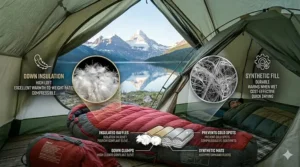
Down — the soft underfeather clusters of geese and ducks — offers an unmatched warmth-to-weight ratio. A quality 800-fill-power down bag achieves the same insulation as a synthetic bag at 30–50% less weight, a difference that matters enormously when you’re portaging in Quetico or hiking the Rockwall Trail in Kootenay National Park.
Down compresses remarkably well, packs small, and — with proper care — lasts 20–30 years. The sleeping gear investment case for down is compelling: spend $350–$600 CAD on a quality down bag, maintain it correctly, and it outlasts four or five synthetic bags that might each cost $100 CAD. The math genuinely works in down’s favour for serious Canadian campers.
The critical caveat: down loses nearly all insulating ability when wet. Wet down clumps, collapses, and provides almost zero warmth. In Canada’s coastal regions — the BC rainforest, New Brunswick’s fog-draped mornings, Newfoundland’s perpetually damp interior — this is a genuine safety risk. Hydrophobic down treatments (DWR coatings applied to individual down clusters) partially address this, but they’re not a substitute for vigilant moisture management.
Synthetic Insulation: The Pragmatic Canadian Choice
Synthetic fill — engineered polyester fibres mimicking down’s structure — offers one defining advantage: it insulates when wet. A synthetic bag retains 70–80% of its warmth even when damp, a characteristic that Canadian conditions reward consistently. Spring snowmelt, coastal humidity, unexpected rain, kids who knock over water bottles inside the tent — synthetic fill handles all of it with calm reliability.
Modern synthetic insulations like PrimaLoft and Polarloft have dramatically narrowed the weight and compressibility gap with down. Camping Life Canada notes that modern insulation technologies now mimic down’s warmth while maintaining better water resistance — a technological evolution that makes synthetic bags genuinely excellent for Canadian camping conditions.
Synthetic bags are also less expensive (the entry-level products in this guide are all synthetic) and easier to maintain — most are machine washable. The trade-off is weight and pack size: a synthetic bag rated to -15°C will typically weigh 400–600 g more than an equivalent down bag.
The Canadian Decision Framework
| Choose Down If… | Choose Synthetic If… |
|---|---|
| You backpack multi-day in dry, cold conditions | You camp in wet or coastal Canadian climates |
| Weight is a serious priority | You’re a beginner or casual car camper |
| You’re making a long-term sleeping gear investment | Budget is a primary constraint |
| Camping in BC interior, Alberta, Yukon dry cold | Camping in BC coast, Atlantic Canada, Great Lakes |
| You’ll dry and store the bag carefully | You want machine-wash simplicity |
The data is clear: for most Canadian recreational campers doing car camping from May to October, synthetic insulation in the $65–$150 CAD range is the pragmatic, weather-resilient choice. For backpackers making a serious sleeping gear investment, down earns its price premium.
How to Build a Complete Camping Sleep System in Canada
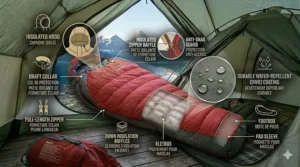
Your sleeping bag is one component of a system. Here’s how the components work together, and how to optimise each for Canadian conditions.
Step 1: Choose Your Temperature Rating with a Buffer
As discussed above, always add a 5°C buffer to your worst-case campsite temperature. A bag rated to -5°C comfort is what you want if nights will reach 0°C. Parks Canada’s camping pages show temperature data for national park regions — use this to research your destination.
Step 2: Match Your Sleeping Pad R-Value
Minimum R-2 for summer, R-4 for shoulder season, R-5+ for winter camping in Canada. Don’t neglect this step — the bag and pad are inseparable partners in your sleep system.
Step 3: Choose Your Bag Shape for Your Sleep Style
- Mummy bags retain the most heat — ideal for cold weather, lightweight backpacking.
- Rectangular bags offer the most room — ideal for car camping, restless sleepers.
- Semi-rectangular bags split the difference — versatile for most Canadian recreational camping.
Step 4: Layer Your Clothing System
A merino wool or synthetic base layer adds approximately 3–5°C of warmth to any sleeping bag. Wearing a balaclava reduces heat loss from your head by up to 30% on cold nights — a simple trick that every Canadian winter camper eventually discovers.
Step 5: Set Up Camp to Minimise Heat Loss
Position your tent to block prevailing winds. Use a tent with a footprint and rain fly to reduce condensation (which accelerates heat loss in both down and synthetic bags). Keep all moisture out of the tent environment — wet gear near a down bag is the fastest way to ruin a cold-weather camping night.
Real Canadian Camper Profiles: Which Sleeping Bag Fits Your Situation?
👤 Profile 1 — The Ontario Family Car Camper (Mississauga, Ontario)
Sarah and her partner camp twice a year at Killbear and Algonquin provincial parks, May through September. They drive to their campsite, have a large family tent, and prioritise comfort over packability. Budget: $100–$180 CAD total for two bags.
Best match: Two Coleman Brazos bags at $65–$95 CAD each. Flannel-lined warmth to -7°C covers even a cool September night at Algonquin, machine washable for easy maintenance, and the price allows two bags within their total budget.
👤 Profile 2 — The BC Coastal Backpacker (North Shore, Vancouver)
Marcus hikes multi-day trips on the Sunshine Coast Trail and West Coast Trail, where morning moisture is constant and unexpected rain isn’t rare. He carries a 12 kg (26 lb) pack. Budget: $120–$160 CAD.
Best match: Sportneer 3-4 Season Bag. The water-resistant outer shell is a meaningful advantage on BC’s coast, the semi-rectangular design provides comfort on uneven campsites, and the weight of ~1.1 kg (2.4 lbs) is manageable in a loaded pack. The dual-zipper ventilation also handles the surprisingly warm summer nights at low elevation on the coast.
👤 Profile 3 — The Shoulder-Season Enthusiast (Calgary, Alberta)
Priya camps from late April through mid-October, including high-elevation sites in Kananaskis where night temperatures can dip to -10°C even in August. Backpacking 3–4 nights at a time. Budget: $130–$220 CAD.
Best match: TETON Sports LEEF 0°F Mummy Bag or Coleman Polara 3-in-1. For maximum cold protection: the TETON LEEF’s -18°C rating provides a genuine safety margin in alpine conditions for $85–$135 CAD. For maximum versatility across the full season: the Coleman Polara’s modular system handles everything from summer Kananaskis nights to October conditions for $155–$220 CAD.
Common Mistakes When Buying a Sleeping Bag in Canada
Mistake 1: Trusting a single temperature number without checking if it’s comfort or lower limit. Many bags advertise the lower limit as the primary rating. Buying a bag “rated to -10°C” without verifying that’s the comfort rating — not the survival threshold — is the most common and consequential mistake in this category.
Mistake 2: Ignoring cross-border warranty realities. Several sleeping bag brands manufactured in the US offer warranty service only at US locations. If you’re buying on Amazon.ca, verify that warranty claims can be processed in Canada — or through Amazon.ca’s return policy — before purchasing.
Mistake 3: Buying for the coldest possible night, not typical conditions. A -30°C expedition bag sounds impressive, but if your typical Canadian camping is mid-summer provincial parks, you’ll be uncomfortably hot and carrying unnecessary weight. Match the bag to 80% of your camping scenarios and use clothing layers for the exceptions.
Mistake 4: Skipping the sleeping pad R-value. Already covered above — but it bears repeating as a mistake, because it’s made constantly by Canadian campers who invest in a quality bag and undercut it with an inadequate pad.
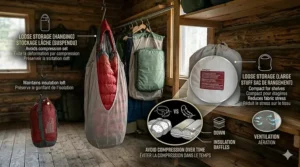
Mistake 5: Storing a sleeping bag compressed. Always store sleeping bags loosely in a large cotton or mesh bag — never in the stuff sack. Compressed storage permanently damages insulation loft (both down and synthetic) over time, reducing warmth ratings by 10–20% within a couple of seasons.
How to Choose a Camping Sleeping Bag in Canada: 6 Criteria That Actually Matter
- Temperature rating with the ISO 23537 label — Always confirm the standard. Unrated bags from lesser-known brands are a gamble. Look for explicit ISO 23537 or EN 13537 labelling, and always reference the comfort rating rather than the lower limit.
- Insulation type matched to your camping environment — Dry, cold regions (Alberta, Yukon interior): down is your best long-term sleeping gear investment. Wet, coastal, or variable regions (BC coast, Atlantic provinces): synthetic is more reliable and forgiving.
- Bag shape aligned with your sleep style — Restless sleepers who roll frequently will be genuinely miserable in a mummy bag on night one. Test shapes if possible before committing to backpacking-specific mummy designs.
- Weight and packed size versus your camping mode — Car camping: weight is irrelevant, comfort is paramount. Backpacking: every 100 g matters. Be honest about which category applies to 80% of your trips.
- Total cost of ownership in CAD — A $50 CAD synthetic bag that degrades in three seasons costs more per year than a $400 CAD down bag that lasts 20+ years. Factor maintenance costs (professional down cleaning: $30–$50 CAD annually) and replacement frequency into your sleeping gear investment analysis.
- Amazon.ca availability and Prime shipping — For Canadians in remote or northern communities, delivery times can extend to 7–14 days for non-Prime items. Always filter for Prime eligibility if your camping timeline is tight. Canadian pricing typically runs 15–25% higher than US equivalents — a reflection of import duties and currency exchange, but you avoid cross-border shipping fees and warranty headaches.
✨ Don’t Miss These Exclusive Deals!
🔍 Finding your perfect sleeping bag is one click away. Check current pricing and stock levels on Amazon.ca for any highlighted product in this guide — Prime members get free shipping, and most of these bags arrive within 2–3 business days across southern Canada. Stock up before peak camping season!
Frequently Asked Questions: Sleeping Bags in Canada
❓ What temperature rating sleeping bag do I need for Canadian camping?
❓ Are sleeping bags on Amazon.ca the same as Amazon.com? Do they ship to Canada?
❓ Can I use a summer sleeping bag in winter in Canada?
❓ Down or synthetic sleeping bag for camping in British Columbia?
❓ How do I store a sleeping bag between camping seasons in Canada?
Conclusion: Your Next Great Canadian Sleep Under the Stars
A great sleeping bag doesn’t just keep you warm — it shapes the entire camping experience. The difference between waking up refreshed at sunrise on Kejimkujik Lake and dragging yourself through the next day in exhausted misery often comes down to one piece of gear. This sleeping bag buying guide exists to make sure you’re in the first camp.
To summarise the key takeaways: always match your temperature rating (with a 5°C buffer) to real Canadian campsite conditions, not best-case forecasts. Understand the ISO 23537 standard and verify your bag is tested to it. Choose insulation type — down or synthetic — based on your specific camping environment, not generic advice. Build a complete sleep system with a matched sleeping pad. And think in terms of total cost of ownership over your camping career, not just the upfront price in CAD.
For most Canadian recreational campers, the Coleman Brazos, Sportneer, or TETON Sports LEEF represent outstanding value across different needs and budgets. If versatility is your priority, the Coleman Polara 3-in-1 is a genuinely clever sleeping gear investment. And if you’re just starting out, the MalloMe offers an accessible, low-risk entry point that gets you out camping without the stress of a major gear decision.
Canada’s camping landscapes — from the boreal shield to the Pacific coast to the Rocky Mountain backcountry — are among the most remarkable on earth. The right sleeping bag is your ticket to experiencing them comfortably, from the last warmth of September evenings to the crisp pre-dawn stillness of a Rockies morning.
✨ Ready to Sleep Better Under Canadian Skies?
🔍 Click any highlighted product in this guide to check current pricing and availability on Amazon.ca. Prime members enjoy free shipping — your next camping season’s best night of sleep is a few clicks away!
Recommended for You
- 7 Best Camping Blanket for Cold Weather Canada 2026
- 7 Best Sleeping Bag Liners in Canada 2026: Warmer Sleep Guaranteed
- Best Compressible Camping Pillow Canada 2026: 7 Top Picks
Disclaimer: This article contains affiliate links. As an Amazon Associate, I earn from qualifying purchases. If you purchase products through these links, we may earn a small commission at no additional cost to you.
✨ Found this helpful? Share it with your friends! 💬🤗
