
In This Article
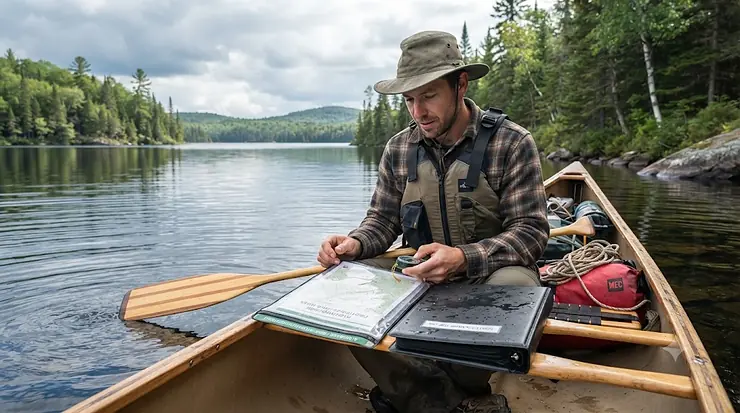
Somewhere on a windy stretch of a Canadian Shield lake, a soggy map has ended more than one canoe trip’s sense of humour. You know the moment: the wind gusts, the map slips off your spray deck, and suddenly you’re eyeballing shoreline features instead of reading contour lines. The debate over waterproof map case vs waterproof binder canoe camping setups isn’t just gear-nerd trivia — it’s the difference between a relaxed afternoon of route-finding and a stressful scramble around an unfamiliar bay. A waterproof map case is a sealed, transparent pouch that protects a paper map from splashes and dunkings while keeping it fully visible and paddle-ready; a waterproof binder, by contrast, organizes multiple map sheets or laminated pages behind rings, trading instant visibility for bulk storage. Both solve real problems, but they solve different ones, and mixing them up can leave you fumbling at exactly the wrong moment. Before you buy anything, it’s worth reviewing Transport Canada’s safe boating guide, which treats navigation equipment as a genuine safety requirement, not an afterthought. This guide breaks down seven real products worth your money, walks through when a case beats a binder (and vice versa), and gives you the practical know-how to keep your route visible from the first put-in to the last portage.
Quick Comparison Table: Waterproof Map Case vs Waterproof Binder
| Feature | Waterproof Map Case | Waterproof Binder |
|---|---|---|
| Best For | Single-day route viewing, quick reference | Multi-day trips, many map sheets, trip notes |
| Visibility | Instant, no unzipping required | Must flip pages, less immediate |
| Waterproof Rating | Often IP68 (submersion-rated) | Cover is water-resistant; paper inside is the real seal |
| Portability | Clips or lashes to thwart/deck | Sits in a pack or day-bag |
| Price Range (CAD) | Roughly C$25-C$70 | Roughly C$30-C$50 (cover only) |
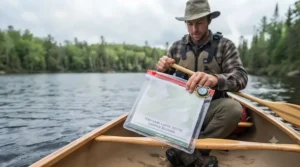
Looking at the numbers above, a case wins for anyone who needs to glance down mid-stroke without breaking paddling rhythm, while a binder earns its keep on long expeditions where you’re carrying a stack of 1:50,000 sheets that would otherwise curl, tear, or blow away at camp. Neither format inherently beats the other — the smart move for most trippers is pairing a case for the day’s active route with a binder stashed in a dry bag for the rest of the trip’s maps.
💬 Just one click — help others make better buying decisions too!😊
Top 7 Waterproof Map Case & Binder Products: Expert Analysis
1. NRS HydroLock Mapcessory Map Case — best all-around waterproof seal for serious trippers
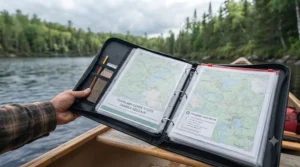
The NRS HydroLock Mapcessory Map Case built its reputation on one thing: a seal that actually holds. That protective black edging along the seams isn’t cosmetic — it’s what keeps the closure from working itself loose after the fortieth open-and-shut of a long trip. Available in four sizes, the large window (roughly 46 x 38 cm) swallows a full McKenzie topo sheet or provincial park route map without folding, which matters more than it sounds; every fold line is a future crease, and creases are where waterproofing eventually fails. Based on the spec comparison with softer vinyl cases, the rigid HydroLock closure resists the bunching that plagues cheaper zip-seal designs when a kayak deck or canoe thwart curves under it. Reviewers consistently note that the seal is genuinely watertight through repeated dunkings, though several also mention it takes real thumb strength to snap shut — cold, wet fingers in October will feel that friction. What most buyers overlook is that this case rewards patience: break it in on dry land before your first trip so the seal isn’t fighting you at the worst possible moment.
Pros:
- ✅ Reinforced seam edging resists long-term wear
- ✅ Large window fits full-size topo sheets unfolded
- ✅ Genuinely watertight through repeated submersion
Cons:
- ❌ Seal requires firm pressure to close properly
- ❌ Stiffer material than some competitors, less packable
Priced in the C$50-C$65 range depending on size, the NRS HydroLock Mapcessory Map Case is a strong value for anyone tripping more than a handful of weekends a season.
2. SealLine Map Case — the tried-and-true classic for canoe and kayak trippers alike
Cascade Designs has been making the SealLine Map Case for long enough that it shows up in gear closets across the Boundary Waters and Quetico circuit, and there’s a reason it sticks around. Four D-rings at the corners let you lash it to a canoe thwart, a pack strap, or a kayak deck line, and the PVC-free construction means it holds up to sun exposure better than older vinyl-coated designs without turning brittle after a season or two. What the spec sheet won’t tell you, but real trip reports suggest, is that the wide-track zip closure is genuinely easy to open one-handed — useful when your other hand is holding a paddle steady in current. On paper this means less fumbling at portages, and in practice, aggregated reviewer sentiment backs that up: paddlers describe it as reliable across “three Canada canoe trips and six Boundary Waters trips” for one long-time user. The one recurring complaint is that the zipper seal gets stubborn in cold, wet conditions, which is worth planning around if you’re a shoulder-season tripper.
Pros:
- ✅ Four D-rings simplify attachment to thwarts or packs
- ✅ PVC-free material resists UV degradation over seasons
- ✅ One-handed zip closure speeds up trail-side access
Cons:
- ❌ Zipper seal stiffens and resists closing in cold weather
- ❌ Available sizes may run smaller than expected for large charts
Expect to pay somewhere in the C$40-C$55 range, making this the sensible mid-range pick for paddlers who want a proven track record without paying premium-brand prices.
3. Ortlieb Map Case (Ultimate6) — best premium build quality from a German waterproofing specialist
German manufacturer Ortlieb applies the same engineering rigour to its Ortlieb Map Case (Ultimate6) that it puts into its award-winning pannier bags, and it shows in the details: tear-resistant, UV-resistant polyurethane on both faces means the window stays clear and crack-free years after cheaper vinyl would have yellowed. The roll-and-hook closure is rated to the IP68 dust-and-immersion standard, so it withstands a full metre of submersion for 30 minutes — genuinely useful if your canoe swamps in a rapid rather than just splashes. Based on the spec comparison with softer competitors, the rigid attachment hooks and included lashing set make this the easiest case here to secure firmly to a canoe thwart without shock cord improvisation. Honest analysis of the trade-off: this precision costs you flexibility, since the roll closure takes slightly longer to reseal than a simple zip. Aggregated customer sentiment is strongly positive on durability and dryness, with several reviewers specifically noting it “kept my map and guide book perfectly dry” across multi-day walking and paddling trips.
Pros:
- ✅ IP68-rated for full submersion up to one metre
- ✅ UV-resistant polyurethane resists yellowing over years
- ✅ Included hook attachment set simplifies thwart mounting
Cons:
- ❌ Roll-and-hook closure is slower to reseal than a zipper
- ❌ Premium pricing compared to simpler vinyl cases
At roughly C$55-C$70, the Ortlieb Map Case (Ultimate6) is the buy-it-once option for trippers who plan to log serious annual mileage on Canadian rivers and lakes.
4. Aquapac Waterproof Map Case (The Kaituna) — best budget pick for occasional trippers
If you paddle a handful of weekends a year and don’t want to drop premium-brand money on navigation gear, the Aquapac Waterproof Map Case (The Kaituna) covers the essentials without the extras. It’s sized to fit Trails Illustrated-style maps and most common provincial park map formats, and the attachment strips are refreshingly flexible — a neckcord, a bungee, or a carabiner all work, so you’re not locked into one mounting style. Here’s what to weigh: this case skips the reinforced seams and rigid hooks you’d find on pricier options, so it’s better suited to flatwater lake trips than whitewater sections where a case might take repeated hard knocks. One quirk worth knowing before you pack a Sharpie: the TPU material isn’t compatible with solvent-based pens, so route-marking calls for a grease pencil instead. For budget-conscious weekend paddlers, that’s a minor trade-off against a genuinely low price point.
Pros:
- ✅ Flexible attachment options (neckcord, bungee, carabiner)
- ✅ Fits standard Trails Illustrated and park map formats
- ✅ Lowest price point among fully waterproof cases here
Cons:
- ❌ Not compatible with solvent-based marker pens
- ❌ Lighter-duty construction than premium alternatives
Sitting under C$35, this is the case to grab if you want reliable protection without committing to a bigger spend.
5. Seattle Sports Dry Doc MagniMap — best for readers who need a closer look at fine print
Topo maps pack a lot of detail into small print, and the Seattle Sports Dry Doc MagniMap solves a problem the other cases on this list don’t even address: readability. Built-in magnification over the viewing window means paddlers who need reading glasses at home don’t have to squint at 1:50,000 scale contour lines while bouncing in a canoe seat. Based on the spec comparison with standard flat-window cases, the magnified lens adds real practical value for anyone over 40 or navigating maps with dense elevation contours, without sacrificing the waterproof seal underneath. Reviewers researching options for aging eyes or low-light dawn starts consistently point to this model as the go-to recommendation in gear round-ups, precisely because no competitor bundles magnification with a genuine waterproof seal. The trade-off is size flexibility: this case comes in fewer size options than the SealLine or NRS lines, so measure your typical map fold before ordering.
Pros:
- ✅ Built-in magnification aids reading dense topo detail
- ✅ Maintains a genuine waterproof seal alongside the lens
- ✅ Specifically recommended for paddlers needing reading aids
Cons:
- ❌ Fewer size options than competing map cases
- ❌ Magnification adds slight bulk versus flat-window designs
Priced around C$35-C$45, it’s a smart pick for anyone who’s caught themselves holding a map at arm’s length trying to make out a portage number.
6. Rite in the Rain All-Weather Field Ring Binder — the waterproof binder built for real field abuse
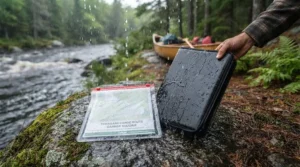
This is where the “binder” side of the debate gets its best real-world entry. The Rite in the Rain All-Weather Field Ring Binder uses a rigid Polydura cover engineered to deflect moisture, mud, and general daily abuse, with rust-resistant rings and spine hardware that won’t seize up after a wet week in the bush. Military units have issued Rite in the Rain gear for field notes and coordinates for decades, and that same weatherproofing philosophy carries directly over to canoe tripping: instead of one map, you can carry an entire route’s worth of sheets, trip itineraries, and permit paperwork behind one set of rings. What most buyers overlook is that the binder cover itself is water-resistant, but true waterproofing of the contents depends on pairing it with actual waterproof paper — a detail worth understanding before you assume the whole package is submersion-proof (see our protect paper maps canoe trip section below for exactly how to set this up correctly).
Pros:
- ✅ Rigid Polydura cover resists moisture and daily wear
- ✅ Rust-resistant rings hold up to repeated field use
- ✅ Stores an entire route’s worth of maps and notes together
Cons:
- ❌ Cover alone doesn’t waterproof unprotected paper inside
- ❌ Bulkier to access mid-paddle than a slim map case
Expect a price in the C$30-C$45 range for the binder itself (paper sold separately), making it the natural choice for multi-day trips with a stack of map sheets to organize.
7. Frost River Map Case — best traditional canvas option for heritage-style canoe trippers
Not every paddler wants TPU and plastic buckles clipped to a wood-and-canvas canoe, and the Frost River Map Case answers that with genuine Made-in-USA canvas construction and cord attachments built for lashing to a thwart the old-fashioned way. Here’s the honest caveat, and it matters: this case is not fully waterproof on its own, a point actual customer reviews confirm directly, describing it as “well-constructed” but best paired with waterproof paper rather than relied on for submersion protection. Based on that honest trade-off, this product earns its spot on the list for a specific type of tripper — someone doing BWCA-style trips with wood-canvas canoes and traditional packs, who wants gear that matches the aesthetic and is willing to combine it with treated map paper for actual moisture protection. What most buyers overlook is that “not waterproof” doesn’t mean “not useful” — it just changes how you need to prep your maps before the trip.
Pros:
- ✅ Genuine canvas construction matches traditional trip gear
- ✅ Cord attachments lash securely to wooden thwarts
- ✅ Made in USA with durable, repairable materials
Cons:
- ❌ Not fully waterproof without pre-treated map paper
- ❌ Higher price for a non-submersion-rated design
Priced around C$40-C$55, this is a style-driven, honest-tradeoff pick rather than a pure performance buy.
✨ Ready to gear up? Check current prices on any of these seven picks before your next put-in! 🧭
Waterproof Map Case vs Waterproof Binder: Which Wins for Canoe Camping?
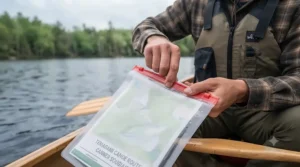
The honest answer is that this isn’t really a rivalry — it’s a division of labour. A waterproof map case wins decisively for active navigation: the day’s route, visible at a glance, clipped where your eyes naturally fall while you paddle. A waterproof binder wins for trip logistics: the full stack of map sheets for a multi-week route, permit confirmations, portage notes, and emergency contact sheets, organized in one place back in the pack. Where paddlers get into trouble is trying to make one product do both jobs. Cramming an entire trip’s worth of maps into a single map case means constant refolding and reduced window visibility, while relying on a binder alone for active navigation means stopping, unzipping a dry bag, and flipping pages — precisely the kind of delay that costs you when weather is closing in fast. The strongest setups this research turned up pair a case like the NRS HydroLock Mapcessory Map Case for the active day’s sheet with a Rite in the Rain All-Weather Field Ring Binder stashed in a barrel for everything else. Trip length is the real deciding factor: weekend trips rarely need a binder at all, while two-week expeditions through multiple map sheets benefit enormously from the organization a binder provides.
How to Choose Navigation Tools for Canoe Tripping
Choosing navigation tools canoe tripping gear comes down to matching equipment to how you actually paddle, not to what looks impressive on a gear list. Follow this reasoning:
- Assess trip length first. A single-day paddle needs only a map case; a multi-day route benefits from binder-based organization for the full sheet set.
- Match window size to map scale. Provincial park route maps and 1:50,000 topo sheets need a larger viewing window than a simple day-trip sketch map.
- Consider your eyesight honestly. If fine contour lines are already a strain at home, a magnifying case like the Dry Doc MagniMap earns its keep fast.
- Plan your attachment method. D-rings suit thwart-lashing in a canoe; a neckcord suits solo paddlers who need both hands free at portages.
- Back up your primary tool. Reviewers and Transport Canada both stress redundancy — a compass and a spare paper map matter even if you also carry a GPS unit.
- Budget for the whole system, not just one item. A C$50 case paired with C$0.40-per-sheet waterproof paper often beats a single expensive all-in-one product.
- Test everything before departure. Seal a case shut, submerge it in a sink, and confirm it holds — cheap insurance against a bad surprise on day one.
Finding the Best Map Case for Backcountry Paddling
Searching for a map case for backcountry paddling means prioritizing different things than a casual day-tripper would. Remote routes — the kind you’d find through Ontario Parks’ backcountry paddling program — mean rescue is hours or days away, not minutes, so gear failure carries higher stakes. That reality pushes backcountry paddlers toward the more rugged end of this list: the IP68-rated Ortlieb Map Case (Ultimate6) or the reinforced-seam NRS HydroLock Mapcessory Map Case, both of which are built to survive repeated dunkings across a two-week trip rather than the occasional splash of a Saturday paddle. Backcountry routes through remote Crown land or provincial park interior zones also tend to require larger-scale maps covering more territory per sheet, which is exactly where a generous window size stops being a nice-to-have and becomes a genuine planning necessity. Reviewers who’ve logged serious interior mileage consistently emphasize durability and seal reliability over price when recommending gear for true backcountry conditions — a pattern worth taking seriously before your own trip into less-travelled water.
How to Protect Paper Maps on a Canoe Trip
Even the best case is only half the equation — you still need to protect paper maps canoe trip style, which starts before you ever load the canoe. Here’s a practical, problem-to-solution approach:
Problem: Standard printer paper disintegrates on contact with water. Solution: print on dedicated waterproof paper, or apply a spray-on water sealant to standard prints before lamination-style treatment; several trippers report success with basic water-repellent sprays on both sides of a printed sheet.
Problem: Folded creases eventually tear. Solution: minimize folds by choosing the largest case window your budget allows, and reinforce fold lines with clear tape before the trip starts.
Problem: Ink runs or fades from UV exposure over multi-day trips. Solution: use pigment-based printer ink where possible, and store maps inside a UV-resistant case like the Ortlieb or SealLine rather than leaving them loose in direct sun.
Problem: Multiple sheets get disorganized mid-trip. Solution: number sheets sequentially and store the full set in a Rite in the Rain All-Weather Field Ring Binder inside a dry bag, pulling only the active sheet for the day’s case.
This layered approach — treated paper, a genuine waterproof case, and organized binder backup — is what separates a map that survives two weeks of Canadian Shield weather from one that turns to pulp on day three.
Essential Backcountry Navigation Gear Beyond the Map Case
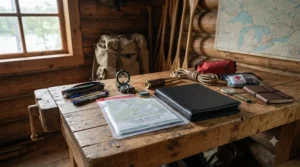
A map case is one piece of a larger system, and serious backcountry navigation gear extends well past the pouch itself. A baseplate compass remains the non-negotiable backup even for paddlers running GPS units, since batteries fail and satellite reception can drop in narrow, tree-lined channels — a point Wikipedia’s overview of the compass covers well if you want the underlying mechanics. Waterproof notebooks for logging bearings and campsite notes pair naturally with any of the binder or case options above, and a simple grease pencil solves the marking problem that trips up paddlers using TPU-based cases incompatible with standard ink. Dry bags rated for full submersion — not just splash-resistant designs — are worth budgeting for separately from your map case, since they’ll carry everything from your binder to your first-aid kit. What most buyers overlook is that navigation gear works as a system: a premium map case paired with a cheap, leaky dry bag still leaves your backup maps exposed if that outer bag fails first.
Smart Canoe Route Map Storage Systems for Multi-Day Trips
Getting canoe route map storage right on a multi-day trip is mostly about sequencing, not just waterproofing. Start by sorting your full map set by day before you leave home, numbering each sheet so it matches your planned campsite progression. Store the full stack in a Rite in the Rain All-Weather Field Ring Binder, then transfer only the current day’s sheet into your active map case each morning at camp — this keeps your case uncluttered and your binder’s contents genuinely protected inside a dry bag rather than exposed to daily handling. A common mistake in the first 30 days of ownership is over-stuffing a single case with multiple folded sheets to avoid the binder-to-case transfer step; this accelerates seal wear and increases the odds of a fold-line tear. Instead, build the transfer into your morning routine alongside packing the tent — it takes under a minute and meaningfully extends the lifespan of both the case and the maps themselves.
Paddle Trip Planning Tools That Pair With Your Map Case
Good paddle trip planning tools turn a pile of gear into an actual plan, and they matter as much as the case itself. Consider three trippers:
The weekend cottage paddler heading out for a two-day loop needs little more than a single Aquapac Waterproof Map Case (The Kaituna) and a printed route from a provincial park map. Budget: under C$50 total. Environment: sheltered lakes, frequent access to shore. Frequency: a handful of trips per summer.
The Algonquin interior tripper planning a five-day route through numbered access points — the kind detailed on the Friends of Algonquin Park’s canoe route resources — needs a full map set organized in a Rite in the Rain All-Weather Field Ring Binder, paired with a rugged daily-use case like the NRS HydroLock Mapcessory Map Case. Budget: C$100-C$130 for the full navigation system. Environment: mixed lake and river with portages. Frequency: one or two serious trips per season.
The expedition paddler running a two-week remote river route needs redundancy above all: the Ortlieb Map Case (Ultimate6) for its IP68 rating, a full binder backup, a baseplate compass, and pre-treated waterproof paper for every sheet. Budget: C$150+ for the complete system. Environment: remote, limited resupply. Frequency: annual flagship trip.
Common Mistakes When Buying Navigation Gear for Canoe Camping
The single biggest mistake paddlers make is buying a map case sized for the map they own today rather than the maps they’ll need on future trips — a small case feels fine for a weekend loop, then becomes a frustrating fold-fest on a longer route next season. A close second is assuming “water-resistant” and “waterproof” mean the same thing; splash-rated gear like a basic ziplock bag survives light spray but fails completely in an actual capsize, while genuinely IP68-rated cases like the Ortlieb are built for full submersion. Reviewers also flag a subtler mistake: buying premium gear but skipping the break-in step, then struggling with a stiff seal on day one of a trip instead of at home where frustration is cheap. Finally, plenty of paddlers buy a binder expecting it alone to waterproof their maps, not realizing the cover protects against splashes while the paper inside still needs its own treatment — an easy fix once you know to look for it.
What to Expect: Real-World Performance on the Water
On paper, IP68 ratings and reinforced seams sound abstract; in practice, they translate to specific moments on the water. Expect a quality case like the NRS or Ortlieb to survive a full capsize and roll without a drop of water reaching the map inside — genuinely reassuring the first time it happens to you on a windy crossing. Expect budget cases like the Aquapac to handle spray and light dunking fine, but to show their limits if repeatedly dragged over rocks at a rough put-in. Expect any zip-seal closure to stiffen somewhat in cold water, meaning early-season and late-fall trippers should plan a few extra seconds to properly reseal after each check. And expect a binder-based system to shine specifically at camp, not on the water — pulling out the full route sheet set to discuss tomorrow’s portage over dinner is where the format’s real value shows up.
Long-Term Cost & Maintenance
Total cost of ownership for a waterproof map case rarely ends at the sticker price. Factor in the cost of waterproof paper if you’re printing your own maps (roughly C$0.35-C$0.80 per sheet depending on paper grade), plus the occasional protectant spray to keep a TPU or vinyl window from clouding under repeated sun exposure. A C$60 premium case that lasts eight seasons works out to roughly C$7.50 per season — often cheaper long-term than replacing a C$25 budget case every two years as seals wear out. Binders hold their value even better since the rigid cover rarely fails; the real recurring cost is simply replacing worn map sheets inside, which happens regardless of storage method. Maintenance itself is minimal: rinse salt or sediment off any case after coastal or muddy-water trips, store gear away from direct sunlight between seasons, and periodically test the seal in a sink before a new trip rather than discovering a failure on the water.
Safety, Regulations & Compliance for Canadian Paddlers
Canadian paddlers should treat map and navigation gear as safety equipment, not just convenience gear — a framing Transport Canada’s boating safety materials reinforce directly by listing charts and compasses alongside required lifesaving equipment for vessels navigating out of sight of shore. While a canoe isn’t subject to the same equipment carriage rules as a larger motorized vessel, provincial park systems increasingly expect trippers to specify a planned route at permit registration, which only works if you can actually read and follow your map reliably in the field. CSA-certified personal flotation devices remain mandatory regardless of navigation setup, and pairing solid map protection with a filed float plan — telling someone on shore your route and expected return — remains one of the cheapest safety upgrades available to any canoe tripper. None of this requires expensive gear, just the discipline to treat a soggy, unreadable map as the safety issue it actually is.
Buyer’s Decision Framework: Which Should You Choose?
Use this simple priority checklist to land on the right setup fast:
- If your trip is a single weekend on a known lake, choose a budget case like the Aquapac Waterproof Map Case because cost matters more than redundancy.
- If you’re running a multi-day route with several map sheets, choose a Rite in the Rain All-Weather Field Ring Binder paired with a daily-use case because organization prevents mid-trip chaos.
- If you’re heading into true backcountry or whitewater, choose the Ortlieb Map Case (Ultimate6) or NRS HydroLock Mapcessory Map Case because full submersion resistance becomes non-negotiable.
- If your eyesight makes fine print a struggle, choose the Seattle Sports Dry Doc MagniMap because readability failures are just as dangerous as waterproofing failures.
- If you paddle a traditional wood-canvas canoe and value aesthetic consistency, choose the Frost River Map Case paired with pre-treated waterproof paper.
Frequently Asked Questions
❓ What's the difference between a waterproof map case and a dry bag for maps?
❓ Can I put my phone or GPS in a waterproof map case too?
❓ How do I stop a waterproof binder cover from actually keeping water out of the paper inside?
❓ Is a laminated map a good substitute for a waterproof case?
❓ How often should I replace a waterproof map case?
Recommended for You
- Waterproof Map Case for Canoe Tripping: 7 Best Picks for 2026
- How to Protect Your Camera on a Canoe Trip: 7 Picks (2026)
- Waterproof Camera Bag for Kayaking: 7 Picks That Won’t Let You Down (2026)
Disclaimer: This article contains affiliate links. As an Amazon Associate, I earn from qualifying purchases. If you purchase products through these links, we may earn a small commission at no additional cost to you.
✨ Found this helpful? Share it with your friends! 💬🤗
