In This Article
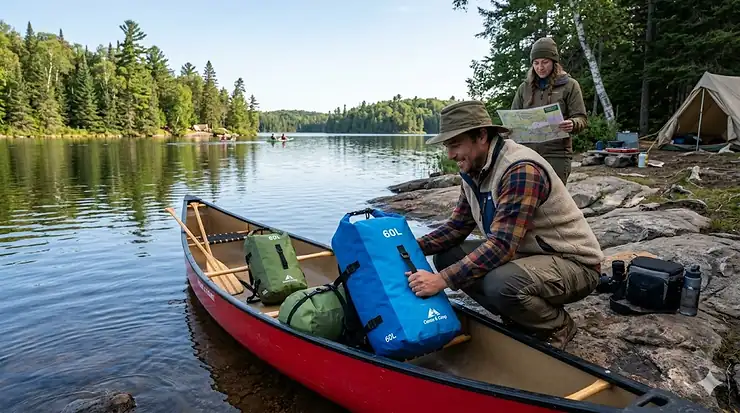
A dry bag canoe camping trip can go sideways fast the moment your canoe takes on a splash of lake water or flips in a set of rapids. A dry bag is a roll-top, sealed storage sack — usually made of coated nylon or PVC — designed to keep your sleeping bag, clothes, and electronics bone-dry even if it’s fully submerged for a few seconds. For most multi-day canoe trips across Ontario’s Algonquin, Quetico, or the Canadian Shield backcountry, somewhere in the 55–65 litre range hits the sweet spot: big enough for a few days of gear, small enough to still fit between the thwarts of a canoe.
I’ve sorted gear for plenty of portages, and I can tell you the “right” capacity depends less on the litre number on the tag and more on how many portages you’re doing and how many people are splitting the load. Below, you’ll find seven real dry bags and packs currently sold on Amazon.ca, along with the heavier-duty 70L and 90L options worth a second look if you’re outfitting a longer trip or a family canoe.
🛶 Quick heads up: prices below are CAD ranges, not exact figures — they shift constantly on Amazon.ca, so always check the current listing before buying.
Quick Comparison Table
| Product | Capacity | Best For | Approx. Price (CAD) |
|---|---|---|---|
| Earth Pak Original Dry Bag Backpack | 55L | Budget paddlers | $45–$65 |
| Sea to Summit Big River Dry Bag | 65L | Durability seekers | $110–$140 |
| SealLine Boundary Pack 70 | 70L | Solo portagers | $170–$210 |
| Earth Pak Waterproof Duffel | 70L | Canoe-bottom hauling | $70–$95 |
| Earth Pak Waterproof Duffel | 90L | Group/base camp gear | $85–$120 |
| SealLine Boundary Pack 115 | 115L | Family/extended trips | $230–$270 |
| Recreational Barrel Works Canoe Barrel | 60L | Food & critter-proofing | $140–$170 |
Looking at the spread, the cheapest options (Earth Pak’s roll-top backpack and duffel lines) suit weekend trippers who don’t want to drop $200 on gear they’ll use a handful of times a year. The SealLine packs justify their higher price with a built-in suspension system that turns a heavy bag into something you can actually carry over a kilometre-long portage without your shoulders screaming. The Recreational Barrel Works barrel sits in its own category — it’s not a “bag” at all, but for Ontario trippers worried about raccoons and black bears getting into food, the rigid, gasketed lid is worth the trade-off in flexibility.
💬 Just one click — help others make better buying decisions too! 😊
✨ Don’t Miss These Exclusive Deals!
🔍 Take your canoe trip packing to the next level with these carefully selected products. Click on any highlighted item to check current pricing and availability on Amazon.ca. These picks will help you keep your gear bone-dry on your next backcountry adventure!
Top 7 Dry Bags & Packs for Canoe Camping: Expert Analysis
1. Earth Pak Original Dry Bag Backpack (55L)
The Earth Pak Original is the roll-top backpack-style dry bag that shows up in nearly every “best of” list for a reason: it’s cheap, tough, and easy to find on Amazon.ca. Made from thick PVC with double-stitched, taped seams, the 55L size adds padded backpack straps and a waist belt — a detail the smaller 30L and 40L versions skip. In practice, that waist belt matters more than it sounds: without it, a fully loaded 55L bag swings and pulls at your shoulders on anything longer than a 200-metre carry.
This is the bag for a first-time canoe camper or a family doing weekend trips who don’t want to commit $200 to a portage pack they might use three times a summer. Canadian buyers on Amazon.ca consistently mention the bag surviving multiple seasons of lake tripping, though a few note the PVC stiffens up in cold weather, which matters if you’re closing out the paddling season in October on a Northern Ontario lake.
✅ Pros: Affordable; comes with a 5-year warranty; padded straps on the 55L size
❌ Cons: PVC feels stiff in cold temperatures; no internal frame for heavy loads
Price sits around $45–$65 CAD depending on colour and current promotions — solid value for a first dry bag.
2. Sea to Summit Big River Dry Bag (65L)
Sea to Summit built its reputation on gear that’s slightly more expensive but noticeably better engineered, and the Big River 65L is a good example. It’s made from 420D nylon laminated with TPU film rather than PVC, which means it stays flexible in cold weather and packs down smaller when empty — a real advantage if you’re trying to nest bags inside a canoe pack for a multi-week trip.
What most buyers overlook about this bag is the oval base. Round-bottomed dry bags tend to roll around in the bilge of a canoe, but the Big River’s flatter, oval shape sits still, which keeps weight distribution more predictable on long lake crossings where wind can already make a canoe squirrelly. Sea to Summit backs the bag with a lifetime warranty, and the field-repair buckle means a cracked clasp on a remote river doesn’t end your trip — a Phillips screwdriver fixes it on the spot.
✅ Pros: Lifetime warranty; packs down small; stable oval base
❌ Cons: Pricier than PVC alternatives; no carry straps included (sling sold separately)
Expect to pay roughly $110–$140 CAD, putting it in the mid-range tier for Canadian paddlers who want one excellent bag rather than three mediocre ones.
3. SealLine Boundary Pack 70 (70L)
If you’ve ever struggled to carry a stuffed dry bag over a long portage, the SealLine Boundary Pack 70 solves the actual problem: it’s a heavy duty dry bag 70L with a backpack suspension system built in, not bolted on as an afterthought. The shoulder straps and waist belt are breathable and waterproof, and the body is PVC-free polyurethane-coated polyester — tougher against abrasion from granite portage trails than basic PVC sacks.
This is the pack for solo or two-person trippers doing real backcountry routes — think Algonquin’s interior, Temagami, or Killarney — where you’re carrying your whole kit over rocky, root-laced trails more than once a day. The side-cinch buckles let you compress the load as it empties over the trip, which keeps a half-full pack from flopping around on your back during the last few days.
✅ Pros: Genuine backpack-style suspension; PVC-free build; watertight DrySeal closure
❌ Cons: Premium price; overkill for car-camping or short day paddles
Pricing typically runs $170–$210 CAD — a real investment, but one that pays off on any trip with more than one portage.
4. Earth Pak Waterproof Duffel Bag (70L)
Separate from its backpack line, Earth Pak also sells a duffel-style dry bag in 50L/70L/90L/120L sizes, and the 70L version is a smart pick for paddlers who don’t need a wearable pack — just a tough, grab-and-go container that sits low in the canoe’s bilge. The duffel shape lashes down easily with bow and stern lines, which is exactly what you want for gear that stays in the boat rather than getting carried on your back.
Where this bag earns its keep is wet-launch days. Loading a canoe at a boat launch in the rain, you want something you can sling in fast without babying the closure system, and the wide roll-top on the duffel forgives a slightly sloppy roll better than a narrower backpack-style bag. It’s a solid match for cottage-to-campsite day trips and shorter overnight runs where portaging isn’t the main event.
✅ Pros: Wide opening for fast loading; lash points for canoe tie-down; budget-friendly for its size
❌ Cons: No frame or padded straps; awkward to carry any real distance
Plan on $70–$95 CAD, making it one of the better-value large gear bag waterproof options on Amazon.ca right now.
5. Earth Pak Waterproof Duffel Bag (90L)
Step up to the 90L version of the same Earth Pak duffel line and you’ve got serious capacity — enough for a family’s clothing and sleeping gear, or a guide outfitting a group trip with shared equipment. This is genuinely a 90L dry bag review-worthy product: the seams and roll-top closure are identical to the smaller sizes, just scaled up, so the waterproofing performance doesn’t change even though the volume nearly doubles.
The trade-off, and it’s an important one for Canadian buyers, is weight when full. A 90L bag packed with wet-weather gear and food for four days can easily exceed 20 kg (44 lbs), and without a frame or hip belt, that weight sits entirely on your hands and forearms during any carry longer than the walk from a vehicle to a dock. Treat this as a “stays in the canoe” bag rather than a portage bag, and it performs beautifully.
✅ Pros: Huge capacity for the price; same proven waterproof construction as smaller sizes; good for groups
❌ Cons: No carrying support for portages; can become unwieldy when fully packed
Typical pricing lands around $85–$120 CAD — genuinely one of the more affordable large-capacity options for Canadian canoe trippers.
6. SealLine Boundary Pack 115 (115L)
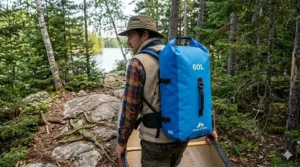
For families or groups doing extended backcountry routes, the SealLine Boundary Pack 115 is the largest dry bag for portage that still comes with a proper backpack suspension. It shares the same PVC-free, scrim-reinforced construction as the 70L version, just sized up to swallow a week’s worth of food, clothing, and a tent for two.
In real Canadian conditions — say, a rain-soaked week on the French River or a windy crossing on Georgian Bay — the 115L’s side-compression straps matter more than they would on a smaller bag, because they keep a partially loaded pack from shifting your balance on uneven portage trails. Reviewers consistently call out how dry their gear stays even after the bag gets tossed in and out of a canoe dozens of times across a multi-day trip, which is the entire point of paying a premium for this category.
✅ Pros: Largest size with full suspension system; excellent for multi-week trips; waist belt included
❌ Cons: Highest price point on this list; bulky if you’re not filling it close to capacity
Expect $230–$270 CAD — a significant spend, but appropriate for outfitters, families, or anyone planning a serious wilderness route this season.
7. Recreational Barrel Works 60L Canoe Barrel
This one isn’t a fabric dry bag at all, and that’s exactly why it deserves a spot on this list. Made by a small, family-run Ontario company, the 60L Canoe Barrel is a rigid, BPA-free HDPE container with a gasketed, lever-lock lid — the gold standard for keeping food away from bears and raccoons on Canadian Shield routes, something a roll-top fabric bag genuinely can’t do as well.
What most first-time barrel buyers don’t realize is that the barrel ships without a carrying harness; you pair it with a separate harness pack (sold by the same company or compatible alternatives) to actually portage it comfortably. Once rigged with a harness, the rigid shape also doubles as a camp stool or prep table at the campsite — a small but genuinely useful bonus that no fabric bag offers. It’s the closest thing to a Canadian-specific portage storage solution on this entire list.
✅ Pros: Critter-proof seal; rigid shape resists punctures on rocky portages; doubles as camp furniture
❌ Cons: Requires a separate harness purchase; less flexible packing shape than a fabric bag
Pricing generally runs $140–$170 CAD for the barrel alone, with harnesses sold separately in the $80–$140 CAD range.
Practical Usage Guide: Setting Up Your Dry Bag for the Season
Getting a new dry bag dialled in before your first trip takes ten minutes and saves you a soggy sleeping bag later.
First use: Inflate the bag slightly by rolling the top down with a bit of trapped air still inside — this isn’t just for buoyancy, it also helps you spot pinhole leaks before they ruin a trip. Submerge it briefly in a sink or bathtub and check the seams.
Cold-weather storage: PVC bags (like the Earth Pak line) stiffen and can crack if folded the same way every winter. Store them loosely rolled, not tightly compressed, in a heated space rather than a garage that drops below freezing — a common mistake among Ontario and Quebec paddlers storing gear for the off-season.
Loading technique: Push out excess air, roll the top down at least three full times before buckling, and avoid sharp items like tent stakes touching the seams directly. A thin dry sack or stuff sack inside the main bag protects against punctures from gear corners.
First 30 days — common mistake: Don’t overstuff a roll-top closure past its rated fill line. An overstuffed bag can’t roll down enough times to seal properly, and that’s the single most common reason a “waterproof” bag leaks on its very first trip.
Real-World Scenario: Matching the Bag to the Canadian Paddler
The Algonquin weekend tripper (Ottawa or Toronto-based): Doing two portages over a long weekend with a partner, carrying maybe 25 kg of combined gear. The Earth Pak 55L backpack or the Sea to Summit 65L both fit the bill — light enough trips that a full suspension pack isn’t worth the extra cost.
The Quetico or Temagami backcountry tripper: Multiple portages a day over 7–10 days, often solo or in pairs, with real elevation and rocky terrain. The SealLine Boundary Pack 70 earns its price here; the built-in suspension is the difference between an enjoyable portage and a painful one.
The family base-camp paddler (cottage country, Muskoka or the Kawarthas): Minimal portaging, mostly loading a canoe from a dock and paddling to a single campsite for the week. The Earth Pak 90L duffel and the Recreational Barrel Works 60L barrel (for food specifically) cover this use case well without paying for portability you won’t use.
How to Choose a Dry Bag for Canoe Camping in Canada
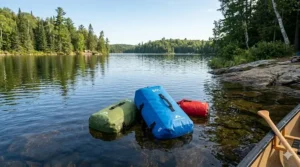
- Match capacity to trip length, not group size. A 55–65L bag covers most weekend trips for one person; longer trips or shared group gear push you toward 70–115L.
- Decide if you’re portaging or just paddling. If you’re carrying gear any real distance, pay for a pack with shoulder straps and a waist belt — your back will thank you.
- Check the material for your season. PVC is cheaper but stiffens in cold; TPU-laminated nylon (like Sea to Summit’s) stays flexible into shoulder-season trips.
- Confirm Amazon.ca availability and shipping. Some sizes or colours sell out faster than others, especially heading into the May long weekend.
- Budget separately for a food barrel if you’re in bear country. A fabric dry bag is not critter-proof; pair it with a hard-sided barrel for food storage on backcountry routes.
- Look for a warranty. Earth Pak’s 5-year and Sea to Summit’s lifetime warranty both reflect genuine confidence in seam durability.
- Buy one size larger than you think you need. Underfilled bags roll down tighter and seal better than overstuffed ones — a counterintuitive but useful rule.
Dry Bag vs. Barrel vs. Portage Pack: Which Wins on Canadian Routes?
| Factor | Fabric Dry Bag | Hard Barrel | Suspension Portage Pack |
|---|---|---|---|
| Critter-proofing | Poor | Excellent | Poor to fair |
| Portage comfort | Fair (if no straps) | Needs separate harness | Excellent |
| Packing flexibility | Excellent | Poor (rigid shape) | Good |
| Best for | Short trips, low portage count | Food storage, bear country | Multi-portage backcountry routes |
No single format wins outright — that’s really the takeaway. A fabric dry bag like the Earth Pak or Sea to Summit packs flexibly into a canoe’s awkward corners, but it won’t stop a determined raccoon. A hard barrel from Recreational Barrel Works seals out critters and survives rough handling, but needs its own harness and doesn’t compress to fit oddly shaped gear. A suspension pack like the SealLine Boundary line is the most comfortable to actually carry, but it’s the priciest option per litre. Most experienced Ontario and Quebec trippers end up running a mixed system: one suspension pack or large duffel for gear, plus a smaller hard barrel just for food.
Common Mistakes When Buying a Dry Bag
Buying based on litre count alone is the biggest one — a 90L bag sounds efficient until you’re the one hauling it solo over a 500-metre portage with no straps. Skipping the waist belt on anything over 55L is another frequent regret; reviewers on Amazon.ca who bought the smaller, strapless versions of larger bags often mention switching models within a season. A third common error is ignoring Canadian-specific warranty service — some bags purchased through third-party Amazon.ca sellers can complicate a US-based warranty claim, so it’s worth checking whether the seller is the brand itself or “Fulfilled by Amazon” versus a separate third-party marketplace seller before buying. Finally, plenty of paddlers buy a single large dry bag and assume it replaces a food barrel — in real bear and raccoon country across most of Canada’s Shield country, that assumption can cost you your food supply on night one.
Long-Term Cost & Care in Canadian Conditions
A $50 CAD PVC dry bag that needs replacing every two seasons of regular Algonquin tripping isn’t necessarily cheaper than a $130 CAD nylon bag backed by a lifetime warranty — do the math over five years of trips rather than the sticker price alone. Salt isn’t usually a factor for inland lake paddling, but UV exposure is: leaving a dry bag lashed to a canoe’s deck in direct sun for entire trips degrades PVC and nylon coatings faster than the manufacturers’ lab tests suggest, since most warranty testing doesn’t account for a full Canadian summer of UV at northern latitudes. Rinse bags with fresh water after any trip near road-accessible lakes (run-off can carry road salt residue in spring), and dry them fully inside-out before winter storage to avoid mildew, which voids most warranties anyway. Replacement parts — buckles, repair kits — are sold directly by Earth Pak, Sea to Summit, and SealLine, so a small site fee or shipping charge for a $10 buckle is usually cheaper than replacing the whole bag.
Canadian Regulations & Safety Standards for Paddlers
A dry bag itself isn’t a regulated safety item, but the canoe trip around it is. Transport Canada’s boating safety guidance sets out the minimum required safety gear for human-powered craft like canoes, and a properly fitted, Canadian-approved PFD for every paddler is the single most important item in that list — no dry bag is worth packing if it comes at the expense of skipping required safety gear. If you’re planning a backcountry route through a provincial park, Ontario Parks’ backcountry paddling page breaks down skill-level requirements and reservation rules by route, which is worth reading before you finalize your gear list, since a longer or more remote route changes how much redundancy (extra dry bags, food barrels) you actually need.
Frequently Asked Questions
❓ What size dry bag do I need for canoe camping?
❓ Is a dry bag fully waterproof if it's submerged in a canoe flip?
❓ Do Amazon.ca dry bags ship to remote Northern Ontario or rural addresses?
❓ Can I use a regular duffel-style dry bag for portaging, or do I need a pack?
❓ How do I keep food safe from bears and raccoons while canoe camping in Canada?
Conclusion
Picking the right dry bag for canoe camping comes down to one honest question: how far are you actually carrying it? If the answer is “from the truck to the dock,” an Earth Pak duffel or the Recreational Barrel Works barrel covers you affordably. If the answer involves real portages — Quetico, Temagami, Killarney, or anywhere with more than one carry a day — the SealLine Boundary packs or the Sea to Summit Big River are worth the higher price tag for comfort and seam durability alone. None of the seven options here are the “wrong” choice; they’re built for different trips, and matching the bag to your actual route, not just the biggest litre number on the listing, is what keeps your gear dry and your shoulders happy over a season of Canadian paddling.
✨ Found your next dry bag?
Don’t forget to compare current pricing on Amazon.ca before you check out — availability and promotions shift weekly, especially heading into peak paddling season.
Recommended for You
- 7 Best Dry Bags for a Multi-Day Kayak Trip in Canada (2026)
- Best 30L Dry Bag for Canoe Camping in Canada: 7 Top Picks (2026)
- Best Dry Bag for Day Hike in Canada 2026: 7 Top Picks
Disclaimer: This article contains affiliate links. As an Amazon Associate, I earn from qualifying purchases. If you purchase products through these links, we may earn a small commission at no additional cost to you.
✨ Found this helpful? Share it with your friends! 💬🤗
