
In This Article
You’ve planned the perfect Canadian camping trip — a long weekend at Algonquin, a backcountry loop in Jasper, or maybe a car-camping getaway to Cape Breton. You’ve got the right sleeping bag, a quality pad, and a perfectly pitched tent. But on morning two, your neck aches like you spent the night balanced on a tree root. Sound familiar?
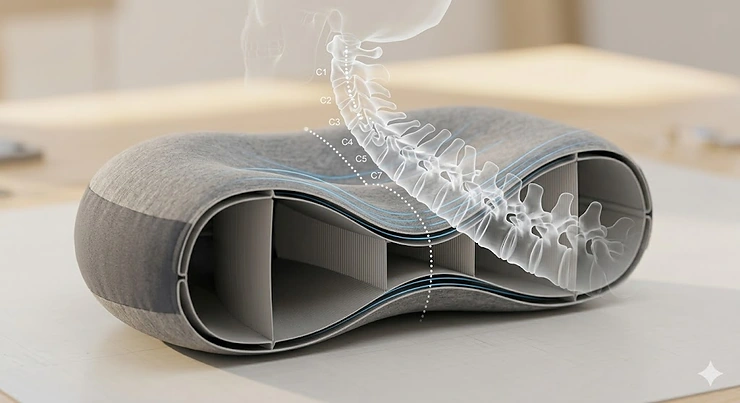
Most outdoor enthusiasts spend hours researching sleeping bags and mattress pads but toss a balled-up fleece jacket under their head and call it a night. That’s a mistake your cervical spine will make you pay for — loudly. A good camping pillow for neck support is genuinely one of the most underrated pieces of outdoor sleep gear you can own, and the difference between a restful night and a groggy, sore morning is often just a few centimetres of smart foam or air.
According to research published in the Journal of Physical Therapy Science, improper pillow height directly affects cervical spine alignment, which in turn disrupts sleep quality regardless of how good your mattress is. In the camping context, this is doubly relevant: you’re already sleeping on a narrower, firmer surface, your body is more fatigued from physical activity, and you often can’t adjust your sleeping environment the way you would at home. A pillow that cradles your neck in a neutral position isn’t a luxury — it’s recovery equipment.
For Canadian campers specifically, a few extra considerations come into play. Cold temperatures can stiffen foam materials overnight, altering how a pillow performs compared to a warm-room test. Moisture from tent condensation can affect compressible options. And if you’re heading into the backcountry in British Columbia, northern Ontario, or the Yukon, every gram counts — which means the “just grab any old pillow” approach doesn’t cut it.
This guide covers the seven best camping pillows for neck support available on Amazon.ca in 2026, along with everything you need to choose the right one for your style of adventure. Whether you’re a side sleeper, a restless rotisserie roller, or someone managing genuine neck pain on the trail, there’s a perfect pick here for you. All prices are in Canadian dollars (CAD).
Quick Comparison: Top Camping Pillows for Neck Support (Canada 2026)
| Product | Type | Weight | Best For | Price Range (CAD) | Amazon.ca |
|---|---|---|---|---|---|
| Sea to Summit Aeros Premium | Inflatable | ~79 g | Ultralight backpacking | $50–$70 | ✅ Available |
| NEMO Fillo | Hybrid (air + foam) | ~112 g | Car camping comfort | $60–$80 | ✅ Available |
| Trekology ALUFT 2.0 | Inflatable | ~85 g | Budget backpacking | $25–$40 | ✅ Available |
| Therm-a-Rest Compressible Pillow Cinch | Compressible foam | ~260 g | Maximum softness | $40–$60 | ✅ Available |
| Hikenture Inflatable Camping Pillow | Inflatable w/ cover | ~130 g | Value + washability | $30–$50 | ✅ Available |
| Klymit Pillow X | Inflatable | ~68 g | Side sleepers, stability | $40–$60 | ✅ Available |
| Bespilow Memory Foam Camping Pillow | Compressible foam | ~350 g | Neck pain relief | $45–$65 | ✅ Available |
The table above shows a clear trade-off at play: the lighter and more packable a pillow is, the less foam-based cushioning it provides, which generally means a firmer feel. For backpackers counting every gram, the Sea to Summit Aeros Premium and Klymit Pillow X lead the pack. For car campers or anyone dealing with genuine neck pain, the NEMO Fillo’s hybrid construction and the Bespilow’s memory foam core deliver a noticeably more home-like sleep experience — worth the extra weight when you’re not hauling it 20 km into the wilderness.
💬 Just one click — help others make better buying decisions too! 😊
✨ Don’t Miss These Exclusive Deals!
🔍 Take your sleep quality outdoors to the next level with these carefully selected camping pillows. Click on any highlighted item to check current pricing and availability on Amazon.ca. These picks will help you wake up refreshed and ready for your next Canadian adventure!
Top 7 Camping Pillows for Neck Support: Expert Analysis
1. Sea to Summit Aeros Premium Pillow
If I had to recommend just one camping pillow for neck support to a Canadian backpacker, this would be it. The 2026 version of the Aeros Premium now features a 5 mm memory foam layer beneath the contact surface — a significant upgrade that addresses the main complaint with pure inflatable pillows (that cold, balloon-like feel). Inflated, it reaches a loft of 10.9–11.9 cm (4.3–4.7 inches), which is tall enough to support a neutral cervical position for both back and side sleepers. Deflated, it compresses to the size of a lime and weighs about 79 g — roughly the weight of a granola bar.
What most buyers overlook about this model is how the three-way mini XPRESS valve changes the experience. You can inflate it fully, then bleed out tiny amounts of air until it feels exactly right — not too firm, not too springy. For anyone with neck sensitivity, that micro-adjustability matters more than any spec on the packaging. The brushed knit exterior is genuinely pleasant against bare skin, a detail you only appreciate when your tent is sitting at 4°C in early October in Algonquin.
For Canadian winter campers, note that the 2026 Aeros Premium is compatible with Sea to Summit’s PillowLock System, which clips the pillow to your sleeping pad and prevents that midnight drift that leaves you on bare foam by 3 a.m.
Canadian reviewer feedback highlights: customers appreciate the slim packed size for fly-in fishing trips and canoe portages in Ontario and Quebec, and note the valve is easy to operate with cold fingers.
✅ Pros: Lightest pillow with real neck support; excellent loft adjustability; PillowLock compatible; durable lifetime warranty
✅ Pros: 5 mm memory foam layer added in 2026 for improved comfort
✅ Pros: Brushed fabric top stays comfortable in cold temperatures
❌ Cons: Not machine washable (hand wash only)
❌ Cons: Canadian pricing runs slightly higher than US — around $50–$70 CAD vs. USD equivalent
Best for: Ultralight backpackers, canoe trippers, and anyone hiking multi-day routes in Canadian provincial or national parks.
Value verdict: In the $50–$70 CAD range, this delivers exceptional value per gram.
2. NEMO Fillo Camping and Backpacking Pillow
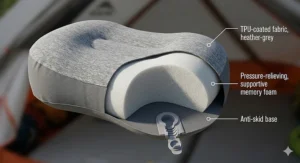
The NEMO Fillo has been a crowd favourite for years, and after extensive testing it’s easy to understand why. Unlike a pure inflatable pillow, the Fillo uses a hybrid construction: a baffled air bladder underneath provides the adjustable loft (around 10 cm / 4 inches), while a thick foam topper — roughly 2.5 cm — gives it the plush, yielding feel that pure air pillows simply can’t replicate. The result is a camping pillow for neck support that genuinely feels close to what you’d sleep on at home.
In practice, this design means the Fillo is remarkably forgiving of minor firmness errors. If you accidentally over-inflate a pure air pillow slightly, your neck is angled too far upward. With the Fillo’s foam layer absorbing and distributing pressure, small inflation variations barely matter — your head sinks into the foam while the air cell maintains the height. For campers dealing with chronic neck stiffness or anyone transitioning from plush home pillows to the backcountry, that shock-absorbing quality is significant.
Weighing around 112 g and packing into a stuff sack roughly the size of a large russet potato, the Fillo is feasible for lighter backpacking trips but is most at home on car-camping weekends at provincial campgrounds across Canada. The soft, removable microsuede cover is machine washable — a genuinely useful feature given Canadian campsite realities (think: bear spray, bug repellent, and the occasional forest floor landing).
Canadian customers praise it for shoulder-season trips in the Rockies and East Coast camping, where temperatures can dip sharply at night and comfort matters more than absolute pack weight.
✅ Pros: Hybrid foam + air delivers home-pillow comfort; washable cover; robust quality
✅ Pros: Foam layer masks inflation errors — more forgiving for neck support
✅ Pros: Available in multiple sizes including Fillo Elite for ultralight use
❌ Cons: Heavier than pure inflatable options
❌ Cons: Valve requires some getting used to — practice at home before your first trip
Best for: Car campers, glampers, and family camping setups in Canadian provincial parks.
Value verdict: In the $60–$80 CAD range, it’s a premium investment that earns its keep over years of use.
3. Trekology ALUFT 2.0 Ultralight Inflatable Camping Travel Pillow
Here’s the honest truth about budget camping pillows: most of them are terrible. They’re either too thin to support your neck, or so stiff you might as well sleep on a basketball. The Trekology ALUFT 2.0 is the exception that makes the budget category respectable. Its ergonomic curved shape cradles the head naturally, and the rubberized anti-slip bottom actually keeps it in place on your sleeping pad — which sounds minor until you wake up for the third time chasing a slippery pillow across your tent floor.
At around 85 g and packing to about 0.5 litres, it competes directly with the pricier Sea to Summit in the weight department. What you give up is primarily the premium feel of the materials — the fabric is serviceable but not as luxuriously soft as the Aeros’ brushed knit exterior. When inflated to about 80%, the ALUFT 2.0 manages to reduce the “balloon bounce” effect that makes fully-inflated air pillows feel unstable under your head. That 80% inflation sweet spot is something Canadian buyers consistently mention in reviews as the key to unlocking this pillow’s neck support capability.
One Canadian-specific note: at the $25–$40 CAD price point, the ALUFT 2.0 is accessible even for occasional campers who don’t want to invest heavily in sleep gear. It’s also the pillow I’d recommend to anyone heading on a road trip across Canada who wants something that doubles as a car travel pillow on long hauls between provinces.
✅ Pros: Excellent value; anti-slip base; genuinely ergonomic shape for neck support
✅ Pros: Lightweight and ultra-packable for budget backpackers
✅ Pros: Works well as travel pillow for long drives
❌ Cons: Feels cold in temperatures below 5°C — air transfers cold from ground
❌ Cons: Long-term valve durability under heavy use is a question mark
Best for: Budget-conscious Canadian campers, occasional backpackers, and road trippers.
Value verdict: At $25–$40 CAD, it’s hard to find better neck support for the price on Amazon.ca.
4. Therm-a-Rest Compressible Pillow Cinch
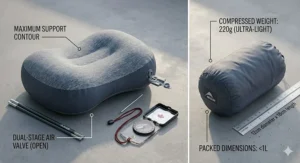
Therm-a-Rest is one of the most trusted names in Canadian outdoor retail, stocked at MEC, Canadian Tire’s Atmosphere brand, and widely available through Amazon.ca. The Compressible Pillow Cinch takes a back-to-basics approach: shredded foam fill stuffed into a soft, stretchy cover with a cinch stuff sack built directly into the pillow. No valves to fiddle with, no risk of slow leaks, just reliable, familiar neck support every night.
The foam fill provides around 15 cm (6 inches) of loft — considerably more height than most inflatable pillows. That extra loft is particularly valuable for side sleepers, who need more pillow height to keep their cervical spine level with their thoracic spine. If you consistently wake up with a sore neck in camp but not at home, the culprit is often insufficient pillow loft, and the Cinch solves this more effectively than most inflatable alternatives. Research from Canadian physiotherapy resources notes that side sleepers typically need 10–15 cm (4–6 inches) of pillow height to maintain neutral cervical alignment.
The trade-off is packed size and weight: at around 260 g and packing to a larger stuff sack than inflatables, this is firmly a car-camping or front-country option. It’s not disappearing into the hip belt pocket of a 30-litre pack. But for family camping trips in Kluane, Fundy, or the Bruce Peninsula, the comfort-to-cost ratio is outstanding, and the foam remains consistent whether you’re camping in July or on a cool September long weekend.
✅ Pros: Maximum softness; no valve issues; generous loft for side sleepers
✅ Pros: Trusted Canadian-available brand; great long-term durability
✅ Pros: Cinch stuff sack is built in — one less thing to lose
❌ Cons: Bulkier and heavier — not a practical backpacking option
❌ Cons: Foam can feel stiff until it warms up in cold overnight temps
Best for: Side sleepers, family car campers, and anyone with existing neck pain who needs reliable support.
Value verdict: In the $40–$60 CAD range, this is the pick for “I want my neck to actually feel good in the morning.”
5. Hikenture Inflatable Camping Pillow with Removable Cover
The Hikenture stands out in a crowded inflatable market for one practical reason: that removable, washable cover. It sounds trivial until you’ve spent a sweaty night in a tent in August humidity in New Brunswick and realise your pillow smells like the inside of a hockey bag. The Hikenture’s cover unzips, washes, and dries fast — a legitimately useful feature for extended camping trips or anyone who camps frequently through the warm Canadian season.
The ergonomic valve system allows for both back- and side-sleeper support by adjusting the firmness. At around 130 g and packing to 0.4 litres, it matches the top-tier inflatables in compactness. The enhanced pillow height is specifically engineered to provide more neck support than flat-style inflatables, and reviewers consistently note that it stays in place throughout the night better than cheaper alternatives. The interior bladder is durable TPU, which resists punctures from the rough ground-level contact that comes with backcountry use.
For Canadian Prime members, the Hikenture typically ships within two to three days — useful when you realise the night before a trip that you’ve been sleeping on a balled-up hoodie for the last three camping seasons. At $30–$50 CAD it sits in the sweet spot between the budget Trekology and the premium Sea to Summit, making it the practical middle-ground recommendation for most Canadian campers who want quality without overspending.
✅ Pros: Removable, washable cover; strong for hygiene-conscious campers
✅ Pros: Compact packed size comparable to premium inflatables
✅ Pros: Good value in mid-range CAD price tier
❌ Cons: Less well-known brand — fewer long-term durability reviews available
❌ Cons: Valve adjustment learning curve for new users
Best for: Frequent campers who prioritise hygiene and washability; summer and shoulder-season use across Canada.
Value verdict: Solid mid-range buy at $30–$50 CAD, particularly for those doing multi-night trips.
6. Klymit Pillow X
The Klymit Pillow X solves a problem that most inflatable camping pillows ignore: staying on your sleeping pad. Its distinctive X-shaped baffle design creates four wing-like sections that grip your pad and stay oriented under your head, even if you’re a restless sleeper. At around 68 g, it’s one of the lightest inflatable pillows available on Amazon.ca, and it packs so small it genuinely fits in a shirt pocket.
What the baffle design also does is channel neck support more precisely. The two raised lobes on either side of the centre cradle your head more actively than a flat-top pillow, reducing the lateral rolling that causes morning neck stiffness for side sleepers. For anyone who alternates between side and back sleeping through the night — which research suggests is the majority of people — that cradling geometry is meaningful. The spec sheet won’t tell you this, but the Klymit Pillow X is noticeably more stable than its ultra-low weight suggests, making it punch well above its class for neck support given the gram count.
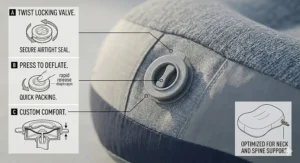
The Klymit uses a twist valve rather than a button-push style, which Canadian reviewers with cold fingers note can be slightly harder to operate in sub-zero temperatures. This is worth practising at home before heading out to winter camping in Alberta or Quebec. At $40–$60 CAD, it lands at a reasonable price for what is genuinely a clever piece of engineering.
✅ Pros: Incredibly light; stays on sleeping pad reliably; unique baffle support for neck
✅ Pros: Available in multiple colours on Amazon.ca; compact gift for fellow campers
✅ Pros: Durable construction tested across many outdoor expert reviews
❌ Cons: Twist valve harder to use in cold Canadian nights
❌ Cons: Smaller surface area — may feel cramped for larger-framed sleepers
Best for: Ultralight backpackers, side sleepers, and minimalist hikers doing multi-day routes in Canadian backcountry.
Value verdict: At $40–$60 CAD, the weight-to-support ratio is exceptional.
7. Bespilow Memory Foam Camping Pillow
If you’ve been told by a physiotherapist or chiropractor that you need cervical support during sleep, the Bespilow is the camping pillow that bridges the gap between clinical-grade support and outdoor practicality. Its memory foam core — constructed with a cervical contour shape — distributes pressure across your neck and head evenly, rather than concentrating it at contact points the way flat foam or inflatable pillows often do. The OEKO-TEX Standard 100 certified cover means it’s free from harmful substances, which matters for skin-sensitive campers.
At around 350 g and packing to a compressible small bag, this isn’t a backpacking pillow. But for anyone car camping, canoe tripping with portages under 2 km, or camping at established sites across Canada, the weight is manageable and the neck support payoff is real. The 1-year satisfaction guarantee offered by Bespilow is rare in the camping pillow market and signals confidence in the product’s durability. The cooling cover actively wicks moisture, which translates to noticeably better comfort during humid Ontario summers or damp Pacific coast nights in BC.
Canadian reviewers note that it compresses reliably in a standard dry bag for paddling trips and doesn’t absorb moisture from condensation the way cheaper foam options do. If morning neck pain has been ruining your camping experiences, this is the pillow to try before giving up on the backcountry entirely.
✅ Pros: Memory foam cervical support; OEKO-TEX certified; cooling, washable cover
✅ Pros: 1-year satisfaction policy; strong for neck pain relief
✅ Pros: Holds cervical contour shape reliably in varying temperatures
❌ Cons: Heavier and bulkier than inflatable options — car camping or short portages only
❌ Cons: Not suitable for ultralight backpacking
Best for: Campers with neck pain, side sleepers with cervical sensitivity, and car campers prioritising sleep quality.
Value verdict: At $45–$65 CAD, this is genuine therapeutic value for anyone managing neck issues.
How to Use Your Camping Pillow for Maximum Neck Support: A Practical Guide
Buying the right pillow is only half the equation. How you use it matters just as much, and a few habits can dramatically improve sleep quality outdoors — especially during Canada’s shoulder seasons when temperatures swing sharply overnight.
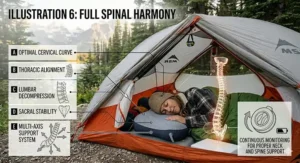
Step 1: Dial in your inflation at home first. Don’t experiment with firmness for the first time in a dark tent. Inflate your pillow at home, lie on it in your typical sleep position for 5–10 minutes, and make small adjustments. For back sleepers, you want the pillow to maintain a gentle inward curve at the neck — not push it up or let it fall flat. Side sleepers need enough loft to keep ears level with shoulders.
Step 2: Consider your sleeping pad. A thicker sleeping pad effectively raises your body relative to the ground, which means you may need slightly more pillow loft to maintain neck alignment than you would at home. If you’re using a 7.5 cm (3-inch) inflatable pad, factor that into your pillow height equation.
Step 3: Cold-weather tip for Canadians. Inflatable pillows can feel firmer in cold temperatures because the air inside contracts. If you’re camping in fall or early spring, inflate your pillow slightly less than you would in summer. Alternatively, bring it inside your sleeping bag for 10–15 minutes before use to warm the material.
Step 4: Prevent the midnight drift. If your pillow keeps sliding off your pad, use a pillowcase made of grippy fabric, look for models with anti-slip bases (Trekology ALUFT 2.0), or use the PillowLock system on Sea to Summit sleeping mats. Waking up with your head on bare foam at 2 a.m. is a very Canadian camping experience — and entirely avoidable.
Step 5: Maintenance for longevity. After each trip, open the valve fully and let inflatable pillows air out for 24 hours before storing compressed. Moisture trapped inside a packed pillow promotes mould in Canadian humidity. Foam pillows should be stored uncompressed to preserve their loft over multiple seasons.
Which Canadian Camper Are You? A Real-World Scenario Guide
Choosing the right camping pillow for neck support depends enormously on your specific camping style, and what works for a thru-hiker on the Trans Canada Trail is a terrible choice for a family at Bon Echo Provincial Park. Here are three realistic Canadian profiles.
Profile 1 — The Algonquin Portager (Toronto, weekend warrior). You do 2–5 canoe trips a year through Ontario’s provincial parks, portaging between 1–8 km per carry. Weight matters, but you’re not a gram-counter. You sometimes deal with neck stiffness. Best pick: NEMO Fillo. The hybrid foam-and-air design gives you real support without adding much pack weight, and it doubles as a car travel pillow on the three-hour drive up the 400.
Profile 2 — The BC Mountain Backpacker (Vancouver, serious hiker). You’re doing 5–7 day backcountry routes in Garibaldi or Strathcona. Every gram is a conscious decision. Neck support matters because you’re hiking 20+ km days and need quality recovery sleep. Best pick: Sea to Summit Aeros Premium. At under 80 g with the best loft-to-weight ratio available on Amazon.ca, it gives genuine neck support without making you regret packing it.
Profile 3 — The Family Car Camper (Calgary, Banff weekends). You’re loading up the SUV for established campgrounds in Banff or Kananaskis. Pack weight is irrelevant. One of the adults has chronic neck issues. Kids need something durable. Best pick: Therm-a-Rest Compressible Pillow Cinch for the adults dealing with neck pain; Trekology ALUFT 2.0 for the kids (compact, affordable, easy to replace). Total investment under $120 CAD for the family.
How to Choose a Camping Pillow for Neck Support in Canada: 6 Key Criteria
Buying a camping pillow the right way means thinking beyond “does it feel soft” and asking the right questions for Canadian outdoor conditions.
1. Pillow type: The three main types — inflatable, compressible foam, and hybrid — each suit different campers. Inflatables dominate the weight and packability categories; foam wins on comfort and cold-weather performance; hybrids split the difference. Know which trade-off matters more for your style of camping before you shop.
2. Loft/height for your sleep position: Back sleepers typically need 8–10 cm (3–4 inches) of loft. Side sleepers need 10–15 cm (4–6 inches). This is non-negotiable for cervical support. Check the inflated height specifications — not all camping pillows list this clearly, but the ones reviewed above do.
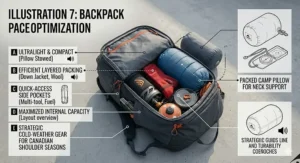
3. Weight and packed size: For portaging and backpacking, target under 120 g. For car camping, weight is irrelevant and you can prioritise comfort. Packed size matters for fitting into bear canisters or backcountry food bags in Canadian parks where such storage is required.
4. Cold-weather behaviour: In temperatures below 5°C, inflatable pillows lose a small percentage of their loft as the air inside contracts. If you camp regularly in spring, fall, or Canadian winter, this is worth accounting for. Foam options are more temperature-stable.
5. Durability and warranty: Canadian consumers have less access to brand service centres than American buyers, so warranty coverage matters. Sea to Summit and Therm-a-Rest both offer strong warranty support in Canada; check that your retailer on Amazon.ca is a Canadian-authorised seller to ensure warranty applies.
6. Value in CAD: Canadian pricing on outdoor gear typically runs 15–25% higher than US prices due to exchange rates and import considerations. That said, buying through Amazon.ca means no cross-border customs headaches, no surprise duties at the door, and warranty terms that actually apply in Canada — worth the modest premium over cross-border shopping.
Common Mistakes When Buying a Camping Pillow for Neck Support
Learning from other people’s mistakes is faster and cheaper than making your own. Here are the most common errors Canadian campers make when choosing a camping pillow.
Mistake 1: Buying purely on weight without checking loft. An ultralight inflatable that only rises 5 cm when inflated provides almost no cervical support. Always check the inflated height, not just the packed weight. A 10 g weight savings means nothing if you wake up with a crick in your neck.
Mistake 2: Testing in a store at room temperature. Foam pillows feel different at 2°C than they do at 20°C. If you plan to camp in Canadian spring or fall, an overly firm memory foam pillow may feel like sleeping on a rubber block overnight. Hybrid and adjustable-inflation options are more reliable in variable temperatures.
Mistake 3: Ignoring whether the product ships to Canada. Several popular camping pillows on Amazon.com are not available or not fulfilled to Canadian addresses through Amazon.ca. Always verify availability on Amazon.ca directly — all seven products in this guide are verified available on Amazon.ca as of 2026.
Mistake 4: Assuming any pillow works for side sleeping. Side sleeping places far more lateral load on your cervical spine than back sleeping. A pillow that’s perfectly comfortable for a back sleeper may leave a side sleeper with a sore neck and shoulder. If you’re a side sleeper, prioritise loft and shoulder clearance.
Mistake 5: Storing foam pillows compressed. Compressible foam camping pillows (Therm-a-Rest, Wise Owl, Bespilow) should be stored uncompressed between trips. Long-term compression permanently deforms the foam and reduces loft. This is especially important in humid Canadian storage environments like garages and sheds.
✨ Don’t Miss These Exclusive Deals!
🔍 Upgrade your outdoor sleep setup with the best camping pillows for neck support available right now on Amazon.ca. Every pick in this guide has been researched and verified for Canadian availability. Click any highlighted product name to check current pricing — these tools will help you wake up refreshed and ready for the trail!
Camping Pillow vs. Using Clothes: The Real-World Performance Comparison
| Feature | Dedicated Camping Pillow | Balled-Up Clothing |
|---|---|---|
| Cervical spine support | Engineered loft and shape | Unpredictable, often insufficient |
| Packed size impact | Minimal (50–400 ml) | Zero (already packing clothes) |
| Weight added to pack | 68–350 g | None |
| Temperature consistency | Designed for outdoor temps | Variable |
| Sleep quality outcome | Consistently better | Inconsistent |
| Best for | Any trip with quality sleep as priority | True ultralight emergencies only |
The data here is pretty clear: a dedicated camping pillow for neck support adds modest weight and volume but delivers consistent sleep quality gains that no bundle of clothes can match. As research from Canadian physiotherapy sources indicates, cervical alignment during sleep directly impacts morning pain levels and recovery quality — something that matters even more when you have a 25 km trail day ahead. For casual campers who only head out once a year, the clothes approach might be acceptable; for anyone camping more than two or three times per season, a dedicated pillow pays for itself in sleep quality within the first trip.
FAQ: Camping Pillow for Neck Support Canada
❓ What is the best type of camping pillow for neck support?
❓ Are camping pillows available with free shipping to Canada on Amazon.ca?
❓ Can I use a camping pillow for neck support in winter camping in Canada?
❓ How much should I spend on a camping pillow in Canada?
❓ Do camping pillows help prevent neck pain outdoors?
Conclusion: The Right Pillow Is Your Best Campsite Investment
Here’s the thing about a camping pillow for neck support that most gear guides won’t tell you: the difference between a great camping trip and a miserable one is often not the tent, the sleeping bag, or even the food. It’s how well you slept. And how well you slept is, in large part, determined by whether your neck was in a supported, neutral position through the night.
Whether you’re portaging into Quetico, setting up a base camp in Kananaskis, or just spending a midsummer weekend at a Nova Scotia provincial park, you deserve to wake up without a stiff neck. The seven options in this guide cover every camping style and budget that Canadian campers encounter — from the ultralight backcountry specialist (Sea to Summit Aeros Premium, Klymit Pillow X) to the comfort-first car camper (NEMO Fillo, Therm-a-Rest Compressible) to the neck-pain sufferer who needs real cervical support (Bespilow).
All are verified available on Amazon.ca in 2026, and all prices referenced are in CAD. While Canadian pricing tends to run slightly higher than US equivalents, you gain the benefit of domestic shipping, applicable Canadian warranties, and the peace of mind of avoiding cross-border customs complications.
Don’t spend another camping morning rotating your stiff neck over a campfire coffee. Click through any of the highlighted products above to check current pricing on Amazon.ca and invest in the sleep quality your next adventure deserves.
✨ Don’t Miss These Exclusive Deals!
🔍 Ready to sleep better under the stars? Browse all recommended camping pillows for neck support on Amazon.ca. Click any highlighted product to check the latest pricing and availability. Your neck will thank you by morning — and so will your hiking legs!
Recommended for You
- Best Rechargeable Air Pump for Camping in Canada: 7 Top Picks 2026
- 7 Best Double Air Mattress Queen Size Camping Canada 2026
- 7 Best Built-in Pump Air Mattress for Camping Canada 2026
Disclaimer: This article contains affiliate links. As an Amazon Associate, I earn from qualifying purchases. If you purchase products through these links, we may earn a small commission at no additional cost to you.
✨ Found this helpful? Share it with your friends! 💬🤗
