In This Article
A kids PFD for canoe camping is a Transport Canada-recognized personal flotation device sized and shaped for a child’s body weight and proportions, designed to keep a small paddler face-up and afloat during multi-day backcountry trips. That’s the textbook definition. Here’s the version that actually matters to you, standing in a gear shop with a squirming eight-year-old: the “right” PFD is the one your kid will actually keep buckled for six hours a day, three days into a portage route, when nobody’s reminding them every ten minutes.
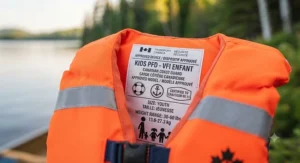
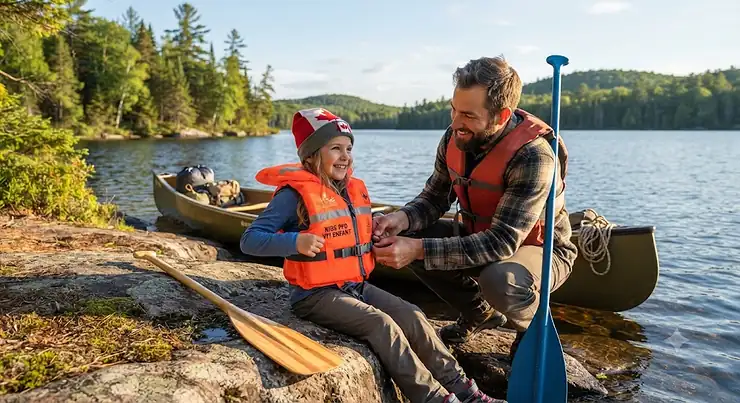
Canoe camping asks more of a life jacket than an afternoon at the cottage dock does. Your child will wear it loading the canoe, sitting through a lunch break on a rocky point, scrambling over a portage, and then wearing it again the next morning before the coffee’s even done. If it chafes, rides up, or pinches under the chin, it comes off — and a PFD in the dry bag saves nobody. So this guide isn’t a spec sheet dump. It’s the reasoning behind seven real, currently available options, how to size them by weight rather than age, why that little loop on the collar matters more than most parents realize, and where the adults fit into the safety picture too.
Everything below is built from real product specifications, publicly available reviewer sentiment, and Transport Canada’s own guidance — not invented testimonials. Where the data is genuinely uncertain (a review count, an out-of-stock size), we’ll say so rather than paper over it.
Quick Comparison Table
| Product | Weight Range | Best For | Approx. Price (CAD) |
|---|---|---|---|
| Salus Nimbus Child Vest | 14–27 kg (30–60 lbs) | All-around canoe camping comfort | C$100–C$130 |
| Level Six Stingray Kids PFD | 9–41 kg (across sizes) | Budget-conscious families | C$60–C$90 |
| Level Six Swordtail Neoprene | 9–41 kg (across sizes) | Kids who hate “life jacket itch” | C$90–C$120 |
| Mustang Lil’ Legends | 9–23 kg (20–50 lbs) | Nervous swimmers, extra flotation | C$70–C$100 |
| Astral Otter 2.0 Kids | 14–29 kg (30–65 lbs) | Whitewater-adjacent trips | C$90–C$130 |
| NRS Crew Youth PFD | 25–40 kg (55–88 lbs) | No-frills flatwater touring | C$60–C$85 |
| Stearns Youth Classic | 20–36 kg (50–80 lbs) | First-time buyers on a budget | C$35–C$55 |
A quick read of this table tells a bigger story than the numbers alone: there’s no single “best” PFD here, because weight range and personality are doing most of the work. The Salus Nimbus Child Vest and Level Six Swordtail Neoprene sit at the comfort-first end, which matters enormously for all-day wear on a multi-day trip, while the Stearns Youth Classic and NRS Crew Youth PFD are built for families who just need certified, reliable flotation without extras. Note the overlapping weight brackets — this is intentional, since PFD sizing runs on chest size and weight, not a clean age cutoff, so two eight-year-olds can need two completely different sizes.
💬 Just one click — help others make better buying decisions too!😊
Top 7 Kids PFDs for Canoe Camping: Expert Analysis
1. Salus Nimbus Child Vest — soft foam built for all-day comfort
Salus designed the Nimbus from the ground up for smaller bodies rather than shrinking an adult PFD, and that shows the moment you put it on a fidgety kid. The child version covers roughly 14–27 kg (30–60 lbs), with a shorter front panel that doesn’t ride up under the chin when your kid is sitting low in a canoe seat — a genuinely useful detail on a multi-hour paddle day, since a tall front panel is one of the top reasons kids refuse to keep a PFD zipped. It’s built by a Canadian company in Waterloo, Ontario, which also means sizing tends to track Canadian growth charts more closely than U.S.-market imports.
Based on the spec comparison, the soft, rounded foam construction and elasticized back put this squarely in the “comfort-first” category rather than the “bombproof whitewater” category — exactly right for flatwater canoe camping, less ideal if your trip involves technical rapids. Reviewers across paddling retailers consistently note that kids tend to forget they’re wearing it after the first few minutes, which — as any camping parent knows — is the single most important review any kid’s gear can get.
Pros:
- ✅ Shorter front panel stays comfortable while seated in a canoe
- ✅ Soft foam and rounded edges reduce chafing on long days
- ✅ Leg harness prevents ride-up during active play
Cons:
- ❌ Premium comfort features come at a higher price point than basic vests
- ❌ Sizing runs specific to weight brackets, so mid-growth-spurt kids may need to size up mid-season
Expect to pay in the C$100–C$130 range at the time of research; check current price before buying, since retailer pricing shifts seasonally. For a kid who spends real days in a canoe rather than an afternoon at the beach, the extra cost buys comfort that translates directly into a kid who keeps the PFD on.
2. Level Six Stingray Kids PFD — Canadian-approved and budget-friendly
Level Six is a Canadian paddlesports company, and the Stingray line is built specifically around Canadian Coast Guard approval rather than being a U.S. import with a sticker slapped on. It comes in infant, child, and youth breakdowns spanning roughly 9–41 kg, with reflective piping stitched into the nylon shell — a small feature that matters far more than it sounds when you’re trying to spot a kid’s silhouette against choppy water at dusk near camp.
What most buyers overlook about this model is the strap-adjustment system: it’s woven directly into the vest panels rather than bolted on with separate webbing, which means fewer pinch points and less bunching under a backpack strap or canoe thwart. On paper this reads like a minor manufacturing detail, but in practice it’s the difference between a PFD your kid tolerates and one they fight you over every morning. Aggregated retailer feedback describes it as reliably comfortable and durable through a full paddling season, though it lacks the plush foam of pricier options.
Pros:
- ✅ Canadian Coast Guard approved with clear weight-based sizing
- ✅ Reflective piping improves visibility near camp and on the water
- ✅ Integrated webbing reduces bunching and pinching
Cons:
- ❌ Nylon shell feels stiffer than neoprene alternatives
- ❌ Fewer colour options than some competing brands
At around C$60–C$90 depending on size, the Level Six Stingray Kids PFD is one of the strongest value plays on this list — solid certification and thoughtful design without the premium foam price tag.
3. Level Six Swordtail Neoprene Kids PFD — soft neoprene, no “life jacket itch”
The standout feature here is right in the marketing copy, and it happens to be true: 1.5mm neoprene construction instead of stiff nylon panels. Reviewers and retailers describe the fabric as noticeably softer against bare skin, which matters enormously for a kid who’s been swimming, sweating, and re-buckling a vest all day at camp. The Swordtail is rated for both U.S. Coast Guard and Canadian Coast Guard use, spanning infant through youth sizes.
Based on the spec comparison, the reinforced nylon grab loop on the collar is worth calling out on its own — it’s a high-strength pull point specifically engineered for quick water rescues or hauling a kid back over a gunwale, not just a decorative tab. Combined with the anti-bunch webbing system, this model is aimed squarely at active, wiggly kids doing kayaking, paddleboarding, and canoe portaging in the same week. What the spec sheet won’t tell you, but user reports suggest, is that neoprene retains a bit more water weight when wet than nylon shells — a minor trade-off for the comfort gain.
Pros:
- ✅ Neoprene fabric reduces chafing versus stiff nylon vests
- ✅ Reinforced grab loop built for actual rescue use
- ✅ Anti-bunch webbing keeps straps from pinching
Cons:
- ❌ Neoprene holds slightly more water weight when soaked
- ❌ Runs at a higher price point than nylon equivalents
Priced roughly C$90–C$120 depending on size, this is the pick for parents whose kids have historically refused to keep a PFD on because of fabric discomfort.
4. Mustang Lil’ Legends — maximum float for nervous swimmers
Mustang has built watersports safety gear in Canada for decades, and the Lil’ Legends line — covering roughly 9–23 kg — leans hard into extra buoyancy rather than a streamlined profile. Independent gear reviewers describe it as the “floatiest” option they tested among comparable toddler and small-child vests, meaning your kid sits noticeably higher in the water than in a minimalist design.
Here’s what that means in practice: for a nervous swimmer, or a family doing their first-ever canoe camping trip, that extra flotation is reassurance you can see, not just a spec on a tag. The trade-off, and it’s an honest one, is bulk — this isn’t the vest for a confident nine-year-old who wants full paddling range of motion. Reflective accents and a substantial grab loop round out the safety features, both genuinely useful for a parent scanning the water from a canoe seat.
Pros:
- ✅ Noticeably higher float than streamlined competitors
- ✅ Reflective accents aid visibility from a distance
- ✅ Sturdy grab loop built for quick water pickups
Cons:
- ❌ Bulkier fit restricts arm movement more than slim designs
- ❌ Better suited to smaller kids than confident paddlers
Expect a price in the C$70–C$100 range. For families whose top priority is visible, obvious flotation over athletic freedom of movement, this is a defensible premium pick.
5. Astral Otter 2.0 Kids — built for kids who paddle hard
Astral built the Otter 2.0 for kids who are already paddling with intent — not just floating at the dock, but actively kayaking or canoeing rapids-adjacent water. Independent gear guides consistently flag it as an industry leader for young paddlers moving beyond flatwater, with a fit that tracks closer to a scaled-down adult whitewater vest than a typical kids’ recreational design.
The honest analytical take here: this is a “grow into it” purchase for a family that’s serious about paddling as a multi-year pursuit, not a casual annual-cottage-trip item. Reviewers describe the segmented, beveled foam as flexible enough for real paddling strokes rather than the boxy stiffness common in entry-level vests, which matters if your canoe camping route includes any moving water at all. It’s priced accordingly — this sits at the premium end of the kids’ lineup.
Pros:
- ✅ Segmented foam moves with active paddling strokes
- ✅ Trusted by whitewater-adjacent paddling communities
- ✅ Durable construction built for repeated hard use
Cons:
- ❌ Premium pricing versus flatwater-only alternatives
- ❌ More vest than most casual canoe camping trips require
At roughly C$90–C$130, the Astral Otter 2.0 Kids is best reserved for families whose canoe camping already edges into moving water or multi-year serious paddling.
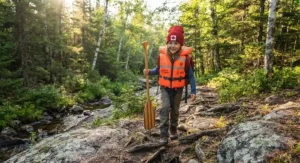
6. NRS Crew Youth PFD — no frills, reliable flatwater safety
NRS built the Crew Youth line, covering roughly 25–40 kg (55–88 lbs), around a simple premise: some families just want a certified, comfortable, all-day PFD without extra features driving up the price. Retailer descriptions are blunt about this — “no frills or fancy stuff” — and that’s not a knock, it’s an honest positioning statement.
Based on the spec comparison, the Crew Youth trades premium foam contouring and neoprene comfort for straightforward reliability, which makes it a strong match for close-to-shore family paddling and shorter canoe camping trips where the vest sees moderate, not extreme, daily wear. What most buyers overlook is that “basic” doesn’t mean under-built — NRS is an established whitewater safety brand, and its youth line still meets the same flotation and turning-capability standards as pricier competitors, just without the marketing gloss.
Pros:
- ✅ Straightforward, comfortable all-day fit for older kids
- ✅ Backed by an established whitewater safety brand
- ✅ Competitively priced against feature-heavy alternatives
Cons:
- ❌ Limited additional features like specialty grab handles
- ❌ Weight range starts higher, so it won’t fit younger kids
Priced around C$60–C$85, the NRS Crew Youth PFD suits older kids on shorter, calmer canoe camping routes where budget matters more than bells and whistles.
7. Stearns Youth Classic — the accessible entry point
The Stearns Youth Classic is frequently cited by independent gear reviewers as the go-to budget pick for kids just getting into canoeing, flatwater kayaking, and casual paddling, covering roughly 20–36 kg (50–80 lbs). It won’t win a comfort-feature comparison against neoprene or contoured-foam competitors, but that’s not really its job.
Here’s the honest read: for a family testing whether canoe camping is even going to be a recurring activity, or outfitting a group of cousins for a single weekend trip, spending premium dollars on a PFD a kid might outgrow in one growth spurt doesn’t make sense. Reviewers consistently frame it as reliable, certified flotation at an accessible price rather than a “buy once, keep forever” investment piece — which, for many families, is exactly the right calculation.
Pros:
- ✅ Lowest price point among certified options on this list
- ✅ Straightforward sizing for first-time buyers
- ✅ Well-suited to casual, occasional canoe outings
Cons:
- ❌ Basic foam and shell feel less refined than premium picks
- ❌ Fewer comfort features for genuinely all-day multi-day wear
At roughly C$35–C$55, the Stearns Youth Classic is the sensible starting point if you’re not yet sure canoe camping is a recurring family tradition.
Benefits vs Traditional Alternatives
| Safety Approach | Face-Up Flotation | Comfort for All-Day Wear | Transport Canada Compliance |
|---|---|---|---|
| Dedicated Kids PFD (e.g. Salus Nimbus Child Vest) | Yes — designed for it | High | Yes |
| Adult PFD “sized down” | Rarely reliable | Low — gaps and slippage | No |
| Inflatable water wings / arm floats | No | N/A | Not approved |
| Puddle jumper-style flotation | Limited | Moderate | Varies by model |
The pattern here is stark once you see it laid out: an adult PFD cinched as tight as possible on a small child still won’t reliably turn them face-up, because the flotation panels and buoyancy distribution are built around adult proportions, not a child’s centre of gravity. Water wings and puddle jumpers are popular at the beach precisely because they’re comfortable, but neither is a Transport Canada-recognized flotation device, and neither is appropriate for a canoe camping trip where a real capsize is a real possibility. A dedicated, correctly sized kids PFD like the Salus Nimbus Child Vest or Level Six Stingray Kids PFD isn’t a nice-to-have upgrade — it’s the only option on this table actually built and certified for the job.
Price Range & Value Analysis
| Product | Price Range (CAD) | Value Verdict |
|---|---|---|
| Stearns Youth Classic | C$35–C$55 | Best for occasional, budget-first families |
| Level Six Stingray Kids PFD | C$60–C$90 | Best all-around value for regular canoe camping |
| NRS Crew Youth PFD | C$60–C$85 | Solid no-frills pick for older kids |
| Mustang Lil’ Legends | C$70–C$100 | Worth it for maximum reassurance with nervous swimmers |
| Level Six Swordtail Neoprene | C$90–C$120 | Justified if comfort has been a past dealbreaker |
| Salus Nimbus Child Vest | C$100–C$130 | Premium comfort for frequent multi-day trippers |
| Astral Otter 2.0 Kids | C$90–C$130 | Best only if paddling includes moving water |
Looking at the value spread, the real cost-per-use calculation isn’t about which PFD is cheapest up front — it’s about how many weekends a year your family actually straps into a canoe. A family that camps three or four times a season gets real value out of the comfort-forward Level Six Swordtail Neoprene or Salus Nimbus Child Vest, because the extra C$40–C$60 amortizes across a dozen wear-days. A once-a-summer cottage family is better served putting that money toward the Stearns Youth Classic or Level Six Stingray Kids PFD and reserving the splurge for when the trips actually become a pattern.
Practical Usage Guide: Fitting and Wearing Your Kid’s PFD on Canoe Camping Trips
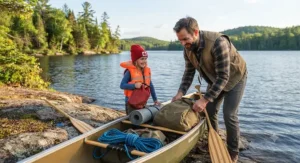
Getting the PFD out of the box is the easy part. The first-use check that actually matters: buckle it up, then grab the shoulders and pull up hard. If the vest rides up past your child’s chin or ears, it’s too big — no amount of strap-tightening fixes a fundamentally oversized vest, and this is the single most common first-30-days mistake parents make. Do this test in your driveway before the trip, not at the put-in with a canoe full of gear and a schedule to keep.
For maintenance, rinse the vest in fresh water after every trip involving lake or river swimming, since sediment and sunscreen residue break down foam and stitching faster than most parents expect. Let it air dry fully before storing — packed away damp in a dry bag between trips is a fast way to grow mildew into the foam panels. Every spring, before the first trip, re-check the fit against your kid’s current weight; a single growth spurt over the off-season is enough to push a “child” size into “youth” territory. A common early mistake is buying a size “to grow into” — resist it. A PFD that’s loose in month one is a PFD that’s loose (and unsafe) in month one, regardless of how it fits by August.
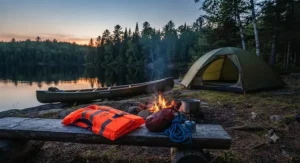
Real-World Scenario: Matching the Right PFD to Your Family’s Canoe Trip
Picture three different families heading out this summer, because “best PFD” really does depend on who’s wearing it. The first is a young family with a five-year-old on their first-ever overnight canoe camping trip, budget tight, uncertain if this becomes a yearly thing — the Stearns Youth Classic or Level Six Stingray Kids PFD covers the essentials without a premium price tag riding on an unproven hobby.
The second is a family with a nervous eight-year-old swimmer heading into a multi-day interior trip with several portages — here the Mustang Lil’ Legends or Salus Nimbus Child Vest earns its keep, since visible extra flotation and all-day comfort matter more than athletic freedom of movement when a kid is already anxious about deep water. The third is a paddling family whose ten-year-old already kayaks confidently and whose route touches moving water near camp — the Astral Otter 2.0 Kids fits a kid who needs real range of motion and a vest built for more than gentle flatwater. None of these families is wrong; they’re just solving for different variables — trip frequency, swimmer confidence, and water conditions.
Problem → Solution: Common Kids PFD Headaches on the Water
Problem: My kid keeps unbuckling the PFD “because it’s hot.” Solution: heat complaints usually trace back to stiff, non-breathable shells. A neoprene option like the Level Six Swordtail Neoprene or a mesh-backed design like the Salus Nimbus Child Vest ventilates noticeably better than basic nylon vests over a full day.
Problem: The vest rides up every time my kid sits down in the canoe. Solution: this is almost always a front-panel-length issue. Look specifically for a “shorter front panel” design, a feature the Salus Nimbus Child Vest calls out directly, since it’s built to stay in place while seated rather than while standing.
Problem: I can’t find my kid’s head fast enough if they go in the water. Solution: prioritize a reinforced grab handle — covered in detail below — rather than relying on fabric alone to haul a kid back over the gunwale.
Problem: The PFD fit perfectly in June and is tight by August. Solution: weight-based sizing means a summer growth spurt is a real risk on multi-week trips; pack the next size up in the vehicle if your child is near a bracket edge.
How to Choose a Kids PFD for Canoe Camping
- Start with current weight, not age. Every PFD on this list is sized by kilograms and pounds, not birthdate — measure your kid the week before you shop.
- Prioritize Transport Canada or Canadian Coast Guard approval. This isn’t optional for a real backcountry trip; check the label, not the marketing copy.
- Test the pull-up fit. A properly sized vest should not ride past the ears when yanked upward at the shoulders.
- Weigh comfort features against trip length. A weekend cottage outing tolerates a basic vest; a five-day interior route rewards neoprene or contoured foam.
- Check for a real grab handle. Reinforced, not decorative — this matters in an actual rescue.
- Match buoyancy style to swimmer confidence. Nervous swimmers benefit from higher-float designs; confident paddlers benefit from streamlined mobility.
- Buy slightly ahead of a growth spurt, never far behind it. Oversized “grow into it” purchases undermine the entire safety case for a properly fitted PFD.
Child PFD Sizing by Weight: Getting the Fit Right
Child PFD sizing by weight is the single most misunderstood part of this purchase, and it’s worth being blunt about why: age is a terrible sizing proxy, because two same-age kids can differ by 9 kg (20 lbs) or more. Nearly every product in this guide uses weight brackets — the Level Six Stingray Kids PFD and Level Six Swordtail Neoprene both break down into infant, child, and youth tiers spanning roughly 9–41 kg, while the Salus Nimbus Child Vest targets 14–27 kg specifically.
The practical move: weigh your child within a week or two of buying, not from memory, and size to their current weight rather than a projected end-of-summer number. If your child sits right at a bracket boundary — say, 26–28 kg, straddling the line between “child” and “youth” on several of these models — size down for a snugger, more protective fit rather than up for room to grow. A PFD that’s slightly snug still does its job; one that’s loose can slip up over a child’s head in the water, which defeats the entire purpose of wearing it.
Grab Handles on Kids’ PFDs: Why This Feature Matters
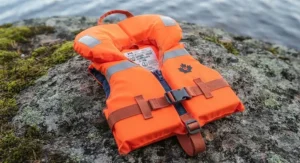
Grab handles on kids’ PFDs sound like a minor accessory until you actually need one — then it’s the single feature that determines how quickly you get your child back into the canoe. The Level Six Swordtail Neoprene specifically markets its collar-mounted loop as a “reinforced rescue grab handle,” built from high-strength nylon rather than the same soft fabric as the rest of the vest, precisely because it needs to hold real weight under real stress. The Mustang Lil’ Legends and Salus Nimbus Child Vest both include comparable grab loops positioned at the collar or shoulder.
What most buyers overlook is the placement, not just the presence, of the handle. A handle mounted high on the collar, behind the head, lets an adult haul a child up and back without twisting their neck or torso — a genuinely different mechanical outcome than a handle sewn onto a shoulder strap. If your canoe camping route includes any current, chop, or distance from shore, treat the grab handle as a non-negotiable feature rather than a bonus, and check that it’s stitched into a reinforced panel rather than just the outer fabric shell.
Adult PFD for Canoeing: Gearing Up the Whole Family
An adult PFD for canoeing deserves its own honest mention here, because kids’ safety on the water is only as strong as the adults modeling it. Transport Canada’s own boating guidance is direct on this point: every person on board should wear a lifejacket or PFD while underway, and Transport Canada’s guide to choosing lifejackets and PFDs notes that visibility colours like red, orange, and yellow genuinely improve rescue odds — advice that applies just as much to the parent in the stern as to the kid in the middle seat.
Based on the spec comparison across adult recreational PFDs, look for the same core traits that matter in the kids’ models above: a comfortable fit that you’ll actually keep zipped for a full paddling day, inherent buoyancy (inflatable PFDs are not permitted for anyone under 16 or under roughly 36 kg on many Canadian vessels, and are generally a poor match for canoe camping compared to foam-based designs), and a grab handle of your own, since an adult overboard in current is exactly the scenario where your kids need to be able to help pull you back in too. Setting that example — wearing yours every single time you’re on the water — does more for a reluctant kid’s compliance than any lecture about safety ever will.
Common Mistakes When Buying a Kids PFD
The most frequent mistake, hands down, is buying by age instead of weight — a “size 6-8” label means nothing if it doesn’t match your child’s actual kilograms on the scale today. A close second is buying oversized “to grow into,” which, as covered above, actively undermines the fit test that keeps a PFD functional in the water. Parents also commonly skip the pull-up fit test entirely, trusting a buckled-and-zipped look rather than physically checking whether the vest stays put under upward pressure.
Another overlooked error: assuming any bright-coloured foam vest counts as “approved.” Not every flotation product sold near paddling gear is Transport Canada or Canadian Coast Guard certified — puddle jumpers and arm floats are common culprits, comfortable and popular at the beach, but not built or tested for the possibility of a real canoe capsize. Finally, many families buy once and never re-check fit season to season, missing a growth spurt that’s turned last year’s perfect fit into this year’s safety gap.
Safety, Regulations & Compliance: Transport Canada Rules for Kids PFDs
Transport Canada’s Small Vessel Regulations set the framework here, and a few specifics matter directly for canoe camping families. Children under 16 years of age, or anyone weighing less than roughly 36 kg (80 lbs), must wear an inherently buoyant PFD or lifejacket rather than an inflatable one — which rules out the popular adult inflatable belt-style PFDs as an option for your kids entirely, regardless of how compact they look. The full Safe Boating Guide from Transport Canada also recommends testing any new PFD in a pool or shallow water under supervision before your trip, so you and your child both know exactly how it behaves before you’re relying on it in open water.
The stakes behind these rules are not abstract. A 2023 Lifesaving Society report covered by Global News found that the overwhelming majority of drownings among young children trace back to a lapse in supervision — which is precisely why a properly worn, correctly sized PFD functions as a backup layer of protection for the moments supervision inevitably slips, whether that’s a distracted minute at camp or a sudden gust that tips a canoe. Provincial rules layer on top of federal ones too — helmet requirements for certain watercraft, age minimums for operating a boat — so it’s worth a quick check of your specific province’s boating authority before a multi-province canoe route.
Features That Actually Matter (And Those That Don’t)
Cutting through the marketing noise: a certified weight-based fit, a reinforced grab handle, and genuine all-day comfort are the three features worth paying extra for. Reflective piping matters more than it sounds, particularly for early-morning or dusk paddling near camp. A crotch strap or leg harness — present on the Salus Nimbus Child Vest and Level Six models — genuinely prevents ride-up during active play, which is a real functional benefit, not a marketing checkbox.
What matters far less: colour variety, brand-name recognition on its own, and “extra pockets,” which sound useful but rarely see real use on a PFD versus a dedicated dry bag. Pocket count and print pattern sell vests in a store aisle; they don’t affect whether your kid stays face-up in the water, and they shouldn’t be the deciding factor once you’ve narrowed down by weight, certification, and grab-handle quality.
Frequently Asked Questions
❓ What's the difference between a lifejacket and a PFD in Canada?
❓ Do kids need a different PFD than adults for canoeing?
❓ How do I know if my child's PFD still fits after a growth spurt?
❓ Are inflatable PFDs allowed for kids in Canada?
❓ What size PFD does a 25 kg child need?
Conclusion
There’s no single “best” kids PFD for canoe camping, and by now that should feel like useful clarity rather than an unsatisfying answer. A first-time family testing the waters, literally and figuratively, is well served by the budget-friendly Stearns Youth Classic or Level Six Stingray Kids PFD. A family logging real multi-day trips gets genuine value out of the all-day comfort built into the Salus Nimbus Child Vest or Level Six Swordtail Neoprene. Nervous swimmers benefit from the reassuring extra float of the Mustang Lil’ Legends, and kids already paddling hard into moving water are better matched with the Astral Otter 2.0 Kids or NRS Crew Youth PFD.
What matters more than which one you pick is that you pick by weight, test the pull-up fit before you leave the driveway, and treat the grab handle as a real safety feature rather than an afterthought. Do that, and the small padded vest doing the least glamorous job in your gear pile becomes the piece of equipment quietly making the whole trip possible.
✨ Ready to gear up your family for the water? Check current pricing and availability on any of the picks above before your next canoe camping trip — the right fit today beats the perfect fit you meant to buy next season. 🛶
Recommended for You
- Adult PFD for Canoeing: 7 Best Picks amp; Buying Guide 2026
- Large Canoe Trip Pack 70L: 7 Top Picks for 2026
- Nylon Portage Pack Review: 7 Best Picks for Canoe Trippers (2026)
Disclaimer: This article contains affiliate links. As an Amazon Associate, I earn from qualifying purchases. If you purchase products through these links, we may earn a small commission at no additional cost to you.
✨ Found this helpful? Share it with your friends! 💬🤗
