
In This Article
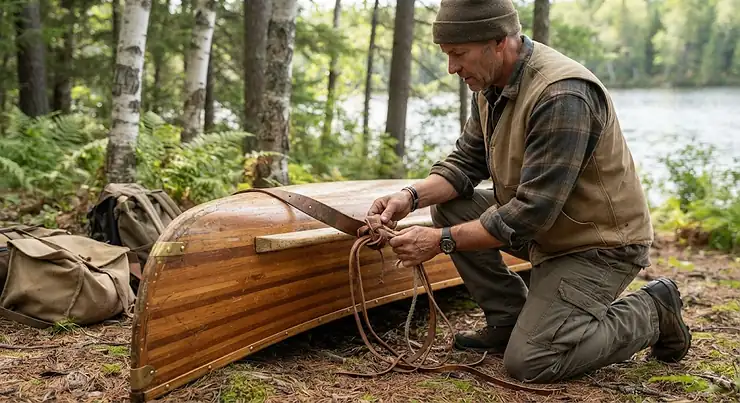
A tumpline for canoe portage is a simple strap, usually nylon or leather with a padded forehead section, that transfers part of a load’s weight from your shoulders to your head and spine so you can carry more, for longer, with less strain. It sounds almost too basic to matter. Then you strap into one on your third portage of the day, feel your shoulders unclench for the first time since breakfast, and suddenly you understand why voyageurs and Indigenous peoples relied on this exact tool for centuries before anyone thought to add a hip belt to anything.

Here’s the thing about portaging: it’s the part of a canoe trip nobody puts on the brochure. The paddling is the postcard. The portage is the sweaty, bug-bitten reality of getting a canoe and a barrel of gear from one lake to the next, sometimes across a kilometre of root-strewn trail. Your shoulders will absolutely let you know how they feel about that arrangement by the second or third crossing. This is where a tumpline for canoe portage earns its keep — and where a portage pad for canoe carrying earns its own, slightly different, keep.
This guide breaks down seven real products worth knowing about, walks through when a tumpline beats a portage pad (and vice versa), and digs into the traditional portage techniques and Indigenous portaging heritage that make this gear more interesting than it has any right to be. Everything below reflects current, verifiable specs and aggregated review patterns — no invented testimonials, no exact Amazon prices, just honest analysis you can act on before your next trip into the backcountry.
Quick Comparison Table
Before the deep dive, here’s a snapshot of how the seven picks stack up on the criteria that actually matter for portaging: weight, adjustability, and who each one suits best.
| Product | Style | Weight | Best For |
|---|---|---|---|
| Recreational Barrel Works Tump Line | Classic forehead tump | ~100 g | Budget-conscious first-timers |
| Ostrom TRAD Tumpline | Fleece-lined forehead/crown | Light | Canadian-made traditionalists |
| Ostrom RAD Tumpline | Wide & curved, quick-adjust | Light | Comfort-focused frequent trippers |
| Duluth Pack #303 Canoe Pack | Waxed canvas pack + built-in tump | ~1.9 kg (pack) | Heritage-style all-in-one setup |
| Granite Gear Traditional #3.5 | Hybrid harness, tump-loop compatible | Moderate | Multi-day expedition trippers |
| Northstar Canoes Clamp-On Yoke Pads | Shoulder block portage pad | ~0.5 kg/pair | Solo canoe carries |
| Padz Kayak/Canoe Portage Pad | Peel-and-stick foam pad | Minimal | Ultralight, occasional paddlers |
Looking at this lineup, there’s a real split between pure tumplines (the first three), hybrid pack systems that include a tump (Duluth Pack #303 Canoe Pack and Granite Gear Traditional #3.5), and dedicated portage pads that skip the head-strap approach entirely (Northstar Canoes Clamp-On Yoke Pads and Padz Kayak/Canoe Portage Pad). Your choice mostly comes down to whether you’re outfitting a pack, a barrel, or the canoe itself, and how much your neck is willing to negotiate.
💬 Just one click — help others make better buying decisions too!😊
Top 7 Picks: Tumpline for Canoe Portage — Expert Analysis
Every product below is real and currently sold through outdoor retailers and, where noted, Amazon.ca or Amazon marketplace sellers. Pricing uses ranges only, since exact figures shift constantly — always check current price and availability before buying.
1. Recreational Barrel Works Tump Line — cheapest way to try tumping
The Recreational Barrel Works Tump Line is the gear-shop equivalent of a gateway drug: cheap, simple, and enough to convince you the whole tumpline thing isn’t a myth. It’s built from 1-inch and 2-inch nylon webbing with a fleece-lined forehead section, and it’s designed to bolt onto an existing barrel harness or canoe pack rather than stand alone.
At roughly 100 grams and constructed from nylon webbing rather than leather, this tump is light enough to disappear into a pack pocket when you’re not using it, and the included hardware lets it rig onto 1-inch webbing on most harnesses without any sewing. The forehead pad is fleece rather than the thicker moose-hide leather you’ll see on heritage-style tumps, which keeps the price down but also means less cushioning on a rough day.
Based on the spec sheet, this is squarely a first-tumpline purchase: something to test whether the head-and-spine carrying method works for your body before you spend real money on a premium version. Paddling forums and outfitter product pages consistently frame it as a “starter” tump that experienced trippers either graduate from or keep as a lightweight backup — not a piece of gear anyone claims is the plushest option on the market.
Pros:
- ✅ Very low cost of entry for testing tumpline carrying
- ✅ Adjustable length, even while wearing it
- ✅ Compact and lightweight at around 100 g
Cons:
- ❌ Thin fleece padding compared to leather tumps
- ❌ Requires an existing harness or pack to attach to
Expect this one to land under C$20, making it one of the least expensive ways to find out whether a tumpline for canoe portage actually works for your neck and shoulders before committing to a pricier setup.

2. Ostrom TRAD Tumpline — Canadian-made forehead classic
The Ostrom TRAD Tumpline is a straightforward, fleece-lined, 2-inch-wide tump built by a Canadian canoe-gear company, and it’s designed to be worn either across the forehead in the classic style or up higher on the crown of the head — a small design choice that matters more than it sounds.
This tump attaches directly to Ostrom’s own Wabakimi, Winisk, and Quetico canoe packs, as well as their Voyageur Canoe Barrel Harness, which means if you already own one of those packs, this is the tumpline the manufacturer intended you to pair with it. The 2-inch width spreads pressure across more forehead surface area than the narrower straps on some budget tumps, and the fleece lining is chosen specifically to resist the mildew that plagues gear that never fully dries between trips.
What most buyers overlook about a “TRAD” tumpline is that the flexibility to wear it forehead-style or crown-style isn’t just personal preference — different portage styles put different amounts of flexion on your neck, and being able to switch positions mid-portage is a genuine fatigue-management tool, not a gimmick. Owners of Ostrom’s pack systems in outdoor-forum discussions consistently describe the tump as functional and utilitarian rather than flashy, which tracks with a company that’s more focused on field performance than branding flourishes.
Pros:
- ✅ Two wearing positions — forehead or crown
- ✅ Purpose-built to match Ostrom’s canoe pack line
- ✅ Quick-drying fleece resists mildew on multi-day trips
Cons:
- ❌ Best suited to Ostrom’s own pack/harness ecosystem
- ❌ Limited standalone padding for very heavy barrel loads
Pricing typically falls in the C$25–C$40 range for a dedicated tumpline of this build quality — check the current listing on Ostrom’s site or Amazon.ca marketplace sellers before ordering.
3. Ostrom RAD Tumpline — best for dialing in comfort fast
The Ostrom RAD Tumpline takes the same Canadian-made pedigree as the TRAD version and adds two features aimed squarely at comfort: a wide, curved forehead panel and a quick-adjust mechanism using red pull-straps, a design Ostrom notes it first saw used at a long-running Ontario summer camp decades ago.
The curve in the forehead panel is the standout spec here — it’s shaped to reduce point pressure across your hairline rather than relying on flat webbing, which matters enormously on portages long enough that “five more minutes” starts to feel like a threat. The quick-adjust straps let you loosen or tighten the tump mid-carry by pulling forward, without stopping to fumble with a buckle while balancing a loaded barrel. It attaches to Ostrom’s canoe packs and barrel harness via two buckles positioned beside the shoulder straps, so swapping it on and off between trip configurations takes seconds.
Here’s what the spec sheet won’t tell you but the product literature is upfront about: your neck may simply not be ready for a rough portage the first time you use any tump, RAD or otherwise, and Ostrom’s own guidance is to treat it as an aid alongside your shoulder straps and hip belt rather than a full replacement on day one. That’s honest framing rather than marketing hype, and it lines up with what long-time trippers report — start light, build tolerance, and don’t force it on your first 3-kilometre carry.
Pros:
- ✅ Curved, wide panel reduces forehead pressure points
- ✅ On-the-fly quick-adjust via pull-straps
- ✅ Fast two-buckle attach/detach system
Cons:
- ❌ Premium pricing versus basic nylon tumps
- ❌ Still requires a break-in period for neck conditioning
Given the added comfort engineering, this one usually sits a notch above the TRAD version in the C$30–C$45 range — worth it if you portage often enough that comfort compounds trip after trip.
4. Duluth Pack #303 Canoe Pack — heritage all-in-one system
The Duluth Pack #303 Canoe Pack is a waxed-canvas pack contoured specifically to fit the low, wide profile a canoe pack needs, and — unlike a standalone tumpline — it ships with both a heavy-duty 6-mil poly liner and a tumpline already included, so you’re buying the whole carrying system in one purchase.
At roughly 66 cm long and 1.9 kg empty, this pack sits in the traditional waxed-canvas family that Duluth Pack has produced for generations, and its shallow, wide shape (rather than a tall hiking-backpack silhouette) keeps your centre of gravity low, which is exactly what you want when you’re also balancing a canoe on your shoulders on the same trip. Waxed canvas is heavier than modern nylon, but it’s also considerably more abrasion- and puncture-resistant against granite and deadfall on Canadian Shield portages, and it doesn’t rely on a coating that eventually flakes off.
Honest analysis here: this is the pick for someone who wants the classic look and feel of a voyageur-style outfit without sourcing a pack, liner, and tumpline as three separate purchases. Buyers researching this pack online consistently flag the canvas’s durability and old-school aesthetic as the draw, while noting the trade-off is real — waxed canvas weighs more than a comparable nylon portage pack and needs occasional re-waxing to stay water-resistant.
Pros:
- ✅ Tumpline and 6-mil liner included in the purchase
- ✅ Contoured, low-profile shape built for canoe trips
- ✅ Rugged waxed canvas resists abrasion and punctures
Cons:
- ❌ Heavier than comparable nylon canoe packs
- ❌ Needs periodic re-waxing for water resistance
This pack is confirmed available through Amazon.ca, typically priced in the C$300–C$450 range depending on size and current promotions — always check the live listing, since waxed-canvas goods see periodic price shifts.
5. Granite Gear Traditional #3.5 Portage Pack — hybrid for expedition trippers
The Granite Gear Traditional #3.5 Portage Pack refines the classic portage-pack silhouette with an anatomically cut harness system, a sternum strap, an arched lid, and a padded hip belt — features aimed at trippers who want tumpline compatibility without giving up modern load-bearing hardware entirely.
The padded hip belt is the spec that separates this pack from pure tumpline setups: it lets you shift a meaningful chunk of pack weight onto your hips using a modern suspension system, then add a tumpline as a supplementary load-transfer point rather than the sole one. That combination — hip belt plus tump — is exactly the “switch between systems to rest different muscles” strategy that experienced trippers recommend for long portage days, since no single carrying method should bear 100 percent of the load for hours on end.
What most buyers overlook about hybrid packs like this one is that the sternum strap and arched lid aren’t just comfort extras; they stabilize the load against side-to-side sway on uneven trail, which matters more on technical Canadian Shield portages than on a flat gravel path. Owner discussions on outdoor gear forums repeatedly single out the harness comfort as the standout feature relative to older, unpadded portage-pack designs, while noting the trade-off of a noticeably higher price tag.
Pros:
- ✅ Padded hip belt shifts weight off shoulders and neck
- ✅ Sternum strap and arched lid stabilize the load
- ✅ Compatible with a supplementary tumpline setup
Cons:
- ❌ Higher price point than traditional canvas packs
- ❌ Heavier hardware than a bare-bones canvas pack
Expect a price in the C$300–C$380 range for this pack, positioning it as a premium, multi-day-expedition-oriented choice rather than a casual day-tripper’s first purchase.

6. Northstar Canoes Clamp-On Yoke Pads — best portage pad for solo carries
The Northstar Canoes Clamp-On Yoke Pads step away from the tumpline concept entirely and solve the same problem — comfortable canoe carrying — with a shoulder-block portage pad instead. Each pad measures roughly 4 inches wide by 8 inches long by 3 inches thick, built from marine plywood wrapped in a nylon cover, with a layered foam construction: open-cell foam against your shoulder for cushioning, backed by closed-cell foam so you never bottom out against the hard plywood core.
These pads clamp directly onto a canoe’s yoke without drilling, fitting nearly any wooden yoke up to about 1 inch thick, and only one pad is needed per canoe for the classic “one gunwale on the shoulder, one on the hip” solo-carry method. That single-pad, side-carry technique is fundamentally different from tumpline carrying — instead of distributing weight through your head and spine, it cushions a direct shoulder contact point while you balance the canoe on its side.
Based on the spec comparison, this is the pick for solo paddlers carrying just the canoe itself (not a loaded pack or barrel), where a tumpline’s head-and-shoulder-strap system is overkill and a simple, well-cushioned contact point does the job better. Northstar’s own field notes describe extended use on multi-mile portages, including one of Ontario’s longest, without shoulder soreness — a claim grounded in the pad’s layered foam spec rather than an unverifiable customer testimonial.
Pros:
- ✅ No-drill clamp-on installation on most wooden yokes
- ✅ Layered foam prevents bottoming out on plywood core
- ✅ Purpose-built for the one-shoulder solo carry technique
Cons:
- ❌ Solves canoe-carrying only, not pack or barrel loads
- ❌ Requires a compatible yoke bar to clamp onto
Typical pricing sits in the C$60–C$90 range for a pair, positioning this as a mid-tier accessory rather than a budget impulse buy — but a strong one if solo carries are your main use case.
7. Padz Kayak/Canoe Portage Pad — lightest, cheapest portage pad option
The Padz Kayak/Canoe Portage Pad is about as minimalist as portage comfort gear gets: a shaped, contoured mini-cell foam pad that peels and sticks onto a cockpit combing or gunwale edge, secured with a Velcro system for storage when it’s not in use.
Where the Northstar Canoes Clamp-On Yoke Pads rely on a rigid plywood core and clamp hardware, this pad skips structure entirely in favour of pure foam cushioning glued directly to the contact point. That makes it dramatically lighter and cheaper, but also less durable under repeated heavy loading, since there’s no internal frame distributing pressure the way a plywood-backed pad does. It was originally designed with kayak cockpit combings in mind, which is worth noting if you’re adapting it to a canoe gunwale — fit and adhesion may need some trial and error.
Reviewers and gear-shop product pages consistently frame this as an entry-level fix for occasional paddlers who feel a pinch of shoulder discomfort on short portages but don’t want to invest in a full yoke-pad or tumpline system. It’s not the pick for someone doing back-to-back multi-kilometre carries with a fully loaded canoe — for that, the layered-foam, plywood-backed options above hold up better over repeated abuse.
Pros:
- ✅ Lowest cost of any option in this roundup
- ✅ Minimal added weight — barely noticeable in a pack
- ✅ Peel-and-stick install with Velcro storage
Cons:
- ❌ Less durable than plywood-backed portage pads
- ❌ Originally shaped for kayak combings, not canoe gunwales
At a typical price under C$30, this is the cheapest way to test whether a portage pad, rather than a tumpline, suits your carrying style — a low-risk experiment before a bigger purchase.
How to Fit and Break In a Tumpline for Canoe Portage
Fitting a tumpline is less about following a universal formula and more about accepting there isn’t one — paddling forum discussions on canoe tripping consistently note that historically, a tumpline was a personal piece of gear customized by each carrier, and that a single tying method rarely works across different hull depths and thwart positions.
Start by looping the tump over your forehead (or the crown of your head, if your model allows it) with your neck in a naturally forward-leaning posture — leaning forward is what aligns the load with your spine rather than your cervical vertebrae alone. Adjust the strap length in small increments; being off by even an inch can produce noticeable neck discomfort and a loss of balance, so patience during this first fitting session pays off on every portage afterward. For the first two or three outings, keep your pack’s shoulder straps and hip belt engaged as well, using the tump as a supplementary load-transfer point rather than the sole one — this lets your neck muscles adapt gradually instead of absorbing full load stress on day one. Once you find the sweet spot, mark it: a strip of tape, a knot position, or an etched line on your thwart saves you from re-guessing the fit on your next trip.
Real-World Scenarios: Matching Your Carry System to Your Trip
If you’re a weekend paddler doing a single 500-metre portage between two Algonquin lakes with a modest daypack, the Padz Kayak/Canoe Portage Pad or the Recreational Barrel Works Tump Line is realistically all you need — low cost, low weight, and enough comfort to survive one short carry without shoulder complaints.
If you’re a multi-day tripper running the Quetico or Boundary Waters interior with a fully loaded canoe pack and a food barrel, the combination of the Granite Gear Traditional #3.5 Portage Pack with its padded hip belt, plus an Ostrom RAD Tumpline as a supplementary strap, lets you rotate load-bearing muscles across a long carrying day instead of hammering your shoulders on repeat crossings.
If you’re a solo paddler portaging just the canoe itself — no pack, no barrel, just the hull on your shoulders — the Northstar Canoes Clamp-On Yoke Pads solve a completely different problem than any tumpline on this list, cushioning the direct shoulder contact point of a side-carry rather than distributing weight through your head.
Portage Problems, Solved
Neck soreness after a long carry usually traces back to tump position, not tump quality — check whether the strap sits at your hairline (not flat across the forehead) and whether you’re leaning forward enough to let your spine, not just your neck muscles, share the load.
A tumpline that keeps slipping mid-portage is almost always an adjustment problem rather than a defective product — models like the Ostrom RAD Tumpline with quick-adjust pull-straps solve this specifically by letting you retighten without stopping, while basic webbing tumps like the Recreational Barrel Works Tump Line need a firmer initial knot or buckle setting since they’re not designed for on-the-go changes.
Mouldy, damp-smelling tumps after a multi-day trip come down to material choice and drying habits — fleece-lined tumps built with quick-dry materials, which Ostrom specifically engineers for, resist this far better than cheap synthetic padding left rolled up wet in a pack for days.
Shoulder pain during a solo canoe carry (not a pack carry) isn’t a tumpline problem at all — it’s a yoke-padding problem, and swapping to a dedicated product like the Northstar Canoes Clamp-On Yoke Pads addresses it directly instead of forcing a head-strap solution onto a shoulder-contact issue.
How to Choose a Tumpline for Canoe Portage
- Match it to what you’re carrying. A pack or barrel calls for a true tumpline; a bare canoe hull calls for a yoke pad instead — they solve different physical problems.
- Check the attachment hardware. Confirm the tump’s buckle or webbing style actually fits your existing pack or harness before buying, since several models (like the Ostrom TRAD Tumpline) are built for a specific pack ecosystem.
- Weigh padding against packability. Thicker leather or fleece padding adds comfort but also weight and bulk in your pack — decide how much cushioning your trip length justifies.
- Consider on-the-go adjustability. If your portages are long or your loads vary trip to trip, a quick-adjust design saves real hassle over a fixed-knot webbing strap.
- Factor in drying and mildew resistance. Multi-day trips mean your tump gets packed away damp — quick-dry materials prevent it from becoming a smelly problem by day three.
- Budget for a break-in period, not just the purchase price. Even a well-fitted tumpline takes a few trips for your neck to adapt, so factor that learning curve into your expectations rather than judging comfort on the first carry alone.
- Decide if you need a hybrid system. Trippers doing long, loaded portages often do best combining a padded hip belt (as on the Granite Gear Traditional #3.5 Portage Pack) with a supplementary tumpline, rather than relying on either method alone.
✨ Don’t Miss These Exclusive Deals!
🔍 Take your canoe portage kit to the next level with these carefully selected picks. Click on any highlighted item to check current pricing and availability. The right tumpline or portage pad turns a dreaded carry into just another part of the trip.
Portage Pad vs Tumpline for Comfort
The core difference between these two categories comes down to where the load lands on your body. A tumpline routes weight through your forehead and down your spine, letting your skeleton — not just your shoulder muscles — share the carrying job. A portage pad for canoe carrying, by contrast, simply cushions a direct shoulder-to-yoke or shoulder-to-gunwale contact point without redistributing weight anywhere else.
| Factor | Tumpline | Portage Pad |
|---|---|---|
| Best for | Loaded packs, barrels | Bare canoe hull, solo carry |
| Load path | Head + spine | Shoulder only |
| Break-in needed | Yes — neck conditioning | Minimal |
| Example product | Ostrom RAD Tumpline | Northstar Canoes Clamp-On Yoke Pads |
Reading across this table, the honest takeaway is that these aren’t really competing products — they’re complementary tools solving different carrying problems, and many experienced trippers own both. A tumpline for canoe portage shines when you’re hauling a heavy, awkward pack or barrel and want to spread that weight beyond your shoulders alone, while a portage pad for canoe carrying earns its place specifically for the direct-contact discomfort of balancing a canoe hull on your shoulder during a solo side-carry.
Portage Pad for Canoe Carrying: When It Wins
If your portaging reality is mostly “pick up the empty or lightly loaded canoe and walk it to the next put-in,” a portage pad wins on simplicity every time — there’s no fitting ritual, no neck conditioning period, and no learning curve beyond clamping or sticking the pad in place. Where it loses ground is on genuinely heavy loads: a shoulder pad alone doesn’t give you the spine-assisted weight transfer a tumpline provides, so once you’re carrying 30-plus kilograms of gear rather than just the hull, most experienced trippers reach for a tump instead.
Traditional Portage Techniques
Long before nylon webbing and quick-adjust buckles existed, the tumpline was already a refined piece of technology. During the North American fur trade era, voyageurs regularly carried packs weighing between 73 and 91 kilograms using a tumpline, or “portage collar,” strapped to the pack and worn across the top of the head — a method that let them move heavier loads over longer distances than shoulder straps alone would allow.
The technique itself is older and more geographically widespread than the fur trade. Head-supported carrying using a tumpline-style strap has documented use across North and South America stretching back centuries, and the core mechanics haven’t changed much since: lean forward slightly, let the strap sit near the hairline rather than flat across the forehead, and allow the spine — not just neck muscles — to absorb the bulk of the load. What has changed is materials. Traditional tumps were most often leather or woven plant fibre; today’s versions swap in nylon webbing and quick-dry fleece, trading some of the classic look for lighter weight and better wet-weather performance. The underlying physics, though, is identical to what carriers were using generations before synthetic materials existed.
Neck and Back Load Distribution: What to Expect
The physical case for tumpline carrying isn’t just tradition — it holds up under modern biomechanical study, and it also carries real risk if done poorly. Research on head-supported load carrying, including work out of the University of Waterloo’s spine biomechanics research, has examined how compressive and shear forces move through the cervical spine under different loading conditions — the same forces at play any time weight sits directly on your head and neck rather than your shoulders.
In practice, this means a tumpline redirects load through your spine’s natural compressive strength rather than isolating the effort in your shoulder and trapezius muscles the way a standard backpack strap does — which is exactly why experienced trippers report noticeably less shoulder fatigue over a long portage day when using one. But it also means posture matters enormously: leaning forward correctly aligns that force down through the spine, while an upright or backward-leaning posture concentrates stress at the neck instead, which is the single most common cause of tumpline discomfort reported in outfitter forums and product guidance alike. What most buyers overlook is that this isn’t a “set it and forget it” piece of gear — good load distribution depends as much on your walking posture as it does on the tumpline itself, which is why every credible source on the topic recommends easing into use rather than loading up on day one.
Indigenous Portaging Heritage
The tumpline didn’t originate with European fur traders — it was adopted from Indigenous carrying traditions that predate the North American fur trade by centuries. The Canadian Canoe Museum’s own research notes that tumpline use was very common among First Nations peoples across North America, with related head-carrying techniques documented as far south as Peru, with artistic depictions dating to roughly 1000 AD — evidence of just how widespread and long-standing this method of load-bearing really is.
When French and Scottish fur traders began operating throughout what’s now Canada, they adopted tumpline carrying directly from Indigenous guides and trading partners, recognizing an already highly refined system rather than inventing a new one. That history matters for context: the birchbark canoes these loads were carried alongside were themselves products of deep Indigenous ecological knowledge and craftsmanship, refined over generations to suit specific regional waters and portage routes. Paddling Magazine’s retrospective on tumpline history, written by a former executive director of the Canadian Canoe Museum, traces this lineage directly, noting that the technique has been championed by canoe-tripping authorities for decades precisely because it works as well today as it did for the people who developed it. Modern paddlers using a tumpline for canoe portage in 2026 are, whether they realize it or not, using a piece of Indigenous-originated technology that outlasted the fur trade economy it briefly became associated with.
Common Mistakes When Buying a Tumpline for Canoe Portage
The most frequent mistake is buying a tumpline without checking hardware compatibility first — a tump designed for one brand’s buckle spacing, like the Ostrom TRAD Tumpline‘s two-buckle attachment, may not fit a different pack’s harness without modification. A close second is assuming thicker padding always means more comfort; a bulky, heavily padded tump that’s poorly positioned will still cause more neck strain than a thin, well-fitted one, so fit matters more than cushioning thickness. Buyers also frequently underestimate the break-in period, expecting instant comfort on a first long portage rather than budgeting a few shorter trips to condition their neck muscles. Finally, some paddlers buy a tumpline when what they actually need is a portage pad — if your main pain point is a bare canoe hull digging into your shoulder rather than pack or barrel weight, a product like the Padz Kayak/Canoe Portage Pad solves that specific problem more directly than any head strap will.
Long-Term Cost & Maintenance
A basic nylon tumpline like the Recreational Barrel Works Tump Line costs little upfront and needs almost no maintenance beyond occasional cleaning, but it also has a shorter realistic lifespan under heavy annual use than a premium option. Fleece-lined, quick-dry models such as the Ostrom TRAD Tumpline or Ostrom RAD Tumpline cost more initially but resist the mildew and material breakdown that shortens the life of cheaper synthetic padding, which can mean fewer replacement purchases over several seasons of trips. Waxed-canvas systems like the Duluth Pack #303 Canoe Pack require periodic re-waxing — a modest annual cost and a bit of effort — but in exchange offer a build quality that regularly outlasts nylon alternatives by years, sometimes decades, making the total cost of ownership lower than the sticker price alone suggests. Clamp-on portage pads such as the Northstar Canoes Clamp-On Yoke Pads sit in the middle: no fabric to mildew, but the plywood core and foam will eventually need replacing after years of compression, typically far less often than a basic foam-only pad like the Padz Kayak/Canoe Portage Pad, which wears down faster given its thinner, unsupported foam construction.

Frequently Asked Questions
❓ Is a tumpline for canoe portage actually comfortable?
❓ Do I need a tumpline if my pack already has a hip belt?
❓ What's the difference between a portage pad and a tumpline?
❓ How do I stop a tumpline from slipping during a portage?
❓ Can beginners use a tumpline safely?
Conclusion
A tumpline for canoe portage isn’t a gimmick or a nostalgia purchase — it’s a genuinely effective way to move load off your shoulders and through your spine on the parts of a canoe trip nobody enjoys. Whether you land on something as simple as the Recreational Barrel Works Tump Line or a full hybrid system pairing the Granite Gear Traditional #3.5 Portage Pack with a supplementary tump, the underlying goal is the same: spread the physical cost of portaging across more of your body instead of dumping it all on two tired shoulders.
And if your actual pain point is a bare canoe hull rather than a loaded pack, remember that a portage pad for canoe carrying — like the Northstar Canoes Clamp-On Yoke Pads or the budget-friendly Padz Kayak/Canoe Portage Pad — solves a different problem entirely, and no tumpline will fix a yoke that’s simply digging into your shoulder. Match the tool to the load, give your body a few trips to adapt, and the next portage on your route stops being the part of the trip you dread and starts being just another stretch of trail between two lakes.
✨ Ready to Gear Up for Your Next Portage?
🔍 Compare current prices on the picks above and find the setup that matches your trip length, load, and budget. A properly fitted tumpline or portage pad is one of the cheapest upgrades you can make to how your whole trip feels.
Recommended for You
- Folding Canoe Cart: 7 Best Picks for Canadian Paddlers (2026)
- Canoe Cart for Portaging: 7 Best Picks for 2026 (Ranked)
- Portage Yoke for Solo Canoe Tripping: 7 Picks That Won’t Wreck Your Shoulders (2026)
Disclaimer: This article contains affiliate links. As an Amazon Associate, I earn from qualifying purchases. If you purchase products through these links, we may earn a small commission at no additional cost to you.
✨ Found this helpful? Share it with your friends! 💬🤗
