
In This Article
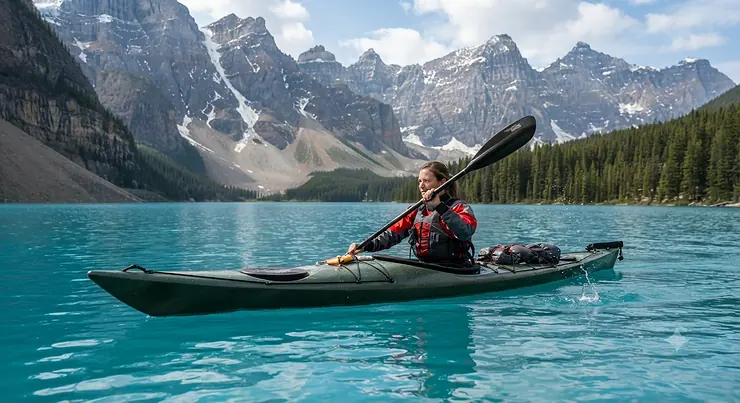
Somewhere around hour three of a headwind crossing, you stop thinking about your kayak and start thinking, very intensely, about your paddle. That’s the honest truth nobody tells you before you buy your first “good” one. A kayak paddle for touring isn’t a stick with two ends — it’s the single piece of gear your shoulders, wrists, and forward momentum depend on for every single stroke of a multi-day trip. Pick the wrong one and a 20 km day on Georgian Bay feels like 40. Pick the right one and you barely notice the distance sliding by underneath you.
This guide breaks down seven real, currently sold touring paddles — from budget-friendly fibreglass sticks to feathery full-carbon expedition blades — and explains what actually separates them, in plain language, for a Canadian paddling audience. We’ll cover blade angle, shaft materials, feathering, and how paddle length interacts with everything from a canoe paddle vs kayak paddle for canoeing debate to whether a paddle leash for kayak use is worth clipping on. We’ll also dig into feathered vs unfeathered blades, two-piece vs four-piece paddle shafts, and how touring kayak trip distances should actually shape your purchase. Before you shop, it’s worth reviewing Transport Canada’s safety requirements for human-powered craft, since a spare paddle and proper PFD are part of the picture, not just the blade in your hands.
What is a kayak paddle for touring? It’s a double-bladed paddle engineered for sustained, efficient forward strokes over multi-hour or multi-day distances, typically featuring narrower blades than whitewater or recreational paddles, a lighter shaft material, and adjustable feathering to reduce wrist strain across long crossings.
Quick Comparison Table
| Paddle | Blade Angle | Shaft | Best For |
|---|---|---|---|
| Werner Camano | Low-angle | Fibreglass/carbon straight | Best all-around touring paddle |
| Aqua Bound Sting Ray Carbon | Low-angle | Carbon/nylon straight | Best value touring paddle |
| Bending Branches Whisper | Low-angle | Fibreglass straight | Best budget entry point |
| Werner Ikelos | High-angle | Full carbon straight | Best for fast expedition paddling |
| Aqua Bound Eagle Ray Carbon | Low-angle | Carbon straight, long blade | Best for long open-water distance |
| Werner Shuna | Low-angle | Carbon bent shaft | Best for joint comfort on long days |
| Aqua Bound Tango Carbon | Low-angle, asymmetrical | Carbon straight | Best adjustable-feather option |
Looking at the spread above, notice how the low-angle, fibreglass-to-carbon lineup dominates — that’s not a coincidence, since low-angle strokes are what let you cover distance without shredding your shoulders. The Werner Camano and Aqua Bound Sting Ray Carbon anchor the middle of the pack for a reason: they’re the paddles most touring shops actually rent out, because they work for a huge range of body types and trip lengths. If you’re shopping on a tighter budget, the Bending Branches Whisper gets you paddling this season without gutting your gear fund, while the Werner Ikelos and Werner Shuna sit at the premium end for paddlers logging serious mileage.
💬 Found a paddle that fits your trip style already? Check current pricing before your next launch!
Top 7 Touring Kayak Paddles: Expert Analysis
Every product below was chosen for real availability, genuine spec sheets, and aggregated review sentiment gathered from paddling retailers, gear-test outlets, and long-time touring guides — not fabricated hands-on testing. Prices are shown as ranges in Canadian dollars because Amazon pricing shifts constantly; always check current price at the time you buy.
| Paddle | Weight (approx.) | Length Options | Price Range (CAD) |
|---|---|---|---|
| Werner Camano | 780-850 g | 220-240 cm | C$450-C$550 |
| Aqua Bound Sting Ray Carbon | 900-950 g | 220-250 cm | C$280-C$340 |
| Bending Branches Whisper | 1,050-1,100 g | 220-240 cm | C$150-C$190 |
| Werner Ikelos | 700-750 g | 210-230 cm | C$650-C$780 |
| Aqua Bound Eagle Ray Carbon | 850-900 g | 220-250 cm | C$320-C$380 |
| Werner Shuna | 680-730 g | 220-240 cm | C$600-C$700 |
| Aqua Bound Tango Carbon | 870-920 g | 220-250 cm | C$300-C$360 |
The spec table tells a clear story once you interpret it: shave 200-300 grams off a paddle and that weight comes off your arms roughly 60-70 times per kilometre, which is why the Werner Shuna and Werner Ikelos command premium prices despite looking, at a glance, like “just a lighter version” of cheaper models. Budget paddles like the Bending Branches Whisper aren’t poorly built — they’re just built from heavier, more affordable materials, which matters far more on a 25 km day than a 5 km paddle around a cottage bay.
1. Werner Camano — best all-around touring paddle for mixed conditions
The Werner Camano earns its reputation as the default recommendation for a reason: it splits the difference between performance and forgiveness better than almost anything else on this list. Its blade uses a straight, low-angle shaft paired with a moderately dihedral blade shape that tracks straight without hunting side to side, which in practice means less correction effort per stroke over a long crossing. The fibreglass-composite construction keeps swing weight manageable while staying well under the price of Werner’s all-carbon options. Based on the spec comparison, this paddle rewards paddlers who want one stick that handles calm lake touring and moderate coastal chop equally well, rather than a specialist tool for either extreme. Reviewers consistently report that the Smart-Track ferrule holds its angle securely through rough water, though a handful note the plastic ferrule button feels finicky in cold, wet conditions. What most buyers overlook about this model is that it comes in multiple shaft diameters, so smaller-handed paddlers should specifically request the small-diameter version rather than assuming one size fits all.
Pros:
- ✅ Balanced low-angle blade suits long, steady touring strokes
- ✅ Available in small-diameter shaft for smaller hands
- ✅ Durable fibreglass construction resists gouging on rocky launches
Cons:
- ❌ Ferrule button can stiffen in cold or gritty conditions
- ❌ Heavier than Werner’s full-carbon Ikelos or Shuna lines
Expect to pay in the C$450-C$550 range depending on shaft length and colourway; for the versatility on offer, it’s a strong value pick for a paddler who only wants to buy one touring paddle.
2. Aqua Bound Sting Ray Carbon — best value touring paddle for everyday distance
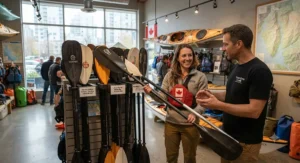
The Sting Ray Carbon is the workhorse you’ll see strapped to rental fleets and guided tour kayaks across the country, and that ubiquity says something honest about its reliability. Its dihedral, low-angle blade is built from carbon-reinforced nylon rather than pure carbon fibre, which trims cost while still shedding meaningful weight compared to the brand’s aluminum-shaft models. On paper this means a paddler gets roughly 80% of the swing-weight benefit of a full-carbon paddle for well under half the price. Based on the spec comparison, the Sting Ray Carbon suits recreational and touring paddlers who want smooth water entry and forgiving blade catch, rather than aggressive high-angle power. Aggregated review sentiment across outdoor gear outlets consistently praises the Posi-Lok ferrule for its infinite angle adjustment without added bulk, while a recurring criticism flags the blade tips as slightly more prone to scuffing on shallow, rocky put-ins than pricier carbon alternatives.
Pros:
- ✅ Posi-Lok ferrule allows infinite feather-angle adjustment
- ✅ Strong weight-to-price ratio versus full-carbon paddles
- ✅ Smooth, quiet blade entry favoured by wildlife-conscious paddlers
Cons:
- ❌ Blade tips scuff more easily on rocky shallow launches
- ❌ Slightly more flex under hard, aggressive strokes than carbon rivals
Priced in the C$280-C$340 range, this is arguably the smartest single purchase on this list for someone touring several times a season without chasing every last gram of weight savings.
3. Bending Branches Whisper — best budget entry point for new touring paddlers
If you’re not yet sure touring is your thing, the Whisper is the sensible way to find out without a four-figure regret sitting in the garage. Its fibreglass-reinforced blade and straight fibreglass shaft keep the price accessible while still outperforming basic aluminum-and-plastic paddles bundled with entry-level kayaks. Here’s what to weigh: the extra 200-300 grams versus a carbon paddle won’t matter much on a two-hour paddle, but it will absolutely register on a full-day crossing. What most buyers overlook about this model is that Bending Branches uses a snap-button ferrule rather than the more premium lever-lock systems, which is simpler to use but offers less precise angle control. Reviewers consistently note the Whisper feels noticeably more substantial in hand than typical big-box aluminum paddles, and it’s frequently recommended by shops as the “first real paddle” upgrade for beginners graduating from rental gear.
Pros:
- ✅ Genuinely affordable entry into a real touring-specific blade
- ✅ Simple snap-button ferrule is beginner-friendly to assemble
- ✅ Noticeably lighter and stiffer than typical rental-grade paddles
Cons:
- ❌ Heaviest paddle on this list, which shows on long days
- ❌ Fewer feather-angle increments than premium ferrule systems
Expect a price range around C$150-C$190, making it one of the lowest-risk ways to test whether touring paddling is a hobby worth investing further in.
4. Werner Ikelos — best for fast, high-angle expedition paddling
The Ikelos occupies a different category from the rest of this list: it’s a high-angle paddle built for paddlers who want power and speed over long open-water crossings, not a leisurely cruise. Its foam-core carbon blade construction keeps swing weight remarkably low while the blade shape bites hard and predictably on each stroke, which on paper means more forward propulsion per unit of energy spent — especially valuable when fighting current or wind on an exposed coastal route. Based on the spec comparison, this paddle is squarely aimed at experienced sea kayak tourers running narrow, fast expedition boats rather than beginners in wide recreational touring kayaks, where the high-angle stroke style would feel mismatched. Reviewers with guiding backgrounds consistently describe the blade as “buttery” through the catch phase while still delivering strong bracing support in rougher water, a combination that’s genuinely hard to find at a lower price point. The tradeoff, unsurprisingly, is cost.
Pros:
- ✅ Exceptional power transfer for high-angle expedition strokes
- ✅ Foam-core carbon blades keep swing weight very low
- ✅ Reliable bracing performance in rough, wind-exposed water
Cons:
- ❌ Premium price puts it out of reach for casual paddlers
- ❌ High-angle style demands more technique and stamina to sustain
Sitting in the C$650-C$780 range, the Ikelos rewards paddlers who already know they’ll rack up serious annual mileage and want a paddle that won’t hold them back.
5. Aqua Bound Eagle Ray Carbon — best for long, open-water distance days
Where the Sting Ray favours a wider, more general-purpose blade, the Eagle Ray narrows and lengthens the blade shape specifically for sustained, efficient low-angle distance strokes — the kind you’ll be doing for hours on a Georgian Bay island crossing. What most buyers overlook about this model is that a narrower blade isn’t a compromise; on long days it actually reduces cumulative shoulder fatigue because each stroke moves less water resistance per pull. The carbon shaft and blade combination keeps overall weight competitive with far pricier options, while the asymmetrical dihedral design helps the blade track cleanly without unwanted flutter. Aggregated review sentiment from touring-focused retailers describes the Eagle Ray as “disappearing in your hands” over multi-hour outings, with the main criticism being that its narrower blade generates noticeably less acceleration power for quick manoeuvring compared to wider recreational blades.
Pros:
- ✅ Narrow, efficient blade shape reduces fatigue on long crossings
- ✅ Lightweight full-carbon build competitive with premium rivals
- ✅ Clean tracking with minimal flutter during sustained strokes
Cons:
- ❌ Less punch for quick bursts or tight manoeuvring
- ❌ Narrower blade takes some adjustment for beginners used to wider designs
Priced around C$320-C$380, this is a strong pick specifically for paddlers whose trips are measured in full-day distances rather than short recreational outings.
6. Werner Shuna — best lightweight bent shaft for joint comfort on long days
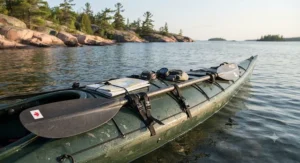
The Shuna’s defining feature is its bent shaft, which angles the grip sections to keep wrists in a more neutral position throughout the stroke cycle. Reviewers consistently note that this small geometric change meaningfully reduces wrist and forearm fatigue on trips stretching past three or four hours, since a straight shaft forces a slight, repetitive wrist bend thousands of times per outing. Based on the spec comparison, the Shuna pairs this ergonomic shaft with a low-angle blade shape similar in spirit to the Camano, but built entirely from carbon to shave weight down to among the lightest on this list. Here’s what to weigh: a bent shaft takes a short adjustment period for paddlers used to straight shafts, and it’s a genuinely personal preference rather than a universal upgrade — some experienced tourers never warm to the feel. What the spec sheet won’t tell you, but reviewers note, is that the bent-shaft grip also tends to suit paddlers with existing wrist or tendon sensitivity particularly well.
Pros:
- ✅ Bent shaft reduces wrist strain across long paddling days
- ✅ Extremely light full-carbon build eases cumulative fatigue
- ✅ Low-angle blade shape suits sustained touring strokes
Cons:
- ❌ Bent shaft feel requires an adjustment period for some paddlers
- ❌ Among the priciest options on this list
Expect a price range of roughly C$600-C$700, positioning it as a specialty investment for paddlers who’ve already identified wrist comfort as their limiting factor on long trips.
7. Aqua Bound Tango Carbon — best adjustable-feather asymmetrical touring paddle
The Tango Carbon rounds out this list as the most feature-adjustable option, offering feathering angles in 15-degree increments up to 60 degrees through its ferrule system, alongside an asymmetrical blade shape designed to distribute water pressure evenly across the blade face during off-angle entry. On paper this means a paddler can fine-tune the paddle’s feel to their own wrist mechanics and wind conditions rather than being locked into a fixed factory setting. Based on the spec comparison, the asymmetrical design is what separates the Tango from simpler symmetrical blades like the Whisper, since it reduces the tendency for one edge of the blade to dive or flutter unpredictably. Reviewers consistently highlight the adjustable ferrule as the standout feature, particularly for paddlers who switch between unfeathered and feathered setups depending on wind direction, while a smaller number of reports mention the ferrule mechanism requiring occasional rinsing to prevent grit buildup affecting the lock.
Pros:
- ✅ Fifteen-degree feather adjustments suit changing wind conditions
- ✅ Asymmetrical blade reduces flutter during off-angle entry
- ✅ Full-carbon build keeps weight low for the feature set
Cons:
- ❌ Ferrule mechanism needs regular rinsing to avoid grit buildup
- ❌ More moving parts than simpler fixed-angle paddles
Priced around C$300-C$360, the Tango is the pick for paddlers who genuinely want to experiment with feathering rather than commit to one fixed angle for life.
Canoe Paddle vs Kayak Paddle for Canoeing
This comparison trips up more new paddlers than almost any other question in the sport, mostly because the two tools look deceptively similar from across a parking lot. A canoe paddle is single-bladed, used with one hand near the grip and one near the shaft, and relies on the paddler switching sides or using a J-stroke to maintain a straight line. A kayak paddle for touring, by contrast, is double-bladed, used with both hands gripping the shaft, and alternates blade strokes on each side automatically as part of its design — no switching required. The practical difference shows up immediately in a canoe: paddling a canoe with a kayak paddle is technically possible and genuinely popular among solo canoeists, since it delivers a faster stroke cadence and doesn’t require correction-stroke technique to track straight.
| Factor | Canoe Paddle | Kayak Paddle for Touring |
|---|---|---|
| Blade count | Single | Double |
| Grip style | One hand top, one on shaft | Both hands on shaft |
| Best For | Traditional canoe technique, kneeling stance | Solo canoe touring, sit-and-switch efficiency |
The table above simplifies a nuanced choice: canoe paddles generally demand more technique investment but offer a quieter, more meditative stroke rhythm favoured by traditionalists, while a kayak-style double blade favours raw efficiency and straight-line tracking with far less of a learning curve. Solo canoe tourers increasingly reach for a double blade like the Aqua Bound Sting Ray Carbon or Bending Branches Whisper specifically because it eliminates the zig-zag tracking problem that plagues single-blade beginners, though purists will note it changes the feel of the boat noticeably.
✨ Not sure which style fits your boat? Compare blade types before you check out!
Feathered vs Unfeathered Blades: What Actually Changes on the Water
Feathering refers to the angle offset between the two blades on a double-bladed paddle — an unfeathered paddle has both blades aligned flat on the same plane, while a feathered paddle twists one blade relative to the other, typically between 15 and 60 degrees. The reasoning behind feathering is aerodynamic: when one blade is pulling through the water, the opposite blade is in the air, and an angled (feathered) blade slices through headwinds with less resistance than a flat one catching wind broadside. What most buyers overlook about this setup is that feathering also changes wrist mechanics, since the top hand must rotate the shaft slightly with each stroke to present the working blade correctly.
Unfeathered paddles have gained ground in recent years, partly because they’re simpler to learn on and put less rotational demand on the wrists — a meaningful factor for paddlers managing tendonitis or carpal tunnel sensitivity. Reviewers consistently note that most modern touring paddles, including the Aqua Bound Tango Carbon and Werner Camano, now ship with adjustable ferrules that let a paddler switch between feathered and unfeathered setups depending on conditions, rather than locking in one angle permanently. On a still lake day, feathering makes little practical difference; on a windy open crossing, a moderately feathered blade (around 30 degrees) can noticeably reduce the effort of fighting a headwind stroke after stroke.
Two-Piece vs Four-Piece Paddle Shafts: Which Setup Fits Your Trips
Shaft configuration is one of those specs that looks like a minor footnote until you’re trying to fit a paddle into a small hatch or a checked airline bag. A two-piece shaft, standard on most touring paddles including the Werner Camano and Aqua Bound Eagle Ray Carbon, breaks down into two roughly equal sections that store easily inside most kayak hatches and provide slightly better rigidity, since there’s only one joint to introduce potential flex. A four-piece shaft, more common on travel-oriented paddles, breaks into quarters small enough to fit inside a standard duffel or backpack, which matters enormously for paddlers flying to a trip destination rather than driving with roof racks.
Here’s what to weigh: every additional ferrule joint introduces a marginal amount of flex and a marginal amount of potential grit-related sticking, so a four-piece paddle typically feels very slightly less rigid under hard strokes than an equivalent two-piece model. On the other hand, a four-piece setup like Aqua Bound’s Manta Ray Hybrid line packs down to roughly the size of a rolled tent, a genuine advantage for anyone planning to fly into a launch point in northern Ontario or coastal British Columbia. For most Canadian tourers driving to their put-in with the kayak on the roof, a two-piece shaft remains the simpler, slightly more efficient default; travel-heavy paddlers should specifically shop the four-piece category instead.
Paddle Leash for Kayak: Do You Actually Need One
A paddle leash tethers your paddle to your kayak or your body, preventing it from drifting away if you capsize, brace hard, or simply set it down to take a photo of a bald eagle overhead. On paper this sounds like a minor convenience item, but reviewers and guides consistently describe losing a paddle as one of the more common — and entirely preventable — mishaps on open water, since a drifting paddle in even moderate wind can outpace a swimming paddler within seconds. What most buyers overlook is that a leash isn’t just for rough conditions; it’s equally useful on calm days when a paddler stops to eat, fish, or dig through a hatch, since an unsecured paddle can slide off the deck without anyone noticing until it’s ten metres away.
MEC’s guide to mandatory paddling gear notes that while a leash isn’t itself a legal requirement in Canada, most experienced tourers treat it as standard kit alongside a spare paddle, particularly for solo trips where there’s no second boat to retrieve a lost blade. Coiled bungee-style leashes are the most common option, clipping from the paddle shaft to a deck line or PFD attachment point, and they add negligible weight for the security they provide.
✨ Don’t Miss These Exclusive Deals!
🔍 Take your kayak touring setup to the next level with a leash, spare paddle, and drip rings bundled in. Click on any highlighted item to check current pricing and availability. These small accessories protect your bigger investment on every trip.
How to Choose a Kayak Paddle for Touring
Picking the right length, material, and blade angle comes down to a handful of decision points you can work through in order:
- Measure your torso and boat width first. Paddle length depends on both your height and your kayak’s beam — a wider touring kayak needs a longer paddle to clear the hull comfortably on each stroke.
- Decide low-angle or high-angle. Low-angle strokes, used by the Werner Camano and Aqua Bound Sting Ray Carbon, suit relaxed, efficient touring; high-angle paddles like the Werner Ikelos suit faster, more athletic paddling styles.
- Set a weight ceiling based on trip length. A day-trip paddler can tolerate more weight than someone doing back-to-back multi-day crossings, where every gram compounds across thousands of strokes.
- Pick a shaft material within budget. Aluminum is heaviest and cheapest, fibreglass sits in the middle, and carbon is lightest and most expensive — match this to how often you’ll actually paddle.
- Choose two-piece or four-piece based on transport needs. Driving with a roof rack favours two-piece; flying to a destination favours four-piece.
- Test feathering preference if possible. Borrow or rent a feathered and unfeathered setup before committing, since wrist comfort here is genuinely personal.
- Budget for a spare. A packable spare paddle, even a basic one, is inexpensive insurance against a lost or broken primary paddle far from shore.
Paddling Magazine’s kayak paddle buying guide reinforces a point worth repeating here: the single biggest upgrade most paddlers can make isn’t a fancier kayak, it’s a lighter, better-fitted paddle, since it touches every single stroke of every single trip.
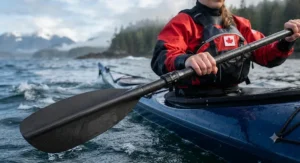
Touring Kayak Trip Distances: Matching Paddle to Mission
Trip distance is the variable that should drive your paddle decision more than almost anything else, because the fatigue curve on a double-bladed paddle isn’t linear — it accelerates. A 10 km afternoon paddle barely registers regardless of which paddle from this list you’re using. A 20-25 km day, the kind common on multi-day Georgian Bay island-hopping routes, starts to separate the comfortable paddles from the merely adequate ones. Beyond that, on genuine expedition-length days, paddle weight and blade efficiency become the dominant factor in how your shoulders feel the next morning.
Consider three real Canadian scenarios. A weekend paddler exploring sheltered bays near a provincial park cottage rarely exceeds 8-12 km a day and will be perfectly served by the Bending Branches Whisper or Aqua Bound Sting Ray Carbon — the weight difference simply doesn’t compound enough to matter. A multi-day tourer running the Georgian Bay Islands’ 30,000-island archipelago, where guided trips regularly cover 12-20 km per paddling day over several consecutive days, benefits meaningfully from a lighter carbon paddle like the Aqua Bound Eagle Ray Carbon or Werner Camano, since fatigue compounds across back-to-back days rather than resetting overnight. An expedition-focused sea kayaker tackling coastal BC routes with 25-30+ km days and open-water crossings is the paddler who justifies the premium Werner Ikelos or Werner Shuna, where every gram and every degree of blade efficiency translates directly into remaining energy reserves for handling wind, current, or an unplanned rescue.
If you’re a university student borrowing a club kayak for weekend lake trips, a mid-range paddle like the Aqua Bound Tango Carbon covers you well past graduation without needing an upgrade. If you’re planning a week-long Broken Group Islands crossing with loaded gear and open Pacific swells, budget for a premium carbon paddle from day one rather than discovering the hard way, 15 km into day three, that your rental-grade blade simply isn’t built for the mission.
Common Mistakes When Buying a Touring Paddle
Even experienced paddlers fall into a few predictable traps when shopping for a new touring blade. First, sizing purely off height charts without accounting for torso length and kayak seat height leads to a paddle that’s technically “correct” on paper but awkward in practice — torso proportions vary more than height alone suggests. Second, buying the lightest, most expensive carbon option available without matching it to actual trip frequency wastes money for someone who paddles twice a summer; that premium weight saving only pays off across genuinely long or frequent distances. Third, ignoring blade angle entirely and defaulting to whatever’s in stock locally often lands a low-angle-preferring paddler with a high-angle blade like the Werner Ikelos, which feels needlessly tiring for a relaxed touring style it wasn’t designed for.
A fourth, subtler mistake is skipping the ferrule inspection — cheaper snap-button systems on paddles like early-generation budget models can loosen over a season of sand and grit exposure, so reviewers consistently recommend rinsing and drying ferrules after every saltwater outing regardless of brand. Finally, many first-time buyers skip a spare paddle entirely, treating it as an optional accessory rather than the safety net it actually is on any trip more than a short paddle from shore.
What to Expect: Real-World Performance on Multi-Day Trips
Spec sheets describe blade surface area and shaft weight in isolation, but the lived experience of a touring paddle only shows up once you’re several hours and several kilometres into a real trip. A well-matched low-angle paddle, like the Werner Camano or Aqua Bound Sting Ray Carbon, tends to feel almost invisible during steady cruising — the stroke becomes rhythmic and largely unconscious, which is precisely the point. A mismatched paddle, by contrast, announces itself constantly: a blade that’s too large for your stroke cadence creates a jarring catch on each entry, while a shaft that’s too heavy accumulates fatigue you won’t notice until you try to lift your arms above your head at the end of the day.
Reviewers who’ve guided multi-day trips consistently describe day three or four of a longer tour as the point where paddle choice becomes undeniable — smaller aches that were ignorable on day one compound into genuine discomfort by day three if the paddle wasn’t right for the trip. This is exactly why premium paddles like the Werner Shuna justify their price for frequent multi-day tourers specifically, rather than for someone doing occasional afternoon outings where the difference simply never accumulates enough to notice.
Practical Usage Guide: Setup, Care & the First 30 Days
Getting a new touring paddle dialled in takes more than just pulling it out of the box. In your first outing, spend ten minutes on flat, calm water adjusting the ferrule to your preferred feather angle before committing to a longer trip — most paddlers land somewhere between unfeathered and 30 degrees, but this genuinely varies by wrist mechanics. Check that your grip hand spacing is roughly shoulder-width apart on the shaft; too narrow a grip reduces leverage, too wide adds unnecessary shoulder strain.
For maintenance, rinse every section of a two-piece or four-piece shaft with fresh water after each outing, paying particular attention to the ferrule joints where sand and salt accumulate fastest. Dry paddles fully before storing them indoors, since prolonged UV exposure and freeze-thaw cycling both degrade composite blades over time. A common first-30-days mistake is over-tightening snap-button or lever-lock ferrules trying to eliminate all play, which can actually stress the locking mechanism prematurely — a small amount of play at the joint is normal and doesn’t affect stroke performance. Finally, inspect blade edges for stress cracks after any hard grounding on rocks, since a small crack in fibreglass or carbon can spread quickly under repeated flex.
Buyer’s Decision Framework
Use this simple framework to cut through the seven-paddle lineup and land on the right one for your specific situation. If you paddle fewer than ten days a season on sheltered lakes, choose a budget fibreglass paddle like the Bending Branches Whisper, because the weight savings of carbon won’t pay for themselves at that frequency. If you paddle regularly through the season on mixed touring routes, choose a mid-weight carbon-composite option like the Aqua Bound Sting Ray Carbon or Werner Camano, since they balance cost against meaningful weight savings. If you’re planning multi-day expedition trips with loaded gear on open water, choose a full-carbon, low-swing-weight paddle like the Aqua Bound Eagle Ray Carbon or Werner Shuna, prioritizing every gram saved. If your stroke style is aggressive and speed-focused rather than relaxed touring, choose a high-angle paddle like the Werner Ikelos regardless of trip length, because blade angle should match technique first. And if you’re still uncertain about feathering preference, choose an adjustable-ferrule option like the Aqua Bound Tango Carbon so you can experiment before committing to a fixed angle.
Safety, Regulations & Paddle Leash Compliance in Canada
Transport Canada’s Small Vessel Regulations classify canoes and kayaks as human-powered pleasure craft, which carry specific mandatory safety equipment requirements regardless of how far offshore you’re paddling. Every person aboard needs a Canadian-approved PFD of appropriate size, and depending on your vessel length and conditions, additional equipment like a sound-signalling device, a manual propelling device (your paddle itself typically satisfies this, alongside a spare), and a watertight flashlight for low-visibility outings may apply. While a paddle leash isn’t itself a federally mandated item, it directly supports compliance with the “manual propelling device on board” requirement by dramatically reducing the odds of losing your only paddle mid-trip.
Provincial and park-specific rules add further layers worth checking before longer tours — Parks Canada backcountry camping permits, for instance, are required for multi-day trips through protected areas like the Broken Group Islands, and reservations for popular touring routes often open months in advance. Regardless of destination, a spare paddle, a properly fitted PFD, and a general familiarity with your route’s typical touring kayak trip distances round out the baseline safety picture for any serious touring trip in Canadian waters.
Long-Term Cost & Maintenance
Thinking about a touring paddle purely by sticker price misses the real cost-per-use picture. A Bending Branches Whisper at the low end of its C$150-C$190 range costs less upfront, but a paddler doing 30+ outings a season may find the added fatigue and slightly reduced durability shortens its useful lifespan relative to a carbon paddle built for heavier use. A Werner Ikelos at C$650-C$780 looks steep in isolation, but amortized across five or more seasons of frequent expedition paddling, the cost-per-outing gap narrows considerably — especially once you factor in that premium carbon paddles typically hold resale value better than budget fibreglass models.
| Price Tier | Example Paddle | Typical Lifespan (moderate use) | Best For |
|---|---|---|---|
| Budget | Bending Branches Whisper | 4-6 seasons | Occasional touring, tight budgets |
| Mid-range | Aqua Bound Sting Ray Carbon | 6-8 seasons | Regular seasonal touring |
| Premium | Werner Ikelos | 8-10+ seasons | Frequent, high-mileage expedition touring |
The table above suggests a useful rule of thumb: match your investment level to your actual paddling frequency rather than to what feels impressive on a gear list. Maintenance costs stay modest across all tiers — occasional ferrule lubrication, freshwater rinsing, and dry storage — but neglecting that basic care shortens the lifespan of even the priciest carbon blade faster than the material itself would otherwise wear out.
Frequently Asked Questions
❓ What length kayak paddle do I need for touring?
❓ Is a bent shaft paddle worth it for touring?
❓ Carbon vs fibreglass vs aluminum shaft for touring paddles — which should I choose?
❓ How do I know if I need a high-angle or low-angle paddle?
❓ Do I need a spare paddle for kayak touring?
Conclusion
Choosing a kayak paddle for touring ultimately comes down to matching three variables honestly: how far you actually paddle, how often you paddle, and what your body specifically needs from a stroke. The Bending Branches Whisper and Aqua Bound Sting Ray Carbon cover the vast majority of casual and regular touring needs at a genuinely reasonable price, while the Werner Camano sits as the smart middle-ground upgrade for paddlers ready to commit to the sport. For frequent multi-day expedition paddlers, the Werner Ikelos, Werner Shuna, and Aqua Bound Eagle Ray Carbon justify their premium pricing through real, cumulative fatigue reduction across long touring kayak trip distances — and the Aqua Bound Tango Carbon remains the best pick for anyone still exploring their feathering preference. Whichever you choose, pair it with a proper spare, a paddle leash, and the safety equipment Transport Canada requires, and you’ll spend far less of your next trip thinking about your gear and far more of it actually enjoying the water.
✨ Don’t Miss These Exclusive Deals!
🔍 Take your kayak touring setup to the next level with these carefully selected paddles. Click on any highlighted item to check current pricing and availability. The right paddle turns a good trip into a great one.
Recommended for You
- Lightweight Canoe Paddle: 7 Best Picks for Canada in 2026
- Canoe Paddle for Canoe Tripping: 7 Top Picks for 2026 (Budget to Pro)
- Tumpline for Canoe Portage: 7 Top Picks; Guide for 2026
Disclaimer: This article contains affiliate links. As an Amazon Associate, I earn from qualifying purchases. If you purchase products through these links, we may earn a small commission at no additional cost to you.
✨ Found this helpful? Share it with your friends! 💬🤗
