In This Article
Somewhere between “I’ll just wear long pants” and “I’m never going in the woods again” sits the smartest tick strategy most Canadian campers never try: treating the gear itself. A permethrin treatment kit for camping gear isn’t a miracle in a bottle, but it’s the closest thing outdoor medicine has to one — a fabric-bonding insecticide that turns your hiking boots, tent mesh, and gaiters into a kill zone for ticks before they ever reach skin. That matters more than it used to. Reported Lyme disease cases in Canada have climbed dramatically over the past decade, and public health data shows most infections happen during exactly the months campers are out there — June through August, right in prime trail season, based on Lyme disease surveillance data from the Public Health Agency of Canada.

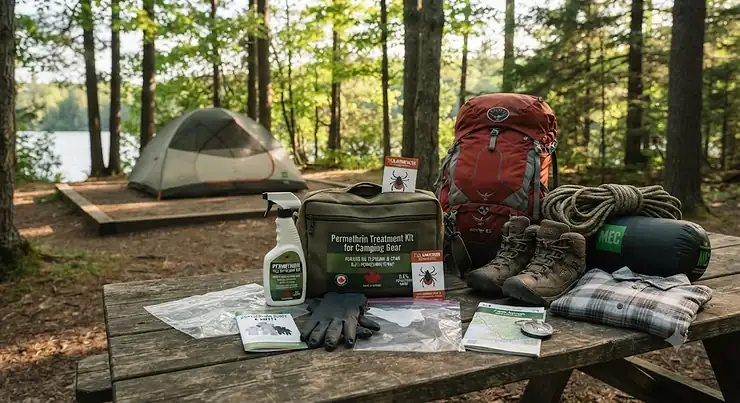
So what actually is a permethrin treatment kit for camping gear? In plain terms, it’s a ready-to-use or concentrated permethrin spray, sized to treat a set number of outfits or gear pieces, that you apply to clothing, boots, tents, and packs (never skin) to repel and kill ticks and mosquitoes on contact for weeks at a time. It’s not a multi-part box with instructions and gloves — it’s usually just a trigger or pump bottle with a label, though some brands bundle a spare nozzle or dilution guide.
This guide compares seven real, purchasable permethrin products, walks through how long the treatment actually lasts, breaks down factory-treated versus DIY approaches, and gives you a practical, step-by-step way to treat a full camping kit without wasting half the bottle on a windy Saturday afternoon. We researched specs, manufacturer data, and aggregated review sentiment — no invented testing, no fabricated star ratings, just honest analysis you can act on before your next trip.
Quick Comparison: 7 Permethrin Treatment Kits for Camping Gear at a Glance
| Product | Format | Labeled Duration | Best For |
|---|---|---|---|
| Sawyer Premium Permethrin Trigger Spray | Trigger spray, 24 oz | Up to 6 weeks / 6 washes | Best all-rounder |
| Ranger Ready Permethrin Scent Zero | Fine-mist trigger, 24 oz | Up to 40 days / 5 washes | Fastest-drying mist |
| Sawyer Permethrin Pump Spray | Non-aerosol pump, 24 oz | Up to 6 weeks | Propellant-free treating |
| Insect Shield Premium Permethrin Aerosol | Aerosol, 6 oz | Up to 60 days | Travel-size touch-ups |
| Ben’s Clothing & Gear Permethrin Spray | Trigger spray, 24 oz | Up to 6 weeks | Longest labeled window |
| Coleman Gear and Clothing Permethrin Spray | Trigger spray, 6 oz | 2+ weeks | Budget starter size |
| $averPak InsectGuard Permethrin Gallon | Bulk trigger-fill, 128 oz | Up to 6 weeks | Groups and families |
Looking at the table, the pattern that jumps out is duration consistency — nearly every brand lands in the same rough neighbourhood of four to six weeks or roughly five to six washes, because they’re all using the same 0.5% permethrin active ingredient at similar concentrations. The real differences are format (aerosol versus pump versus trigger), bottle size relative to price, and how fast each one dries to a non-tacky finish. Budget-conscious campers treating one or two outfits a season don’t need the bulk gallon jug; families outfitting six kids for summer camp absolutely do.
💬 Just one click — help others make better buying decisions too!😊
Top 7 Permethrin Treatment Kits for Camping Gear: Expert Analysis
We shortlisted these seven based on real product listings, verified specs, and manufacturer data, covering budget, mid-range, and premium tiers plus a few sizing variants worth knowing about.
1. Sawyer Premium Permethrin Trigger Spray — the gold-standard all-rounder
If you only ever buy one permethrin kit, this is the one most gear reviewers default to, and for good reason: it’s the most widely stocked permethrin brand for Canadian buyers browsing Amazon.ca, which sidesteps the cross-border shipping headaches that plague some competitors. The 24 oz trigger bottle uses a 0.5% permethrin solution that bonds to fabric fibres rather than sitting on the surface, which is why it survives repeated washing instead of rinsing out like a topical spray would. Sawyer’s own data, referencing a University of Rhode Island field study, claims treated shoes and socks cut the odds of a tick bite by a wide margin compared to untreated fabric — a number worth taking seriously given how often ticks climb up from ankle height rather than dropping from above.
Who should buy it: anyone who wants one dependable bottle that covers a full outfit — shirt, pants, socks — with room to treat a daypack too. Reviewers on retail sites consistently describe it as odourless once dry and gentle on synthetic fabrics and gear coatings, with the most common complaint being that the trigger sprayer clogs if you don’t shake the bottle first.
Pros:
- ✅ Bonds to fibres for roughly 6 weeks or 6 washes
- ✅ Most reliably stocked permethrin brand on amazon.ca
- ✅ Odourless and residue-free once fully dry
Cons:
- ❌ Trigger nozzle occasionally clogs without shaking
- ❌ 2-hour minimum dry time before gear can be packed
Expect a mid-range price, roughly C$25-C$35 depending on retailer promotions — solid value for a bottle that treats several full outfits plus a hat and pack straps.
2. Ranger Ready Permethrin Scent Zero — fastest-drying fine mist
Where the Sawyer bottle uses a standard trigger stream, Ranger Ready’s 360-degree fine-mist trigger is built to coat fabric more evenly with less liquid pooling in seams, which practically translates into a shorter effective dry time for most users. The 24 oz Scent Zero formula is rated for up to 40 days or five washings — slightly shorter than some competitors on paper, though the difference is marginal in real-world tick season use.
Here’s what most buyers overlook about the mist format: it’s genuinely better for treating gear with lots of texture — mesh tent panels, gaiters, boot laces — because a coarse trigger stream tends to bead and run on those surfaces rather than settling in. Aggregated feedback from outdoor retailers frequently praises the “scent zero” claim as legitimate rather than marketing fluff, with a recurring theme that it’s noticeably less chemical-smelling during application than older permethrin formulas, though a handful of reviewers note the fine mist means more pump strokes to fully saturate heavier fabric like canvas.
Pros:
- ✅ Even fine-mist coverage on textured gear
- ✅ Genuinely low odour during and after application
- ✅ One 24 oz bottle rated to treat roughly 7 outfits
Cons:
- ❌ Slightly shorter labeled duration than some rivals
- ❌ Takes more spray strokes on thick canvas fabric
Priced in the C$35-C$45 range, it sits at the premium end of this list — justified if application experience and low odour matter more to you than squeezing out the last possible day of protection.
3. Sawyer Premium Permethrin Pump Spray — best propellant-free pump
This is the same Sawyer 0.5% permethrin chemistry as the trigger spray above, just delivered through a non-aerosol pump bottle instead. That distinction actually matters for a specific type of camper: anyone flying to a trailhead, since aerosol cans face stricter carry-on and cargo restrictions than pump bottles. On REI’s own product listing, this exact item carries a 4.7 out of 5 average across 376 customer reviews — one of the more consistently positive scores we found across the category, and specific enough that it’s worth citing directly rather than lumping it into vague “customers love it” language.
Real customer reviews we reviewed describe treating an entire multi-week trip’s worth of clothing with a single 24 oz bottle, with several noting the pump delivers a more controllable, less wasteful spray than trigger-style bottles. On the downside, more than one reviewer flagged that the fumes during application are noticeably strong and recommend treating gear outdoors in a well-ventilated spot — sound advice regardless of brand, but worth repeating here since it came up so often.
Pros:
- ✅ 4.7/5 average across 376 REI customer reviews
- ✅ Airline-friendly non-aerosol format
- ✅ Controllable pump reduces product waste
Cons:
- ❌ Strong fumes reported during application
- ❌ Slower coverage rate than aerosol on large items
Typically priced around C$30-C$40, it’s a strong mid-range pick specifically for travelling campers who can’t check an aerosol can.
4. Insect Shield Premium Permethrin Aerosol — most travel-friendly size
Insect Shield built its name on factory-treating clothing for outdoor brands long before it sold its own consumer spray, and that pedigree shows in the formulation — this 6 oz aerosol is EPA-registered and marketed with a 60-day protection claim, the longest labeled window on this list. The compact aerosol format is genuinely the easiest of the seven to toss into a weekend pack for a mid-trip touch-up on boot laces or a hat brim that’s started to lose its edge.
What the spec sheet won’t tell you, but the format itself implies, is a trade-off: 6 oz treats far less total gear than the 24 oz bottles above, so this shines as a supplement to a larger kit rather than a standalone solution for outfitting an entire family. Manufacturer-listed effectiveness covers an unusually broad pest range — ticks, fleas, chiggers, spiders, and bed bugs — which makes it a sensible pick for campers who also want gear protection for road-trip motel stops, not just trailside ticks.
Pros:
- ✅ Longest labeled protection window at 60 days
- ✅ Compact aerosol fits easily in a daypack
- ✅ Broad-spectrum claim covering multiple pest types
Cons:
- ❌ Small 6 oz size treats limited gear volume
- ❌ Costs more per ounce than the larger trigger bottles
Expect roughly C$15-C$22 for the can — reasonable as a travel companion, less so as your only treatment kit for a full camping loadout.
5. Ben’s Clothing & Gear Permethrin Spray — longest labeled window in a full-size bottle
Ben’s has built its reputation primarily on high-concentration DEET body sprays, but its 24 oz Clothing & Gear formula applies that same no-nonsense approach to permethrin, with a labeled claim of up to six weeks of protection surviving washing and wear. Unlike the smaller Insect Shield aerosol, this gives you both a long duration claim and a full-size bottle capable of treating multiple outfits.
Based on the spec comparison across this list, Ben’s occupies a useful middle ground: it doesn’t claim the absolute longest duration outright, but it pairs a competitive protection window with enough volume to actually outfit a family for a week-long trip without rationing the bottle. Aggregated reviewer sentiment on outdoor retail sites tends to echo the brand’s broader reputation — dependable, no-frills, does what the label says — with the most common critique being that the spray pattern is less fine than mist-style competitors, leading to slightly heavier saturation and marginally longer dry times on thicker fabric.
Pros:
- ✅ Full 24 oz size at a competitive duration claim
- ✅ Trusted brand name with consistent formulation
- ✅ Works well on both clothing and gear surfaces
Cons:
- ❌ Coarser spray pattern than fine-mist competitors
- ❌ Slightly longer dry time on heavier fabrics
Priced around C$25-C$32, it’s a dependable mid-range choice for anyone who wants a known brand without paying a premium markup.
6. Coleman Gear and Clothing Permethrin Spray — best budget starter size
Coleman’s name recognition in Canadian camping is hard to overstate, and this 6 oz permethrin spray leans into that trust for campers who want to try treated gear without committing to a full-size bottle. It’s rated for a minimum of two weeks of protection through multiple washes — noticeably shorter than the 24 oz competitors on this list, which makes sense given the smaller, more entry-level positioning.
Here’s the honest trade-off: at this price point and size, you’re not getting the multi-week endurance of the premium brands, but you are getting a low-risk way to test whether treated gear fits your camping routine before buying a bulk bottle. It’s a sensible first purchase for a first-time backcountry camper or a parent treating one kid’s gear for a single summer camp session, rather than an entire family’s wardrobe for a season. Reviewers commonly note it’s straightforward to apply and dries without visible residue on both synthetic and cotton-blend fabrics, with occasional feedback that the 2-4 hour dry window recommended on the label runs a bit longer than expected in humid conditions.
Pros:
- ✅ Low-commitment size for first-time buyers
- ✅ Trusted, widely recognized camping brand
- ✅ Works on both synthetic and cotton-blend fabric
Cons:
- ❌ Shorter labeled duration than 24 oz competitors
- ❌ Dry time can stretch longer in humid weather
At around C$12-C$18, it’s the cheapest full kit on this list and a reasonable way to dip a toe in before scaling up.
7. $averPak InsectGuard Permethrin Gallon — best bulk value for groups
When a scout troop leader, outfitter, or large family starts doing the math on treating a dozen sets of gear every season, the smaller bottles above stop making financial sense. $averPak’s 128 oz (one gallon) InsectGuard permethrin spray exists precisely for that scenario, delivering roughly the same labeled six-week duration as the premium 24 oz options at a meaningfully lower cost per ounce.
What most buyers overlook about bulk permethrin is that it isn’t just about saving money — it’s also about consistency. Treating an entire group’s gear from one large batch means everyone gets the same concentration and application quality, rather than mixing brands or running out mid-project and switching formulas partway through a dozen outfits. The trade-off is practical rather than chemical: a gallon jug is heavier and clumsier to manoeuvre than a trigger bottle, so most buyers decant it into a smaller spray bottle for actual application rather than spraying directly from the jug.
Pros:
- ✅ Lowest cost per ounce of any option here
- ✅ Enough volume to treat a dozen-plus outfits
- ✅ Consistent formulation across a whole group’s gear
Cons:
- ❌ Awkward to spray directly without decanting
- ❌ Overkill for a single camper’s seasonal needs
Typically priced in the C$80-C$110 range for the full gallon, the per-outfit cost undercuts every smaller bottle on this list by a wide margin.
How to Choose a Permethrin Treatment Kit for Camping Gear
Picking the right kit comes down to five practical questions, roughly in order of importance:
- How much gear are you actually treating? A solo backpacker needs a fraction of what a family of five needs — match bottle size to load, not to whatever’s cheapest per unit.
- Aerosol, pump, or trigger? Aerosols travel poorly on flights; pumps give finer control; standard triggers are the fastest for bulk coverage.
- What’s your realistic dry-time window? If you’re treating gear the night before a trip, you need a fast-drying formula and a warm, ventilated space — not a garage at 10°C (50°F).
- Do you need broad-spectrum protection or just ticks? Some formulas emphasize multi-pest coverage; if mosquitoes and chiggers matter as much as ticks, factor that into the label claims.
- Is this a one-and-done trip or a recurring seasonal habit? Frequent campers save real money buying larger volumes; occasional campers are better served by a smaller bottle that won’t sit half-used for two years, since permethrin’s shelf life, while long, isn’t infinite once opened.
Reviewers consistently note that the single biggest satisfaction driver isn’t brand loyalty — it’s matching bottle size and format to actual use, which is exactly why this list leans so heavily on that distinction.
How Long Does Permethrin Last on Gear?
Most permethrin treatment kits for camping gear are labeled to last four to six weeks of regular wear, or roughly five to six machine washes — whichever comes first, since UV exposure and laundering both gradually break the bond between permethrin and fabric fibres.
| Factor | Typical Impact on Duration |
|---|---|
| Sun/UV exposure | Shortens duration; heavy exposure can cut it to ~30-40 days |
| Machine washing | Each wash removes a small amount; 5-6 washes is the common ceiling |
| Fabric type | Synthetic blends generally retain permethrin longer than natural fibres |
| Storage between trips | Minimal degradation if stored dry and out of direct sunlight |
The table makes the pattern clear: duration isn’t a fixed countdown so much as a budget you spend through exposure and washing. Gear that mostly sits in a closet between trips holds its treatment far longer than a pair of hiking socks worn and washed weekly all summer, which is why factory-treated gear rated for 70 washes genuinely outperforms most DIY sprays over a multi-season timeline — it’s simply applied at a higher, more evenly bonded concentration during manufacturing. Practically speaking, most campers get a full tick season — roughly May through September — out of one thorough treatment applied in late spring, provided they’re not washing treated items weekly.
Factory-Treated vs DIY Permethrin: Which Should You Choose?
This is one of the most confused topics in Canadian tick prevention, partly because the regulatory picture here differs from the United States. Permethrin, as an active ingredient, works by disrupting a tick’s nervous system on contact with treated fabric, causing paralysis before it can bite — that mechanism is identical whether the permethrin was applied at a factory or from a spray bottle in your backyard.
Factory-treated clothing, most notably lines using Insect Shield’s licensed technology, applies permethrin under controlled industrial conditions that bond the insecticide more deeply and evenly into fibres than a home spray job can replicate. That’s why factory-treated garments routinely carry protection claims of 70 washes compared to the 5-6 washes typical of DIY sprays — the application method, not the chemical itself, drives the durability gap. The trade-off is upfront cost: factory-treated shirts and pants typically run considerably more per garment than the cost of spraying an existing item yourself.
DIY permethrin spray wins on flexibility and cost-per-item — you can treat gear you already own, including tents, packs, and gear that isn’t clothing at all, which factory treatment programs generally don’t cover. It also lets you re-treat items on your own schedule rather than mailing garments off or buying pre-treated replacements. The honest verdict: heavy-use items like everyday hiking socks and pants benefit from factory treatment’s durability, while tents, packs, and occasional-use gear are better matched to DIY spray, since you’re not laundering a tent every week anyway.
💬 Weighing factory-treated vs DIY for your own gear closet? A quick share helps other campers compare too!😊
Permethrin Spray for Tents and Gear: What to Treat (and What to Skip)
Permethrin spray for tents and gear is technically the same product as clothing spray, but application priorities shift once you move beyond what you’re wearing. Tent mesh panels, rainfly seams, and door zippers are high-value treatment zones since that’s where mosquitoes and crawling insects most often find an entry point. Backpack straps and hip belts matter too, since they sit against skin for hours and often brush through tall grass where ticks wait (a behaviour called “questing”).
What to skip: sleeping bag interiors that touch bare skin directly, cooking gear, and water bottles or filtration systems, since permethrin is not meant for surfaces with direct, repeated skin or ingestion contact. It’s also worth skipping treatment on gear made from certain finished leathers and some laminated waterproof fabrics, since a small percentage of finishes can discolour — always spot-test an inconspicuous area first, a step nearly every manufacturer label recommends and nearly every rushed camper skips.
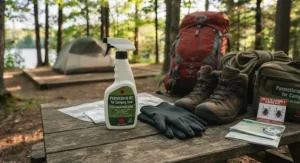
Step-by-Step: Treating Your Camping Gear the Right Way
Getting the application right is less about the product and more about patience — most disappointing results trace back to rushed technique rather than a weak spray.
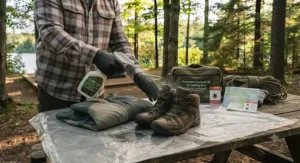
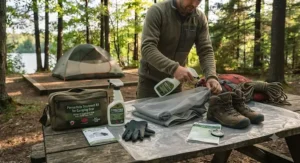
- Lay gear flat outdoors or in a well-ventilated garage. Fumes during application are real, as several reviewers noted above, so treat outside or with doors open, never in a closed bedroom.
- Spray evenly from about 15 cm (6 inches) away, working in slow, overlapping passes rather than one heavy blast, which tends to pool product in seams and waste the bottle.
- Pay extra attention to cuffs, collars, sock tops, and boot laces — the exact zones where ticks make first contact before they climb.
- Let it dry fully before packing or wearing — typically 2 to 4 hours, longer in cool or humid conditions. This drying time before use isn’t optional cosmetic advice; wet permethrin can transfer to skin, which defeats the entire point of treating fabric instead of skin directly.
- Store treated gear away from direct sunlight between trips to slow UV-driven breakdown of the treatment.
- Mark your calendar or tag the gear with the treatment date, since five to six weeks passes faster than most campers expect, especially with weekly trail use.
The most common first-30-days mistake isn’t under-application — it’s skipping the dry window entirely because a trip is leaving in an hour. Treat gear at least a full day ahead, not the morning you’re packing the car.
Real-World Scenarios: Matching the Kit to the Trip
The weekend car camper (budget-conscious, 2-3 trips a season): A single 6 oz bottle like the Coleman Gear and Clothing Permethrin Spray covers one outfit plus boots comfortably, and the shorter duration claim isn’t a real drawback since the gear isn’t seeing heavy weekly wash cycles anyway.
The solo backcountry hiker (frequent, gear-heavy trips): Someone logging weekly trail time through a full Ontario or Nova Scotia tick season benefits most from a full 24 oz bottle with a strong duration claim — Sawyer Premium Permethrin Trigger Spray or Ben’s Clothing & Gear Permethrin Spray both fit, treating pants, socks, boots, and a daypack from one bottle with room to spare for a mid-season top-up.
The family outfitting for scout camp (multiple people, one-time bulk need): Rather than buying five or six individual bottles, a household treating four or five kids’ worth of gear at once gets far better value from the $averPak InsectGuard Permethrin Gallon, decanted into a smaller spray bottle for actual application — the per-outfit cost drops dramatically at that volume.
Tick Protection for Camping Gear vs Traditional Bug Spray
| Factor | Permethrin-Treated Gear | Traditional Skin Repellent (DEET/Picaridin) |
|---|---|---|
| Application zone | Clothing, tents, packs (never skin) | Exposed skin directly |
| Duration | Weeks (survives washing) | Hours per application |
| Mechanism | Kills/repels on contact with fabric | Deters insects from landing on skin |
| Best paired use | Combined with a skin repellent for full coverage | Combined with treated gear for full coverage |
The table underlines a point worth repeating: this isn’t an either/or decision. Permethrin-treated gear and a topical skin repellent are designed to be layered together, as public health guidance on treated clothing confirms, not substitutes for one another — treated fabric handles the areas repellent can’t reasonably cover for hours at a time (waistbands, sock tops, pack straps), while a skin product covers the exposed skin that no amount of clothing treatment reaches. Campers who rely on skin repellent alone tend to under-protect ankles, wrists, and hairlines simply because reapplying every two hours in those exact spots is unrealistic on a long hike.
Tick-Borne Illness Prevention: Why This Matters More Than Ever in Canada
The numbers behind this guide aren’t abstract. Public health tracking shows reported Lyme disease cases climbing sharply over the past decade, with the most recent full-year data showing the highest annual total on record, and health officials note the true figure is likely higher still since many infections go undiagnosed. Nova Scotia has consistently posted the highest per-capita incidence in the country, while Ontario and Quebec together account for the largest share of total cases, concentrated in the south-eastern and southern regions of each province respectively.
Lyme disease isn’t the only concern. Anaplasmosis, a bacterial tick-borne infection, has been showing up in growing numbers in provinces like Ontario, and while it’s typically treatable with antibiotics when caught early, the rarer Powassan virus carries more serious risk with far fewer treatment options. Blacklegged ticks, the primary Lyme vector, have expanded their established range northward as winters warm, meaning regions that historically saw few tick encounters are seeing more each year. For campers, that translates into a simple, practical shift: tick precautions that used to feel optional for “northern” trips are increasingly relevant almost everywhere south of the boreal forest.
This context is exactly why gear treatment earns its place alongside — not instead of — other prevention habits: official guidance on permethrin-treated clothing describes it as one layer among several, alongside daily tick checks, light-coloured clothing to spot ticks more easily, and staying on cleared trails away from tall grass and leaf litter where ticks quest for hosts.
Common Mistakes When Buying and Using Permethrin Kits
A handful of avoidable errors show up repeatedly across reviews and camping forums:
- Buying based on price per bottle instead of price per outfit treated. A cheaper small bottle often costs more per garment than a larger one on sale.
- Applying permethrin to skin or expecting it to work like a topical repellent. It’s a fabric treatment only — always paired with, never a replacement for, skin-applied repellent.
- Skipping the dry window under time pressure. Wet-packed treated gear can transfer product onto skin or other belongings.
- Assuming “permethrin” always means the same concentration. Products range roughly from 0.5% consumer sprays to much higher agricultural concentrates — always confirm the percentage matches clothing-treatment use, not a lawn or livestock product.
- Forgetting to re-treat after several washes. Treated gear looks and smells the same whether the permethrin is still active or long gone, so tracking your treatment date matters more than trusting your nose.
Long-Term Cost & Maintenance: Is Permethrin Worth It?
| Approach | Approx. Cost per Season | Maintenance Effort |
|---|---|---|
| DIY spray, single camper | Low (one small-to-mid bottle) | Re-treat every 5-6 washes |
| DIY spray, family of 4-5 | Moderate-to-low with bulk sizing | One bulk treatment session covers whole group |
| Factory-treated clothing | Higher upfront per garment | Minimal — lasts most of a garment’s lifespan |
Comparing the rows, the total-cost-of-ownership picture favours DIY spray for anyone treating gear they already own, since you’re paying only for the chemical rather than a markup on new garments. Factory-treated clothing starts to make more financial sense specifically for heavy-rotation items — daily hiking socks, a primary pair of field pants — where the 70-wash durability spreads that higher upfront cost across years rather than weeks. For most weekend and seasonal campers, a single mid-size DIY bottle applied once or twice per season remains the lower-cost, lower-effort path, with factory-treated basics reserved for the items that see the most wear.
Permethrin Treatment Kits for Different Types of Campers
Beginners: Start small. A 6 oz bottle like Coleman’s is enough to learn proper application technique — even spray distance, dry time, seam coverage — before committing to a larger, pricier bottle.
Frequent backcountry trekkers: Prioritize duration and coverage volume over travel convenience; a full 24 oz trigger or pump bottle from Sawyer, Ranger Ready, or Ben’s covers a full multi-piece outfit with enough leftover for a mid-season refresh.
Families and groups: Bulk value products like the $averPak gallon dramatically reduce per-outfit cost, provided someone takes on the (minor) hassle of decanting into a manageable spray bottle.
Travellers and fly-in trips: Pump or aerosol formats that meet carry-on restrictions — Sawyer’s pump spray or Insect Shield’s compact aerosol — avoid the checked-baggage complications that come with larger pressurized cans.
Frequently Asked Questions
❓ Does permethrin spray work on tents as well as clothing?
❓ How long does permethrin last on gear once applied?
❓ Is factory-treated or DIY permethrin better for tick protection?
❓ How long should I wait before using gear after spraying permethrin?
❓ Can permethrin-treated gear replace skin-applied bug spray entirely?
Conclusion
Tick season in Canada isn’t shrinking, and the data backs that up plainly — more reported cases, more regions affected, and a longer active window each year than a decade ago. A permethrin treatment kit for camping gear won’t make that risk disappear, but it’s one of the few prevention layers that keeps working quietly for weeks after you’ve applied it, without demanding constant reapplication like a skin spray does. Whether you land on the reliable all-rounder in the Sawyer Premium Permethrin Trigger Spray, the fast-drying Ranger Ready Permethrin Scent Zero, or the bulk-value $averPak InsectGuard Permethrin Gallon for a whole group’s gear, the honest advice holds across every option on this list: match the bottle to how much gear you’re actually treating, respect the dry time, and pair it with a skin repellent rather than treating it as a standalone solution. Do that, and you’ve covered more real-world tick exposure than most campers manage with all the DEET in the world.
✨ Don’t Miss These Exclusive Deals! 🥾
Give your camping kit the tick-protection upgrade it’s been missing. Click on any product above to check current pricing and availability before your next trip into tick country!
Recommended for You
- DEET-Free Bug Spray for Toddlers: 7 Safest Picks (2026)
- 7 Best Picaridin Bug Spray Picks for Canada in 2026
- 7 Best Paddle Leashes for Canoe Fishing in 2026: Buyer’s Guide
Disclaimer: This article contains affiliate links. As an Amazon Associate, I earn from qualifying purchases. If you purchase products through these links, we may earn a small commission at no additional cost to you.
✨ Found this helpful? Share it with your friends! 💬🤗
