
In This Article
There’s a particular sound every Canadian knows. That high, thin whine right next to your ear at 9 p.m. on a dock in Muskoka, or at a trailhead in the Laurentians, or in your own backyard in Winnipeg when you made the mistake of watering the tomatoes at dusk. You swat. It comes back. It brought friends.

What is a mosquito head net? A mosquito head net is a lightweight mesh hood that drops over your head (usually over a hat) and cinches at the neck, creating a physical barrier between biting insects and your face, ears and neck. It weighs about as much as a granola bar wrapper, uses no chemicals by default, and works the instant you pull it on.
That last part matters. Repellent wears off, sweats off and — for young kids — comes with real limits. Health Canada’s guidance on personal insect repellents caps DEET concentrations for children and restricts permethrin-treated clothing for anyone under 16, which is exactly why physical barriers keep showing up in the advice. A mosquito head net doesn’t have an expiry time. It just sits there, being a wall.
But here’s the catch: not all nets are built the same. Mesh density ranges from roughly 300 holes per square inch on a pocket-change basic model to 2,000 on an ultra-fine no-see-um net, and that single number changes how well you can see, how hot you feel and which bugs you’re actually stopping. Fit matters just as much — a net that sags onto your ears is a net mosquitoes can bite through.
So below, I’ve broken down seven real products you can find on amazon.ca, compared them spec by spec, and translated those specs into what they mean when you’re sweating up a portage trail. No invented testing, no fake reviews — just honest analysis built on published specs and aggregated reviewer feedback. Let’s keep the bugs on the outside. 🦟
Quick Comparison Table: 7 Mosquito Head Net Picks at a Glance
| Product | Mesh Density (holes/in²) | Style | Approx. Price (CAD) | Best For |
|---|---|---|---|---|
| Coghlan’s Mosquito Head Net | ~300 | Draw-cord / elastic | Under C$10 | Coghlan’s Mosquito Head Net: tightest budgets, glovebox spare |
| EVEN NATURALS Premium Mosquito Head Net | ~380 | Oversized draw-cord | C$12–C$20 | EVEN NATURALS: wide-brim hats, extra shoulder coverage |
| Sea to Summit Mosquito Head Net | 500 | Draw-cord | C$20–C$30 | Sea to Summit Mosquito Head Net: all-round hiking and camping |
| Ben’s InvisiNet Head Net | Not published | Elastic crown + drop front | C$15–C$25 | Ben’s InvisiNet: ball-cap wearers who want clear vision |
| Coghlan’s Deluxe Mosquito Head Net | ~1,150 | Hoop/ring, brim-style | C$15–C$25 | Coghlan’s Deluxe: net off the face, hot days |
| Sea to Summit Ultra-Fine Mesh Head Net | 2,000 | Draw-cord | C$25–C$35 | Sea to Summit Ultra-Fine: no-see-ums, midges, coastal trips |
| Outdoor Research Helios Bug Hat | Integrated stowable mesh | Brim hat with built-in net | C$85–C$110 | Outdoor Research Helios Bug Hat: sun + bugs in one piece |
Prices are approximate ranges at the time of research — check current price on amazon.ca, as prices may vary.
Looking at the table, the pattern is clear: mesh density climbs roughly with price, but “more holes” isn’t automatically better. The Sea to Summit Mosquito Head Net sits in the sweet spot for most people, while the Sea to Summit Ultra-Fine Mesh Head Net only earns its place if you’re dealing with no-see-ums. And if you already own a favourite hat, the draw-cord nets will serve you better than paying premium money for the Outdoor Research Helios Bug Hat.
💬 Just one click — help others make better buying decisions too!😊
Top 7 Mosquito Head Net Picks: Expert Analysis
Each pick below is chosen to cover a different buyer: the budget minimalist, the wide-brim gardener, the ultralight hiker, the no-see-um sufferer and the “I just want one hat that does everything” crowd. Specs come from manufacturer pages; review sentiment comes from published gear reviews and aggregated retailer feedback.
1. Coghlan’s Mosquito Head Net — the Winnipeg-born budget classic
The Coghlan’s Mosquito Head Net is about as basic as a bug net gets — and that’s the whole point. Coghlan’s is headquartered in Winnipeg, a city that practically has mosquitoes on its coat of arms, so it’s fitting that this is the net many Canadians first owned.
Coghlan’s lists it as a fine polyester mesh with around 300 holes per square inch, an elasticized neck and a cut that fits over most headgear. In practice, 300 holes per square inch stops mosquitoes and black flies comfortably, but it’s too open for no-see-ums — those tiny biting midges will stroll right through. The upside of that open weave? It’s the most breathable and see-through mesh in this round-up.
Here’s what to weigh: this is an affordable mosquito head net for people who need “good enough” protection occasionally — a spare in the car, a backup in the tackle box, a net for the kids’ camp bag. It’s not the one I’d pick as your only net for a week in the backcountry, simply because the elastic neck is less adjustable than a proper drawcord.
Detailed review data for this specific model is thinner than for premium brands, but the consistent theme in retailer feedback is that it does the job for the price and packs down to nothing.
Pros:
- ✅ Lowest price in this round-up by a wide margin
- ✅ Very breathable, high-visibility open mesh
- ✅ Established Canadian brand with wide availability
Cons:
- ❌ Mesh too coarse to block no-see-ums
- ❌ Elastic neck less secure than a drawcord
At well under C$10 (check current price), the Coghlan’s Mosquito Head Net is the cheapest insurance policy in your gear bin.

2. EVEN NATURALS Premium Mosquito Head Net — roomiest fit for wide-brim hats
The EVEN NATURALS Premium Mosquito Head Net wins on sheer size, which solves the most common head-net complaint: not enough room.
Published dimensions are roughly 24.5 inches across the top, 23.5 inches tall and 39.5 inches around the bottom (about 62 × 60 × 100 cm). Translation: it drapes over a wide-brim sun hat without straining and extends well past the collar onto your shoulders. The mesh is around 380 holes per square inch — a notch finer than the budget Coghlan’s, still clearly a mosquito-and-black-fly net rather than a no-see-um barrier.
Based on the spec comparison, this is the pick for gardeners, cottage-goers and anyone who wears a Tilley-style brim. That extra length means you can tuck it into a shirt collar or just let it fall, and the bugs have a much harder time finding a gap at the neck. It’s also untreated — no insecticide — which matters for families.
Aggregated review sentiment, including a roundup from Today’s Homeowner, highlights the breathable, lightweight feel, while the commonly noted downside is that it isn’t machine washable.
Pros:
- ✅ Oversized cut fits over wide-brim hats easily
- ✅ Long drop covers neck and upper shoulders
- ✅ Chemical-free, family-friendly mesh
Cons:
- ❌ Not machine washable, so hand-wash only
- ❌ Extra fabric can snag on branches
In the C$12–C$20 range (often sold as a multi-pack), the EVEN NATURALS Premium Mosquito Head Net delivers strong value for casual outdoor days.
3. Sea to Summit Mosquito Head Net — the best all-rounder for hikers
If you asked a room of backpackers to name one mosquito head net, the Sea to Summit Mosquito Head Net would come up first — and the specs explain why.
It weighs just 24 g (0.8 oz), uses a hexagonal polyester mesh at 500 holes per square inch (80 holes per cm²), and closes with a proper elasticized neck drawcord. That 500 figure is the balance point: fine enough to stop mosquitoes and black flies reliably, open enough that you can still read a trail sign at dusk. The drawcord lets you cinch it snugly around a collar, which is where cheap nets usually leak.
This is the net I’d point most hikers toward. It’s small enough to live permanently in a hip-belt pocket, and the one-size cut works with or without a hat. There’s also a permethrin-treated Insect Shield version, which adds a repellent layer to the mesh itself — useful when mosquitoes land on the net and probe through. Note that Health Canada restricts permethrin-treated clothing for kids under 16.
Reviewers consistently praise the neck cinch and comfort; the recurring complaint is that it’s not ideal over very wide-brimmed hats. Sea to Summit itself notes the standard mesh won’t stop no-see-ums.
Pros:
- ✅ Ultralight 24 g packs into any pocket
- ✅ Adjustable drawcord seals the collar properly
- ✅ Insect Shield permethrin version available
Cons:
- ❌ Snug fit over wide-brim hats
- ❌ Standard mesh doesn’t stop no-see-ums
Around C$20–C$30 (Insect Shield version a bit higher), the Sea to Summit Mosquito Head Net is the best-value serious net here.
4. Ben’s InvisiNet Head Net — clearest view for ball-cap wearers
The Ben’s InvisiNet Head Net tackles the complaint nobody mentions until they’ve worn a net for an hour: seeing through it.
It weighs about 20 g (0.7 oz) and uses a high-visibility mesh with an elastic crown band and an extended drop front, closed with a drawcord. The dark netting is the visibility trick — like tinted window screening, dark mesh reflects less light, so your eyes focus past it rather than on it. The long front panel covers the collar area that shorter nets leave exposed.
Here’s what to weigh: this net is designed around ball caps. SectionHiker’s published review of the Insect Shield version found the elastic crown band grips a cap brim well but bunches up on wide-brim hats — and that the band can feel tight on larger heads. If you’re a trucker-cap hiker, it’s excellent; if you’re a boonie-hat person, look at the EVEN NATURALS Premium Mosquito Head Net instead.
Aggregated reviewer feedback also carries a practical warning: worn without a brimmed hat, the mesh can rest on your ears, and mosquitoes can bite through the holes wherever mesh touches skin.
Pros:
- ✅ Dark mesh gives noticeably better visibility
- ✅ Extended drop front protects collar area
- ✅ Very light at roughly 20 g
Cons:
- ❌ Elastic crown can squeeze larger heads
- ❌ Bunches on wide-brim hats
In the C$15–C$25 range, the Ben’s InvisiNet Head Net is worth the premium for anyone who hates squinting through white mesh.
5. Coghlan’s Deluxe Mosquito Head Net — hoops keep mesh off your face
The Coghlan’s Deluxe Mosquito Head Net takes a different approach: instead of relying on your hat, it builds its own structure.
It pairs a cotton top and adjustable headband with wide rings sewn into the net, plus a drawstring at the neck. Those hoops hold the mesh away from your face and neck, which fixes the “bitten through the net” problem at its source. The mesh is fine nylon at roughly 1,150 holes per square inch — far denser than the standard Coghlan’s model and close to (though just under) the 1,200-hole threshold Sea to Summit cites for reliable no-see-um protection.
Based on the spec comparison, this brim-style design suits people who spend long, stationary hours outdoors — anglers, birders, blueberry pickers — and don’t want to wear a separate hat. The trade-off is packability: rings don’t fold as flat as a pure-mesh net, and the denser weave is warmer on still, humid days.
Detailed, verifiable review data for the Deluxe version is limited, so weigh it mainly on its design logic: hoops plus fine mesh equals fewer bites through the net.
Pros:
- ✅ Built-in rings hold mesh off skin
- ✅ Dense mesh stops smaller biting insects
- ✅ No separate hat required
Cons:
- ❌ Bulkier to pack than mesh-only nets
- ❌ Denser mesh feels warmer in humidity
At roughly C$15–C$25, the Coghlan’s Deluxe Mosquito Head Net is a smart mid-price pick for stationary outdoor time.
6. Sea to Summit Ultra-Fine Mesh Head Net — built for no-see-ums
When mosquitoes are the least of your problems, the Sea to Summit Ultra-Fine Mesh Head Net is the specialist tool.
It packs a startling 2,000 holes per square inch (310 per cm²) into a 23 g net — four times denser than the standard Sea to Summit Mosquito Head Net. That density blocks no-see-ums, sandflies and midges, which is exactly what you need on the Atlantic coast, around northern lakes in late summer, or at any campsite where you’re getting bitten by something you can’t see.
Here’s what the spec sheet won’t shout about: denser mesh means less airflow and slightly dimmer, hazier vision. Sea to Summit openly notes that no-see-um material has reduced airflow. So this isn’t the net to wear on a hot, sunny climb when only mosquitoes are around — it’s the one you pull out when the tiny stuff arrives. Many experienced trippers carry both.
Reviewer sentiment around Sea to Summit’s head nets consistently credits build quality and packability; the recurring caution with ultra-fine mesh in general is heat build-up.
Pros:
- ✅ 2,000-hole mesh blocks no-see-ums and midges
- ✅ Weighs only 23 g packed
- ✅ Safe to treat with permethrin spray
Cons:
- ❌ Noticeably reduced airflow on hot days
- ❌ Slightly hazier view than coarser mesh
Around C$25–C$35, the Sea to Summit Ultra-Fine Mesh Head Net is essential value if no-see-ums are your nemesis.
7. Outdoor Research Helios Bug Hat — premium sun hat with built-in net
The Outdoor Research Helios Bug Hat is for people who’d rather not think about “pairing” anything — the net lives inside the hat.
It’s a UPF 50+ sun hat in bluesign-approved nylon, with a structured brim of about 8.4 cm (3.3″) front and back, an adjustable, detachable chin cord and an integrated stowable mesh net that Outdoor Research says was refined in its 2026 update. At 99 g it’s heavier than any standalone net here, but it replaces your sun hat entirely, so net weight added to your kit is small.
Based on the spec comparison, this is the premium choice for paddlers, anglers and hikers who already wear a sun hat all day. The built-in brim holds the net off your face automatically, the net tucks away when the wind picks up and the bugs vanish, and sizes run from S to XL, so fit is better than a one-size net. Outdoor Research rates its own breathability a modest 3 out of 5, and the company notes the hat contains PFAS — worth knowing if you’re avoiding them.
Aggregated retailer feedback tends to centre on convenience and sun coverage; sizing between S–XL is the detail buyers most often need to get right.
Pros:
- ✅ UPF 50+ sun hat and bug net combined
- ✅ Stowable net deploys in seconds
- ✅ Sized S–XL for a proper fit
Cons:
- ❌ Far pricier than standalone nets
- ❌ Contains PFAS per manufacturer disclosure
In the C$85–C$110 range, the Outdoor Research Helios Bug Hat makes sense only if you’ll wear it as your everyday summer hat.
Top 7 Mosquito Head Net Spec Comparison
| Product | Weight | Mesh (holes/in²) | Stops No-See-Ums? | Hat Needed? | Best For |
|---|---|---|---|---|---|
| Coghlan’s Mosquito Head Net | Very light | ~300 | No | Recommended | Coghlan’s Mosquito Head Net: backup net |
| EVEN NATURALS Premium Mosquito Head Net | Light | ~380 | No | Yes (wide brim ideal) | EVEN NATURALS: gardening, cottage |
| Sea to Summit Mosquito Head Net | 24 g | 500 | No | Recommended | Sea to Summit Mosquito Head Net: hiking |
| Ben’s InvisiNet Head Net | ~20 g | Not published | No | Yes (ball cap) | Ben’s InvisiNet: visibility |
| Coghlan’s Deluxe Mosquito Head Net | Moderate | ~1,150 | Partly (just under 1,200) | No (built-in hoops) | Coghlan’s Deluxe: fishing, birding |
| Sea to Summit Ultra-Fine Mesh Head Net | 23 g | 2,000 | Yes | Recommended | Sea to Summit Ultra-Fine: coastal, late summer |
| Outdoor Research Helios Bug Hat | 99 g | Integrated | Not specified | Is the hat | Outdoor Research Helios Bug Hat: sun + bugs |
Reading across the columns, the real divide isn’t price — it’s whether you need no-see-um protection and whether you already own a hat. The Sea to Summit Mosquito Head Net and Ben’s InvisiNet Head Net are the lightest serious options, but both depend on a brimmed hat to stay off your skin. The Coghlan’s Deluxe Mosquito Head Net and Outdoor Research Helios Bug Hat solve that structurally, at the cost of bulk or budget.
✨ Don’t Miss These Exclusive Deals! 🔍
Take your bug-season comfort to the next level with these carefully selected picks. Click on any highlighted product name to check current pricing and availability on amazon.ca. The right net turns a buggy evening into one you’ll actually want to remember!
Pairing a Head Net with a Hat: A Practical Setup Guide
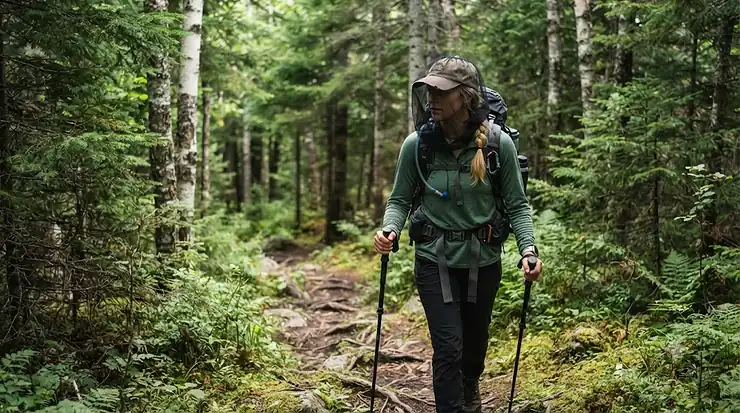
Here’s the single most useful thing nobody prints on the packaging: a head net works best as a system, and pairing a head net with a hat is the difference between “zero bites” and “why is my ear itchy?”
Mosquitoes can’t squeeze through a 500-hole mesh, but their proboscis absolutely can poke through it wherever the mesh presses against skin. A brim acts like a tent pole, holding the fabric a few centimetres away from your forehead, ears and nose. Without it, the net collapses onto you and becomes a very expensive pincushion.
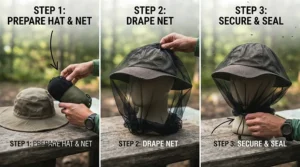
Step-by-step setup ✅
- Hat first. Put on your hat and settle it where it’ll stay all day.
- Drape the net over the crown. Let the elastic or top opening sit around the hat’s crown, above the brim.
- Check the face gap. You want at least 3–5 cm between mesh and nose. If the net touches your face, you need a wider brim.
- Seal the neck. Cinch the drawcord at your collar — or tuck the hem inside a buttoned shirt or jacket.
- Do the head-turn test. Look over each shoulder. If the net pulls tight against your ear, loosen the cord or switch hats.
Which hat works with which net?
- Ball cap: great with the Ben’s InvisiNet Head Net; workable with the Sea to Summit Mosquito Head Net, though the sides and back can still sag onto your ears.
- Wide-brim / boonie hat: the EVEN NATURALS Premium Mosquito Head Net has the room; tighter nets can bunch.
- No hat at all: go with the hooped Coghlan’s Deluxe Mosquito Head Net or the all-in-one Outdoor Research Helios Bug Hat.
A final trick: a light-coloured hat and shirt help too. Guidance from The Friends of Algonquin Park notes that dark colours attract black flies, so khaki and tan earn their keep.
Real-World Scenarios: Which Mosquito Head Net Fits Your Summer?
Specs are abstract. Real people aren’t. Here are three typical Canadian profiles, matched to the net that makes the most sense.
🥾 Profile 1: The weekend day-hiker in Ontario or B.C.
Budget: under C$30. Environment: forest trails, lakeside lunch stops. Frequency: every other weekend, May to August.
This person needs a basic bug head net for hiking — light, packable, forgettable until the moment it’s needed. The Sea to Summit Mosquito Head Net is the logical match: 24 g, a real drawcord, and 500-hole mesh that handles mosquitoes and black flies without making the forest look like it’s behind frosted glass. Pair it with the ball cap they already wear. If they’re a trucker-cap loyalist, the Ben’s InvisiNet Head Net is an equally smart swap.
🌻 Profile 2: The cottage gardener in Manitoba
Budget: as low as possible. Environment: backyard, dock, vegetable beds. Frequency: most evenings in June and July.
This is the classic head net for casual outdoor use. Weight doesn’t matter; coverage and comfort do. The EVEN NATURALS Premium Mosquito Head Net drapes over a wide garden hat and down to the shoulders, and it’s chemical-free — handy with kids and pets around. Toss a Coghlan’s Mosquito Head Net in the shed as a spare for visitors.
🛶 Profile 3: The canoe tripper heading to Nova Scotia or northern lakes
Budget: C$50–C$120. Environment: water, sun, evenings at camp. Frequency: one or two week-long trips per year.
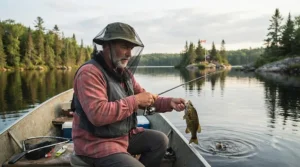
This paddler faces sun at noon and no-see-ums at dusk. The winning combo: an Outdoor Research Helios Bug Hat for daytime sun and mosquitoes, plus a Sea to Summit Ultra-Fine Mesh Head Net stashed in the PFD pocket for the evening midge swarm. Two tools, zero compromise.
Problem → Solution Guide: Fixing the Most Common Head Net Headaches
Most head net complaints fall into a handful of predictable categories. Here’s how to fix each one — often without buying anything new.
❌ Problem 1: “Mosquitoes are biting me through the net.”
✅ Solution: The mesh is touching your skin. Add a brimmed hat, switch to a hooped model like the Coghlan’s Deluxe Mosquito Head Net, or choose a larger net such as the EVEN NATURALS Premium Mosquito Head Net so there’s more air between you and the mesh.
❌ Problem 2: “Tiny bugs are getting inside anyway.”
✅ Solution: You’re probably dealing with no-see-ums or midges, and your mesh is too coarse. Anything around 300–500 holes per square inch won’t reliably stop them. Upgrade to the 2,000-hole Sea to Summit Ultra-Fine Mesh Head Net for those conditions.
❌ Problem 3: “I can’t see where I’m stepping.”
✅ Solution: White or light mesh glares in low sun. A darker net like the Ben’s InvisiNet Head Net improves the view. Also, keep a coarser net for daytime hiking when only mosquitoes are out.
❌ Problem 4: “Black flies are crawling up under the hem.”
✅ Solution: Black flies crawl rather than hover, so seal the neck completely. Tuck the net into a buttoned collar or a zipped jacket, and cinch the drawcord firmly. The long drop of the EVEN NATURALS net helps here.
❌ Problem 5: “It’s unbearably hot.”
✅ Solution: Denser mesh traps heat. Use the most open mesh the bugs allow — the Coghlan’s Mosquito Head Net or Sea to Summit Mosquito Head Net — and save ultra-fine mesh for evenings. Stowing the net between bug zones, as the Outdoor Research Helios Bug Hat allows, helps as well.
How to Choose a Mosquito Head Net: 7 Steps That Actually Matter
Choosing a mosquito head net sounds trivial until you’re standing in a swarm with the wrong one. Run through these seven steps in order:
- Identify your bugs. Mosquitoes and black flies are stopped by 300–500 holes per square inch; no-see-ums need roughly 1,200 or more. This one decision eliminates half your options.
- Match the net to your hat. Ball cap, wide brim or no hat? Your answer points to a draw-cord net, an oversized net or a hooped/integrated design.
- Check the neck closure. An adjustable drawcord seals better than plain elastic, especially against crawling black flies.
- Consider length. A longer drop protects the collar and upper chest, which short nets leave exposed when you turn your head.
- Think about visibility. Darker mesh is easier to see through; denser mesh is harder. If you’ll be driving a boat or scrambling over roots, visibility is a safety factor.
- Weigh treated vs untreated. Permethrin-treated nets add repellency but aren’t for kids under 16 in Canada. Families often prefer untreated mesh.
- Set a realistic budget. A reliable net runs C$10–C$35. Only spend premium money if you’re replacing another piece of gear, like a sun hat.
Follow these steps and you’ll land on the right net in about two minutes — much less time than you’d spend swatting.
Mesh Size and Visibility Trade-Off: What the Hole Count Really Means
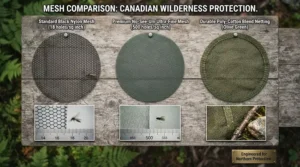
The mesh size and visibility trade-off is the core engineering puzzle of every head net. More holes per square inch means smaller holes, which stops smaller insects. It also means more threads crossing your field of view and fewer gaps for air to pass through. You can’t max out all three — protection, visibility and airflow — at the same time.
Think of it like window screens versus frosted glass. A standard window screen (roughly the density of the Coghlan’s Mosquito Head Net) barely registers when you look through it. Frosted glass blocks everything, including your view. Every head net lives somewhere on that spectrum.
Here’s how the numbers translate:
- ~300–380 holes/in² (Coghlan’s standard, EVEN NATURALS): best visibility and airflow; stops mosquitoes and black flies.
- 500 holes/in² (Sea to Summit standard): the sweet spot for most Canadian hiking.
- ~1,150 holes/in² (Coghlan’s Deluxe): stops many smaller insects; warmer and slightly hazier.
- 2,000 holes/in² (Sea to Summit Ultra-Fine): stops no-see-ums; the warmest and least transparent.
Why do black flies sit on the “easy” end? As the black fly entry on Wikipedia explains, they’re small, stout flies, but they’re still considerably larger than biting midges, so moderate mesh is enough. The real no-see-ums are the ones that force you into the dense end.
The practical takeaway on the mesh size and visibility trade-off: buy for your worst realistic bug, not the worst imaginable one. Plenty of people buy ultra-fine mesh “just in case” and then leave it in the pack because it’s too hot to wear. If you face both, carry two nets — they weigh less than a chocolate bar combined.
Brim-Style vs Draw-Cord Nets: Which Design Wins?
The brim-style vs draw-cord nets debate comes down to one question: what’s holding the mesh off your face?
Draw-cord nets
A draw-cord net is a simple mesh bag that you drape over a hat and cinch at the neck. The Sea to Summit Mosquito Head Net, Sea to Summit Ultra-Fine Mesh Head Net, EVEN NATURALS Premium Mosquito Head Net and Ben’s InvisiNet Head Net all fall into this camp.
- Strengths: featherweight (20–24 g for the lightest), packs into a fist, works with a hat you already own, cheap to replace.
- Weaknesses: entirely dependent on your hat; without a brim, mesh sags onto skin.
Brim-style and hooped nets
Brim-style designs build the structure in — either with wire or fabric rings, like the Coghlan’s Deluxe Mosquito Head Net, or by integrating the net into a sun hat, like the Outdoor Research Helios Bug Hat.
- Strengths: mesh stays off your face automatically; no hat-matching guesswork; usually more comfortable for long, stationary sessions.
- Weaknesses: bulkier, pricier, and you’re committed to that one hat or frame.
The verdict
For hikers counting grams, draw-cord nets win easily. For anglers, birders, gardeners and anyone standing in one place for hours, brim-style designs are simply more comfortable. And if your existing hat has a wide, stiff brim, a roomy draw-cord net gives you roughly 80% of the brim-style benefit for a fraction of the price. Brim-style vs draw-cord nets isn’t about which is better overall — it’s about which one matches how you spend your time outside.
Affordable Mosquito Head Net Options: Long-Term Cost & Value
Let’s talk money, because an affordable mosquito head net is one of the best-value pieces of outdoor gear you can buy. Cost-per-use makes the case better than any marketing copy.
| Product | Approx. Price (CAD) | Typical Lifespan with Care | Est. Cost per Outing (40 uses/season, 3 seasons) | Best For |
|---|---|---|---|---|
| Coghlan’s Mosquito Head Net | Under C$10 | 1–3 seasons | Under C$0.10 | Coghlan’s Mosquito Head Net: occasional use, spares |
| EVEN NATURALS Premium Mosquito Head Net | C$12–C$20 | 2–4 seasons | ~C$0.10–C$0.17 | EVEN NATURALS: frequent backyard use |
| Sea to Summit Mosquito Head Net | C$20–C$30 | 3+ seasons | ~C$0.17–C$0.25 | Sea to Summit Mosquito Head Net: regular hikers |
| Outdoor Research Helios Bug Hat | C$85–C$110 | Multiple seasons (backed by OR’s guarantee) | ~C$0.70–C$0.90 | Outdoor Research Helios Bug Hat: replaces a sun hat |
Lifespan estimates are practical assumptions based on material type and typical wear, not manufacturer claims. Check current price on amazon.ca.
The table shows that even the pricier draw-cord nets cost pennies per outing over a few seasons. The Outdoor Research Helios Bug Hat looks expensive per use, but if it replaces a separate sun hat (which could easily cost C$50+ on its own), its effective premium shrinks considerably. Meanwhile, the Coghlan’s Mosquito Head Net is so cheap that owning three — car, cottage, backpack — still costs less than one premium net.
Stretching your net’s lifespan
- Hand-wash only in cool water with mild soap; air-dry flat.
- Store it loose in its stuff sack, away from Velcro, which shreds fine mesh.
- Patch small holes immediately with a dab of seam sealer or a mesh repair patch — a single tear is a front door for mosquitoes.
- Keep it away from DEET. DEET can damage some synthetic fabrics and plastics, so apply repellent before putting on the net and let it dry first.
Basic Bug Head Net for Hiking: What You Actually Need on the Trail
A basic bug head net for hiking should do three things well: weigh nearly nothing, stay put while you move, and let you see the trail. Everything else is a bonus.
On the trail, you’re turning your head constantly — scanning roots, checking maps, glancing at your hiking partner. That movement is where cheap nets fail, pulling tight across an ear or riding up at the neck. So the drawcord matters more than the fabric colour. The Sea to Summit Mosquito Head Net and Sea to Summit Ultra-Fine Mesh Head Net both use proper drawcords; the Ben’s InvisiNet Head Net combines one with an elastic crown band that locks onto a cap.
Weight-wise, all three sit between 20 and 24 g. At that point, weight is basically irrelevant — you’ll never notice it in your pack. What you will notice is heat on an uphill climb. That’s why, for a basic bug head net for hiking in mosquito-and-black-fly country, a 500-hole mesh beats ultra-fine mesh most days.
Trail habits worth building 🥾
- Keep the net in a hip-belt or shoulder-strap pocket, not buried in the pack.
- Put it on before you stop for a break — swarms find you fast once you stand still.
- Pull it off on breezy ridges and open rock; bugs struggle in wind.
- Carry it through July even if June was calm; mosquito season usually outlasts black fly season.
A basic bug head net for hiking is the rare piece of gear where the simplest version is often the best version.
Head Net for Casual Outdoor Use: Cottage, Garden & Backyard
Not everyone is summiting peaks. A head net for casual outdoor use has completely different priorities: comfort over grams, coverage over packability, and price over premium materials.
Picture the typical scenario: mowing the lawn at the cottage, weeding the garden at dusk, sitting on the dock with a coffee at 7 a.m. You’re not moving fast, and you’re often not moving much at all — which makes you an easy target. Stationary people get swarmed, so neck coverage and room inside the net matter more than weight.
That’s why the EVEN NATURALS Premium Mosquito Head Net shines as a head net for casual outdoor use: it’s big enough to wear over a floppy garden hat and long enough to cover shoulders. The Coghlan’s Deluxe Mosquito Head Net is another good fit, since its hoops keep mesh off your face while you’re bent over flower beds, and there’s no separate hat to hunt for.
Casual-use tips 🌿
- Keep a net by the door. If it’s hanging on a hook, you’ll actually use it.
- Buy spares for guests. Cottage visitors rarely pack one; a few budget nets make you the hero of the long weekend.
- Go untreated around kids. Health Canada restricts permethrin-treated clothing for children under 16, so chemical-free nets are the simpler choice for family use.
- Mind the timing. Dawn and dusk are prime biting windows, especially in shaded yards near water.
A head net for casual outdoor use won’t win any design awards — but it’ll win you back your evenings.
Mosquito Head Net vs Repellent-Only Protection
Most Canadians default to bug spray. It’s familiar, it’s everywhere, and it works — for a while. So how does a mosquito head net stack up against repellent alone and other traditional options?
| Protection Method | Face & Neck Coverage | Duration | Chemical Exposure | Best For |
|---|---|---|---|---|
| Mosquito head net (e.g., Sea to Summit Mosquito Head Net) | Full, physical barrier | As long as you wear it | None (untreated versions) | Sea to Summit Mosquito Head Net: heavy bug zones, kids’ gear bags |
| DEET or icaridin repellent | Good, but patchy near eyes/mouth | Hours; reapplication needed | Yes | Light bug pressure, short outings |
| Citronella candles / coils | Limited, only near source | While burning | Smoke/fumes | Patios with no wind |
| Bug jacket | Full upper body | As long as you wear it | Varies | Extreme black fly seasons |
The comparison makes one thing obvious: repellent struggles exactly where bugs love to bite most — around your eyes, mouth and hairline, where you can’t comfortably apply it. A mosquito head net covers those zones completely and never needs reapplying. That said, the smartest approach is layered: net for your face, repellent on exposed hands and wrists, light-coloured long sleeves for everything else.
Where repellent still wins is convenience in light conditions. If you’re taking a 10-minute walk to the mailbox, spray is quicker. But for anything longer than an hour in true bug country — June in Algonquin, July in northern Manitoba — a net stops being optional and starts being the main event.
Common Mistakes When Buying a Mosquito Head Net
A mosquito head net is simple, which is exactly why people buy the wrong one without thinking. Avoid these five pitfalls:
❌ Mistake 1: Buying the densest mesh “to be safe”
Ultra-fine mesh is brilliant against no-see-ums and miserable on a hot climb. Unless midges are your main problem, a 500-hole net like the Sea to Summit Mosquito Head Net is more comfortable and just as effective against mosquitoes.
❌ Mistake 2: Ignoring the hat question
Many “this net doesn’t work” complaints trace back to wearing it without a brim. Decide your hat first, then buy the net — or pick a structured option like the Coghlan’s Deluxe Mosquito Head Net.
❌ Mistake 3: Choosing a net that’s too short
Short nets leave the collar exposed when you look sideways. Black flies will find that gap. Look for a long drop, like the EVEN NATURALS Premium Mosquito Head Net or the extended front of the Ben’s InvisiNet Head Net.
❌ Mistake 4: Assuming “treated” is always better
Permethrin adds a repellent layer, but it isn’t recommended for kids under 16 in Canada, and many people simply prefer untreated gear. For most casual users, untreated mesh plus good fit is plenty.
❌ Mistake 5: Overspending on features you won’t use
An integrated bug hat is fantastic if you’ll wear it daily. If you’ll use a net four times a summer, an affordable mosquito head net in the C$10–C$30 range is the smarter buy.
Safety & Canadian Regulations: Permethrin, Kids and Bug-Borne Illness
Most head nets are just untreated mesh, so the safety story is refreshingly short. The exception is permethrin-treated nets like the Insect Shield version of the Sea to Summit Mosquito Head Net or the Ben’s InvisiNet Head Net.
Permethrin is a synthetic insecticide that kills or repels insects on contact. Health Canada allows permethrin-treated clothing for adults, including pregnant women, but not for children under 16, and cautions against young kids chewing on treated fabric. In practice, that means treated nets are adult gear — keep untreated nets for the family bin.
Why face protection matters in Canada
Mosquitoes in parts of Canada can carry West Nile virus, and ticks carry Lyme disease, which is why public health agencies emphasise layered bite prevention — clothing, repellent and physical barriers together. A mosquito head net handles the part of your body that’s hardest to protect any other way.
Practical safety tips
- Never wear a head net while driving a vehicle. Even high-visibility mesh reduces peripheral vision.
- Be careful near fire. Polyester and nylon mesh melt easily — keep nets well away from campfires and stoves.
- Lift it to eat and drink only in a breeze or after moving away from the swarm.
- Supervise children wearing any head net, and make sure it can be removed easily.
Handled sensibly, a head net is one of the lowest-risk, highest-reward pieces of bug protection you can own.

FAQ
❓ Where can I buy a mosquito head net in Canada?
❓ Is a mosquito head net worth it for fishing?
❓ Can I wear a mosquito head net over glasses?
❓ Do mosquito head nets work for black flies?
❓ How much does a good mosquito head net cost?
Conclusion
Canadian bug season isn’t a rumour — it’s a recurring event with a schedule. Black flies arrive in late spring, mosquitoes linger well into July, and no-see-ums show up whenever they feel like ruining a sunset. A mosquito head net is the simplest, cheapest way to stay outside through all of it.
Here’s the short version:
- 🥾 Hiking most weekends? The Sea to Summit Mosquito Head Net is the best all-rounder, and the Ben’s InvisiNet Head Net is the visibility pick for ball-cap wearers.
- 🌻 Gardening or cottage lounging? The EVEN NATURALS Premium Mosquito Head Net gives you room and coverage for little money.
- 💰 Just want a backup? The Coghlan’s Mosquito Head Net is almost too cheap not to own.
- 🎣 Standing still for hours? The hooped Coghlan’s Deluxe Mosquito Head Net keeps mesh off your face.
- 🦟 No-see-ums on the menu? The Sea to Summit Ultra-Fine Mesh Head Net is non-negotiable.
- ☀️ Want one hat for sun and bugs? The Outdoor Research Helios Bug Hat is the premium do-it-all option.
Whatever you choose, remember the three rules: match the mesh to your worst bug, pair the net with the right hat, and seal the neck. Do that, and the whine by your ear becomes background noise instead of a reason to go inside.
✨ Ready to Reclaim Your Evenings? 🛒
Click any highlighted product above to check current pricing and availability on amazon.ca. The right net costs less than a campsite fee — and it’ll pay you back every single buggy evening this summer!
Recommended for You
- Permethrin Clothing Spray For Hiking: 7 Proven Tick Picks 2026
- Bug Spray For Kids: 7 Safest Picks Parents Trust (2026)
- Natural Mosquito Repellent For Sensitive Skin: 7 Top Picks (2026)
Disclaimer: This article contains affiliate links. As an Amazon Associate, I earn from qualifying purchases. If you purchase products through these links, we may earn a small commission at no additional cost to you.
✨ Found this helpful? Share it with your friends! 💬🤗
