
In This Article
A foldable propane stove for small trunk space is a two burner camp stove that collapses, latches, or nests into a slim package, so it fits beside a cooler instead of replacing it. Most run on 1 lb propane cylinders and add a carry handle or bag for the walk to camp.
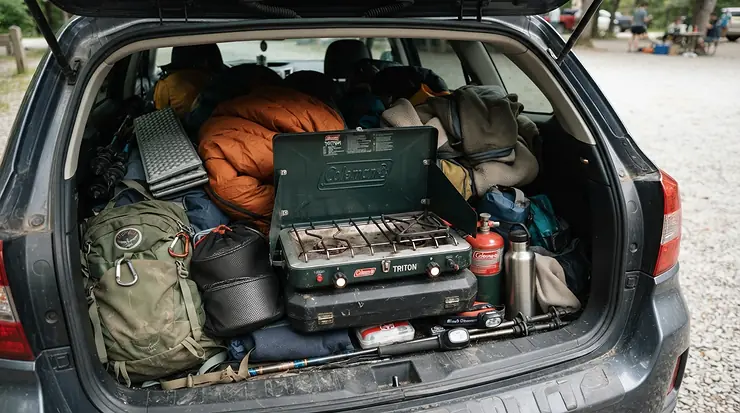
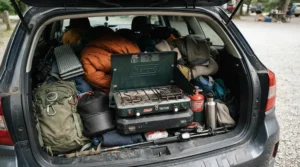
Trunks are the Tetris board of road-trip life. Cooler, duffel, folding chairs, that one bag of firewood you swore you’d skip. Then somebody asks where the stove goes, and the car gets very quiet.
A good space saving propane camp stove for car camping answers that question with a few inches of height instead of half a shelf. According to the Portable stove entry on Wikipedia, refillable gas bottles are heavier and tend to be paired with larger stoves for car camping and base camps. So choosing a foldable propane stove for small trunk space really means finding the middle ground between a pocket burner and a full outdoor kitchen.
I haven’t cooked on any of these stoves myself, and I won’t pretend otherwise. What you’ll get is a spec-by-spec reading of seven real models, a summary of what published reviews and retailer listings consistently report, and plain advice on who should buy what. Prices appear as ranges because they move constantly, so check current price before you commit.
Three features get their own sections below: carry handle, folding legs, and leg height adjustment. Spec sheets love to blur them together.
Quick Comparison: Space Saving Propane Camp Stove Picks at a Glance
| Stove | Total Output | Packed Size | Weight | Handle / Legs | Best For |
|---|---|---|---|---|---|
| ODSD 2 Burner Camping Stove | 20,000 BTU | About 10.6 × 9.1 × 5.1 in | About 4.5 lb (stove only) | Carry bag; no legs | Tight budgets, tiny trunks |
| Coleman Fold N Go | 20,000 BTU | Briefcase-style fold (varies by listing) | Light; check your listing | Handle listed by some retailers; no legs | Hinge-fold simplicity |
| Coleman Triton+ 2-Burner Propane Stove | 22,000 BTU | 23 × 13.75 × 5.75 in | About 10.5 lb (Coleman’s Triton page) | Latch and handle; no legs | Everyday family cooking |
| Camp Chef Everest 2X | 40,000 BTU | 25.2 × 12.7 × 5.6 in | 12 lb (Camp Chef) | Carry handle and latches; no legs | Fast boils, breezy sites |
| Camp Chef Mountaineer | 40,000 BTU | 25.25 × 13.75 × 5.25 in (closed) | 16 lb | Handle; optional adjustable leg kit | Standing-height cooking |
| Primus Kinjia | 2 × 10,200 BTU | 18.7 × 11.6 × 3.1 in | 8.2 lb | Wooden handle; no legs | Slimmest storage |
| Jetboil Genesis | 2 × 10,000 BTU | Clamshell fold in a carry bag | About 6 lb 3 oz | Bag; no legs | Maximum compactness |
Looking at the table, the ODSD 2 Burner Camping Stove and Jetboil Genesis win on weight and packed volume, while the two Camp Chef models win on raw output. The Primus Kinjia is the flattest of the group. Notice that no stove here ships with built-in folding legs, which is a theme we’ll return to.
💬 Just one click — help others make better buying decisions too!😊
Top 7 Foldable Propane Stove for Small Trunk Space Picks: Expert Analysis
Every pick below was chosen from real manufacturer specs, retailer listings, and published reviews. Where I couldn’t verify owner feedback, I say so instead of filling the gap.
1. ODSD 2 Burner Camping Stove — cheapest way into a compact two burner
The ODSD’s whole personality is small and cheerful: a folding steel cooktop that arrives with a frying pan, coffee stand, grill plate, windscreen, and carry bag, so the accessory drawer can stay home.
The stove is rated at 20,000 BTU total, packs to roughly 10.6 × 9.1 × 5.1 inches, and weighs around 4.5 lb on its own. In practice, that’s a stove you can wedge beside a cooler and lift one-handed. OutdoorGearLab’s test averaged a one-liter boil of nearly six minutes, which is respectable at this price. Burner spacing is only about 8 inches center to center, so two big pans will elbow each other.
Based on the spec comparison, this is a collapsible two burner propane stove for road trips where cooking is a side quest: weekend camps, tailgates, roadside coffee. The same reviewer found the piezo igniter struggled in breezy conditions and the windscreen needed extra securing, so keep a lighter handy.
I couldn’t verify a large pool of owner reviews. The sentiment here comes from that expert tester, who praised value, portability, and easy setup while noting weak cold-weather performance.
Pros:
- ✅ Packs down to roughly camping-tub dimensions
- ✅ Pan, grill plate, and coffee stand included
- ✅ Easy setup and simple cleanup
Cons:
- ❌ Igniter and windscreen struggle in breezy conditions
- ❌ Tight burner spacing crowds large pans
Expect roughly $70-$90, which makes it the value leader if your trunk is tiny and your mornings are calm.
2. Coleman Fold N Go — most briefcase-like fold for the money
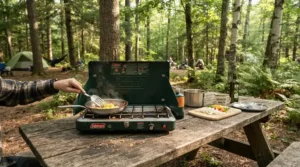
Coleman built this one around a hinge. Open it for side-by-side burners; close it for a tidy slab.
It offers two 10,000 BTU burners, room for two 10-inch pans, and InstaStart push-button ignition. Coleman’s retail copy says one 16 oz cylinder lasts about an hour with both burners on high. That makes it a pancakes-and-coffee stove, not a pasta-for-eight stove.
For a foldable propane stove for small trunk space, the hinge is the real selling point: it closes into a briefcase-sized shape instead of a suitcase-sized one. Handle information is inconsistent. Several retailers describe a built-in carry handle, but at least one marine retailer lists the handle as absent, so verify the listing you’re buying from.
Reviewer sentiment is moderately positive: one retailer listing shows about 4.1 out of 5 across roughly 50 reviews. Owners commonly mention cooking grates that sit tall, gas knobs that feel touchy, and a regulator that rattles while driving. One reviewer reported boiling a one-gallon kettle in about 12 minutes at 4,000 feet.
Pros:
- ✅ Folds smaller than most suitcase-style stoves
- ✅ Push-button ignition, no matches needed
- ✅ Removable grates clean up easily
Cons:
- ❌ Tall grates feel awkward under some pans
- ❌ Handle presence varies by listing
Retailers list it in roughly the $150-$190 range, which is steep for 20,000 BTU. Compare it against the Coleman Triton+ 2-Burner Propane Stove before buying.
3. Coleman Triton+ 2-Burner Propane Stove — the balanced everyday workhorse
The Triton+ hits the middle of the road on purpose: big enough for real pans, flat enough to stack under a duffel.
It delivers 22,000 BTU (11,000 per burner), fits a 12-inch and a 10-inch pan together, and adds dual wind guards plus push-button ignition. Closed, it measures about 23 × 13.75 × 5.75 inches. Independent burner knobs give you two temperature zones. In family-dinner terms, a second large pan matters more than raw BTUs.
What most buyers overlook is a spec-sheet conflict. Coleman’s own Triton page lists roughly 10.5 lb, while some marketplace listings say 5 lb. Trust the manufacturer figure and plan accordingly. Reviewers on listings praise burner control and straightforward operation, while at least one buyer found it too big and heavy for their needs. Coleman’s own listing shows about 4.3 out of 5.
Pros:
- ✅ Fits a 12-inch and a 10-inch pan together
- ✅ Dual wind guards protect the flame
- ✅ Independent burner control for two heat zones
Cons:
- ❌ Roughly 10 lb, heavier than clamshell designs
- ❌ Tabletop only, no legs
Plan on around $100-$130. It is the best power-per-dollar option in this roundup for sedan and hatchback trunks.
4. Camp Chef Everest 2X — boil-fast power in a 4-inch-tall case
If the Triton+ is the workhorse, the Everest 2X is the sprinter.
It offers two 20,000 BTU burners, a 215 square inch cooking area, a 21.5 × 10 inch grate, and matchless ignition. Closed, it measures 25.2 × 12.7 × 5.6 inches, with a carry handle and metal latches. Camp Chef lists 12 lb, though some retailer listings say up to 15 lb. It runs on 1 lb cylinders using the included regulator adaptor. The folding lid doubles as wind protection. OutdoorGearLab scored its boil time 9.0, versus 6.0 for the ODSD 2 Burner Camping Stove, so the extra BTUs buy real speed.
Reviewer sentiment is strong but not spotless. Listings show around 4.6 out of 5 from roughly 450 reviews on one marketplace, and REI buyers averaged about 4.3. Recurring notes include a rattling regulator hose, care needed to avoid cross-threading, and latches that OutdoorGearLab found less than durable. There was also a 2020 CPSC recall of model MSHP units with certain regulator date codes, with a free replacement regulator as the remedy. Check your model and regulator code before first use.
Pros:
- ✅ Fast boils from two 20,000 BTU burners
- ✅ Recessed carry handle and secure latches
- ✅ Folding lid helps in breezy sites
Cons:
- ❌ Latches draw durability complaints
- ❌ Older units need regulator recall check
Expect roughly $190-$240. It is the premium-power pick when wind and big appetites matter more than weight.
5. Camp Chef Mountaineer — roomiest packed stove with an optional leg kit
The Mountaineer is the only pick here that can grow legs on demand.
This aluminum stove offers two 20,000 BTU burners, a 302 square inch cooking area, and a closed size of 25.25 × 13.75 × 5.25 inches at about 16 lb. It has a suitcase-style latch, a carry handle, and a folding three-sided windscreen. Backcountry’s listing says it includes a bulk-tank regulator and 5 ft hose.
The accessory leg kit (LX27A) is aluminum, weighs about 3 lb, measures 28.5 × 6.25 × 2 inches, and includes adjustable leg levelers plus a carry bag. Camp Chef describes it as extra height without sacrificing portability. Honestly, though, you’re now packing another 3 lb and another bag.
Sentiment is mixed across eras. GearJunkie rated it 8.3 out of 10 and named it most durable, while an older REI buyer gave it three stars. Older MS40A units also fell under the Camp Chef regulator recall, so verify your model.
Pros:
- ✅ Most cooking room of the seven when closed
- ✅ Rugged aluminum build with a carry handle
- ✅ Optional legs add standing-height cooking
Cons:
- ❌ Heaviest pick here at about 16 lb
- ❌ Leg kit is a separate purchase
I couldn’t confirm a current exact range, so treat $200-$300 as a ballpark and add roughly $45-$60 for the leg kit.
6. Primus Kinjia — slimmest profile of the group
If trunk height is your enemy, the Kinjia is your friend.
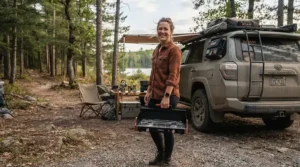
It measures 18.7 × 11.6 × 3.1 inches, weighs 8.2 lb, and delivers 10,200 BTU per burner. A wooden carry handle doubles as a lock, and the pot supports and drip tray remove for cleaning. CleverHiker found it slides under a car seat, which tells you everything about its thickness.
On the downside, there are no windscreens and no auto-ignition. CleverHiker reported that in gusts up to 40 mph the burners couldn’t hold enough heat, and that small burners made pancakes cook unevenly. It averaged a one-liter boil of about 5:56. GearJunkie called it the smallest two-burner it had found and scored it 7.6 out of 10.
This makes it a space saving propane camp stove for car camping couples and solo road-trippers who cook simple meals in calm spots. It is not the choice for windy lakesides or big group dinners.
Pros:
- ✅ Lowest profile in this roundup
- ✅ Wooden carry handle with a locking closure
- ✅ Simmers and sears across its two burners
Cons:
- ❌ No windscreen and manual ignition only
- ❌ Premium price for modest output
Retailers list it in roughly the $220-$300 range. You’re paying for design and slimness more than power.
7. Jetboil Genesis — folds like a clamshell, simmers like a pro
The Genesis is the most space-obsessed stove here. OutdoorGearLab called its Basecamp system the most compact and lightweight two burner in its review, rivaling single burners.
It has two 10,000 BTU burners, weighs about 6 lb 3 oz, and comes with a regulator and carry bag. A lever igniter replaces fragile piezo buttons. GearJunkie measured a boil of about 5:45 per liter and scored simmer control 7 out of 10, but wind protection only 6 out of 10.
The spec sheet won’t tell you this, but its burner spacing is wide enough that big pans don’t collide. For a collapsible two burner propane stove for road trips in small cars, that’s a quiet advantage. Reviewers on REI praised fine flame adjustment, while another called it slow to heat. The Basecamp system adds a 5L pot and 10-inch pan that nest inside.
Pros:
- ✅ Collapses to the smallest volume of the seven
- ✅ Wide burner spacing suits larger pans
- ✅ Fine flame adjustment for simmering
Cons:
- ❌ Highest price in this roundup
- ❌ Modest wind protection
Expect roughly $350-$450 depending on whether you buy the stove alone or the Basecamp system. It’s worth it only if every inch of trunk space is precious.
Side-by-Side Spec Check for a Foldable Propane Stove for Small Trunk Space
| Stove | Price Range | Review Snapshot | Fuel Setup | Best For |
|---|---|---|---|---|
| ODSD 2 Burner Camping Stove | $70-$90 | OutdoorGearLab: 72/100, #6 of 14 | Propane via flexible connector | Budget buyers |
| Coleman Fold N Go | $150-$190 | About 4.1/5 on a retail listing | 16.4 oz cylinder | Briefcase-size storage |
| Coleman Triton+ 2-Burner Propane Stove | $100-$130 | About 4.3/5 on Coleman’s listing | 16 oz cylinder | Family meals |
| Camp Chef Everest 2X | $190-$240 | OutdoorGearLab Editors’ Choice; GearJunkie 8.5/10 | 1 lb cylinder with adaptor | Windy sites, fast boils |
| Camp Chef Mountaineer | $200-$300 (verify) | GearJunkie 8.3/10 | Bulk-tank regulator and hose included | Standing-height cooking |
| Primus Kinjia | $220-$300 | CleverHiker 4.2/5; GearJunkie 7.6/10 | Propane canister | Slimmest storage |
| Jetboil Genesis | $350-$450 | Strong expert reviews | Propane canister with regulator | Maximum compactness |
Looking at the table, the Coleman Triton+ 2-Burner Propane Stove delivers the best power per dollar, while the Jetboil Genesis and Primus Kinjia charge a premium for packing efficiency. Buyers weighing the Camp Chef Everest 2X against the Camp Chef Mountaineer should note the Mountaineer only pulls ahead if you want the optional legs and extra cooking room.
✨ Don’t Miss These Exclusive Deals!
🔍 Take your road-trip cooking to the next level with these carefully selected stoves. Click on any highlighted item to check current pricing and availability. These picks will help you cook hot, satisfying meals your whole crew will love!
Carry Handle: The Small Detail That Decides Whether You Use the Stove
A carry handle sounds trivial until you’re hauling a 12-16 lb stove across a gravel lot with a cooler in the other hand. Then it’s the whole game.
The Camp Chef Everest 2X pairs a carry handle with metal latches. The Camp Chef Mountaineer uses a suitcase-style latch and handle. The Primus Kinjia turns its wooden handle into the closure itself. The ODSD 2 Burner Camping Stove and Jetboil Genesis rely on included carry bags instead of a built-in handle.
Here’s what to weigh. A carry handle only helps if the latch holds the stove shut, and OutdoorGearLab flagged the Everest 2X closures as less than durable. A handle mounted off-center can make a heavy stove swing, so look for one placed near the middle of the long edge. And if a listing for the Coleman Fold N Go says “built-in handle,” confirm it, since retailer data conflicts.
My rule: under 8 lb, a bag is fine. Over 12 lb, insist on a real carry handle.
Folding Legs: Which Stoves Have Them and Which Just Say They Do
Here’s the uncomfortable truth: none of the seven stoves above ships with built-in folding legs. All of them are tabletop designs. If a listing promises folding legs, read the fine print.
The closest thing is the Camp Chef Mountaineer, whose leg kit is sold separately. Beyond this roundup, the Camp Chef Explorer is a different animal: retailer listings describe detachable legs, a 29-inch cooking height, a 14 × 32 inch cooking surface, and a weight around 30.5 lb. One reviewer noted it stands only about 7 inches tall without legs. Brilliant for a patio, brutal for a small trunk.
Based on the spec comparison, folding legs and small-trunk packing pull in opposite directions. Legs add weight, bulk, and another bag. If you want standing-height cooking, a folding table does the same job and also holds your cutting board. Reserve legs for stoves that offer a dedicated, compatible kit, and skip anything advertised as 150,000 BTU, since those are patio-class cookers rather than space savers.
Leg Height Adjustment: Cooking Height, Uneven Ground, and Real Limits
Leg height adjustment matters most on the uneven ground that car campers actually pitch on: gravel pull-offs, sloped grass, cracked picnic tables.
The Camp Chef Mountaineer leg kit advertises adjustable leg levelers for uneven ground. Retailer listings describe the Camp Chef Explorer legs as detachable and adjustable, although at least one reviewer noted that leg levelers weren’t included. Verify before you buy, because “adjustable” can mean fixed telescoping or true levelers.
For tabletop stoves, you adjust the surface instead of the legs. Camp Chef’s Mesa table, for example, lists leg height from about 27 to 39 inches, which gives you standing-height cooking without any leg kit on the stove itself. Add the Everest 2X‘s roughly 4-inch system height and you land comfortably near counter height at the upper setting.
If your stove has no leg height adjustment, level the surface first. A flat board or a shim under one table leg fixes most wobble. Stability matters more than any spec on this page.
How to Choose a Foldable Propane Stove for Small Trunk Space
Follow these steps in order. Each one narrows the field quickly.
- Measure your trunk first. Check the closed length, width, and height against your free floor space. The Primus Kinjia needs about 3.1 inches of height; the Coleman Triton+ 2-Burner Propane Stove needs about 5.75.
- Match output to your menu. 10,000 BTU per burner handles eggs, coffee, and rice. 20,000 BTU per burner suits big pans and faster boils.
- Check wind protection. A folding lid or wind guards help more than extra BTUs on exposed sites.
- Decide tabletop or legs. Most compact stoves are tabletop, so plan a table.
- Confirm fuel setup. Some stoves use 1 lb cylinders; the Camp Chef Mountaineer ships with a bulk-tank regulator and hose.
- Look for a carry handle and secure latch. Heavier stoves need both.
- Verify safety status. Check recall notices for older units and make sure the regulator is current.
Collapsible Two Burner Propane Stove for Road Trips: Setup, Packing, and First-Trip Tips
A collapsible two burner propane stove for road trips only saves space if you pack it right. This is a practical guide to avoid the first-30-day mistakes.
Packing. Slide the stove flat against a trunk wall with the cooler on top, never underneath where drips and weight can crush latches. Keep cylinders upright and secured, away from heat.
Setup. Find level ground, connect the regulator by hand until snug, and check for leaks with a few drops of soapy water. Don’t overtighten, and avoid cross-threading, which reviewers of the Camp Chef Everest 2X specifically warn about.
First-use habits. Pack a backup lighter, since igniters like the ODSD 2 Burner Camping Stove‘s can struggle in wind. Wrap a loose hose or regulator with a cloth to stop the rattle some Coleman Fold N Go owners report while driving.
Maintenance. Let the stove cool completely, then clean grates and drip trays before packing. Grease is the quickest way to ruin a trunk’s carpet.
Space Saving Propane Camp Stove for Car Camping: Three Real-World Scenarios
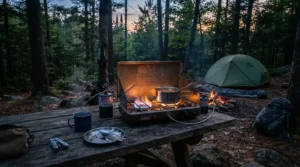
These are hypothetical profiles, built to show how the specs translate into decisions.
Scenario A: the hatchback couple. Two people, two nights, $100 budget, calm summer sites. The Coleman Triton+ 2-Burner Propane Stove is the sensible pick. If budget is tighter, the ODSD 2 Burner Camping Stove saves trunk volume and money.
Scenario B: the family of four with a sedan. Windy lakeside weekends, big pans, a trunk already full of chairs. The Camp Chef Everest 2X earns its space with 40,000 BTU and a folding lid, and its carry handle makes load-in easy.
Scenario C: the compact-SUV nomad. Cooking daily, stove stored every night, simmering sauces matters. The Jetboil Genesis and Primus Kinjia shine here. Pick the Genesis for simmer control and burner spacing, or the Kinjia for the thinnest profile in calm weather.
Notice a pattern: the more often you cook, the more a premium stove pays back in convenience. For two weekends a year, it won’t.
Foldable Two Burner Stoves vs Traditional Alternatives
Foldable stoves aren’t the only way to cook at camp. Here’s how they compare.
| Stove Type | Trunk Footprint | Cooking Power | Setup | Weakness | Best For |
|---|---|---|---|---|---|
| Clamshell or ultra-slim foldable | Smallest | Moderate | Fast | Higher cost per BTU | Jetboil Genesis, Primus Kinjia |
| Suitcase two burner | Medium | High | Fast | Heavier | Camp Chef Everest 2X, Coleman Triton+ 2-Burner Propane Stove |
| Full-size legged stove | Large | Very high | Slower | Needs a big trunk | Camp Chef Explorer |
| Single canister burner | Very small | Low | Fast | One pan at a time | Solo trips |
Looking at the table, suitcase designs give the best balance of power and packing for most families, while true clamshells shine when trunk space is truly scarce. The Camp Chef Explorer offers 60,000 BTU but at roughly 30 lb and 32 inches long, it’s a different category of luggage.
In plain terms: if you cook for one or two, a single burner is cheaper and smaller. If you cook breakfast for four, the second burner is what saves your morning.
Features That Actually Matter (And Those That Don’t)
What matters. Wind protection, burner spacing, igniter reliability, and simmer control. These decide whether dinner is pleasant or a three-person argument.
What doesn’t. Peak BTU on its own. Boil times in published tests cluster tightly: about 5:52 for the ODSD 2 Burner Camping Stove, 5:56 for the Primus Kinjia, and 5:45 for the Jetboil Genesis. BTUs buy speed, as the Camp Chef Everest 2X‘s 9.0 boil score shows, but they don’t buy trunk space or simmer control.
Bundled accessories look generous but add little. A coffee stand is nice; a good windscreen is better. And be wary of listings boasting 150,000 BTU for double burners. Those are patio-class cookers with detachable legs, not trunk-friendly stoves.
Finally, don’t overvalue weight alone. A 4.5 lb stove with a flimsy windscreen can cost you more in fuel and frustration than a 12 lb stove that holds heat.
Long-Term Cost and Maintenance
Cost per use beats sticker price. A stove in the $100-$130 range used on 20 trips works out to roughly $5-$6.50 per trip before fuel, while a $400 stove needs far more trips to match that.
Fuel setup matters too. Small 1 lb cylinders are convenient but cost more per ounce than a refillable 20 lb tank, which is why the Camp Chef Mountaineer‘s bulk-tank hose appeals to frequent travelers.
Maintenance is mostly cleaning. Wipe drip trays, brush grates, and inspect hoses for cracks each season. Check the regulator on older Camp Chef stoves against the CPSC recall date codes. Store the stove dry; rust is the quiet killer of cheap steel cooktops.
Safety, Fuel and Regulations Guide
Carbon monoxide is odorless and deadly, so respect the rules. The CPSC’s carbon monoxide fact sheet says to never use portable fuel-burning camping equipment inside a home, garage, vehicle, or tent unless it’s specifically designed for enclosed spaces.
For trunk-based cooks, the safest reading is simple: cook outside, on stable ground, away from the vehicle and tents. Never run the stove with the hatch closed over it or inside the cargo area.
Other basics: keep cylinders upright and away from heat, avoid leaving them in a hot closed car, and check hoses and connections before every trip. If you smell gas, shut off the cylinder and move away. And always follow the manual for your specific stove.
FAQ
❓ What is the smallest two burner propane stove for car camping?
❓ Can I use a foldable propane stove on my tailgate?
❓ How long does a 1 lb propane cylinder last on a two burner stove?
❓ Is a collapsible two burner propane stove for road trips windproof?
❓ Can I add folding legs to a tabletop two burner stove?
Conclusion
Picking a foldable propane stove for small trunk space comes down to three honest questions: how much trunk you can spare, how often you cook, and how windy your campsites usually are.
For most people, the Coleman Triton+ 2-Burner Propane Stove is the sensible default. If wind and big meals are your reality, the Camp Chef Everest 2X earns its space. The ODSD 2 Burner Camping Stove is the budget hero for tiny trunks, while the Primus Kinjia and Jetboil Genesis are the space-obsessed premium picks. The Coleman Fold N Go is the hinge-fold option to compare on price, and the Camp Chef Mountaineer is the one to buy if you want optional legs and standing-height cooking.
Remember the three feature takeaways: confirm the carry handle, don’t assume folding legs exist, and check leg height adjustment before trusting any stove on uneven ground. Whatever you choose, cook outside, check your regulator, and test it at home before your first trip.
Recommended for You
- Propane Camp Stove With Built-In Griddle: 7 Best Picks 2026
- Two Burner Propane Stove For Cottage Cooking: 7 Best Picks 2026
- Single Burner Propane Stove For Ice Fishing: 7 Best Picks 2026
Disclaimer: This article contains affiliate links. As an Amazon Associate, I earn from qualifying purchases. If you purchase products through these links, we may earn a small commission at no additional cost to you.
✨ Found this helpful? Share it with your friends! 💬🤗
