
In This Article
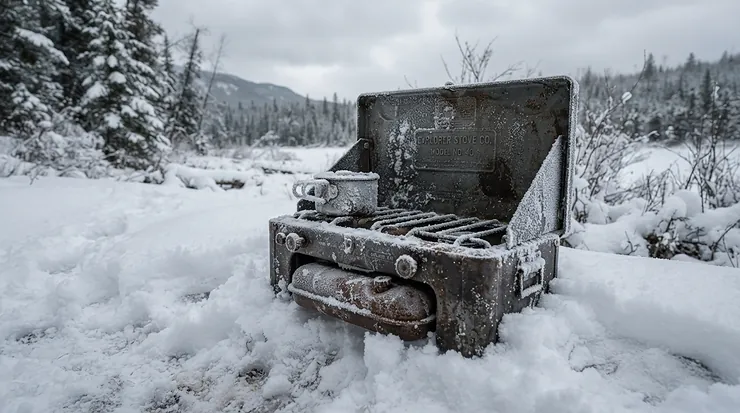
Picture this. It’s -22°C, the wind is sandpapering the lake, and your tip-up flag finally pops. Your hands are too cold to work the line, and the soup you packed is a brick. A single burner propane stove for ice fishing fixes that. It turns a long, grim wait into hot coffee, a pot of chili, and a reason to stay on the ice another two hours.
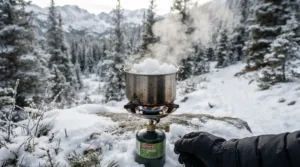
Here’s the catch. Most stove guides are written for summer campsites, and the ice is a different animal. Fuel behaves differently at -25°C. Wind rips through a flip-over shelter, and a stove that wobbles on a flat picnic table sulks on an uneven auger hole rim. Your gear also has to survive being dragged on a sled over bumpy ice.
This guide is built for Canadian anglers. I dug into current specs, aggregated reviewer sentiment, and safety guidance from Canadian sources to rank seven real stoves. I haven’t handled any of them myself, so the analysis is spec-driven and review-driven, and I flag where verified review data was thin. You’ll also get a plain-English look at cold weather performance, piezo ignition, the canister vs bulk tank hookup decision, and a compact kayak camping option for when the ice melts.
One safety fact before we start. Carbon monoxide is colourless, odourless and tasteless, and forms whenever propane burns, per Health Canada, so nothing below is permission to get casual with ventilation.
Quick Comparison: 7 Single Burner Propane Stoves at a Glance
| Stove | Output (per listings) | Fuel Hookup | Best For |
|---|---|---|---|
| Coleman Bottletop | Up to 10,000 BTU | Screws onto 454 g (16.4 oz) cylinder | Budget shore lunches |
| Coleman PowerPack | Up to 7,500 BTU | Cylinder, via adapter/hose design | Wide-pan cooking, simple setup |
| Stansport Model 201 | 10,000 BTU | 16.4 oz cylinder, regulator knob | Stability on uneven surfaces |
| Primus Moja | Not confirmed in sources | 1 lb canister or tank adapter hose | Canister vs bulk tank flexibility |
| Mr. Heater MH15C | 8,000–15,000 BTU variable | 1 lb cylinder | Cooking plus warming in one unit |
| Camp Chef Stryker 200 | Not confirmed in sources | Propane or butane canister | Compact kayak camping |
| Camp Chef High Pressure Single Cooker | 60,000 BTU | High-pressure, tank-style hookup | Big pots, base camp, outdoor use only |
Read the table by job, not by raw BTU. The Coleman Bottletop and Stansport Model 201 are the straightforward, wallet-friendly answers for a shore lunch. The Mr. Heater MH15C sits in a different category because it doubles as a heater. And the Camp Chef High Pressure Single Cooker is a sledgehammer, ideal for a big pot outside and wrong for a cramped shelter.
💬 Just one click — help others make better buying decisions too!😊
What Is a Single Burner Propane Stove for Ice Fishing?
A single burner propane stove for ice fishing is a portable, one-flame cooker that runs on propane and is used on frozen lakes to boil water, heat food and warm hands. Propane is the fuel of choice because it keeps vaporizing far below freezing. Most models draw from a 454 g (about 1 lb) disposable cylinder. Some can connect to a 9.1 kg (20 lb) tank through a regulator hose.
The category blurs at the edges, which matters for your safety. Some units are pure cookers. Others, like the Mr. Heater MH15C, are radiant heaters that convert into cookers with a stand. Pure cookers are generally rated for outdoor use only, so treat any cooking inside a shelter as a ventilation problem first and a convenience second.
Top 7 Single Burner Propane Stoves for Ice Fishing: Expert Analysis
Every pick below follows the same logic: what the specs mean on the ice, who it suits, and what reviewers say. Where I could not verify real reviews, I say so instead of guessing.
1. Coleman Bottletop — the no-fuss, screw-on workhorse
The design is clever in its simplicity. The burner screws straight onto a 454 g propane cylinder, and the whole thing separates for packing. Coleman’s materials cite up to 10,000 BTU, though one retailer data sheet lists 7,650 BTU, so confirm the number on the exact model you’re buying. The cooking surface fits an 8-inch (20 cm) pan, and Coleman quotes up to about 2.5 hours on high from one cylinder.
Here’s what that means on the ice. Bottle-top stoves put the cylinder directly under the flame, so the cylinder sits on cold ice and robs itself of heat. A scrap of foam or a plank under it helps more than you’d expect. Based on the spec sheet, this suits solo anglers and pairs who want hot water and a one-pot meal, nothing fancier.
Reviewer sentiment on Coleman’s own site averages about 4.6 out of 5 across 76 ratings. A recurring caution is that it gets top-heavy with a large 4-quart pot, and users advise a solid support surface.
Pros:
- ✅ Simple screw-on design with no hose to fail
- ✅ Packs small once separated from the cylinder
- ✅ Backed by a multi-year limited warranty
Cons:
- ❌ Top-heavy with large pots on uneven ice
- ❌ Cylinder exposed to cold ground and wind
Price range: roughly C$55–C$85 at the time of research. Verdict: strong value for casual anglers. Check current price before you buy.
2. Coleman PowerPack — wide base, wide pans, wide-open to wind
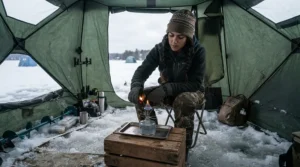
If the Coleman PowerPack has a party trick, it’s the pot support. It’s built to carry a large 12-inch (30 cm) pan, which makes it appealing for frying fish or heating a proper skillet of breakfast. It’s rated around 7,500 BTU and quotes up to about 3 hours on high from a single 454 g cylinder. It packs to roughly 33 × 24 × 10 cm.
Lower output isn’t automatically a flaw. A 7,500 BTU burner sips fuel, and a wider pan spreads heat gently. On paper, this is a good partner for a long day when you’re feeding two or three people rather than racing to boil water.
Now the honest part. OutdoorGearLab’s review found no real wind resistance at all and told readers to either pick their cooking spot carefully or add a windscreen. A windscreen matters even more on open ice. Coleman’s own listing gives about 4.5 out of 5 across 55 ratings, with practical praise for versatility. Lighting is by match or lighter, with no built-in igniter.
Pros:
- ✅ Supports big 12-inch pans stably
- ✅ Fuel-sipping output stretches a cylinder
- ✅ Simple, repairable, few parts
Cons:
- ❌ Very exposed to wind without a screen
- ❌ No built-in igniter in the listings reviewed
Price range: around C$70–C$110. Verdict: good for relaxed, group-sized cooking, as long as you bring a windscreen.
3. Stansport Model 201 — the stability specialist
Stansport’s single burner prioritizes a steady footprint over weight savings. The Model 201 carries a 10,000 BTU stainless burner about 19 cm across, wide enough for single-serving pots and pans. A “Dura Base” with extendable legs keeps the whole stove planted, and a regulator on/off knob manages the flame. It runs on a 454 g cylinder and measures roughly 19 × 19 × 32 cm. A US retailer lists it as CSA registered, so confirm that mark on the box you’re handed.
That base is the sleeper feature. Ice is rarely level, and a stove on a pressure-cracked surface wants to tip. Extendable legs give you a way to level the cooker on uneven lake surfaces instead of propping it up with your boot.
I could not find verified reviewer data for this exact model, so I won’t put numbers on customer satisfaction. What the spec sheet does tell you is that it’s aimed at light-duty cooking, so think boiling water, soup and sausages rather than a feast.
Pros:
- ✅ Extendable legs help on uneven ice
- ✅ Wide burner head for stable pot support
- ✅ Straightforward regulator knob control
Cons:
- ❌ Verified review data is hard to find
- ❌ Tall profile raises centre of gravity
Price range: roughly C$45–C$70. Verdict: a sensible budget pick if stability on rough surfaces is the priority.
4. Primus Moja — the one that flips fuel formats
The Primus Moja earns its spot because it answers the canister vs bulk tank hookup question better than most. For North American buyers, a field test from Expedition Portal notes it uses 1-lb propane canisters or an available tank adapter hose, and it includes an adapter for isobutane canisters. That’s flexibility on both sides: grab a cylinder at a gas station today, run it off a bigger tank later.
The tester praised it for space-saving cooking and said they hadn’t found a better single burner. The knock is the lack of a piezo ignition. With a big pot on top, lighting it by hand gets fiddly, so plan on a long-reach lighter.
For ice work, the practical read is clear. If you plan to run a stove regularly through a season, the ability to connect a hose and a larger tank cuts your running cost over time. I couldn’t confirm a Canadian price for the Primus Moja, so expect it to land above the Coleman and Stansport models and check current pricing.
Pros:
- ✅ Works with cylinders or a tank adapter hose
- ✅ Compact footprint for tight vehicles and sleds
- ✅ Includes isobutane adapter for flexibility
Cons:
- ❌ No piezo ignition on this model
- ❌ Likely pricier than basic single burners
Verdict: a strong long-term buy for regular anglers who want fuel options.
5. Mr. Heater MH15C — the cooker that doubles as a space warmer
This is the hybrid. The Mr. Heater MH15C is a radiant heater that converts into a cooking burner with an included stand. It offers variable output from 8,000 to 15,000 BTU, with high, medium and low settings and a safety shutoff valve. A 454 g cylinder runs roughly 1.4 to 2.6 hours depending on setting.
Why does that matter? A hybrid lets you cook and take the edge off a small shelter with one unit and one fuel source. The trade-off is that a radiant heater is built to heat. A dedicated heater with a built-in oxygen depletion sensor is a safer match for a closed shelter, so don’t assume a heater-cooker magically solves ventilation.
Reviewers on retail listings say it keeps even a large four-person shanty warm, though one thoughtfully warns users to maintain proper ventilation. Another found it heated a small shanty fast on low. Those are retailer-listing reviews, so treat them as directional, not laboratory data.
Pros:
- ✅ Heats and cooks from one burner
- ✅ Adjustable high, medium and low settings
- ✅ Safety shutoff valve included
Cons:
- ❌ Short runtime on high from one cylinder
- ❌ Still demands serious ventilation indoors
Price range: around C$90–C$140. Verdict: good value if you want one unit to do two jobs.
6. Camp Chef Stryker 200 — the canister-top for people with more dry bag than sled
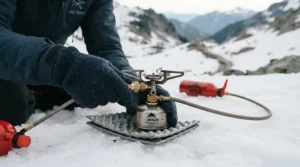
The Camp Chef Stryker 200 is the odd one out here, because it’s built for the backcountry first. It’s a compact canister-top system that runs on propane or butane canisters, and it weighs about 19.4 oz (550 g) per the retail listing. The pot volume is quoted at about 1.3 to 1.5 litres, with an insulated sleeve for gripping.
That makes it the best fit in this lineup for the compact single burner propane stove for kayak camping job. Weight and packed size dominate when you’re counting every gram in a hatch. For ice work, though, the dual-fuel flexibility cuts both ways. Butane-heavy canister blends are the cold-weather weak spot, so if the Stryker is going on the ice, feed it propane or a propane-rich mix.
I couldn’t verify independent reviews for this model, so I’m reading the spec sheet only. The retail price (about US$150) places it firmly in premium-stove territory.
Pros:
- ✅ Light and compact for paddling trips
- ✅ Accepts propane or butane canisters
- ✅ Insulated sleeve makes handling easier
Cons:
- ❌ Premium price versus basic burners
- ❌ Reviews difficult to verify
Price range: roughly C$190–C$250. Verdict: pick it for kayak and shoulder-season trips, not as a dedicated ice-fishing workhorse.
7. Camp Chef High Pressure Single Cooker — the 60,000 BTU sledgehammer
Raw power is the headline here. The Camp Chef High Pressure Single Cooker is rated at 60,000 BTU per hour, which is far beyond anything else on this list. It’s marketed as a lightweight single burner for boiling and frying, and it’s the natural partner for the bulk-tank side of the canister vs bulk tank hookup debate.
The upside is speed. A big pot of water, a fish boil, or a crew’s worth of chili moves along quickly. The downside is everything that comes with that much fire. This is an outdoor-only tool, meant to run from a regulator hose on a larger tank, and it’s an overkill choice for a cramped shelter. A tractor-supply Q&A drives home a hard rule: never connect a high-pressure regulator to a standard low-pressure stove.
I only found retail copy for this model, so I can’t report verified reviewer sentiment. Confirm what hose and regulator come in the box before you buy.
Pros:
- ✅ Extreme output boils large pots fast
- ✅ Suits big groups and base camps
- ✅ Pairs with bulk tanks for long sessions
Cons:
- ❌ Far too much output for most shelters
- ❌ Needs correct high-pressure regulator and hose
Price range: around C$110–C$150. Verdict: the right tool for a big outdoor cook-up, the wrong one for solo ice sessions.
Head-to-Head: Which Stove Wins Which Scenario?
| Stove | Ignition (per sources) | Wind Handling | Best For |
|---|---|---|---|
| Coleman Bottletop | Manual light | Wind baffles listed | Quick solo meals |
| Coleman PowerPack | Match flame | Poor without a screen | Large pans, casual groups |
| Stansport Model 201 | Not confirmed | Unverified | Uneven surfaces |
| Primus Moja | None; lighter needed | Unverified | Fuel flexibility |
| Mr. Heater MH15C | Not confirmed | Unverified | Dual-purpose heat and cooking |
| Camp Chef Stryker 200 | Not confirmed | Unverified | Kayak and light trips |
| Camp Chef High Pressure Single Cooker | Not confirmed | Unverified | Big pots outdoors |
The table is blunt about a gap in the market: most single burners in this price range skip a built-in igniter, so a long-reach lighter is the cheap upgrade. Where wind data is missing, assume exposure and bring a screen. If I had to choose one for the broadest mix of jobs, the Coleman Bottletop wins on simplicity, the Primus Moja on flexibility, and the Mr. Heater MH15C on versatility.
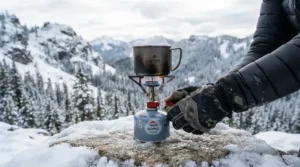
How to Choose a Single Burner Propane Stove for Ice Fishing
- Match the fuel to the temperature. Propane keeps vaporizing at much lower temperatures than butane, so stay propane-led for deep winter.
- Decide how you’ll carry fuel. Cylinders are convenient. A tank hookup is cheaper per hour but heavier on the sled.
- Look at stability. A wide base or adjustable legs beat a pretty design on uneven ice.
- Check wind protection. A built-in baffle or a separate windscreen can double effective output.
- Think about ignition. A piezo igniter is a gloved-hand convenience, but a long lighter is the reliable backup.
- Right-size the output. Ten thousand BTU handles most solo cooking, while 60,000 BTU is for crews and outdoor cook-ups.
- Look for certification marks. Check for CSA or equivalent marks, and inspect hoses and fittings before every season.
Cold Weather Performance: What Actually Happens to Your Stove at -25°C
Propane boils at -42°C, which is why it remains the default for winter. Butane boils near -0.5°C, and isobutane around -12°C, so blends with more butane fade first. That’s the whole story on paper. The real-world twist is that a canister cools as it drains, because boiling liquid pulls heat out of the cylinder. Scandinavian Outdoor notes that even winter-blend canisters start to become a risk around -20°C.
On a lake, you fight three enemies at once: ambient cold, wind, and the cold ice under the cylinder. The fixes cost almost nothing. Insulate the base with foam or a plank. Keep spare cylinders in an inside jacket pocket until you need them. Shield the burner from the wind. Treat a flaky flame as a signal to warm the cylinder gently with body heat, never with open flame.
Bottle-top designs like the Coleman Bottletop are the most exposed because the fuel sits directly under the flame in the cold airflow. A remote cylinder or hose-fed design like the Primus Moja lets you tuck the fuel somewhere warmer. As a rule, cold weather performance depends more on how you manage the fuel than on the brand on the burner.
Canister vs Bulk Tank Hookup: Which Wins on the Ice?
Cost and convenience pull in opposite directions here. A 454 g cylinder is light, pre-regulated and idiot-proof. A 9.1 kg tank costs far less per hour of burn but needs a hose, a regulator and a stable spot to stand.
| Factor | Canister | Bulk Tank Hookup |
|---|---|---|
| Weight on the sled | Light | Heavy |
| Cost per hour | Higher | Lower |
| Setup complexity | Minimal | Hose and regulator needed |
| Cold-weather control | Cylinder chills quickly | Larger mass holds temperature better |
| Best For | Day trips, solo anglers | Base camps, long weekends |
Look at the table, and the decision is almost a personality test. If you fish two hours at a time, canisters win on pure convenience. If you camp for a weekend on the ice with a crew, a bulk tank with a regulator hose pays for itself fast, and the Camp Chef High Pressure Single Cooker is the natural pair. The pivot point is safety. Match the regulator to the stove: Stansport’s own hose instructions warn against bypassing the regulator supplied with the stove. Inspect every hose and fitting too, because Health Canada once recalled single and double burner camp stoves over a propane hose connection defect that could leak fuel.
Piezo Ignition: Worth Paying For on the Ice?
Piezo ignition is the little click-and-spark button that lights the burner without a flame source. On a frozen lake, with gloves on and a gust whipping across the hole, it’s a quality-of-life feature rather than a safety feature. Some propane heaters such as the Mr. Heater Buddy advertise an integrated piezo igniter, and plenty of cheap stoves skip it entirely.
Among the seven stoves here, the field notes I found flagged the Primus Moja as lacking piezo ignition, and the Coleman PowerPack lists a match-flame start. For the others, the listings I reviewed didn’t confirm one either way. That’s the pragmatic takeaway: verify before you buy, and pack a long-reach lighter regardless.
Piezo ignition also fails more often in extreme cold, since the ceramic crystal and spark gap get damp or frosty. A dead igniter on a -20°C morning shouldn’t strand you without breakfast. Think of it as a bonus, never a plan.
Propane Stove for Ice Fishing Shelter: Safety, Ventilation and CO
This is the section to read twice. A propane stove for ice fishing shelter use sounds cozy, and it also puts combustion gases inside a small, sealed box. The numbers are sobering. A Montana Technological University study in the CDC’s research library found that eight of ten fishermen showed measurable carboxyhemoglobin within an hour of fishing in a propane-heated structure, and 40% already had measurable levels on arrival.
Coleman states plainly that its bottle-top stove is for outdoor use only and shouldn’t be used indoors or in confined spaces. So the realistic approach is layered:
- Cook outside or at an open door. Prop the flap open and keep the burner away from the walls.
- Keep burn time short. Boil, cook, shut down. Don’t leave a burner running as a heater.
- Use a carbon monoxide alarm. Battery-operated units made for tents and cabins are cheap insurance.
- Prefer a purpose-built heater for warmth. Models with an oxygen depletion sensor and tip-over shutoff are designed for this job.
- Vent top and bottom. Cross-ventilation beats a single cracked zipper.
Treat the stove as a cooking tool and the heater as a heating tool. Blurring them is how people get hurt.
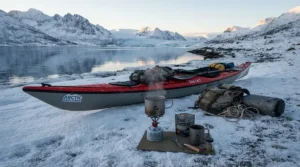
Compact Single Burner Propane Stove for Kayak Camping
When the ice goes out, the same fuel logic works for paddlers, but the priorities flip. Weight and packed size matter more than raw output. A compact single burner propane stove for kayak camping has to fit a hatch, shrug off salt or spray, and light reliably after a rough landing.
The Camp Chef Stryker 200 is the natural fit with a listed weight of about 550 g and an insulated pot sleeve. The Coleman Bottletop is a lighter-on-the-wallet alternative that separates into a compact kit. The Primus Moja also draws praise for space-saving cooking.
One tip carries over: stash a long lighter in a waterproof bag. A paddler fishing a shoreline campsite at dusk will thank you.
Practical Usage Guide: Your First Season on the Ice
Setup is where people lose fingers and fuel. Start by testing everything at home. Fire the stove in the garage with the door open, check the flame colour (steady blue is good), and inspect the seals and O-rings before they matter. Use a soapy-water test around connections and watch for bubbles.
On the ice, build a simple “kitchen corner.” Set the stove on a flat board to insulate it from the ice, put a windscreen on the windward side, and keep your lighter and pot within arm’s reach. Pre-warm the cylinder inside your jacket for ten minutes before the cook.
Add a maintenance rhythm. After each trip, wipe the burner head, check the hose for cracks, and store cylinders upright in a cool, ventilated spot. Once a season, replace any suspicious seals. Quebec’s public safety guidance also reminds outdoor users that fuel-burning devices can release carbon monoxide, so detectors belong in cabins and camps.
In your first 30 days, avoid three classic errors: overloading a small stove with a heavy pot, running a burner unattended, and storing cylinders in a warm vehicle cabin.
Real-World Scenarios: Which Stove for Which Angler
The solo weekend angler. Four hours on a small lake, a thermos, and a pot of soup. The Coleman Bottletop keeps the kit light and the bill low. Add a foam pad under the cylinder and a windscreen.
The family hut crew. Four people, a hub shelter, and a long afternoon. The Mr. Heater MH15C can warm the space and heat a pot of chili, provided the door is cracked and a CO alarm hangs from the ceiling. Use a Coleman PowerPack outside for the big skillet.
The weekend camper. Two nights on the ice with a sled full of gear. A Camp Chef High Pressure Single Cooker running off a 9.1 kg tank powers a crowd’s breakfast, and a Primus Moja is the backup. Budget for the right regulator and hose.
Matching the stove to the pattern matters more than chasing the biggest number on the box.
Common Mistakes When Buying a Single Burner Propane Stove for Ice Fishing
The first mistake is buying on BTU alone. A 60,000 BTU burner is spectacular and also wasteful for a mug of tea. The second is ignoring wind. A powerful burner in an open gust underperforms a modest one behind a screen.
The third is skipping the fuel plan. Cylinder cost adds up fast across a season, and buyers who skip the math sometimes discover a tank hookup would have saved real money. The fourth is trusting a stove with a vague label. Look for recognizable certification marks and avoid unlabelled imports, since the Health Canada recall noted that the affected camp stoves carried no brand or model labelling.
The last mistake is treating a cooker as a heater. A burner designed for pots isn’t designed to keep a shelter safely warm.
Long-Term Cost: Cylinders vs Tanks Over a Season
| Scenario | Fuel Setup | Likely Annual Cost Direction |
|---|---|---|
| 10 day trips, solo | Canisters only | Low upfront, higher per hour |
| 20 trips, regular | Canisters plus regulator hose | Mid; hose pays back within a season |
| 8 weekend camps | Bulk tank, high-pressure burner | Higher setup, lowest per hour |
| Best For | Match to your trip frequency |
The pattern is predictable. The more hours you burn, the faster a hose and tank pay for themselves. For an occasional angler, the extra gear is a distraction, and a basic Stansport Model 201 with a handful of cylinders is plenty.
FAQ: Single Burner Propane Stoves for Ice Fishing
❓ Can I cook inside my ice fishing shelter with a camp stove?
❓ Will a propane stove work at -30°C?
❓ How many BTUs do I need to boil water on the ice?
❓ Can I connect a camp stove to a 20 lb propane tank?
❓ How long does one 454 g propane cylinder last?
Conclusion: Pick the Stove That Fits Your Ice, Not Just Your Budget
The best single burner propane stove for ice fishing is the one that matches how you actually fish. For a casual solo angler, the Coleman Bottletop delivers the most no-fuss value. If big pans and shared meals matter, the Coleman PowerPack earns its footprint, as long as you bring a windscreen. The Stansport Model 201 handles uneven surfaces, and the Primus Moja is the smartest long-term pick if you want canister vs bulk tank hookup flexibility. The Mr. Heater MH15C blends cooking with warmth, the Camp Chef Stryker 200 is the paddler’s choice, and the Camp Chef High Pressure Single Cooker is the heavyweight for base camps.
Whatever you choose, build your plan around three habits: manage the fuel for cold weather performance, ventilate like your life depends on it, and carry a lighter even if the stove has a piezo ignition. Do that and you get hot soup, steady hands, and a lot more time with a line in the water.
✨ Ready to upgrade your ice-fishing kitchen?
🔍 Click any highlighted product above to check current pricing and availability, and stay warm out there! 🎣
Recommended for You
- Bug Tarp Shelter For Canoe Camping: 7 Best Picks To Beat Bugs 2026
- Mosquito Shelter For Patio: 7 Best Picks For Canada (2026)
- Screened Shelter For Mosquitoes: 7 Best Picks For Canada In 2026
Disclaimer: This article contains affiliate links. As an Amazon Associate, I earn from qualifying purchases. If you purchase products through these links, we may earn a small commission at no additional cost to you.
✨ Found this helpful? Share it with your friends! 💬🤗
