
In This Article
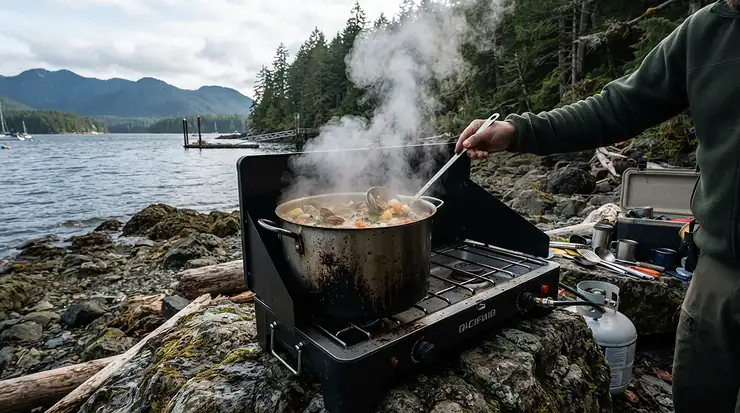
Picture the dock at 7 a.m. Mist is lifting off the lake, a loon is being dramatic, and you’re wrestling a lone one-burner camp stove to heat coffee water and pancake batter at the same time. Something has to give, and it’s usually the pancakes. A two burner propane stove for cottage cooking ends that standoff. One burner takes the kettle, the other takes the skillet, and breakfast shows up hot instead of in shifts.
This guide covers seven real, currently sold models, from budget classics to a compact folding design to a legs-and-all cabin workhorse. I’ve weighed their specs against aggregated tester and reviewer feedback, then translated the numbers into what they mean on a screened porch, a lakeside deck or a gravel pad behind an off-grid shack.
What Is a Two Burner Propane Stove for Cottage Cooking?
A two burner propane stove for cottage cooking is a portable, outdoor-rated cooktop with two independently controlled burners, fed by a 16.4 oz (454 g) cylinder or a larger 20 lb tank through a regulator. It replaces or supplements a cottage’s indoor range, so you can boil, fry and simmer without electricity. Heat is rated in BTU per hour, a unit explained on Wikipedia’s British thermal unit page.
Quick Comparison: 7 Stoves at a Glance
| Model | BTU per Burner | Weight | Ignition | Wind Protection | Best For |
|---|---|---|---|---|---|
| Camp Chef Everest 2X | 20,000 | ~5.4 kg | Matchless | Lid + steel side shields | Big families, fast boils |
| Coleman Classic Propane Stove | 10,000 | ~5.3 kg | Match/lighter | Adjustable WindBlock panels | Budget cottage kitchens |
| Coleman Triton+ | 11,000 | ~4.6 kg shipped | Push-button | Wind guards | Easy starts on a budget |
| Coleman Cascade Classic | 10,000 | ~5.4 kg | Rotary matchless | Tall screens, recessed burners | Steady, fuel-sipping cooking |
| Eureka Ignite Plus | 10,000 | ~5.4 kg | Push-button | Modest; add a screen | Two big pans, simmer work |
| Jetboil Genesis Basecamp | 10,000 | ~2.8 kg (stove) | Push-button | Clip-on screen | Small storage, boat access |
| Camp Chef Explorer 2-Burner | 30,000 | ~13.8 kg | Manual light (verify model) | 3-sided windscreen | Cabin decks, large pots |
Look at the BTU column first. The Camp Chef Explorer 2-Burner and Camp Chef Everest 2X play a different game than the four 10,000-11,000 BTU models, but the Explorer’s power comes with a 20 lb tank and 13.8 kg of heft. If your cottage cooking leans toward crowds and big pots, the Camp Chef pair wins on paper. If it leans toward quiet breakfasts and weekend pasta, the Coleman Classic Propane Stove and Eureka Ignite Plus deliver without the extra bulk.
💬 Just one click — help others make better buying decisions too!😊
Top 7 Two Burner Propane Stoves for Cottage Cooking: Expert Analysis
1. Camp Chef Everest 2X — fastest boils in this class
Two 20,000 BTU burners put this stove well ahead of the 10,000 BTU pack. In OutdoorGearLab’s testing, it averaged about 3 minutes 21 seconds to boil a litre of water across windy and calm trials, versus six-plus minutes for the 10,000 BTU rivals. The folding lid and side shields form a three-sided windbreak, and four full knob rotations from off to full give you proper adjustable burner control instead of a blast-furnace switch. The 215 sq in (about 1,390 cm²) surface fits two 10-inch skillets side by side.
Based on the spec comparison, this is the pick for large families and hosts who cook real meals, like pasta for eight, not just coffee. Reviewers consistently praise the heat and wind resistance. The recurring complaints are bulk and weight (about 5.4 kg), and some owners of the earlier Everest found the low end touchy. OutdoorGearLab also notes a recall of older units over the gas regulator, so confirm yours isn’t affected.
Pros:
- ✅ Twice the heat of most rivals
- ✅ Four-turn control for gentle simmers
- ✅ Sturdy shields clip in firmly
Cons:
- ❌ Bulky and heavy for a small porch
- ❌ Older units had a regulator recall
Price: around C$250-C$350 at the time of research; check current price. Verdict: premium money, but it earns it if you feed crowds.
2. Coleman Classic Propane Stove — the budget workhorse with adjustable wind panels
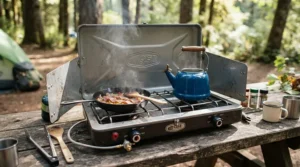
The Coleman Classic Propane Stove is the old-school answer to the cottage cooking problem, and its adjustable WindBlock panels fold in or out to suit your pan size. Two 10,000 BTU burners (20,000 total) run about an hour on high with both burners on a single 16.4 oz cylinder, which matches my own back-of-envelope math: one pound of propane holds roughly 21,500 BTU. It fits a 10-inch and a 12-inch pan together and carries a three-year limited warranty.
The honest take is that this stove rewards simplicity. You light it with a match or lighter, there’s no ignition to fail, and a buckle-style latch keeps the lid shut. Reviewers repeatedly call it reliable and easy to pack. The most common complaints are a hard-to-find low simmer on the cheaper variants and a rigid regulator line that stresses if the cylinder hangs unsupported.
Pros:
- ✅ Dead-simple, rugged build
- ✅ Adjustable WindBlock panels
- ✅ Three-year warranty
Cons:
- ❌ No built-in ignition
- ❌ Simmer range is limited
Price: around C$100-C$170; check current price. Verdict: the safest value pick for a first cottage stove.
3. Coleman Triton+ — push-button starts without the fuss
Push-button Instastart ignition and 22,000 total BTU (11,000 per burner) make the Coleman Triton+ the easy-start sibling of the Classic. Independent PerfectFlow regulation holds heat steady as the cylinder drains, and it runs roughly an hour on high per 16.4 oz bottle. A built-in handle, a rust-resistant aluminized steel top and a three-year warranty round out the package.
What the spec sheet won’t tell you is how it handles breezes. OutdoorGearLab’s test of the earlier Triton Plus boiled a quart in 4:45 in calm conditions, but the same task took 9:15 on a breezier day, and its wind resistance scored poorly. Treat the wind guards as a helper, not a fortress, and position it with its back to the lake wind. Owner feedback is warm: the flame is controllable, setup is fast, and one common tip is to quiet the rattle when packed.
Pros:
- ✅ Matchless push-button ignition
- ✅ Independently adjustable burners
- ✅ Built-in carry handle
Cons:
- ❌ Boil times suffer in wind
- ❌ Modest total power
Price: around C$110-C$180; check current price. Verdict: great value for sheltered porches.
4. Coleman Cascade Classic — recessed burners and tall wind screens
The Coleman Cascade Classic adds improved knob rotation for simmer control and rotary matchless lighting. Wind screens slot into the body with adjustable notches, and the burner heads sit recessed in the base, which gives the flame extra shelter. Each burner is rated 10,000 BTU, and the stove weighs about 5.4 kg.
Here’s where testers disagree, and why you should care. OutdoorGearLab calls it affordable, portable and fuel efficient, but slow to boil and weak against wind. GearJunkie credits the screens and recessed burners for better wind protection than its Triton sibling, while timing a litre at about seven minutes. Read that as a stove built for patient cooking, not speed. If your cottage mornings are slow anyway, that’s a fair trade.
Pros:
- ✅ Rotary matchless ignition
- ✅ Recessed burners shelter flames
- ✅ Fuel-efficient operation
Cons:
- ❌ Slow boil times
- ❌ Among the weakest outputs here
Price: around C$130-C$200; check current price. Verdict: a sensible choice for steady, unhurried cooking.
5. Eureka Ignite Plus — two-turn simmer control and room for two big pans
The Eureka Ignite Plus is built for people who actually cook. Two 10,000 BTU stainless burners sit 30 cm apart, so two 12-inch pans fit at once. A two-turn simmer control lets you dial from a whisper to full output, and push-button ignition lights it fast. It measures roughly 58 × 33 × 10 cm closed and weighs about 5.4 kg, with rubber feet for a stable stance.
JetLink compatibility means you can chain it to other Eureka stoves for extra burners, a neat trick for a crowded long weekend. OutdoorGearLab calls it straightforward with a few perks and says the extra size over the smaller Ignite barely registers in a loaded car. Owner reviews are positive, with one calling it great value in windy conditions after years of use. I’d still add a clip-on screen for exposed lakeside spots.
Pros:
- ✅ Fits two 12-inch pans
- ✅ Precise two-turn simmer control
- ✅ JetLink expansion option
Cons:
- ❌ 10,000 BTU burners boil modestly
- ❌ Wind protection isn’t its strength
Price: around C$200-C$300; check current price. Verdict: strong for slow cooks who want precision.
6. Jetboil Genesis Basecamp — folds smallest of the group
The Jetboil Genesis Basecamp unfolds to about 52 × 25 cm and packs down into a compact case. The stove alone weighs roughly 2.8 kg (the full system with pot and pan is about 4.1 kg). Two 10,000 BTU burners with four full turns of regulated flame give excellent control, and a windscreen and JetLink compatibility are included.
Tester views are consistent. BetterTrail praises its temperature control but dings its wind protection, and OutdoorGearLab calls it overkill for most buyers. The case for it is storage and portability: tiny cottage closets, boat-access properties and canoe-in sites. The case against it is price, since you pay a premium for compact engineering rather than raw heat.
Pros:
- ✅ Most compact two-burner here
- ✅ Four-turn flame control
- ✅ Includes windscreen
Cons:
- ❌ Wind performance disappoints
- ❌ Premium pricing for 10,000 BTU
Price: stove alone around C$300-C$450; check current price. Verdict: buy it for portability, not for power.
7. Camp Chef Explorer 2-Burner — 30,000 BTU per burner for cabin decks
The Camp Chef Explorer 2-Burner is a different animal: two 30,000 BTU cast-aluminum burners on detachable steel legs, with a three-sided windscreen, regulator and three-foot hose for a 20 lb tank. The cooking surface measures 14 × 32 inches (about 36 × 81 cm), and it weighs roughly 13.8 kg. The Explorer 2X variant lists up to 15 hours on one 20 lb tank, which makes sense if you run one burner mid-flame most of the time.
Practically, this is a fixed-deck or tailgate stove, not a carry-to-the-dock one. OutdoorGearLab describes it as durable and freestanding with excellent flame power and simmering. A reviewer using it on family 4×4 trips noted the windshield definitely helps. With both burners wide open, I estimate roughly seven hours from a full 20 lb tank, so plan your refills.
Pros:
- ✅ Serious power for big pots
- ✅ Freestanding legs, 3-sided windscreen
- ✅ Hose runs from a refillable 20 lb tank
Cons:
- ❌ Heavy at about 13.8 kg
- ❌ Needs a 20 lb tank and hose setup
Price: around C$170-C$260 plus fuel; check current price. Verdict: the best fit for a cabin porch or a deck with a permanent corner.
✨ Don’t Miss These Exclusive Deals!
🔍 Take your cottage meals to the next level with these carefully selected stoves. Click on any highlighted product to check current pricing and availability. These picks will help you create the lakeside breakfasts your family will remember!
How to Choose a Two Burner Propane Stove for Cottage Cooking
Seven steps will get you to the right model faster than scrolling reviews all evening.
- Count your mouths and pans. If you routinely cook for more than four, prioritise a wider surface (two 12-inch pans) or higher BTU. Small crowds can live happily on 10,000 BTU burners.
- Match power to patience. A 10,000 BTU burner boils a litre in roughly six to seven minutes. A 20,000 BTU burner halves that.
- Test the low end. A stove that can’t hold a gentle simmer will scorch sauce. Look for multi-turn knobs.
- Check wind exposure. Lakeside decks and open docks demand good screening; sheltered porches don’t.
- Think about carrying and storage. Heavy units suit a permanent deck. Light ones suit boat-access trips.
- Pick your fuel system. 16.4 oz cylinders are convenient but run out fast. A 20 lb tank needs a hose but lasts all weekend.
- Plan for cleaning. Removable grates and drip trays save you from a greasy end-of-summer chore.

BTU Output Per Burner: What the Numbers Really Mean
BTU output per burner is the single most overhyped and misunderstood spec in this category. A BTU is simply the energy needed to warm a pound of water by one degree Fahrenheit, so 10,000 BTU/h equals about 2.9 kW, and 20,000 BTU/h equals about 5.9 kW.
More isn’t automatically better. A 30,000 BTU burner under a small saucepan wastes fuel and scorches food, while a 10,000 BTU burner struggles to boil a 5 L pot in wind. The sweet spot for most cottage cooking is 10,000-20,000 BTU per burner, where the Coleman Classic Propane Stove, Eureka Ignite Plus and Camp Chef Everest 2X all sit.
Fuel maths follows from the output. A 16.4 oz cylinder holds roughly 21,500 BTU, so a 40,000 BTU/h stove such as the Camp Chef Everest 2X at full tilt empties one in about half an hour. That’s why dedicated cottage cooks swap to a 20 lb tank and hose when they can. The Camp Chef Explorer 2-Burner pairs naturally with that setup.
Wind Panels: Why They Matter More Than You Think
Wind panels do more than keep your flame lit; they decide whether your 20,000 BTU stove acts like a 20,000 BTU stove. OutdoorGearLab tests wind resistance with a box fan producing 2-4 mph of airflow, and the results show how much panel design matters. OutdoorGearLab’s Everest 2X review singles out its large side shields that lock into the body as a big reason it boils so fast despite breezes.
Fixed vs adjustable panels
Adjustable wind panels like those on the Coleman Classic Propane Stove and Coleman Cascade Classic let you tuck the screens tight around a small pan or open them for a wide skillet. Fixed ones, like the lid-and-shield design on the Camp Chef Everest 2X, are sturdier but less flexible.
The panels most buyers overlook
Tall screens are good, but gaps between panel and body leak air. The Jetboil Genesis Basecamp ships with a screen, yet testers still found its wind performance lacking. When reading reviews, look for comments on gaps, not only on height.
Propane Camp Stove With Wind Guard for Lakeside: Dock, Beach and Point Cooking
Cooking at the water’s edge changes everything. A propane camp stove with wind guard for lakeside use faces gusts that bounce off open water, shifting direction without warning. Here the stove’s design matters more than its BTU rating.
For the dock or beach, I’d rank the Camp Chef Everest 2X and Coleman Cascade Classic highest. The former has rigid shields and the power to recover quickly from a gust. The latter tucks burner heads into the base so the flame sits below the airflow. The Coleman Triton+ works if you position it tail-to-wind or build a low windbreak from a cooler and a log.
Two simple habits help: place the stove on a level, non-flammable surface away from dry grass, and keep the cylinder in the shade. Direct sun on a small cylinder isn’t dangerous on its own, but it’s a bad habit near any open flame.
Adjustable Burner Control: The Simmer Test
Adjustable burner control separates stoves that cook from stoves that merely heat. Look for knobs with several full turns between off and high, like the four rotations on the Camp Chef Everest 2X and Jetboil Genesis Basecamp, or the two-turn simmer dial on the Eureka Ignite Plus.
Why simmer matters at the cottage
Rice, sauces, scrambled eggs and anything with cheese all need a low flame. A stove that goes from off straight to roaring will scorch the bottom of a pot in seconds. Some Coleman Classic Propane Stove owners report this problem, so they slide the pan partly off-centre to cut the heat.
A quick at-home check
Light each burner, turn it to the lowest stable flame and see whether it holds steady with the lid open and a light breeze. If it flickers or dies, adjustable burner control isn’t doing its job. Test this before your first trip, not on a family holiday weekend.
Two Burner Propane Stove for Cabin Cooking: Setting Up an Off-Grid Kitchen
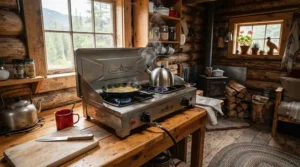
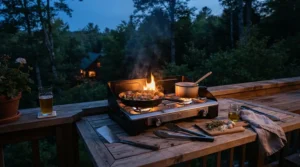
Cabins differ from cottages in one big way: they’re often truly off-grid and used in colder shoulder seasons. A two burner propane stove for cabin cooking has to handle lower temperatures, longer burn times and a more permanent setup.
For those jobs, the Camp Chef Explorer 2-Burner is the obvious choice, with its detachable legs, 20 lb tank connection and room for large pots or a stockpot of chili. The Camp Chef Everest 2X works as a tidier tabletop alternative if deck space is tight.
Cold weather needs attention. Propane’s vapour pressure drops as temperatures fall, so regulated burners such as those on the Coleman Triton+ and Coleman Classic Propane Stove help maintain steady output. Keep spare cylinders outdoors in a ventilated spot (more on this in the safety section) and never run any of these stoves inside a closed cabin.
Setup and Maintenance Guide: Your First 30 Days
Day one: build it right
- Inspect the hose and regulator for cracks before every connection.
- Place the stove on a flat, stable, non-flammable surface.
- Connect the cylinder, then brush soapy water on the joint and watch for bubbles.
Store cylinders upright, outdoors, with outlets capped, as recommended in the Canadian Propane Association’s handling and transporting guide.
Week one: common mistakes
- Over-tightening the connection. Hand-tight plus a small snug is enough.
- Letting grease build up. Wipe the drip tray after each use.
- Hanging a heavy cylinder off a rigid line. Support it so the regulator hose doesn’t bend, a stress point owners of two-burner stoves frequently flag.
Week four: the maintenance habit
Clean burners with a soft brush, check igniters and wipe the grate. If you own a model with a recall history, like older Camp Chef Everest 2X units, check the manufacturer’s site once a season.
Real-World Scenarios: Matching Stoves to Cottage Types
The weekend hosting family (six people, mixed meals)
Budget around C$300 and cook three meals a day on a screened porch. The Camp Chef Everest 2X handles two pans at once with quick boils. If cost matters more, the Coleman Classic Propane Stove is the lean alternative.
The couple on a boat-access cottage
Everything arrives by boat, so weight and size matter. The Jetboil Genesis Basecamp folds small and weighs about 2.8 kg for the stove alone. It suits two people cooking breakfast and dinner.
The cabin with a permanent deck
A 20 lb tank sits in a corner, and big pots of chili and corn-boil dominate fall weekends. The Camp Chef Explorer 2-Burner shrugs off big-batch cooking, with legs and a screen built in.
Two Burner Propane Stove vs Alternatives
A two burner propane stove sits between a single-burner camp stove and a full cottage range, and each option has trade-offs.
| Option | Strength | Weakness | Best For |
|---|---|---|---|
| Two burner propane stove | Two pans, no electricity | Needs fuel and ventilation | Most cottage cooks |
| One-burner stove | Light and cheap | One pot at a time | Solo trips |
| Electric hot plate | Quiet, indoor-friendly | Needs power or a generator | Grid-connected cottages |
| BBQ side burner | Already built in | Often weak, awkward height | Occasional boil-ups |
Looking at the table, the two-burner design wins on versatility for off-grid cottage cooking. A one-burner stove saves weight but forces sequential cooking. An electric hot plate is indoor-safe but useless when the power’s out. A BBQ side burner is convenient but limited in size and control.
Price Range and Value Analysis
| Model | Price Range (CAD) | Value Verdict | Best For |
|---|---|---|---|
| Coleman Classic Propane Stove | C$100-C$170 | Excellent entry value | First-time buyers |
| Coleman Triton+ | C$110-C$180 | Strong for sheltered use | Easy-start fans |
| Coleman Cascade Classic | C$130-C$200 | Fair, slow boils | Patient cooks |
| Camp Chef Explorer 2-Burner | C$170-C$260 (+ tank) | Best power per dollar | Cabin decks |
| Eureka Ignite Plus | C$200-C$300 | Good for precision | Two-pan cooks |
| Camp Chef Everest 2X | C$250-C$350 | Premium, justified | Large families |
| Jetboil Genesis Basecamp | C$300-C$450 (stove) | Pay for compactness | Small spaces |
Prices vary and change often, so check current price before buying. The most efficient value per dollar belongs to the Camp Chef Explorer 2-Burner, since extra BTUs cost relatively little, but its fuel setup raises the true price slightly. The Coleman Classic Propane Stove wins on the lowest total cost of ownership, while the Jetboil Genesis Basecamp only makes sense if portability is worth a premium.
Propane Safety and Canadian Regulations
Propane is safe when treated with respect. In Canada, the transport of propane cylinders falls under the federal Transportation of Dangerous Goods framework, and Transport Canada’s summer safety advice on camping and propane tanks is a good starting point before any road trip.
Key habits worth building:
- Always carry cylinders upright and secured, never in a closed passenger area.
- Disconnect and cap cylinders before transport.
- Never refill disposable 1 lb cylinders; the Canadian Propane Association notes it is illegal to refill cylinders without proper training.
- Use outdoors only, never inside a closed cottage or cabin.
- Check local fire restrictions before lighting any stove during dry summer months.
Cylinders also have a service life. Refillable ones are typically requalified through a registered provider after ten years, so check the date stamped on your tank.
FAQ
❓ How long does a 16.4 oz cylinder last on a two burner propane stove?
❓ Can I run a two burner propane stove on a 20 lb tank?
❓ Is it safe to use a propane stove inside a cottage?
❓ Which stove is best for windy lakeside cooking?
❓ How do I clean and store my stove for winter?
Conclusion
A good stove turns cottage weekends from improvised to effortless. For most buyers, the right two burner propane stove for cottage cooking comes down to three trade-offs: power versus weight, wind protection versus price, and simmer finesse versus simplicity.
If you want the strongest all-rounder, the Camp Chef Everest 2X is hard to beat for speed and wind resistance. On a tight budget, the Coleman Classic Propane Stove delivers dependable cooking with no electronics to fail. The Coleman Triton+ and Coleman Cascade Classic suit easy starts and slow, fuel-sipping meals. Cooks who care about control should look at the Eureka Ignite Plus, while the Jetboil Genesis Basecamp serves boat-access properties where every kilo counts. For cabin decks and big pots, the Camp Chef Explorer 2-Burner brings serious firepower.
Whichever you pick, set it up safely, respect the wind and let the first lakeside pancake stack tell you it was worth it.
Recommended for You
- Single Burner Propane Stove For Ice Fishing: 7 Best Picks 2026
- Bug Tarp Shelter For Canoe Camping: 7 Best Picks To Beat Bugs 2026
- Mosquito Shelter For Patio: 7 Best Picks For Canada (2026)
Disclaimer: This article contains affiliate links. As an Amazon Associate, I earn from qualifying purchases. If you purchase products through these links, we may earn a small commission at no additional cost to you.
✨ Found this helpful? Share it with your friends! 💬🤗
