
In This Article
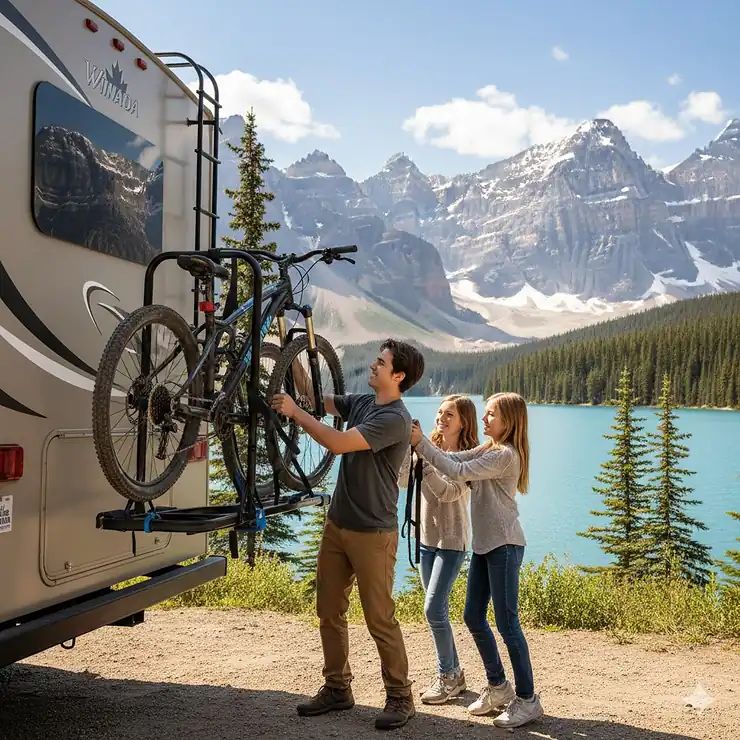
Picture this: you’ve just arrived at a stunning campground in Banff, Alberta, or perhaps you’re exploring the rugged coastlines of British Columbia. Your camper is parked, the scenery is breathtaking, and you’re itching to explore on two wheels. But wait—where are your bikes? Still strapped awkwardly in the back, taking up valuable storage space, or worse, left at home because transporting them was too much hassle?
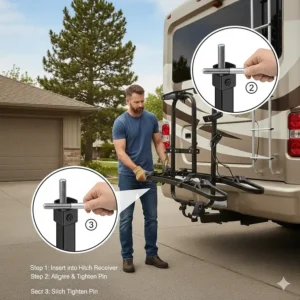
If this scenario sounds familiar, you’re not alone. Thousands of Canadian RV enthusiasts face the same dilemma every camping season. The solution? A proper camper bike rack designed specifically for the unique demands of recreational vehicles. Unlike standard car bike racks, RV-approved bike racks are engineered to withstand the tremendous forces, vibrations, and movement that occur when towing a travel trailer or driving a motorhome across Canada’s diverse terrain.
In this comprehensive guide, we’ll explore the top seven camper bike racks available in Canada for 2026, complete with real-world pricing in CAD, detailed specifications, and honest pros and cons. Whether you’re hauling electric bikes, fat-tire mountain bikes, or classic cruisers, we’ve got you covered. According to Transport Canada regulations, proper load securement is not just about convenience—it’s a legal requirement that ensures safety on Canadian highways.
Quick Comparison Table: Best Camper Bike Racks 2026
| Bike Rack Model | Type | Bike Capacity | Weight Limit | Price (CAD) | Best For |
|---|---|---|---|---|---|
| Swagman XTC2 | Hitch Platform | 2 bikes | 35 lbs/bike | $125-$160 | Budget-conscious buyers |
| Swagman E-Spec | Hitch Platform | 2 bikes | 80 lbs/bike (70 lbs RV) | $595 | E-bikes & heavy loads |
| Kuat Transfer v2 | Hitch Platform | 2-4 bikes | 40 lbs/bike | $350-$550 | Versatile families |
| Lippert Jack-It 429756 | A-Frame Mount | 2 bikes | 80 lbs total | $360 | Front trailer mounting |
| Thule Range 9057 | Hitch Hanging | 4 bikes | 37.5 lbs/bike | $500 | Multiple bikes |
| Hollywood RV Rider | Hitch Platform | 2 bikes | 80 lbs/bike | $650 | Premium e-bike transport |
| Futura GP | Hitch Platform | 2-4 bikes | 50 lbs/bike | $300-$450 | Canadian-made quality |
💬 Just one click – help others make better buying decisions too!😊
Top 7 Camper Bike Racks: Expert Analysis
1. Swagman XTC2 – Best Budget-Friendly Option
The Swagman XTC2 represents exceptional value for RVers who don’t want to break the bank. This Canadian favourite has been a staple on countless travel trailers across the country, and for good reason.
Key Specifications:
- 2-bike capacity (35 lbs maximum per bike)
- Fits 1.25″ and 2″ hitch receivers
- Accommodates 20″-29″ wheels, up to 2.5″ wide tires
- Foldable design for compact storage
Pricing: $125-$160 CAD on Amazon.ca
Canadian buyers consistently praise this rack’s ease of assembly and solid construction. One reviewer from Ontario noted: “Assembled in under 20 minutes, and it’s been rock-solid through 5,000 km of travel across three provinces.” The anti-wobble hitch device ensures minimal movement, crucial when navigating Canada’s sometimes rough highways.
✅ Pros:
- Exceptionally affordable for quality construction
- Simple assembly with clear instructions
- Powder-coated finish resists Canadian weather
- Lightweight yet sturdy (29.7 lbs)
❌ Cons:
- 35 lbs weight limit excludes most e-bikes
- No tilt feature for rear access
The XTC2 shines for couples or small families with standard bikes. However, if you’re hauling heavy electric bikes or need to access your RV’s rear storage frequently, consider upgrading to a more feature-rich model.
2. Swagman E-Spec – E-Bike Specialist Champion
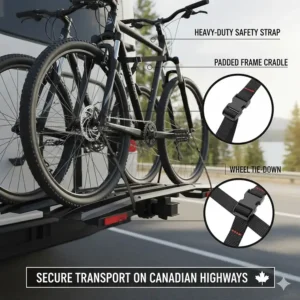
For the growing number of Canadians investing in electric bikes, the Swagman E-Spec is purpose-built to handle the extra weight and demands of e-bike transportation on RVs.
Key Specifications:
- RV-approved for travel trailers and 5th wheels
- 80 lbs per bike capacity (regular vehicles); 70 lbs per bike (RV mode)
- Accommodates tires up to 5″ wide (fat bikes included)
- Locking ratchet hooks and hitch pin
Pricing: $595 CAD
This rack converts between folding (for regular vehicles) and non-folding (RV-approved) configurations with an included bolt. Canadian e-bike owners from Alberta to Nova Scotia report excellent stability even on long-haul trips. The rack weighs 63 lbs, reflecting its heavy-duty construction.
✅ Pros:
- Dual-mode functionality (vehicle/RV)
- Handles the heaviest e-bikes on the market
- Fat tire compatible (up to 5″)
- Comprehensive locking system included
❌ Cons:
- Significant initial investment
- Heavy weight requires two people for installation
Perfect for e-bike enthusiasts who want one rack for both their truck and travel trailer, though the price point places it firmly in the premium category.
3. Kuat Transfer v2 – The Versatile Family Option
Kuat’s reputation for quality engineering shines through in the Transfer v2, a modular system that grows with your family’s cycling needs.
Key Specifications:
- Available in 1, 2, 3, or 4-bike configurations
- 40 lbs per bike weight capacity
- Flatlock hitch cam for zero-wobble performance
- Semi-integrated cable lock system
Pricing: $350-$550 CAD (depending on configuration)
The Transfer v2’s standout feature is its expandability—purchase the 2-bike base model and add single-bike expansions as needed (up to 4 bikes total). According to reviews from Canadian cyclists, the automotive-grade hardware holds up excellently against road salt and winter conditions.
✅ Pros:
- Modular design allows future expansion
- No-tool installation with hand-tight cam
- Accommodates wheelbase up to 50″
- Holds tires 18″-29″ (wider than most competitors)
❌ Cons:
- Add-ons sold separately
- 1.25″ 2-bike model doesn’t accept add-ons
Ideal for families who anticipate buying more bikes over time or need flexibility for different trip configurations.
4. Lippert Jack-It 429756 – Innovative Front-Mount Solution
Breaking away from traditional rear-mount designs, the Lippert Jack-It mounts to your trailer’s A-frame, offering unique advantages for RV storage and visibility.
Key Specifications:
- Mounts over tongue jack (3-bolt pattern)
- 2-bike capacity, 80 lbs total weight limit
- Includes BikeWing carrier and PowerTower
- Adjustable wheel cradles with SwayStop straps
Pricing: $360 CAD
This innovative design from Let’s Go Aero (a Lippert brand) places bikes at the front of your trailer where bounce and sway are minimized. Canadian RVers appreciate seeing their bikes in the rear-view mirror and having access to rear cargo space. One user from British Columbia noted: “Installation took 30 minutes, and I can finally use my rear hitch for cargo carriers.”
✅ Pros:
- Frees up valuable rear hitch space
- Minimal bounce on roughest roads
- Visible in rear-view mirror
- Breaks down for compact storage
❌ Cons:
- Requires compatible A-frame and tongue jack
- Higher loading height may challenge some users
- Not suitable for motorhomes or 5th wheels
Perfect for travel trailer owners seeking maximum rear access and minimal bike movement during transit.
5. Thule Range 9057 – Premium 4-Bike Capacity
When you need to transport the whole family’s bikes, the Thule Range 9057 delivers Swedish engineering excellence with RV-specific reinforcement.
Key Specifications:
- 4-bike hanging rack design
- RV-approved with 40% load reduction (150 lbs total)
- 7″ spacing between bikes prevents contact
- Integrated cable lock and STL2 hitch lock included
Pricing: $500 CAD
Thule’s reputation for rigorous testing is evident—their Hillerstorp Test Center in Sweden subjects racks to extreme vibration, temperature cycling, and simulated rough terrain. The Range 9057 features ratcheting cradle straps that secure bikes quickly, and the entire rack folds down when not in use.
✅ Pros:
- Carries four bikes with generous spacing
- Compact cradle design fits various frame styles
- Premium powder coat resists corrosion
- Backed by Thule’s lifetime warranty
❌ Cons:
- Hanging style may not suit all frame types (adapter sold separately)
- Cannot tilt with bikes loaded
- 36 lbs rack weight
Excellent choice for families of four who prioritize bike-to-bike protection and have a dedicated 2″ receiver on their RV.
6. Hollywood RV Rider – Ultimate E-Bike Hauler
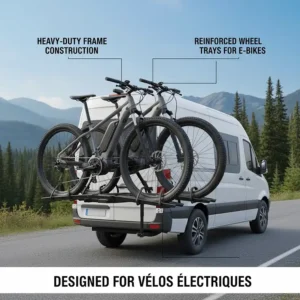
California-based Hollywood Racks brings 50+ years of family-owned expertise to the RV Rider, engineered specifically for motorhomes, 5th wheels, and flat-towed vehicles.
Key Specifications:
- Heavy-duty 160 lbs total capacity (80 lbs per bike)
- Accommodates tires up to 5″ wide
- Locking frame grabbers plus security cable
- Tilt and fold functionality
Pricing: $650 CAD
This rack represents the premium tier of e-bike transportation, with an internally reinforced frame and external bracing for heavy loads. The frame grabbers hold step-through bikes by the seatpost, eliminating the need for adapters. Canadian e-bikers report excellent stability even on 10,000+ km journeys across provinces.
✅ Pros:
- Highest weight capacity in its class
- Versatile frame grabber system
- Multiple locking points (keyed-alike)
- Can be used on front hitches (unique feature)
❌ Cons:
- Premium pricing
- 63.5 lbs rack weight requires strong installation
- NOT approved for travel trailers (only motorhomes/towed vehicles)
Best suited for Class A/C motorhome owners or those towing vehicles behind RVs who transport top-tier electric bikes.
7. Futura GP – Proudly Canadian-Made Excellence
Supporting Canadian manufacturing, Futura GP has been crafting bike racks in Canada since 1994, offering ultra-lightweight aluminum construction.
Key Specifications:
- 100% made in Canada
- Ultra-lite aluminum (among lightest on market)
- Foldable design fits cars, RVs, trailers
- Optional reinforcement bars boost capacity to 120 lbs
Pricing: $300-$450 CAD
Futura GP’s unique selling point is adaptability—the same rack works on your tow vehicle, travel trailer, or 5th wheel. The reinforcement bar kit (sold separately) increases load capacity specifically for e-bikes. Quebec-based manufacturing means faster shipping across Canada and excellent customer service in both official languages.
✅ Pros:
- Lightweight aluminum won’t rust
- Canadian company with local support
- Compact storage when folded
- Versatile mounting options
❌ Cons:
- Requires reinforcement kit for e-bikes
- Smaller market presence than major brands
- Limited availability outside Canada
Ideal for patriotic RVers who value lightweight construction and want to support Canadian manufacturing.
✨ Don’t Miss These Exclusive Deals!
🔍 Take your camping adventures to the next level with these carefully selected products available in Canada. Click on any highlighted item to check current pricing and availability on Amazon.ca. These tools will help you create authentic outdoor experiences your family will love!
Understanding Camper Bike Rack Types
Before diving deeper into selection criteria, let’s explore the main categories of bike racks suitable for RVs, campers, and motorhomes.
Hitch Mounted Bike Rack RV Options
Hitch-mounted racks attach to your RV’s 2″ or 1.25″ receiver, offering the most popular configuration for good reason. These racks distribute weight effectively and keep bikes accessible. Platform-style hitch racks (where bikes rest on tire trays) generally provide more stability than hanging racks, especially important for the significant vibrations experienced on RV travel.
The Canadian Motor Vehicle Safety Act emphasizes proper load distribution, which hitch-mounted designs excel at achieving. When selecting a hitch rack, verify your RV’s hitch receiver is frame-mounted, not bumper-mounted, as many factory bumpers can’t safely support bike rack weight.
Ladder Bike Rack Camper Mounting
While less common in our top 7 picks, ladder-mounted racks attach to your RV’s rear ladder, offering an alternative when hitch access is limited. These work well for lighter bikes but typically have lower weight capacities. The Ontario Highway Traffic Act requires loads to be properly secured—ladder racks must be professionally installed to meet these standards.
Bumper Bike Rack RV Solutions
Bumper-mounted racks were once popular but have fallen out of favour due to safety concerns. Most modern RV bumpers carry warning labels explicitly stating “not designed for cargo or bike rack mounting.” The tremendous forces generated during highway travel can compromise bumper integrity, leading to dangerous failures. Industry experts universally recommend avoiding bumper-mounted systems in favour of frame-mounted hitch receivers.
RV Rear Bike Rack vs. Front Mounting
Traditional rear-mount racks place bikes at the RV’s back, while innovative front-mount systems like the Lippert Jack-It attach to trailer A-frames. Front mounting offers distinct advantages: reduced sway, better visibility, and freed rear cargo space. However, compatibility is limited to specific trailer configurations.
How to Choose the Best Camper Bicycle Rack for Canadian Conditions
Selecting the right RV bike rack involves balancing multiple factors, especially when facing Canada’s unique climate and regulations.
Weight Capacity Considerations
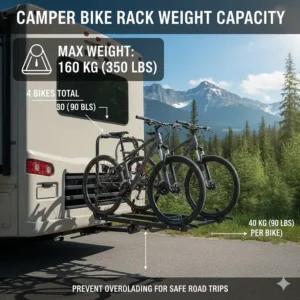
This is non-negotiable: your rack must safely support your bikes’ combined weight plus a safety margin. Standard bikes weigh 25-35 lbs, while e-bikes range from 50-80 lbs. Always choose a rack rated 20% above your actual needs. For instance, two 65-lb e-bikes require a rack rated for at least 156 lbs total capacity (2 × 65 × 1.2).
Canadian e-bike adoption has surged 240% since 2020, according to industry reports, making adequate weight capacity more crucial than ever. The Swagman E-Spec and Hollywood RV Rider specifically address this market.
RV Compatibility and Certification
RV-approved racks undergo additional testing to withstand trailer-specific forces. The constant bouncing, swaying, and vibration at the rear of a travel trailer far exceed what occurs on passenger vehicles. Look for racks explicitly marketed as “RV-approved” or “RV-rated”—this isn’t marketing fluff; it indicates engineered reinforcement and manufacturer liability coverage.
Frame Style Compatibility
Platform racks accommodate virtually any frame geometry, while hanging racks may struggle with step-through designs, children’s bikes, or unusual frame shapes. The $10-30 frame adapter bars solve this issue but add complexity. If your family rides diverse bike styles, platform racks offer hassle-free versatility.
Hitch Size and Class Requirements
Most RVs feature Class III (2″) or Class IV (2″) hitches, while some lightweight trailers use Class II (1.25″). Verify your hitch class before purchasing—using a rack designed for 2″ receivers on a 1.25″ hitch (even with an adapter) compromises safety. Check your RV’s documentation or measure the receiver’s internal dimensions.
Canadian Weather Resistance
Canada’s climate extremes demand durable finishes. Powder coating resists road salt and winter moisture better than painted finishes. Aluminum racks (like Futura GP) won’t rust but may corrode in coastal environments without proper maintenance. Steel racks offer superior strength but require vigilant corrosion protection.
Quebec’s Road Salt Institute estimates Canadian roads receive 5 million tonnes of de-icing salt annually—your bike rack must withstand this chemical assault to provide years of service.
Security Features
Theft is a real concern, especially at busy campgrounds. Integrated locks secure bikes to the rack and the rack to your hitch. “Keyed-alike” systems (where one key operates all locks) provide convenience without sacrificing security. The Hollywood RV Rider excels here with its comprehensive locking system.
Budget Considerations for Canadian Buyers
Prices range from $125 (Swagman XTC2) to $650+ (Hollywood RV Rider). While budget constraints matter, consider the total ownership cost: a $125 rack lasting two seasons costs more than a $500 rack serving ten years. Canadian retailers often match prices—don’t hesitate to negotiate or wait for seasonal sales around May (start of camping season) and September (end of season).
Installation and Safety Tips for Trailer Bike Racks
Proper installation isn’t just about following instructions—it’s about understanding the physics and regulations governing load transport in Canada.
Pre-Installation Verification
Before mounting any rack, inspect your RV’s hitch receiver thoroughly. Look for cracks, rust, or loose bolts in the mounting framework. Many Canadian RV dealers offer free hitch inspections—take advantage of this service annually. According to British Columbia’s DriveSmartBC, failure to maintain equipment constitutes a traffic violation.
Mounting Best Practices
- Torque specifications matter: Use a torque wrench for critical bolts. Over-tightening can strip threads or crack mounting points; under-tightening allows dangerous movement.
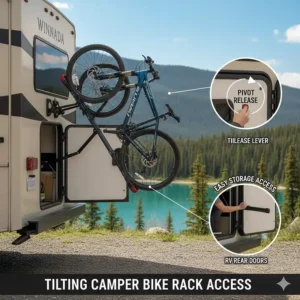
- Anti-rattle devices: The threaded hitch pins included with quality racks eliminate slack between rack and receiver. This seemingly minor detail prevents metal-on-metal wear and noise.
- Weight distribution: Load heavier bikes closest to the vehicle, lighter bikes on outer positions. This reduces leverage forces on the rack and hitch.
- Regular inspection: Before each trip, check all connection points, straps, and locking mechanisms. Vibration can loosen hardware over hundreds of kilometres.
Load Securement Regulations
Each Canadian province maintains specific load securement laws, but common requirements include:
- Loads must not extend more than 1.2 metres (4 feet) beyond the rear of the vehicle without warning flags
- All cargo must be secured to prevent shifting or falling
- License plates and lights must remain visible (a critical point we’ll address next)
The License Plate Visibility Question
Here’s where Canadian law gets tricky. Provinces like British Columbia, Alberta, and Ontario require license plates to remain “entirely unobstructed” at all times—yes, even with bike racks attached. According to a Globe and Mail investigation, Vancouver police have issued $230 tickets for empty bike racks covering plates.
Solutions:
- License plate relocation kits: Move your plate to the bike rack itself
- Remove the rack when not actively hauling bikes
- Verify rack design: Some models include plate mounting provisions
Calgary Hitch Shop notes that Alberta’s Highway Safety Act Section 71(1) explicitly requires plates to be “securely attached, legible, and always visible,” with no exceptions for bike racks.
Lighting Considerations
If your bikes obscure tail lights, turn signals, or reflectors, you’re violating Canadian motor vehicle regulations. Solutions include:
- Auxiliary light bars: Clamp LED lights to the rack or bikes
- Trailer lighting adapters: Wire into your RV’s lighting system
- Reflective tape: Add high-visibility tape to bikes and rack
Maintenance and Care for Motorhome Bike Racks
Canadian conditions accelerate wear on outdoor equipment. Proper maintenance extends your rack’s lifespan from years to decades.
Post-Trip Cleaning Protocol
After each trip, especially winter journeys, remove road salt, mud, and debris. A garden hose and mild soap suffice for most cleaning. Pay special attention to:
- Hinge points and folding mechanisms
- Locking cylinders (a shot of dry lubricant prevents freezing)
- Strap attachment points
- Wheel tray contact surfaces
Off-Season Storage
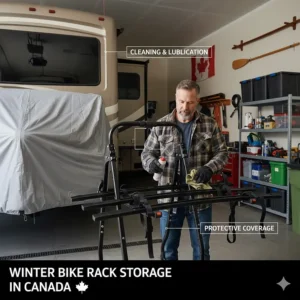
During Canada’s harsh winters, store your rack indoors if possible. If outdoor storage is necessary:
- Apply protective coating: Products like Fluid Film or Boeshield T-9 provide barrier protection
- Cover with weatherproof material: A quality cover prevents ice and snow accumulation
- Remove locking cores: Store locks indoors to prevent cylinder freezing
Inspection Schedule
Implement a quarterly inspection routine:
- Visual inspection: Cracks, rust, or deformation
- Hardware check: Tighten any loose bolts
- Functional testing: Operate all folding, tilting, and locking mechanisms
- Touch-up paint: Address any finish damage immediately
RV Bike Rack Accessories and Upgrades
Enhance your rack’s functionality with these Canadian-available accessories:
Fat Tire Trays
Both Swagman and Thule offer fat tire trays that accommodate 4-5″ wide tires, essential for fat bikes popular in Canadian winter cycling. These bolt-on upgrades typically cost $60-100 CAD per pair.
Frame Adapters
For step-through or unusual frame designs, $20-40 adapters create a virtual top tube, allowing hanging-style racks to secure these bikes. The Swagman Cruiser Bar and Thule 982XT are Canadian favourites.
Locking Upgrades
While budget racks may include basic locks, premium cable locks and locking skewers (which secure wheels to frames) provide comprehensive theft deterrence. Budget $50-80 for a complete locking system.
Bike Covers
RV-specific bike covers protect against road debris, weather, and UV damage during transit. Ensure any cover is well-vented to prevent wind loading—solid covers can act like sails, stressing the rack. Canadian brands like Comnova offer well-reviewed options on Amazon.ca.
Hitch Extensions and Adapters
If your RV’s hitch sits too low or too high, 2″ hitch risers/drops ($40-80 CAD) optimize rack positioning. Note that extensions affect leverage forces—consult the rack manufacturer before using them.
Comparing Platform vs. Hanging Racks for RV Use
Understanding the fundamental differences helps optimize your purchase decision.
Platform Rack Advantages
Platform designs dominate RV applications for several reasons:
- Universal compatibility: Bikes rest on tire platforms, accommodating any frame style
- Superior stability: Lower center of gravity reduces sway
- No frame contact: Eliminates paint damage risk
- Ease of loading: Simply roll bikes on and secure wheels
The downside? Platform racks typically weigh more and cost more than comparable hanging racks. However, the RV market overwhelmingly favours platforms—six of our top seven picks use platform designs.
Hanging Rack Benefits
Hanging racks suspend bikes by the top tube, offering advantages in specific scenarios:
- Lighter weight: Easier for solo installation
- Compact storage: Fold flatter when not in use
- Lower initial cost: Budget options start around $150 CAD
- More bikes per rack: 4-5 bike capacity common
The Thule Range 9057 demonstrates that hanging racks can work for RVs, but require reinforced construction and careful bike positioning to prevent contact during transit.
Electric Bike Specific Considerations
E-bikes have revolutionized Canadian cycling, but their 20-35 lb weight advantage over standard bikes demands specialized transport.
Weight Distribution Challenges
A typical 70 lb e-bike creates significant moment forces on a rack. Physics matters: weight multiplied by distance equals torque. A bike 3 feet from the hitch generates far more stress than the same weight 1 foot away. Premium racks like the Swagman E-Spec and Hollywood RV Rider engineer specifically for these forces.
Battery Removal Recommendations
While most racks can transport e-bikes with batteries attached, removing batteries offers advantages:
- Reduced weight: Makes loading easier and reduces rack stress
- Theft prevention: Batteries are valuable targets
- Weather protection: Extreme cold (common in Canadian winters) can damage batteries
Store batteries inside your RV, secured to prevent movement during transit.
E-Bike Width Considerations
Many e-bikes feature wider tires (2.5-4″) than traditional bikes. Verify your chosen rack accommodates your specific tire width—the 5″ capacity of the Swagman E-Spec and Hollywood RV Rider provides comfortable clearance even for fat-tire e-bikes.
Maximizing Rear Access with Tilt and Swing Features
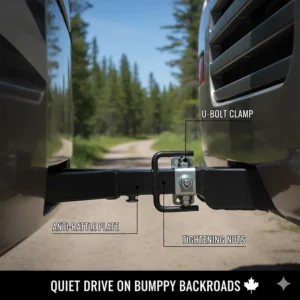
One frustration with rear-mounted racks is blocked access to RV storage compartments, particularly the rear cargo area or “basement” storage common on larger motorhomes.
Tilt Mechanisms Explained
Tilt-away designs allow the rack (with bikes loaded) to pivot away from the vehicle, providing access to doors and compartments. The Hollywood RV Rider’s tilt feature is particularly robust, supporting full-weight e-bikes while tilted. When purchasing, verify:
- Tilt angle: 45° minimum for meaningful access
- Weight limit while tilted: Some racks reduce capacity in tilt position
- Locking in tilt position: Safety feature prevents accidental closure
Swing-Away Alternatives
For ultimate access, swing-away accessories like the Kuat Pivot mount the rack on a long arm that swings completely to the side. These cost $200-350 CAD but can be worth the investment for RVers who frequently access rear storage.
Budget-Friendly Options for Canadian RVers
Not everyone needs premium features, and the RV bike rack market offers solid budget alternatives.
Under $200 Solutions
The Swagman XTC2 leads this category at $125-160, but other options exist:
- Allen Sports Deluxe+: 2-bike capacity, $90-120 CAD
- Maxx Haul hitch rack: Basic 2-bike platform, $100-140 CAD
Understand the trade-offs: budget racks may lack:
- Integrated locks (add $30-50 for aftermarket)
- Anti-wobble features (expect more noise and movement)
- Premium finishes (rust protection may be limited)
- Warranty coverage (some budget brands offer only 1 year vs. lifetime)
Mid-Range Sweet Spot
The $300-400 range represents excellent value, including options like:
- Futura GP: Canadian-made quality at $300-450
- Kuat Transfer v2 base: Expandable platform design, $350
- Lippert Jack-It: Innovative front mounting, $360
These mid-tier racks offer 80-90% of premium rack features at 50-60% of the price, making them the logical choice for most Canadian RV families.
❓ FAQ
❓ Can I use a regular car bike rack on my RV or travel trailer?
❓ What's the weight capacity I need for two e-bikes on my camper?
❓ How do I prevent my bike rack from blocking my license plate in Canada?
❓ Which type of hitch mount is better: 1.25' or 2' receiver for camper bike racks?
❓ Are ladder bike racks safe for travel trailers in Canada?
Conclusion: Finding Your Perfect RV Bicycle Rack
After analyzing the top camper bike racks available in Canada for 2026, several clear patterns emerge. For budget-conscious RVers with standard bikes, the Swagman XTC2 delivers unbeatable value at $125-160 CAD. Its simple platform design and proven durability make it a staple at Canadian campgrounds from Newfoundland to British Columbia.
E-bike owners should seriously consider the Swagman E-Spec or Hollywood RV Rider, both engineered specifically for 70-80 lb e-bikes. The $595-650 investment protects expensive electric bicycles while providing peace of mind during cross-country Canadian adventures. Their RV-approved construction withstands the unique stresses of trailer towing that destroy lesser racks.
Families with diverse cycling needs benefit from the Kuat Transfer v2’s modular expandability or the Thule Range 9057’s generous 4-bike capacity. Both offer premium build quality with pricing that reflects Swedish and American engineering excellence.
The innovative Lippert Jack-It deserves special mention for travel trailer owners willing to embrace front-mounting. By placing bikes on the A-frame, it frees valuable rear storage while minimizing bounce and sway—an elegant solution to a persistent problem.
Finally, the Futura GP represents Canadian pride and manufacturing excellence. Supporting our domestic economy while enjoying lightweight aluminum construction appeals to patriotic RVers who value local customer service and bilingual support.
Remember: the “best” rack depends on your specific needs—bike types, RV configuration, budget, and personal priorities. Use this guide’s detailed specifications, Canadian pricing, and real-world insights to make an informed decision. Your perfect camping bike rack is waiting on Amazon.ca, ready to unlock countless kilometres of two-wheeled exploration across our magnificent country.
Safe travels, and happy cycling! 🍁🚴♀️
Recommended for You
- 7 Best Camper Stairs Canada 2026 – Ultimate RV Entry Steps Guide
- 7 Meilleurs Matela pour Camping 2026
- Top 7 Lit de Camp Canada 2026: Best Camping Cots & Buying Guide
Disclaimer: This article contains affiliate links to Amazon.ca. If you purchase products through these links, we may earn a small commission at no additional cost to you.
✨ Found this helpful? Share it with your friends! 💬🤗
