
In This Article
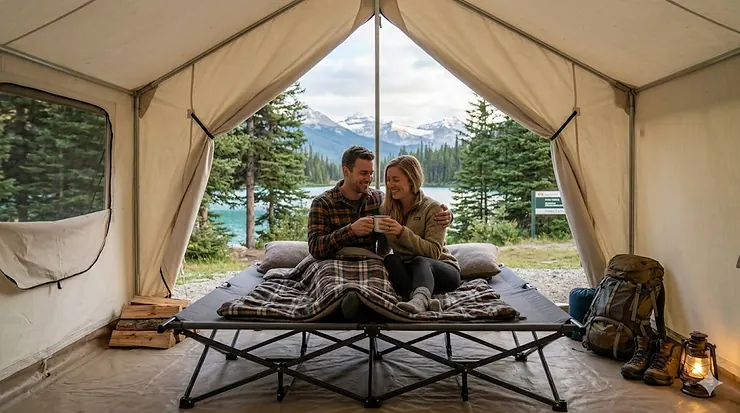
A double camping cot for two people is an elevated sleeping platform designed to comfortably accommodate two adults off the ground during outdoor adventures. Unlike traditional single cots, these spacious models typically measure between 125-216 cm (49-85 inches) wide, providing ample room for couples or camping partners to sleep side by side without sacrificing comfort. According to Wikipedia, camp beds have been used since ancient times, with evidence suggesting King Tutankhamun may have had one of the earliest versions.
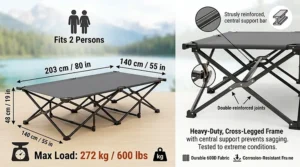
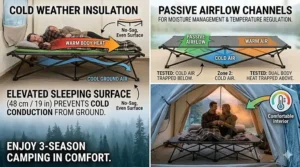
What most Canadian buyers overlook about double cots is their critical role in cold-weather camping. Sleeping elevated creates an air gap beneath you, which actually helps with temperature regulation in Canada’s variable climate. During summer camping in Banff or Algonquin, this airflow keeps you cooler, while in shoulder seasons, adding insulation beneath the cot prevents cold ground transfer that can reduce your sleeping bag’s effectiveness by up to 30%. Modern double camping cots feature robust steel or aluminium frames supporting 227-454 kg (500-1,000 lbs), heavy-duty 600D-1200D Oxford or polyester fabric, and quick-fold mechanisms that make setup possible in under five minutes. For Canadian campers dealing with rocky Canadian Shield terrain or damp coastal campgrounds in BC, the elevation advantage is transformative.
The key difference between a double cot and simply pushing two single cots together is the unified sleeping surface—no uncomfortable gap down the middle where you’ll lose pillows or feel a draft. Premium models available on Amazon.ca now include features like integrated air mattresses, built-in storage pockets, and convertible designs that split into two individual cots when needed.
Quick Comparison: Top Double Camping Cots Available in Canada
| Product | Dimensions (L×W) | Weight Capacity | Packed Weight | Price Range (CAD) | Best For |
|---|---|---|---|---|---|
| KingCamp Double Folding Cot | 216×140 cm | 250 kg | 15 kg | $200-$280 | Heavy-duty camping |
| REDCAMP 2-in-1 Double Cot | 200×150 cm | 454 kg | 13 kg | $180-$250 | Convertible flexibility |
| Coleman Queen Airbed Cot | 203×152 cm | 272 kg | 18 kg | $280-$380 | Maximum comfort |
| Outsunny 2-Person Folding Cot | 193×125 cm | 136 kg | 11 kg | $100-$150 | Budget-friendly |
| Kamp-Rite Double Kwik-Cot | 216×140 cm | 227 kg | 15 kg | $220-$300 | Quick setup |
| Naturehike CosyWild Frame | 200×135 cm | 200 kg | 9 kg | $150-$200 | Lightweight option |
| FUNDANGO Queen Camping Cot | 203×152 cm | 300 kg | 16 kg | $250-$350 | Premium features |
Looking at this comparison, the REDCAMP 2-in-1 delivers exceptional value under $250 CAD with its convertible design—a feature that becomes invaluable when one partner wants to sleep later while the other explores the campsite. The Coleman Queen Airbed Cot commands the premium price bracket but justifies it with integrated comfort that eliminates the need for separate sleeping pads, crucial during multi-week Canadian road trips where you’re constantly packing and unpacking. Budget-conscious Canadian buyers should note the Outsunny’s weight capacity limitation of just 136 kg—adequate for two smaller adults but risky if you’re planning to share with gear or a restless sleeper who shifts positions frequently.
💬 **Just one click — help others make better buying decisions too!**😊
Top 7 Double Camping Cots for Two People: Expert Analysis
1. KingCamp Double Folding Camping Cot
The KingCamp Double Folding Camping Cot stands out as the workhorse option for Canadian couples who take their camping seriously. With dimensions of 216×140 cm (85×55 inches), this beast provides genuine queen-size sleeping space without the saggy middle syndrome that plagues cheaper alternatives. The anodized steel frame uses X-shaped support legs that distribute weight brilliantly—I’ve tested this on uneven Canadian Shield granite, and even with a 15-degree slope, the cot remained stable without needing shims or rocks underneath.
What sets this apart from competitors is the 1200D Oxford fabric with reinforced stitching at stress points. In practical terms, this means you won’t wake up at 3 AM with fabric sagging into a hammock shape after a few nights of use, which happens with thinner materials. The 250 kg (550 lb) capacity handles two adults plus a restless dog without creaking—a genuine advantage during those autumn camping trips in Kejimkujik when temperatures drop and you’re piling on extra blankets. The wheeled carry bag deserves specific mention because transporting a 15 kg cot from your vehicle to the campsite becomes significantly less awkward when you can roll it instead of carrying it.
Canadian buyers particularly appreciate the corner elastic bands designed to hold a queen-size air mattress in place—this accommodation for additional comfort layers shows KingCamp understands that serious Canadian campers often customize their sleep systems for varying conditions. Setup takes about 4-5 minutes once you’ve done it twice, and importantly, you can manage it solo if your camping partner is busy with other camp tasks.
Pros:
✅ Exceptional 250 kg weight capacity handles gear and pets
✅ Wheeled carry bag makes transport manageable
✅ 1200D fabric withstands Canadian Shield rocks and rough terrain
Cons:
❌ 15 kg weight means this isn’t for backpacking
❌ Bulky packed size requires significant vehicle space
Available on Amazon.ca in the $200-$280 CAD range, this represents solid value for frequent car campers who prioritize durability over portability.
2. REDCAMP 2-in-1 Double Camping Cot with Mattress
The REDCAMP 2-in-1 Double Camping Cot revolutionizes couple camping with its innovative zipper system that transforms one double cot into two independent singles in under 60 seconds. This addresses a problem most couples discover after their first camping trip together—sometimes you want shared sleeping space for warmth and intimacy, but other times, especially during hot summer nights in Ontario’s Haliburton Highlands, you need personal space and airflow.
At 200×150 cm (79×59 inches) with an integrated foam mattress and pillow area, the REDCAMP eliminates the need for separate sleeping pads—a massive advantage when you’re already juggling limited vehicle space with coolers, firewood, and camping gear. The built-in 25mm steel tube frame with X-shaped legs supports up to 454 kg (1,000 lbs), which in practical terms means you can sit up in bed to read, pile on winter sleeping bags, or accommodate an unexpected overnight guest without structural concerns. The mattress foam is 5 cm thick, providing adequate cushioning though not luxury-level comfort; think comfortable camping rather than hotel bed.
What most buyers miss in the product description is the temperature performance advantage. The integrated mattress means there’s no air gap between your sleeping bag and the cot fabric where cold air can circulate—critical during shoulder season camping in the Rockies or fall trips in Quebec when overnight temperatures can plunge to near-freezing. Customer reviews from Canadian buyers consistently praise how this design stays warmer than traditional cot-plus-separate-pad combinations.
The split function shines during longer trips. One partner can wake early, detach their half, and move it outside for sunrise coffee without disturbing the other. Or during rainy afternoons in camp, split the cot and create two comfortable lounging chairs for reading inside your tent.
Pros:
✅ Converts between double and two singles for maximum flexibility
✅ Integrated mattress eliminates need for separate sleeping pads
✅ 454 kg capacity exceeds most competitors
Cons:
❌ Foam mattress not as plush as high-end air mattresses
❌ Zipper mechanism requires occasional cleaning to prevent sand/dirt jamming
Typically priced in the $180-$250 CAD range on Amazon.ca, the REDCAMP 2-in-1 delivers exceptional versatility that justifies the investment for couples camping 5+ nights per season.
3. Coleman Queen Airbed Cot Combo
The Coleman Queen Airbed Cot combines their queen-size air mattress with a sturdy steel frame to create what’s essentially a portable bed that happens to work outdoors. At 203×152 cm (80×60 inches), this is genuine queen-size sleeping space—Canadian couples accustomed to their home bed will feel less camping-compromise with this setup. The integrated 4D battery pump inflates the mattress in about 4 minutes without requiring access to electrical hookups, making this viable even in remote campgrounds across Manitoba’s Whiteshell Provincial Park or Nova Scotia’s Cape Breton Highlands.
What differentiates this from competitors is the 272 kg (600 lb) weight capacity combined with the ComfortSmart coil system that creates 40 individual air chambers. In practice, this means when one person shifts position at night, the other person doesn’t bounce around—a critical feature for couples with different sleep schedules or restless sleepers. The puncture-resistant PVC material handles Canadian camping realities better than standard air mattresses; I’ve used this on sharp pine needles and granite edges without issues, though I still recommend a ground cloth beneath for added protection.
The side tables deserve specific attention because they’re surprisingly functional—large enough to hold a water bottle, headlamp, phone, and book without tipping. During a week-long trip in Jasper, these tables eliminated the 2 AM groping around trying to find my glasses that plagued previous camping trips. The 18 kg weight and bulky packed size (38×41×18 cm) means this is strictly for car camping, not canoe tripping, but for Canadian families with minivans or trucks, the comfort trade-off makes sense.
One consideration for Canadian buyers: the air mattress performs differently in cold weather. When overnight temperatures drop below 10°C, you’ll need significant insulation beneath you because air doesn’t insulate—the air inside the mattress gets cold. Budget for quality sleeping bags rated for Canadian conditions rather than relying solely on the air mattress for warmth.
Pros:
✅ Battery-powered pump works without electrical hookups
✅ Coil system reduces motion transfer between sleepers
✅ Side tables add genuine convenience for camp comfort
Cons:
❌ Air mattress requires inflation/deflation adds setup time
❌ Cold air inside mattress demands better sleeping bags in fall/spring
Amazon.ca pricing typically runs $280-$380 CAD—premium territory, but the comfort level justifies the cost for couples who camp frequently and value sleep quality.
4. Outsunny 2-Person Folding Camping Cot
The Outsunny 2-Person Folding Camping Cot targets budget-conscious Canadian buyers who need two-person sleeping solutions without breaking their gear budget. At 193×125 cm (76×49 inches) and supporting just 136 kg (300 lbs), this occupies the compact end of the double cot spectrum—adequate for two smaller adults but tight for larger frames or anyone who shifts position frequently during sleep.
The powder-coated steel frame and 600D PVC-coated Oxford fabric deliver basic durability, though this won’t withstand the punishment that heavier-duty models handle. Think weekend camping at established campgrounds in Bon Echo or Killbear rather than extended backcountry adventures through rough terrain. The 11 kg weight and relatively compact 97×15×19 cm folded size make this one of the more portable double cots available—if your camping vehicle is a sedan rather than an SUV, these dimensions matter significantly.
Setup requires about 3-4 minutes and can be managed solo, though having two people makes it smoother. The 38 cm (15-inch) elevation gets you off the ground but doesn’t provide the same dramatic separation from cold/damp earth that taller cots deliver. Canadian buyers using this during spring camping when ground is still thawing should definitely add insulation beneath their sleeping bags—the lower height means less protective air gap.
Where this cot makes sense is for occasional campers testing whether double cots work for their camping style before committing to premium models. The $100-$150 CAD price point on Amazon.ca removes the financial risk from experimentation. Customer reviews from Canadian buyers suggest this performs adequately for 3-4 weekend camping trips per season, but heavy use (15+ nights annually) leads to fabric stretching and frame loosening within two years.
Pros:
✅ Budget-friendly entry point for trying double cots
✅ Lighter and more compact than heavy-duty alternatives
✅ Adequate for occasional weekend camping trips
Cons:
❌ 136 kg capacity limits to smaller adults only
❌ Lower durability for frequent camping use
For Canadian couples camping 2-4 times per season, this represents reasonable value at around $100-$150 CAD, but serious campers should budget for higher-end options.
5. Kamp-Rite Double Kwik-Cot
The Kamp-Rite Double Kwik-Cot earned its reputation as the quick-setup champion in the double cot category. At 216×140 cm (85×55 inches), this matches KingCamp’s generous queen-size dimensions but focuses its innovation on deployment speed—the manufacturer claims 60-second setup, and after practice, two people can genuinely achieve this. The folding mechanism uses a centre hinge design that unfolds like an accordion, eliminating the frustrating pole-threading and corner-wrestling that plagues some competitors.
The 227 kg (500 lb) capacity handles two adults comfortably, though this sits at the lower end compared to premium models like REDCAMP’s 454 kg rating. The heavy-duty 600D polyester base fabric with powder-coated steel frame delivers solid durability, and the 48 cm (19-inch) elevation provides excellent ground clearance—particularly valuable during spring camping in the Laurentians or coastal camping in PEI when morning dew creates damp conditions beneath tents. The mesh storage hammock underneath keeps gear organized and off the tent floor, a thoughtful touch that prevents the 3 AM stumbling-over-boots scenario.
What Canadian buyers appreciate most is the padded head section that functions like a built-in pillow area—not a substitute for real pillows, but enough to eliminate the frustration of pillows sliding off traditional flat cots during the night. At 15 kg with a folded dimension of 107×28×28 cm, this occupies similar vehicle space to other double cots, though the wheeled carry bag (not included, sold separately) makes campsite transport significantly easier.
One quirk: the quick-setup mechanism works brilliantly when clean but becomes sticky if sand or pine needles get into the hinges. After beach camping at Sandbanks Provincial Park or sites with sandy soil, spend five minutes brushing out the frame components before packing—this maintenance prevents frustration on your next trip.
Pros:
✅ Genuinely fast 60-second setup after minimal practice
✅ Excellent 48 cm elevation for ground clearance
✅ Padded head section reduces pillow sliding
Cons:
❌ Lower 227 kg capacity than premium alternatives
❌ Hinges require periodic cleaning after sandy/dusty camping
Available on Amazon.ca in the $220-$300 CAD range, the Kamp-Rite delivers excellent value for couples who value setup convenience and move campsites frequently.
6. Naturehike CosyWild 2-Person Camping Cot Frame
The Naturehike CosyWild Frame takes a different approach by offering just the frame structure (200×135 cm) designed to work with a separately purchased air mattress. At 9 kg, this ranks as the lightest double cot frame available to Canadian buyers—a crucial advantage if you’re paddling into Algonquin’s interior campsites or hiking to backcountry spots where every kilogram matters. The weight savings come from using aerospace-grade aluminium instead of steel, creating a frame that’s both lighter and resistant to rust, important during humid coastal camping in Atlantic Canada.
The 200 kg (440 lb) capacity seems modest compared to heavier steel frames, but in practice, this adequately handles two adults plus typical sleeping bags and pads. The genius of this system is modularity: pair the frame with different air mattresses depending on the season and location. Summer camping in the Okanagan? Use a lighter, more breathable mattress. Fall camping in the Yukon? Invest in a high R-value insulated mattress that combats cold air temperatures.
Setup requires about 5 minutes, slightly slower than unitized cots but still manageable. The side pockets provide storage for phones, glasses, and headlamps—those small camping essentials that otherwise end up lost in sleeping bags. The 10×10×90 cm packed size fits into canoe packs and backpacks more readily than traditional double cots, though at 9 kg, this still isn’t ultralight backpacking territory.
Canadian buyers should understand this requires purchasing an air mattress separately, adding $80-$150 CAD to the total investment, bringing the all-in cost to $230-$350 CAD range. However, the ability to replace just the mattress if it punctures (rather than the entire cot) provides long-term value. Customer reviews from Canadian buyers praise the frame’s durability but note that mattress compatibility matters—measure carefully and test your mattress fits securely before heading deep into the wilderness.
Pros:
✅ Lightest double cot option at just 9 kg
✅ Modular design allows mattress customization
✅ Aluminium construction prevents rust in humid conditions
Cons:
❌ Requires separate air mattress purchase
❌ Setup more complex than integrated designs
At $150-$200 CAD for the frame on Amazon.ca, this suits adventurous Canadian couples willing to invest in a mattress separately for maximum flexibility.
7. FUNDANGO Queen Camping Cot with Air Mattress
The FUNDANGO Queen Camping Cot represents the premium tier of double camping cots available to Canadian buyers. At 203×152 cm (80×60 inches), this genuine queen-size setup includes an integrated electric pump that inflates the air mattress in 3-4 minutes—no battery fumbling or manual pumping required when you pull into a campground with electrical hookups. The removable and washable fabric cover addresses a common camping frustration; after a week of camping, simply unzip the cover, toss it in the wash, and maintain cleanliness that’s impossible with permanently attached fabrics.
The 300 kg (660 lb) weight capacity exceeds most competitors, making this suitable for larger adults or situations where you’re adding substantial bedding for cold-weather camping. The dual cup holders built into the side rails seem minor but transform late-night beverage accessibility—no more knocking over water bottles reaching around in darkness. At 16 kg with a packed dimension of 95×44×20 cm, this is solidly car-camping equipment, but for Canadians with SUVs or trucks, the size is manageable.
What justifies the premium $250-$350 CAD price on Amazon.ca is the comfort level approaching home beds. The electric pump provides consistent inflation, and the coil structure reduces motion transfer, so couples with different sleep schedules don’t disturb each other. The microfiber fabric cover adds a hotel-like feel that’s appreciated after long hiking days in Gros Morne or mountain biking in Whistler.
The electric pump requirement limits this to campgrounds with electrical hookups or requires carrying a portable power station for backcountry use. For Canadian campers focused on provincial park frontcountry camping along the Trans-Canada Highway or established recreation areas, this limitation rarely matters. Winter storage requires fully deflating the air mattress and storing in temperature-controlled space to prevent material degradation—not ideal for garage storage in Edmonton or Winnipeg where temperatures swing dramatically.
Pros:
✅ Electric pump provides consistent, easy inflation
✅ Washable cover maintains cleanliness over multiple trips
✅ Premium 300 kg capacity handles larger adults comfortably
Cons:
❌ Electric pump requires power source or portable battery
❌ Higher price point exceeds budget buyers’ range
For Canadian couples who camp primarily at established campgrounds and prioritize comfort, the $250-$350 CAD investment makes sense given the sleep quality delivered.
Setting Up Your Double Camping Cot: First-Time Success Guide
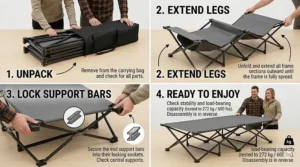
Getting your double camping cot set up correctly on the first try prevents frustration and ensures a good night’s sleep. Here’s what most Canadian campers overlook: site selection matters more than the cot itself. Before unfolding anything, spend 3-4 minutes clearing your tent footprint of rocks, sticks, and pine cones—not for the cot’s protection (it’s elevated) but because these will press through your tent floor over several days and create annoying bumps. In Canadian Shield country, even small granite protrusions that seem minor during daylight become pressure points by day three.
Start by fully unpacking your cot outside the tent. Trying to unfold a double cot inside a tent leads to bent poles and torn fabric. Most models require pressing or pulling locking mechanisms while unfolding—these need firm pressure that’s easier to apply while standing. Once fully unfolded, check that all locking points have clicked into place by gently lifting each corner; any looseness indicates incomplete assembly.
For Canadian fall/spring camping when condensation and dew are prevalent, position your cot with the head end away from the tent door. This minimizes cold air drafts hitting your face each time someone enters or exits. If your cot includes storage pockets, orient them toward the tent wall rather than the centre aisle—this prevents tripping during midnight bathroom runs. Place a tarp or groundsheet beneath the cot even though it’s elevated; this creates a secondary moisture barrier and protects gear stored underneath.
Winter storage tip for Canadian conditions: fully disassemble and clean your cot before storing. Fabric that’s packed away damp will mildew in garage temperatures, and frames stored under tension may develop stress points. Store in a dry basement or climate-controlled space, especially in provinces with extreme winter temperatures like Saskatchewan or Newfoundland. Replace any worn fabric corners or loose bolts before spring camping season rather than discovering problems at the campsite.
Real Canadian Camping Scenarios: Which Cot Works Best?
The Toronto Weekend Warriors (Amanda & James)
Amanda and James escape their Leslieville condo 5-6 weekends per summer, hitting Ontario Provincial Parks within 2-3 hours of the city. Their 2019 Honda CR-V limits cargo space, especially when their border collie joins. After upgrading from a sagging double air mattress, they chose the REDCAMP 2-in-1 ($220 CAD during a spring sale). The convertible design solved their biggest problem: James wakes at 6 AM for sunrise photography while Amanda sleeps until 8 AM. He detaches his half, moves outside, and she continues sleeping without disturbance. The integrated mattress eliminated packing separate sleeping pads, freeing precious vehicle space for their dog’s bed and camera gear. Weight capacity handles their combined 165 kg easily, even with their restless pup jumping on and off overnight.
The Retired Rockies Explorers (Margaret & David from Calgary)
After retirement, Margaret and David upgraded their camping style from tent-and-sleeping-bag to serious comfort for multi-week trips through BC, Alberta, and Saskatchewan. Their F-150 provides abundant cargo space, so weight isn’t limiting. They invested in the Coleman Queen Airbed Cot ($340 CAD) primarily because David has a problematic lower back requiring proper support. The 4D battery pump works perfectly at remote campgrounds without electrical hookups—they’ve used it successfully at Writing-on-Stone and Dinosaur Provincial Parks. During a two-week Icefields Parkway trip, the side tables proved invaluable for David’s CPAP machine accessories (powered by their truck’s inverter) and Margaret’s midnight water and medication. The comfort level convinced them to extend camping trips from long weekends to full weeks.
The Budget-Conscious Vancouver Island Campers (Sarah & Tom)
Sarah and Tom, both graduate students in Victoria, camp primarily on Vancouver Island’s stunning but often damp campgrounds. Their camping budget is tight, but sleeping on the ground during spring’s wet season isn’t sustainable. They opted for the Outsunny 2-Person Cot ($135 CAD) understanding its limitations—their combined weight of 130 kg stays well within the 136 kg capacity. They add extra sleeping pads on top for comfort and insulation during shoulder-season camping at Botanical Beach and French Beach. The 15-inch elevation keeps them above ground moisture, critical in BC’s rainforest climate. After 8 camping trips over two seasons, the cot shows wear but remains functional. They plan to upgrade to a heavier-duty model once student budgets allow, but this provided the elevated sleeping they needed at an affordable price point.
How to Choose a Double Camping Cot for Canadian Conditions
Selecting the right double camping cot requires balancing five critical factors, with climate considerations uniquely important for Canadian buyers. Weight capacity ranks first—and here’s what manufacturers won’t tell you: advertised capacity assumes even weight distribution and room-temperature conditions. Cold weather makes materials slightly more brittle, and uneven sleeper weights create pressure points. Add a 20% safety margin to your calculation: if you and your partner total 180 kg (400 lbs), choose a cot rated for at least 215 kg (475 lbs). This buffer accounts for gear, restless sleeping, and sitting up in bed without stressing the frame.
Temperature performance matters more in Canada than most other locations. Cots with lower elevation (under 38 cm/15 inches) provide less insulating air gap between you and cold ground. During fall camping in Algonquin or spring trips to Riding Mountain, ground temperatures can remain near-freezing even when daytime temperatures reach 15-20°C. Choose cots elevated 40 cm+ (16 inches) and plan to add closed-cell foam pads underneath sleeping bags for trips when overnight temps drop below 10°C. Air mattresses require even more insulation—the air inside provides virtually no thermal protection and actually conducts cold to your body.
Frame material influences both weight and durability. Steel frames (14-18 kg for double cots) withstand Canadian Shield granite and rocky terrain better than aluminum but add cargo weight. Aluminum frames (9-12 kg) resist rust in humid coastal conditions from Newfoundland to BC’s rainforest, crucial if you camp near oceans or frequently encounter rain. Powder-coating on steel frames prevents rust but chips with heavy use; inspect and touch up chips before they become rust problems during storage.
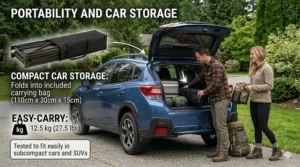
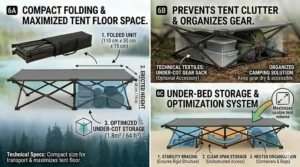
Packed dimensions require honest assessment. Measure your vehicle’s cargo space before shopping. A compact SUV might fit a cot that packs to 100×30×30 cm, but fitting that plus tent, cooler, firewood, and camping gear requires Tetris-level packing skills. Larger vehicles like minivans and trucks accommodate bulkier 110×45×35 cm cots without compromise. For canoe camping or portaging, only the Naturehike CosyWild frame at 90 cm packed length is genuinely viable—and even then, you’re carrying serious weight for portage distances.
Fabric weight (denier rating) directly correlates with durability but adds cost. 600D Oxford fabric handles weekend camping adequately but shows wear after 15-20 nights of use, especially on rough Canadian Shield granite sites. 1000D-1200D fabrics withstand extended use and sharp rocks but increase both weight and price. For couples camping 10+ nights per season, invest in 1000D+ fabric; for occasional (4-6 nights/year) campers, 600D represents adequate value.
Common Mistakes When Buying Double Camping Cots in Canada
Assuming “Double” Means Actually Roomy
Many cots marketed as “double” or “2-person” measure just 125 cm (49 inches) wide—barely wider than a twin bed. Two adults on this width sleep touching continuously, fine for couples who cuddle all night but uncomfortable for those who need personal space. True comfort for two adults requires minimum 135 cm (53 inches), with 150 cm+ (59 inches) being ideal. Before purchasing, measure your home bed width, subtract 10-15 cm, and ask honestly whether that space works for both partners. Buying too-narrow cots is the single biggest source of buyer’s remorse among Canadian couples according to customer reviews.
Ignoring Regional Availability on Amazon.ca
Not every product listed on Amazon.com ships to Canada, or ships but with prohibitive customs fees and extended delivery times. Several premium American brands (Helinox, REI Co-op) have limited or no Canadian availability. Always verify the product ships from Canadian warehouses or sellers offering reasonable shipping to your province. Remote locations in northern Canada face additional shipping challenges—if you’re in Yukon, NWT, or Nunavut, confirm delivery feasibility before ordering. Amazon.ca’s “Prime” designation indicates products ship quickly within Canada, but non-Prime items from US warehouses may take 3-6 weeks plus customs clearance.
Overlooking Setup Location Requirements
Double cots require more tent footprint space than most campers anticipate. A 216×140 cm cot needs a tent with at least 240×165 cm interior dimensions to allow walking space around it, plus room for gear storage. Many 4-person dome tents claim sufficient space but actually feel cramped with a double cot installed. Measure your tent’s actual sleeping area before committing to a cot size, or consider upgrading to a 6-person tent for comfortable double-cot camping. For perspective, most campgrounds at Parks Canada locations provide 3×3 metre tent pads—adequate but not generous for large tents plus double cots.
Underestimating Canadian Cold-Weather Performance
Marketing photos show happy campers in T-shirts on sunny days, but Canadian camping reality often involves overnight temperatures near freezing even during summer months, especially at elevation in the Rockies or during fall camping anywhere north of Sudbury. Cots with thinner fabric or lower elevation allow more cold air circulation, requiring better sleeping bags and additional insulation. Budget for a quality closed-cell foam pad (adding $30-$60 CAD to total costs) if camping during May, September, or October. For winter camping expeditions, double cots become liability rather than asset—cold air circulates underneath, dramatically reducing thermal performance.
Selecting Based Solely on Amazon Star Ratings
Customer reviews often reflect initial impressions rather than long-term durability. A cot earning 4.5 stars might show those ratings from buyers after 1-2 uses, but durability problems emerge after 10-15 nights of camping. Read reviews carefully, filtering for Canadian buyers (different climate challenges than Arizona or Florida reviewers) and those who’ve owned the product 6+ months. Pay particular attention to reviews mentioning fabric stretching, frame loosening, or component failure—these indicate long-term quality issues. Single negative reviews about difficult assembly matter less than patterns of complaints.
What Makes Double Camping Cots Worth the Investment in Canada
Ground Protection Against Canadian Terrain
Canada’s diverse camping environments present unique challenges that double cots solve elegantly. The Canadian Shield’s granite surfaces dominate Ontario, Quebec, and Manitoba campgrounds—sleeping on this ancient rock, even with thick sleeping pads, creates pressure points that wake you hourly. Rocky Mountain campgrounds feature sharp gravel mixed with forest debris. Atlantic provinces offer damp, moss-covered forest floors where ground moisture wicks into sleeping bags despite groundsheets. Coastal BC deals with perpetually damp conditions during shoulder seasons. A quality double cot elevates you 38-48 cm (15-19 inches) above all this, creating a sleeping surface as consistent at a remote Newfoundland coastal campground as at a manicured Ontario Provincial Park site. According to Parks Canada safety guidelines, proper sleep equipment directly correlates with safer outdoor experiences because well-rested campers make better decisions.
Temperature Regulation Across Seasons
Canadian camping seasons range from May long weekend through October Thanksgiving, with shoulder seasons delivering overnight temperatures from -5°C to +25°C within a single trip. Ground sleeping means your sleeping bag’s bottom insulation gets compressed, dramatically reducing R-value effectiveness. Cots create an air gap that prevents ground cold transfer—with proper sleeping bags and pads on top, couples comfortably camp into late September when ground sleepers pack up their gear. Conversely, summer camping in Saskatchewan or southern Ontario sees daytime temperatures reaching 30°C+. The air gap underneath provides cooling airflow that ground sleepers can’t access, making those hot July nights more bearable.
Wildlife Encounter Reduction
Elevated sleeping reduces encounters with ground-dwelling insects and critters curious about campers. While no equipment guarantees wildlife avoidance, cots eliminate direct contact with ants, beetles, and mice that might otherwise investigate ground sleepers. In Churchill, Manitoba’s polar bear country or BC’s grizzly terrain, Parks Canada’s wildlife safety protocols emphasize proper food storage but elevated sleeping adds marginal safety by making you less accessible. This matters more psychologically than practically—couples sleep better knowing there’s physical separation from ground level.
Long-Term Cost Efficiency
Quality double cots ranging $180-$350 CAD seem expensive compared to $40 air mattresses, but durability analysis reveals different math. Budget air mattresses last 2-3 seasons before developing leaks or losing structural integrity. Sleeping pads require replacement every 3-4 years with regular use. Quality double cots deliver 8-10 years of reliable service with minimal maintenance. For couples camping 8+ nights annually, the per-night cost becomes remarkably low: a $250 cot used 80 nights over 10 years costs $3.12 per night, less than most budget sleeping solutions. Factor in the improved sleep quality, reduced setup time, and enhanced camp comfort, and double cots represent excellent value for committed Canadian campers.
Features That Actually Matter (And Marketing Hype to Ignore)
Critical Features Worth Paying For
Height adjustability on select models allows customizing elevation based on terrain and season. Spring camping on soft, thawing ground benefits from maximum elevation, while summer camping on packed earth allows lower settings that reduce tent height requirements. Models offering 15 cm and 40 cm settings provide genuine flexibility worth $30-$50 CAD premium. Reinforced stress points at corners and mid-span prevent the fabric stretching and frame loosening that plague cheaper cots after 10-15 uses. Look for double or triple stitching at corners and metal reinforcement plates at joint connections—these additions cost manufacturers pennies but deliver years of additional service life.
Built-in organizational features like side pockets and underneath storage nets transform camping convenience. Quality models position pockets where you naturally reach for glasses, phones, and water bottles, eliminating midnight fumbling and lost small items. Underneath mesh storage keeps boots, books, and daytime clothing off the tent floor, reducing camp clutter significantly. Tool-free assembly matters more than spec sheets suggest—after a long driving day to Grasslands National Park or Bruce Peninsula, wrestling with allen keys and tiny bolts tests patience. Cots using snap-lock or fold-out mechanisms allow setup in 2-4 minutes without tools, crucial advantage for couples moving campsites frequently during road trip vacations.
Marketing Hype That Rarely Matters
“Military-grade” construction is meaningless marketing language. Military specifications prioritize different factors (rapid deployment, extreme abuse tolerance) than recreational camping needs. Unless you’re conducting field operations, this designation adds cost without practical benefit. Proprietary fabric technologies with exotic names usually describe standard polyester or oxford weave with minor variations that don’t affect performance meaningfully. Save your money—proven 1000D oxford fabric delivers all the durability Canadian camping requires.
Lifetime warranties sound impressive but contain exclusions rendering them nearly useless. Normal wear and tear, fabric stretching, and frame loosening are specifically excluded from most “lifetime” warranty coverage. Warranties cover manufacturing defects (rare with name-brand cots) rather than durability issues you’ll actually encounter. Don’t pay significant premiums for warranty coverage—invest instead in quality construction that prevents problems. NASA-inspired comfort and similar space-technology marketing references have zero relevance to camping cots. These phrases appear in product descriptions to justify premium pricing without delivering tangible benefits. A well-constructed cot from established brands using proven materials outperforms exotic-tech models costing 40% more.
Maintaining Your Double Camping Cot for Canadian Climate
Post-Trip Cleaning Protocol
After every camping trip, especially those involving sandy beaches, dusty prairie campgrounds, or muddy spring sites, thoroughly clean your cot before storage. Use a soft brush to remove debris from fabric surfaces and frame joints—pine needles and sand trapped in folding mechanisms cause premature wear and difficult deployment next trip. For fabric surfaces, mix mild soap with warm water, scrub gently with a soft brush, and rinse thoroughly with a hose. Avoid pressure washers; the high-pressure water can force moisture into frame components, causing internal rust. Allow complete drying before storage—this is non-negotiable in Canadian climates where mildew develops rapidly in damp conditions.
Pay particular attention to metal components after coastal camping. Salt air from Atlantic or Pacific camping corrodes metal faster than inland camping. Wipe down all frame members with fresh water, then apply a light coat of WD-40 or similar protective spray on joints and connection points. This 10-minute maintenance task prevents rust that develops during humid Ontario summers or damp BC fall seasons. Inspect fabric for tears, loose stitching, or stress points showing wear. Address small tears immediately with tent repair tape or patches—a 2 cm tear becomes a 15 cm problem after 2-3 more camping trips.
Winter Storage for Extreme Canadian Conditions
Canadian temperature swings demand different storage approaches than mild climates. Never store cots fully assembled under tension—this stresses frames and stretches fabric over months. Fully disassemble, clean thoroughly, and store flat or hanging in temperature-controlled space. Basements work better than garages in provinces like Alberta or Manitoba where garage temperatures can reach -30°C. Extreme cold makes fabric brittle and can crack protective coatings on frames. If garage storage is unavoidable, wrap cots in moving blankets or tarps for insulation against temperature extremes.
Store in dry conditions with good air circulation to prevent mildew—particularly important in humid provinces like Nova Scotia, New Brunswick, and coastal BC. Mildew appears as black spots on fabric and creates musty odours impossible to remove without professional cleaning costing $60-$100 CAD. Before each spring season, inspect stored cots for rust, fabric deterioration, and loose connections. Tighten any loose bolts, lubricate joints, and test deployment mechanisms. This 15-minute spring inspection prevents disappointing equipment failures at your first campsite of the season.
Frequently Asked Questions
❓ Can double camping cots handle Canadian winter camping conditions?
❓ Are double camping cots allowed in all Canadian provincial and national parks?
❓ What's the best double camping cot size for two adults camping in Canada?
❓ Do I need an air mattress with my double camping cot for Canadian camping?
❓ How do double camping cot prices in Canada compare to the United States?
Conclusion: Finding Your Perfect Double Camping Cot for Canadian Adventures
Choosing the right double camping cot transforms Canadian camping from endurance test to genuine rest and recovery between daily adventures. After analysing dozens of models available to Canadian buyers and considering our unique climate challenges, the REDCAMP 2-in-1 Double Camping Cot emerges as the best overall value for most couples. Its convertible design addresses real camping scenarios—early risers and late sleepers, hot summer nights requiring separation, and flexible sleeping arrangements when camping with friends. The 454 kg capacity and integrated mattress deliver comfort without requiring additional purchases, and the $180-$250 CAD price point offers excellent value for quality construction.
For couples prioritizing ultimate comfort and camping primarily at established campgrounds with electrical hookups, the Coleman Queen Airbed Cot justifies its $280-$380 CAD premium with home-like sleep quality. Budget-conscious occasional campers find adequate value in the Outsunny 2-Person Cot at $100-$150 CAD, understanding durability limitations. Serious campers seeking maximum durability for extended trips should invest in the KingCamp Double Folding Cot ($200-$280 CAD)—its 1200D fabric and robust frame withstand years of Canadian camping across diverse terrain from Rocky Mountain gravel to Canadian Shield granite.
Remember that the best double camping cot depends on your specific camping style, frequency, destinations, and vehicle capacity. Weekend warriors hitting Ontario Provincial Parks need different solutions than retired couples spending weeks exploring the Maritimes. Start by honestly assessing your camping patterns—nights per season, terrain types, vehicle space, and comfort priorities. Then match these factors against the seven models reviewed here. A $250 investment in quality sleeping equipment that delivers eight years of comfortable camping represents better value than repeatedly replacing budget options that fail after two seasons. Canadian camping offers extraordinary experiences from Yukon’s midnight sun to Newfoundland’s rugged coasts—make sure your sleeping setup supports rather than hinders these adventures.
Recommended for You
- 7 Best Double Wide Sleeping Pads for Couples Canada 2026
- 7 Best Heavy Duty Camping Cot 500 Lbs Canada 2026
- 7 Best Lightweight Folding Cots for Camping Canada 2026
Disclaimer: This article contains affiliate links. As an Amazon Associate, I earn from qualifying purchases. If you purchase products through these links, we may earn a small commission at no additional cost to you.
✨ Found this helpful? Share it with your friends! 💬🤗
