In This Article
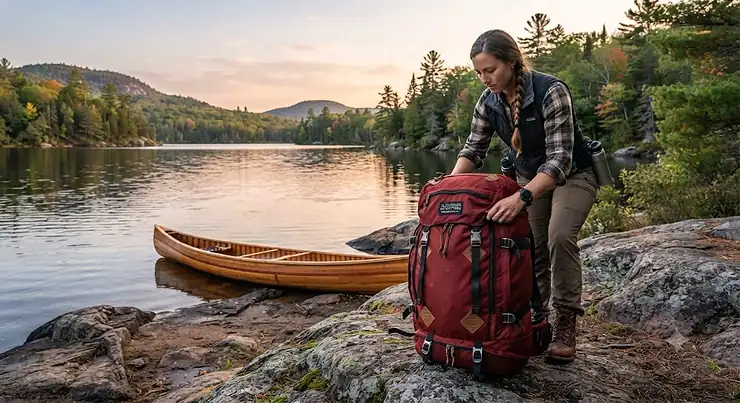
A nylon portage pack is a canoe-tripping backpack made from coated or ripstop nylon fabric — typically 420 to 1000 denier — instead of traditional waxed canvas, designed to ride low on your back so you can carry it (and sometimes the canoe) across rocky, root-tangled portage trails. If you’ve ever watched a canoe party stagger off a put-in with a canvas Duluth pack riding up around their neck, you already understand why nylon has quietly taken over so much of Ontario’s and Quebec’s paddling scene. It’s lighter. It sheds rain instead of soaking it up like a sponge. And on a 900-metre portage in July, every gram you’re not hauling feels like a personal favour from the universe.
This nylon portage pack review exists because most “best canoe pack” lists online are either recycled press releases or a single blogger’s one-and-only backpack, dressed up as gospel. We went a different route: pulling real specs, real material grades, and real aggregated review sentiment from retailers, manufacturer spec sheets, and paddler communities across Canada, then weighing them against each other honestly — pros, cons, and the trade-offs nobody puts on the product page.
According to Wikipedia’s overview of canoe packs, this style of pack must ride below shoulder level so the wearer can also carry a canoe, giving it a lower centre of gravity than a standard hiking backpack — a design constraint that shapes everything from strap placement to how a 100-litre bag manages to feel sane on your spine. Below, we’ve broken down seven real nylon portage packs sold to Canadian paddlers, from bargain-bin basic to fully custom-fit, plus the comparisons, mistakes, and buying logic that actually matter before you drop your card on one.
Quick Comparison Table
| Pack | Material | Capacity | Price Range (CAD) | Best For |
|---|---|---|---|---|
| North 49 Norwester 100L | Coated nylon | 100L | Under C$150 | Tightest budget |
| Level Six Algonquin 55L | 840D nylon | 55L | C$160–C$200 | Weekend solo/duo trips |
| Level Six Algonquin 95L | 840D nylon | 95L | C$240–C$280 | Family or multi-day loads |
| Granite Gear Quetico 82L | 420D ripstop Cordura | 82L | C$245–C$280 | All-around mid-range |
| Granite Gear Superior One 121L | 420D ripstop Cordura | 121L | C$260–C$300 | Big-volume expeditions |
| Ostrom Outdoors Quetico | 420D nylon, custom-fit | 82–100L (varies) | C$250–C$350 | Custom torso fit, comfort priority |
| RBW Coureur 2-Part | 1000D nylon | 104L | C$180–C$390 (config-dependent) | Modular, tumpline-style carrying |
Looking at the spread, there’s a clear split between packs that prioritize raw toughness through heavier denier fabric (the RBW Coureur 2-Part, built from bomb-proof 1000D nylon) and packs that chase comfort and organized storage through padded suspension systems (the Granite Gear Quetico and Ostrom Outdoors Quetico). If your trips involve rocky Canadian Shield portages where you’re setting the pack down on granite more than grass, fabric weight matters more than harness padding; if you’re doing 2-kilometre carries in Algonquin, the reverse is often true.
💬 Just one click — help others make better buying decisions too!😊
Top 7 Nylon Portage Packs: Expert Analysis
1. North 49 Norwester 100L Canoe Portage Pack — best entry point under C$150
The Norwester is the pack most Canadian trippers buy for their very first canoe trip, mainly because it’s the rare portage pack you can actually find at a big-box outdoor retailer without a two-week wait. Constructed from mid-weight coated nylon rather than a high-denier ripstop weave, it trades long-term abrasion resistance for an accessible price point — a fair trade for someone testing whether canoe tripping is even their thing.
At around 100 litres, the main compartment swallows a sleeping bag, a week of dehydrated meals, and a tent without needing a second pack for a weekend trip. It’s a simple top-loading, roll-and-buckle design with external compression straps rather than an internal frame, so the load-carrying comfort depends heavily on how well you pack it — soft items against your back, dense items low and centred. Based on the spec comparison against pricier packs on this list, the trade-off is obvious: no padded hip belt, no adjustable torso, and a shoulder harness that flattens out fast under heavy loads.
Reviewers across outdoor retailer sites consistently describe the Norwester as “good enough” for casual, infrequent trippers, with the most common complaint being strap comfort past the 25-kilogram mark and a coating that can crack at the seams after a few seasons of hard use — normal wear for budget nylon, not a defect. If you portage twice a summer, that’s a non-issue. If you’re doing back-to-back 1,000-metre carries every weekend, you’ll outgrow it fast.
Pros:
- ✅ Genuinely affordable — often under C$150 CAD
- ✅ Roomy 100L capacity for weekend loads
- ✅ Widely available at Canadian big-box retailers
Cons:
- ❌ Harness comfort drops off under heavy loads
- ❌ Coating can crack at stress points over time
Price sits comfortably under C$150 CAD at the time of research, making the North 49 Norwester the easiest on-ramp into nylon portage packs — genuinely good value if your trips stay casual.
2. Level Six Algonquin 55L Waterproof Canoe Pack — best pre-curved fit for weekend duos
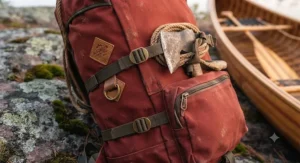
Level Six built the Algonquin line specifically with Canadian canoe-tripping terrain in mind, and it shows in the pre-curved panel shape — the pack is molded to sit against your lower back rather than standing bolt upright like a hiking pack, which keeps the load’s centre of gravity close to your hips on uneven ground. The 55-litre size is the smaller of two Algonquin capacities and lands right in the sweet spot for a solo tripper’s full kit or a duo’s shared overnight gear.
The 840-denier nylon shell is genuinely waterproof rather than merely water-resistant, using a roll-top closure similar to a dry bag rather than a zippered lid. What most buyers overlook about this detail is that it eliminates the need for a separate pack liner, which saves both weight and the annoyance of double-bagging everything before a rainy portage. Reviewers on outdoor forums frequently mention the Algonquin as a step up in comfort from bargain nylon packs, though a few note the roll-top style makes it slower to access gear mid-day compared to a lid-pocket design.
For a paddler doing three or four trips a season through Algonquin, Temagami, or the Kawarthas, this is a genuinely durable middle-ground choice — tougher fabric than entry-level packs without the premium price of a fully custom harness system.
Pros:
- ✅ Fully waterproof roll-top, no liner needed
- ✅ Pre-curved shape hugs your lower back
- ✅ Heavy 840D nylon resists abrasion well
Cons:
- ❌ Roll-top is slower for mid-day access
- ❌ Simple harness lacks a structured hip belt
At a price in the C$160–C$200 range, the Level Six Algonquin 55L earns its keep for weekend and short multi-day trips where dry gear matters as much as durability.
3. Level Six Algonquin 95L Waterproof Canoe Pack — best for families and heavier loads
The bigger sibling in the Algonquin lineup, this 95-litre version shares the same 840-denier nylon shell and waterproof roll-top construction, just scaled up for parties who single-portage rather than double back for a second load. Here’s what to weigh: nearly doubling the volume means nearly doubling the potential weight you’re carrying, so this pack rewards trippers who pack disciplined and punishes those who don’t.
In practice, this size shows up constantly in trip reports from Algonquin Park regulars, often mentioned as a “steal” relative to premium American-made packs when purchased on sale through Canadian retailers. The waterproof shell means food barrels and kitchen gear can ride in the same pack as clothing without a second liner, which matters when you’re trying to keep your total pack count low for a solo carry over a long portage.
The spec sheet won’t tell you this, but user reports suggest the biggest limiting factor on a pack this size isn’t the fabric — it’s your own back. Without a rigid internal frame, a fully loaded 95L nylon pack redistributes weight less predictably than a framed hiking pack, so packing technique becomes the real durability test.
Pros:
- ✅ Cavernous 95L single-portage capacity
- ✅ Waterproof construction handles food and gear together
- ✅ Strong value relative to premium competitors
Cons:
- ❌ No internal frame to structure heavy loads
- ❌ Bulky when partially empty
Typically priced C$240–C$280 CAD, the Level Six Algonquin 95L suits families or single-portage trippers who’d rather carry one big load than two smaller ones.
4. Granite Gear Quetico Portage Pack 82L — best all-around mid-range pick
The Quetico is arguably the pack that popularized modern nylon portage design outside the traditional canvas world, and the current version — built from 420-denier ripstop Cordura with a water-resistant coating — reflects two decades of refinement. Unlike simpler roll-top designs, the Quetico uses an anatomically shaped harness with a padded back panel and hip belt, borrowing more from backpacking pack design than the old Duluth-style shoulder-strap-only approach.
Based on the spec comparison, the 82-litre main body (expandable to roughly 5,000 cubic inches with the overflow collar) sits in a genuinely useful middle ground — big enough for a week-long trip if you pack efficiently, small enough that it doesn’t become an unwieldy brick on tight portage trails. The Vapor suspension system and padded straps are where this pack earns its price premium over the Level Six and North 49 options above.
An independent gear reviewer who directly compared this pack to a traditional canvas Duluth pack noted that despite offering more volume, the Quetico felt noticeably lighter on the trail than a heavy-duty canvas pack of similar size, largely because 420D ripstop nylon weighs a fraction of what waxed canvas does per square metre. Aggregated user sentiment consistently praises the hip belt and load-stabilizer straps for making 35+ kilogram loads bearable across multiple portages, with the main complaint being that top-only access makes packing order more important than with lid-pocket designs.
Pros:
- ✅ Anatomical harness with real hip-belt support
- ✅ 420D ripstop Cordura resists tears and abrasion
- ✅ Noticeably lighter than comparable canvas packs
Cons:
- ❌ Top-loading only — no side or front access
- ❌ Premium price versus basic nylon packs
Expect to pay in the C$245–C$280 range for the Granite Gear Quetico, which stacks up as the strongest all-around value on this list for regular multi-day trippers.
5. Granite Gear Superior One Portage Pack 121L — best for expedition-length loads
Where the Quetico handles a standard week-long trip, the Superior One is built for parties who single-portage everything on longer expeditions — think three weeks in the Barren Lands or a Quetico Provincial Park circuit where resupply isn’t an option. At 121 litres of expandable capacity, this is one of the largest nylon portage packs commercially available, constructed from the same 420-denier ripstop Cordura family as the Quetico but scaled up with reinforced stress points for the extra weight it’s designed to carry.
Here’s what most buyers overlook: a pack this large isn’t just “bigger,” it changes how you pack an entire trip. Reviewers and outfitters note that the Superior One is genuinely built to be loaded past 40 kilograms without the seams or straps giving out — a load that would destroy a budget nylon pack’s stitching within a season. The trade-off, unsurprisingly, is bulk; several aggregated reviews mention that the pack feels genuinely unwieldy when under-filled, since the frame and harness are tuned for heavy loads rather than light day-tripping.
For most weekend or even week-long Canadian trips, this pack is overkill. For guides, outfitters, and serious multi-week expedition trippers, it’s frequently cited as the workhorse that survives seasons of commercial use without needing replacement.
Pros:
- ✅ Massive 121L capacity for extended trips
- ✅ Reinforced construction handles 40kg+ loads
- ✅ Trusted by outfitters for repeated commercial use
Cons:
- ❌ Feels bulky and awkward when lightly packed
- ❌ Overkill for weekend or casual trippers
At roughly C$260–C$300 CAD, the Granite Gear Superior One is a specialist’s pack — buy it if your trip length actually demands the volume, not because bigger sounds better.
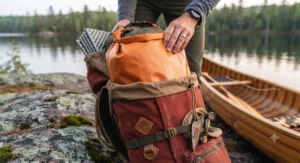
6. Ostrom Outdoors Quetico Canoe Pack — best custom-fit comfort
Ostrom Outdoors, based in Thunder Bay, Ontario, builds its canoe packs to order with interchangeable shoulder straps and hip belts sized to the individual paddler’s torso — a genuinely different approach from the one-size harness most competitors ship. The Quetico model uses a 420-denier nylon body with a second layer of 400-denier nylon reinforcing the back panel specifically where the suspension system attaches, a detail the company highlights as unique to their construction.
What the spec sheet won’t tell you, but customer testimonials on the company’s own site suggest, is that the custom-fit sizing genuinely changes the experience for paddlers who are notably smaller or larger than “average” — several reviewers describe portaging becoming meaningfully less painful once they switched from a standard harness to a properly torso-matched fit. That’s a real and honest advantage worth weighing if a previous portage pack has ever left you with bruised collarbones or a hip belt that rode up around your ribs.
Because these packs are assembled to order in a Canadian warehouse rather than shipped from mass-production overseas, lead times can run longer than ordering an in-stock Granite Gear pack, and the price reflects the made-to-measure labour involved. It’s not the right choice if you need a pack before next weekend, but for a paddler planning ahead who has struggled with ill-fitting harnesses, it’s a legitimately different value proposition than anything else on this list.
Pros:
- ✅ Custom torso and hip-belt sizing per paddler
- ✅ Reinforced back panel unique to Ostrom’s build
- ✅ Assembled in Canada with a lifetime workmanship warranty
Cons:
- ❌ Longer lead time than in-stock competitors
- ❌ Premium pricing for the custom-fit process
Pricing runs roughly C$250–C$350 CAD depending on size and configuration — check Ostrom’s site for current figures, as custom-fit packs price differently than off-the-shelf models — making the Ostrom Outdoors Quetico the pick for paddlers who prioritize fit over speed of delivery.
7. Recreational Barrel Works Coureur 2-Part Canoe Pack — best modular, tumpline-style build
The Coureur takes an entirely different structural approach than everything else on this list: rather than one large sack, it’s built as two stackable pack sections joined by heavy-duty webbing that runs down both sides and along the bottom to secure the load to a tumpline — the traditional forehead strap voyageurs used to distribute weight through the spine rather than the shoulders alone. Constructed from 1000-denier nylon, it’s the toughest fabric grade of any pack in this review, roughly double the denier of the Granite Gear packs above.
Here’s the honest trade-off: the modular two-part design and removable shoulder straps mean the Coureur can be configured several different ways — full pack-and-attic combo, single section, tumpline-only — but that flexibility comes with a genuinely steeper learning curve than a standard single-compartment pack. This isn’t a grab-it-and-go design for a first-time tripper; it rewards paddlers who already understand traditional portaging technique and want gear that matches it.
Aggregated feedback on comparable heavy-nylon canoe packs in this category consistently praises the fabric’s resistance to punctures from rock scrapes and canoe gunwale abrasion, which matters enormously on Canadian Shield routes where packs get dragged, dropped, and wedged into rocky put-ins more often than gently set down. The 1000D weight does add noticeable pack weight compared to the 420D options above — a genuine trade-off between raw durability and carrying a lighter empty pack.
Pros:
- ✅ 1000D nylon — toughest fabric on this list
- ✅ Modular two-part design adapts to trip length
- ✅ Tumpline compatibility for traditional weight distribution
Cons:
- ❌ Steeper learning curve than standard packs
- ❌ Heavier empty pack weight than 420D options
Pricing varies widely by configuration, roughly C$180 for a single section up to around C$390 CAD for a full multi-part rig at the time of research — the RBW Coureur 2-Part rewards paddlers willing to learn traditional carrying technique with genuinely exceptional durability.
Practical Usage Guide: Packing, Portaging & Maintaining Your Nylon Pack
Getting a nylon portage pack home is the easy part — packing it right is what actually determines whether your first portage feels manageable or miserable. Start by lining the interior with a heavy-duty contractor bag or a dedicated pack liner, even on packs marketed as waterproof; seams and roll-tops can wick moisture under sustained rain in ways a fully sealed liner won’t. Load soft, compressible items like your sleeping bag and spare clothing against the panel that sits closest to your back, and put denser items — the stove, canned goods, cook kit — low and centred so the pack’s weight sits over your hips rather than pulling backward off your shoulders.
In your first 30 days of ownership, resist the urge to max out every cubic inch of capacity on trip one. Break the pack in on a moderate load first, checking that the shoulder straps sit flat without twisting and that any hip belt actually rides on your hip bones, not your waist. A common rookie mistake is over-tightening the top compression straps before the load is settled, which can strain the stitching at the attachment points prematurely.
For maintenance, rinse coated nylon packs with fresh water after any trip involving lake or river dunking, and let them air-dry fully inverted before storage — packing a damp nylon pack away encourages mildew that coated fabrics don’t breathe off easily. Reapply a nylon-safe waterproofing spray to seams and high-wear zones annually, and check buckles and webbing stitching each spring before the season’s first trip.
Real-World Scenarios: Matching Trippers to Packs
Consider a university student planning a five-day Algonquin loop on a tight budget, splitting gear with a tripping partner — a route that requires booking a backcountry camping permit through the Ontario Parks reservation system well before departure. The North 49 Norwester 100L or a single Level Six Algonquin 55L covers this well — moderate trip length, moderate budget, and infrequent enough use that ultimate durability matters less than not blowing the whole gear budget on one pack.
Now picture a family of four doing a week-long single-portage trip through Killarney, where nobody wants to make a second trip across a muddy carry with toddlers in tow. The Level Six Algonquin 95L or Granite Gear Quetico 82L, paired with a second smaller pack, handles the volume without requiring anyone to double back.
Finally, imagine a canoe guide running commercial three-week trips into the Barren Lands every summer for a decade. That’s the scenario the Granite Gear Superior One or RBW Coureur 2-Part was actually built for — packs that need to survive hundreds of load-and-unload cycles on rock without the seams giving out, where the extra cost amortizes across years of professional use rather than one weekend.
Buyer’s Decision Framework: Budget-Friendly Portage Packs & Beyond
If your trips are occasional and your budget is the primary constraint, choose a budget-friendly portage pack like the North 49 Norwester because infrequent use doesn’t justify premium fabric grades or custom harnesses. If you’re paddling three or more trips a season, choose a mid-range option like the Level Six Algonquin or Granite Gear Quetico, because 840D or 420D ripstop nylon will simply outlast cheaper coated fabric under repeated abrasion. If you’re running commercial trips or multi-week expeditions, choose the Granite Gear Superior One or RBW Coureur, because the cost of pack failure mid-trip far outweighs the upfront price difference. And if a previous pack has left you with real physical discomfort — pinched shoulders, a hip belt that never sits right — choose a custom-fit option like the Ostrom Outdoors Quetico, because no amount of denier toughness fixes a harness that doesn’t match your body.
A simple priority checklist: decide your typical trip length first, your budget ceiling second, and your body-fit needs third — in that order, since trip length dictates the minimum durability you actually need before price or fit become the deciding factors.
✨ Don’t Miss These Exclusive Deals!
🔍 Take your canoe tripping kit to the next level with these carefully selected nylon portage packs. Click on any highlighted pick to check current pricing and availability. The right pack turns a dreaded portage into just another part of an authentic Canadian wilderness trip your whole crew will remember fondly!
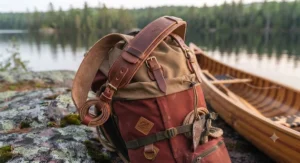
How to Choose a Nylon Portage Pack
Choosing the right nylon portage pack for canoe tripping comes down to matching fabric weight, capacity, and harness design to your actual trip pattern rather than chasing the priciest option on the shelf. Here’s the reasoning behind each decision point:
- Match capacity to trip length, not aspiration. A 55–65L pack covers most weekend trips; anything beyond a week typically needs 80L or more to avoid a second pack.
- Check the denier rating. Higher denier (like the RBW’s 1000D) means more abrasion resistance but more empty-pack weight — there’s no free lunch here.
- Decide if you need waterproof or water-resistant. A true roll-top waterproof shell like the Algonquin skips the need for a separate liner; a water-resistant coating like the Quetico’s usually still wants one in sustained rain.
- Test the harness under load, not empty. An empty pack always feels comfortable; the real test is a 30kg+ loaded fitting if you can arrange one before buying.
- Consider access style. Top-loading packs are simpler and lighter but slower to dig through mid-day; lid-pocket designs add convenience at a small weight cost.
- Factor in your torso and body size. If standard harnesses have failed you before, a custom-fit option is worth the extra cost and lead time.
- Budget for the whole system, not just the pack. A liner, tumpline, or hip belt upgrade can add C$20–C$80 to your total cost — worth pricing in before you commit.
Canvas Duluth Pack vs Nylon Portage Pack: Which Should You Choose?
The canvas duluth pack is the original portage pack — a traditional style dating back to the fur-trade era, when loads carried across a single portage often ran 160 to 200 pounds, according to Wikipedia’s history of the canoe pack — hand-crafted from heavyweight waxed canvas with leather straps, built to last generations with basic maintenance. A nylon portage pack does the same job with modern synthetic fabric, prioritizing weight savings and water resistance over the canvas pack’s old-growth durability and classic aesthetic.
| Factor | Canvas Duluth Pack | Nylon Portage Pack |
|---|---|---|
| Weight (empty) | Heavier (waxed canvas) | Lighter (nylon fabric) |
| Water resistance | Absorbs water, needs re-waxing | Sheds water; some fully waterproof |
| Longevity | Decades with care | Years to a decade, fabric-dependent |
| Price range (CAD) | C$400+ typically | C$150–C$400 |
| Repairability | Widely repairable by hand | Often needs specialty gear repair |
The analysis here isn’t as simple as “nylon wins.” Canvas Duluth packs genuinely can last decades — some paddlers still use packs handed down from grandparents — but that longevity comes with meaningfully more empty-pack weight and less inherent water resistance unless regularly re-waxed. Nylon portage packs like the Granite Gear Quetico shave real weight off every portage and often build in water resistance the canvas style simply can’t match without maintenance, but they typically won’t outlive a well-cared-for canvas pack by decades. If heirloom durability and classic look matter more to you than shaving grams, canvas still has a legitimate case; if you’re counting every kilometre of every portage, nylon usually wins on pure practicality.
Top Duluth Packs Under $150 CAD: Where Budget-Friendly Portage Packs Actually Deliver
Searching for duluth packs under $150 CAD gets complicated fast, because true handcrafted canvas Duluth packs from the original Duluth Pack Company or Frost River almost never hit that price point — most start well above C$400 for genuine waxed canvas construction. What you’ll actually find under C$150 CAD in that search are budget-friendly portage packs built in the Duluth-inspired nylon style: simplified, single-strap or basic-harness bags that borrow the classic silhouette without the canvas price tag.
The North 49 Norwester 100L is the clearest example on this list — a nylon pack that nods to the traditional Duluth shape and function at a genuinely accessible price. Honestly assessed, packs in this bracket won’t match a real canvas Duluth pack’s decades-long lifespan or a premium nylon pack’s harness engineering, but for occasional trippers, weekend warriors, or anyone testing whether canoe tripping is a hobby worth investing more in, they deliver legitimate value without the premium price tag. Check current pricing before buying, since budget outdoor gear inventory and pricing shifts more often than premium lines.
Lightweight Nylon Portage Pack for Canoe Tripping: Shaving Weight Without Losing Durability
For paddlers doing long portage routes — the kind where you’re crossing 500 metres or more multiple times a day — pack weight becomes its own kind of cargo. A lightweight nylon portage pack for canoe tripping typically means choosing a lower-denier fabric (around 420D rather than 1000D) paired with a simplified harness that skips heavy internal frame components, trading some structure for real grams saved.
Among the packs reviewed here, the Granite Gear Quetico 82L strikes this balance most deliberately — its 420D ripstop Cordura construction and Vapor suspension system were specifically engineered to be lighter than both traditional canvas and heavier nylon alternatives like the 1000D RBW Coureur, without sacrificing the padded harness comfort that makes multi-portage days bearable. Reviewers consistently note that this lighter build becomes most noticeable on trips with several portages per day, where the cumulative weight of the empty pack itself adds up across repeated carries — a detail that’s easy to overlook when you’re only thinking about how much gear the pack holds, not how much the pack itself weighs before you put anything in it.
Ripstop Nylon Durability: Decoding Denier Numbers and Coatings
Denier measures the weight of the individual fibres used to weave a fabric — higher denier means thicker, heavier threads, which generally (though not always) means better resistance to punctures and abrasion. On this list, that ranges from the unspecified mid-weight coating on the budget North 49 Norwester up to the 1000-denier nylon on the RBW Coureur 2-Part, with most premium packs like the Granite Gear duo sitting at 420D.
What most buyers overlook is that “ripstop” refers to a weaving technique — reinforcing threads woven in a grid pattern — not a specific fabric weight, meaning a 420D ripstop nylon can actually resist tear propagation better than a heavier, non-ripstop fabric of similar denier, even though the raw number is lower. Ripstop nylon durability also depends heavily on the coating applied — polyurethane (PU) coatings add water resistance and abrasion protection but degrade with UV exposure over years, while newer PFAS-compliant coatings, now used on updated Granite Gear packs, trade a small amount of water-repellency performance for reduced environmental persistence. For Canadian Shield portaging specifically, where packs get dragged across granite and jammed into rocky put-ins, ripstop weave matters at least as much as raw denier count when it comes to actual field durability.
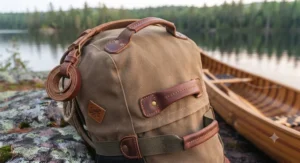
Quick-Dry Pack Materials: What Sheds Water and What Doesn’t
Not every nylon portage pack handles rain the same way, and understanding quick-dry pack materials before you buy prevents a soggy surprise on day two of a trip. True waterproof construction — like the roll-top closure and seam-taped seams on the Level Six Algonquin packs — uses welded or taped seams with a roll-and-buckle closure similar to a dry bag, keeping water out entirely regardless of how long it rains.
Water-resistant coatings, by contrast — the polyurethane or DWR (durable water repellent) finishes found on packs like the Granite Gear Quetico and Ostrom Outdoors Quetico — bead water off the surface initially but will eventually let moisture through zippers, seams, or sustained saturation, which is why most manufacturers still recommend an interior liner for these styles. Reviewers consistently report that DWR coatings lose effectiveness over a few seasons of use as the finish wears down from friction and UV exposure, meaning a pack that felt bone-dry in year one may need re-treatment by year three. If quick-drying after a dunking matters more to you than upfront water resistance, look for packs using open-weave mesh panels or minimal padding, since foam-backed harnesses — common on the Granite Gear and Ostrom lines — hold moisture longer than simpler, unpadded designs.
Common Mistakes When Buying a Nylon Portage Pack
The single most common mistake is buying based on capacity alone without considering harness quality — a 100L pack with a flat, unpadded strap system will hurt more on a long portage than a well-designed 70L pack, regardless of how much gear technically fits inside. A close second is assuming “water-resistant” means “waterproof,” which leads to soaked sleeping bags when a coated-nylon pack meets sustained rain without a liner.
Buyers also frequently underestimate how much empty-pack weight matters on multi-portage days, choosing a heavy 1000D pack for casual weekend trips where a lighter 420D option would serve just as well with less fatigue. On the flip side, some paddlers under-buy durability for demanding routes, picking a budget nylon pack for a rocky, multi-week Canadian Shield expedition where the fabric simply wasn’t engineered for that abuse. Finally, skipping a loaded fitting before purchase — trying the pack empty in a store rather than weighted to something close to trip conditions — leaves buyers surprised when a “comfortable” pack turns punishing after two hours under 30 kilograms.
Long-Term Cost & Maintenance: Total Cost of Ownership
| Pack | Upfront Price (CAD) | Expected Lifespan | Annual Maintenance |
|---|---|---|---|
| North 49 Norwester | Under C$150 | 2–5 seasons, moderate use | Minimal; occasional reproofing |
| Level Six Algonquin | C$160–C$280 | 5–10 seasons | Seam checks, occasional reproofing |
| Granite Gear Quetico/Superior One | C$245–C$300 | 10+ seasons | Annual DWR reproofing, buckle checks |
| Ostrom Outdoors Quetico | C$250–C$350 | 10+ seasons | Similar to Granite Gear, plus custom-fit longevity |
| RBW Coureur 2-Part | C$180–C$390 | 10–15+ seasons | Minimal; 1000D resists wear well |
The value/ROI picture here isn’t just about the sticker price — a North 49 Norwester replaced every three to four seasons can end up costing more over a decade than a single Granite Gear Quetico that lasts ten-plus years with basic annual care. That said, for someone who paddles once or twice a year, the budget option’s lower total lifetime cost still wins, since they’ll likely retire from tripping before the pack wears out regardless. The heavier 1000D fabric on the RBW Coureur also tends to minimize ongoing repair costs, since punctures and abrasion tears — the most common failure points on lighter nylon — are simply less likely to happen in the first place.
Safety & Regulations: Paddling Gear Rules in Canada
While a portage pack itself isn’t classified as required safety equipment, how you pack directly affects the mandatory gear Transport Canada requires you to carry. Under Transport Canada’s rules for operating a human-powered craft, canoes are required to carry certain safety equipment as specified in the Small Vessel Regulations — meaning your PFD, sound-signalling device, bailer, and (depending on trip length and visibility conditions) a watertight flashlight or flares all need a dedicated, quickly accessible spot, not buried at the bottom of a stuffed 121-litre pack.
A practical habit worth building: pack safety-mandated items in an easily reachable pocket or the top of your load rather than mixed in with clothing and food, so you’re not digging through an entire pack mid-emergency. If you’re leading a group trip rather than a personal outing, note that Transport Canada’s definitions around “guided excursions” can trigger additional equipment requirements beyond personal pleasure-craft rules — worth confirming directly with Transport Canada’s guidance if you’re ever unsure of your obligations as a trip leader. Programs like Lakehead University’s Outdoor Recreation, Parks and Tourism degree in Thunder Bay train the guides and trip leaders who deal with these regulations professionally, and their course material on risk management is a useful reference point for anyone leading group trips.
Frequently Asked Questions
❓
What's the difference between a nylon portage pack and a regular hiking backpack?
❓ Is 420 denier nylon durable enough for rocky portages?
❓ How much does a good nylon portage pack cost in Canada?
❓ Do nylon portage packs need a separate rain liner?
❓ Are nylon portage packs better than canvas Duluth packs?
Conclusion
There’s no single best nylon portage pack — there’s only the best one for how often you actually trip, how far you portage, and what your budget realistically allows. For occasional weekend paddlers, the North 49 Norwester or a single Level Six Algonquin 55L covers real needs without overspending. For regular trippers doing several trips a season, the Granite Gear Quetico earns its higher price through genuine harness comfort and lighter ripstop construction. For expedition-length or commercial use, the Granite Gear Superior One and RBW Coureur 2-Part trade some convenience for durability built to survive years of hard portaging, while the Ostrom Outdoors Quetico solves fit problems no amount of fabric toughness can fix on its own.
Whichever pack you land on, remember that the fabric and harness only do half the job — how you pack, maintain, and waterproof your gear inside it does the rest. A well-chosen nylon portage pack, packed thoughtfully and cared for between trips, should handle a decade or more of Canadian canoe tripping before it’s anywhere close to retirement.
Recommended for You
- Canvas Duluth Pack: 7 Best Picks for 2026 (Tough & Timeless)
- Waterproof Map Case vs Binder: 7 Picks for Canoe Camping 2026
- Waterproof Map Case for Canoe Tripping: 7 Best Picks for 2026
Disclaimer: This article contains affiliate links. As an Amazon Associate, I earn from qualifying purchases. If you purchase products through these links, we may earn a small commission at no additional cost to you.
✨ Found this helpful? Share it with your friends! 💬🤗
