
In This Article
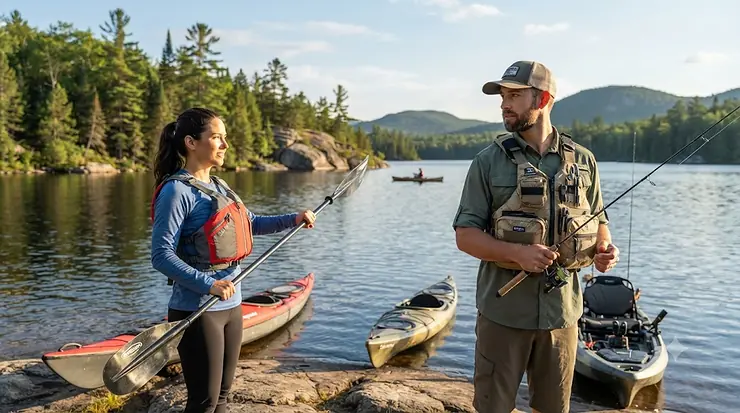
Standing in the paddlesports aisle with two nearly identical orange vests in your hands is a strangely specific kind of confusion. One says “Level 70, general boating.” The other has enough zippers to organize a tackle shop. This is the exact moment most Canadian paddlers land on the question of adult PFD vs fishing PFD for paddling, and honestly, it’s a fair question — the two categories overlap more than marketing copy suggests, and picking wrong usually means either paying for pockets you’ll never use or discovering, three hours into a lake trip, that you have nowhere to clip a stringer. This guide breaks down the real differences using actual products sold across Canada, actual specs, and honest analysis of who each style suits. We’ll also dig into the gear that surrounds the decision — a bailing sponge for kayak use, tackle storage vests, building smart kayak fishing setups, and why high-back PFD design for seated paddling matters more than most buyers realize until their first eight-hour day on the water.
Quick definition, since Google likes a straight answer: an adult PFD (Personal Flotation Device) is a general-purpose buoyancy vest built for freedom of movement across paddling, boating, and watersports, while a fishing PFD is a specialized version of the same safety category, adding pockets, tool mounts, and a torso cut designed to work around rods, pliers, and tackle without sacrificing certified buoyancy.
Neither is “safer” than the other in the raw sense — both are certified flotation devices — but the day-to-day experience of wearing one versus the other is genuinely different, and that difference is what this article unpacks.
Quick Comparison Table
| Feature | General Adult PFD | Fishing PFD |
|---|---|---|
| Primary design goal | Freedom of movement, ventilation | Storage, tool access, seated comfort |
| Typical pockets | 1 small zip pocket, if any | 2-5 pockets, pliers holster, rod holder loop |
| Back profile | Standard or high-back mesh | Almost always high-back, mesh lower panel |
| Best for | General paddling, SUP, canoeing | Kayak fishing, tournament anglers |
| Price range (CAD, at time of research) | C$90-C$180 range | C$140-C$250 range |
A general adult PFD wins on pure mobility and breathability, which matters a lot if you’re doing distance touring or SUP where casting and tackle aren’t part of the equation. A fishing PFD earns its higher price tag through organization — pliers holsters, rod loops, and tackle-sized pockets that keep your hands free between casts. Where it gets interesting is the middle ground: several models blur the line entirely, offering fishing-grade pockets on a chassis light enough for all-day recreational paddling, which is exactly why the “versus” framing in the title deserves some nuance rather than a flat either/or answer.
💬 Just one click — help others make better buying decisions too!😊
Top 7 Adult and Fishing PFDs for Paddling: Expert Analysis
Every product below is a real, currently available model sold through Canadian retailers, cross-referenced against Amazon.ca listings and Canadian paddlesports shops. Prices are shown as ranges in Canadian dollars because exact Amazon pricing shifts constantly — always check current price and availability before buying. We’ve grouped these to represent a genuine spread: general paddling PFDs, dedicated fishing PFDs, and a couple of hybrids that split the difference well.
1. Onyx MoveVent Dynamic — best budget all-rounder for general paddling
The standout here is simple: this is the PFD most Canadian paddlers should default to if they aren’t fishing and just want a comfortable, certified vest. The sculpted foam panels are shaped to flex with your torso instead of sitting like a rigid box, and the mesh ventilation channels across the front and lower back genuinely cut down on that clammy, overheated feeling by midday. Spec-wise, it’s built from 200-denier nylon ripstop and oxford fabric, carries U.S. Coast Guard and Transport Canada dual approval, and includes SOLAS-grade reflective trim for visibility in low light. What that dual approval means in practice is you can legally use this vest on both sides of the border without swapping gear, which matters if you paddle border lakes or travel south seasonally. Reviewers consistently note the low-profile fit sits higher on the torso than bulkier vests, reducing chafe against kayak seat backs — a small detail that becomes a big deal after four hours of paddling. Aggregated buyer sentiment across major retailers is strongly positive, with the most common praise centred on mobility and the mesh back working well with high-seat kayaks; the recurring complaint is that the single zippered pocket is too small for anything beyond a phone and keys. If you paddle recreationally, tour, or occasionally fish without needing serious tackle storage, this is the sensible starting point.
Pros:
- ✅ Dual USCG/Transport Canada certification for cross-border use
- ✅ Excellent ventilation reduces overheating on warm days
- ✅ Low-profile cut avoids rubbing on high-back kayak seats
Cons:
- ❌ Single small pocket, unsuitable for serious tackle storage
- ❌ Sizing runs snug for larger frames per buyer reports
At around C$90-C$130 at the time of research, this remains one of the best value-per-dollar entries in the category — a genuinely solid buy for anyone who wants “adult PFD” without the fishing-specific premium.
2. Onyx Kayak Fishing Life Jacket — best budget fishing-specific pick
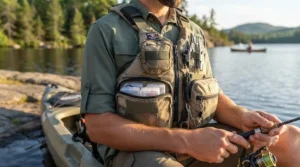
This is the MoveVent platform’s angler-focused sibling, and the standout feature is how much fishing functionality it packs in without pushing the price into premium territory. Multiple pockets replace the single zip pouch of the standard MoveVent, and the high-back design is purpose-cut to clear the raised seat backs found on most sit-on-top fishing kayaks. Construction mirrors its sibling — durable nylon shell, USCG approval, adjustable side and shoulder straps — but the torso panel adds mounting loops for small accessories like a stringer clip or retractable lanyard. On paper, this means you get tackle-adjacent storage without the bulk of a full-blown tournament vest, which suits weekend anglers better than the 20-plus-pocket options built for guides. Reviewers consistently report the pocket layout being intuitive even for first-time kayak anglers, and the price point relative to fishing-specific competitors draws repeated praise in aggregated review sentiment. The main criticism that surfaces is that pocket capacity, while decent, can’t match dedicated tackle vests when you’re carrying multiple boxes for a full day on the water.
Pros:
- ✅ High-back design clears raised kayak fishing seats
- ✅ Multiple pockets without excessive bulk or weight
- ✅ Strong value relative to premium fishing PFD competitors
Cons:
- ❌ Pocket capacity limited for multi-box tackle days
- ❌ Fewer dedicated tool mounts than tournament-grade vests
Expect a price in the C$110-C$150 range, making this the natural upgrade path for anyone who tried a general PFD, found the storage lacking, and wants fishing features without committing to a C$200-plus vest.
3. Stohlquist Fisherman — best old-school reliability on a budget
What stands out about the Stohlquist Fisherman is that it doesn’t chase trends — it’s been a dependable kayak-angling staple for years, and the WRAPTURE-shaped torso panel is the reason why. That shaping wraps foam around your body contour rather than sitting flat, which spec sheets rarely explain well but matters enormously for comfort during long sits. The vest uses a Cross-Chest Cinch harness and multiple front and back adjustment points, accommodating chest sizes from roughly 44 to 56 inches, and the thinner back panel is specifically built to pair with high-back kayak seating. Velcro front pockets are large enough to swallow small tackle boxes, and mounting points let you attach pliers or a stringer wherever suits your reach. Aggregated review data puts buyer satisfaction at a strong 88% positive rating, with build quality and adjustability cited most often; the recurring downside noted by testers is reduced breathability once temperatures climb past the mid-80s Fahrenheit (roughly 29°C), and a tendency to ride up slightly while seated unless the cinch harness is properly tightened. For anglers who prioritize proven mounting versatility over cutting-edge ventilation tech, this remains a smart, budget-conscious choice.
Pros:
- ✅ WRAPTURE foam shaping improves long-session comfort
- ✅ Wide chest-size range fits most adult body types
- ✅ Strong 88% positive rating in aggregated reviews
Cons:
- ❌ Reduced breathability in high-heat conditions
- ❌ Can ride up if the cinch harness isn’t fully tightened
Typically priced in the C$110-C$150 CAD range, it competes directly with the Onyx Kayak Fishing Life Jacket on value while offering a more traditional, mounting-heavy layout that veteran anglers tend to prefer.
4. NRS Chinook Fishing PFD — best all-around kayak angler favourite
The NRS Chinook Fishing PFD is, by aggregated sales data across paddlesports retailers, the best-selling fishing life jacket for kayak anglers, and the standout reason is organization done right. Two large zippered pockets are specifically sized for tackle boxes with internal dividers, plus two smaller hook-and-loop accessory pockets and a dedicated tool holster for pliers or line cutters positioned for right-hand quick access. PlushFit foam molds to the body over time, and the high-back cut is engineered around raft and kayak seating specifically — Transport Canada and UL-approved as a Type III, medium-profile jacket delivering 16 pounds of flotation. What that buoyancy figure means practically: it’s enough for calm-to-moderate inland paddling but not a substitute for higher-flotation gear in rough open water. Reviewers who logged extended testing describe the fit as “a fishing vest that happens to float,” with the pliers holster and clamshell pockets earning consistent praise across thousands of aggregated reviews; the main friction point noted is that sizing runs slightly large and the drop-down pocket sits low enough that bigger phones can be awkward to retrieve while seated.
Pros:
- ✅ Best-selling design with proven, tested tackle organization
- ✅ PlushFit foam improves comfort across long fishing days
- ✅ Dedicated pliers holster for fast one-handed access
Cons:
- ❌ Sizing runs large according to multiple buyer reports
- ❌ Drop-down pocket sits low, awkward for larger phones
Canadian retailers list the NRS Chinook Fishing PFD in the C$150-C$200 range, and given the pocket engineering and brand track record, it represents strong value for anyone serious about kayak fishing setups rather than casual paddling.
5. Astral Ronny — best comfort-first pick for high-seat kayaks
The Astral Ronny was built specifically to pair with recreational kayaks that have tall, padded seat backs, and that’s the standout feature worth leading with. Multiple storage pockets handle tackle and small gear without turning the vest into a bulky tool belt, while a highly breathable mesh back panel keeps heat from building up against the seat — a detail that matters enormously once you’re strapped into a kayak seat for six-plus hours. The nylon outer shell resists cuts and tears from hooks, branches, and rocky put-ins, and a velcro-secured beverage holder is a small but genuinely appreciated touch for long days. Based on the spec comparison against more fishing-heavy vests like the NRS Chinook Fishing PFD, the Astral Ronny leans slightly more toward general comfort than tackle capacity, making it a strong pick for anglers who value all-day wearability over maximum pocket count. Aggregated buyer sentiment highlights the high-seat compatibility and breathable back as the two most-praised features, with occasional notes that the pocket layout, while functional, isn’t as specialized as dedicated fishing vests.
Pros:
- ✅ High mesh back purpose-built for tall kayak seats
- ✅ Genuinely breathable design reduces heat buildup
- ✅ Durable nylon shell resists hooks, branches, and rock contact
Cons:
- ❌ Storage less specialized than dedicated fishing vests
- ❌ Premium pricing versus entry-level general PFDs
Expect a price landing in the C$190-C$230 CAD range, positioning this as a mid-to-premium choice that splits the difference between comfort-first paddling gear and light fishing capability.
6. Astral V-Eight — best for hot-climate paddling comfort
If overheating is your biggest complaint with life vests, the Astral V-Eight exists specifically to solve that, and its Airescape airflow system is the standout feature. This patented ventilation approach actively works to reduce heat buildup and wick sweat rather than just passively including mesh panels, which on paper means noticeably better comfort during summer paddling sessions than most competitors in this list. The super-high mesh back is engineered for kayaks with tall seat backs, and adjustable webbing side straps combined with adjustable shoulder straps let it snug down to a wide range of body shapes rather than fitting like a one-size compromise. What most buyers overlook about this model is that its strength lies less in tackle storage and more in wearability during genuinely hot conditions — a category where cheaper vests routinely fail. Reviewers testing it through peak summer heat consistently cite reduced sweat buildup compared to standard mesh-back designs, positioning it as a strong option for anglers and paddlers in warmer Canadian regions or summer long-weekend trips.
Pros:
- ✅ Airescape system meaningfully reduces heat and sweat buildup
- ✅ Adjustable straps accommodate a wide range of body shapes
- ✅ High mesh back suits tall kayak seating comfortably
Cons:
- ❌ Premium price relative to storage-focused competitors
- ❌ Fewer dedicated fishing-specific pockets than tackle vests
At an estimated C$230-C$270 CAD range, it sits at the premium end of general paddling PFDs — justified for hot-weather comfort, less so if pocket count is your top priority.
7. Mustang Survival Khimera — best low-profile hybrid PFD
The Mustang Survival Khimera takes a genuinely different approach: it’s a dual-buoyancy PFD combining foam construction with a manually activated inflatable chamber, and that hybrid design is the clear standout. Base foam buoyancy sits around 7.5 pounds, low-profile enough to feel almost unnoticeable during casual paddling, with an additional roughly 13 pounds available instantly via CO2 cartridge if conditions intensify or you end up swimming. Large armholes and a minimal silhouette maximize range of motion — genuinely useful for anglers casting repeatedly or paddlers doing technical strokes — and re-arming after use just means squeezing out the air and swapping the CO2 cylinder, no repacking required. Based on the spec comparison with pure-foam vests, this model trades some pocket space for dramatically improved mobility and reduced bulk, which on paper suits SUP anglers, expedition kayakers, and warm-weather paddlers who overheat easily in thicker vests. Reviewer sentiment is largely positive on comfort and mobility, though a recurring criticism is that the plastic inflator pin is prone to falling out and costs extra to replace if lost.
Pros:
- ✅ Dual flotation offers low bulk plus emergency reserve buoyancy
- ✅ Large armholes maximize casting and paddling range of motion
- ✅ Easy re-arming with replaceable CO2 cartridge system
Cons:
- ❌ Inflator pin reportedly falls out and needs replacement
- ❌ Minimal storage compared to dedicated fishing PFDs
Priced around C$300-C$340 CAD, it’s the most expensive entry here, aimed squarely at paddlers who value mobility and low bulk over tackle capacity.
Practical Usage Guide: Setup, Maintenance, and the Accessories That Complete Your Kit
Buying the right vest solves half the problem — the rest comes down to what surrounds it. A bailing sponge for kayak trips is one of the cheapest, most overlooked additions to any setup, and it earns its place fast. Water sneaks into a cockpit from paddle drip, waves, and the simple act of climbing in and out, and a bailing sponge for kayak use soaks that pooled water up in seconds — squeeze it small, press it into standing water, let it expand, then wring it out over the side. Most sponges hold 24 to 32 ounces per squeeze, which sounds modest until you realize a soggy cockpit floor adds real weight and discomfort over a full day. Pair it with a compact bilge pump for anything beyond light splash, since a pump reaches into tighter spaces around foot wells that a sponge can’t fully clear.
Tackle storage vests deserve a maintenance routine too, and it’s simpler than most anglers assume. Rinse pockets and zippers with fresh water after every saltwater trip to prevent corrosion buildup on hardware, and let the vest air-dry fully before storage to avoid mildew inside foam panels. In the first 30 days of ownership, the most common mistake is overloading every pocket immediately — start with essentials only, then add gear incrementally so you learn where weight distribution feels balanced rather than front-heavy. Inspect stitching and buckle tension monthly; foam flotation degrades faster when compressed under constant heavy tackle loads, so rotating gear between pockets extends usable lifespan.
✨ Ready to build out your full kit? Check current pricing on the vest that fits your style before your next trip.
Real-World Scenarios: Matching PFDs to Kayak Fishing Setups
Different anglers need genuinely different kayak fishing setups, and matching the PFD to the scenario avoids expensive trial and error. Consider a weekend angler fishing local lakes twice a month on a budget under C$150 total for safety gear — the Onyx Kayak Fishing Life Jacket paired with a basic bailing sponge covers the essentials without overspending on features that won’t get used often.
A tournament-focused angler fishing 8-plus hours weekly in a high-back sit-on-top kayak represents a different profile entirely. Here, the NRS Chinook Fishing PFD or Stohlquist Fisherman makes more sense, since both are engineered specifically around long seated sessions and heavy tackle organization — the extra investment pays back in comfort and reduced gear-fumbling per cast.
Then there’s the SUP or technical paddler who fishes occasionally but prioritizes mobility above all else — someone doing distance touring with light tackle. The Mustang Survival Khimera fits that profile well, trading pocket capacity for a barely-there feel that doesn’t restrict paddle stroke or casting motion. Matching gear to actual usage patterns, rather than buying the most feature-packed option available, consistently produces better satisfaction than defaulting to the priciest vest on the shelf.
What Is the Difference Between an Adult PFD and a Fishing PFD?
An adult PFD is a certified flotation vest designed for general paddling comfort and mobility, while a fishing PFD is a functional variant built around the same certified buoyancy standards but reshaped with pockets, tool mounts, and a torso cut optimized for seated, tackle-heavy use. Both must meet Transport Canada or dual USCG/Transport Canada approval to be legal for use on Canadian waters — the distinction is purely about added functionality, not safety rating. According to Transport Canada’s official guidance on choosing lifejackets and personal flotation devices, buoyancy performance level matters more than category labelling when assessing whether a vest suits your specific paddling conditions.
High-Back PFD Design for Seated Paddling: Why It Matters
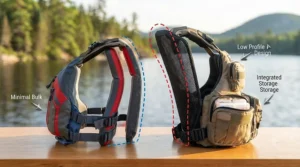
High-back PFD design for seated paddling isn’t a marketing gimmick — it solves a real mechanical problem. Standard PFDs extend foam flotation evenly across the torso, including the lower back, which is exactly where a kayak seat back presses hardest during seated paddling. That constant pressure creates discomfort within an hour and can push the vest upward uncomfortably against your neck. High-back PFD design for seated paddling solves this by shortening or replacing lower-back foam with mesh panelling, letting the vest sit cleanly around a raised kayak seat instead of fighting it.
What most buyers overlook about high-back PFD design for seated paddling is that it doesn’t reduce total buoyancy — flotation shifts upward and to the sides rather than disappearing, meaning certified performance stays intact while comfort improves dramatically. Nearly every fishing-specific PFD in this guide, including the NRS Chinook Fishing PFD and Stohlquist Fisherman, uses this exact approach, and it’s the single biggest reason dedicated kayak anglers avoid standard vests. If your kayak has a padded, elevated seat back — which most modern sit-on-top fishing kayaks do — a high-back design isn’t optional comfort, it’s close to mandatory for multi-hour trips.
How to Choose Between an Adult PFD and a Fishing PFD
- Assess your primary activity. If tackle organization matters more than pure mobility, lean fishing-specific; if you paddle broadly across touring, SUP, and casual fishing, a general adult PFD flexes better.
- Check your kayak’s seat height. Tall, padded seat backs strongly favour high-back PFD design for seated paddling, regardless of category.
- Count your realistic gear needs. Be honest about how much tackle you actually carry — overbuying pockets adds cost and bulk without benefit.
- Prioritize climate and ventilation. Hot-weather paddlers should weight mesh coverage and airflow systems heavily in the decision.
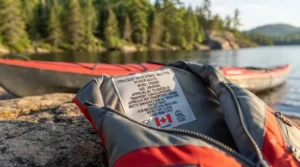
- Confirm certification. Only consider vests carrying Transport Canada approval, USCG/TC dual approval, or UL Canada certification.
- Test the fit seated, not standing. A PFD that feels fine standing can ride up or dig in once you’re seated in a kayak for hours.
- Set a realistic budget range. Expect roughly C$90-C$180 for general PFDs and C$140-C$340 for fishing-specific or hybrid models, based on the products compared above.
Adult PFD vs Fishing PFD: Benefits Compared
| Factor | General Adult PFD | Fishing PFD |
|---|---|---|
| Mobility for casting/paddling | Very good | Good, slightly restricted by pockets |
| Tackle organization | Minimal | Excellent |
| Heat management | Often best-in-class | Good, varies by model |
| Best for | Touring, SUP, casual paddling | Kayak fishing, tournament use |
| Typical price (CAD) | C$90-C$230 | C$110-C$340 |
Looking at the table, the trade-off is fairly linear: every added pocket and tool mount on a fishing PFD costs a small amount of mobility and, often, a proportional increase in price. Paddlers who fish occasionally but prioritize comfort — like those choosing the Astral Ronny or Astral V-Eight — tend to be happier splitting the difference rather than committing fully to either extreme. Anglers logging serious hours, on the other hand, consistently report that dedicated fishing-specific storage on models like the NRS Chinook Fishing PFD pays for itself in reduced fumbling and lost gear.
Common Mistakes When Buying a Paddling PFD
Buyers routinely default to the highest pocket count without weighing whether they’ll actually use that storage, which adds unnecessary bulk and cost. Another frequent misstep is sizing purely off chest measurement without accounting for torso length — a vest that’s technically the right chest size can still ride painfully high or low if torso proportions don’t match. Skipping the seated fit test is a third common error; a PFD that feels great standing in a store can behave completely differently once compressed against a kayak seat for hours. Finally, many buyers assume any bright-coloured vest is automatically certified — always verify the Transport Canada or dual USCG/TC label rather than trusting colour or brand reputation alone.
Long-Term Cost & Maintenance
Total cost of ownership extends well beyond the sticker price. Foam flotation degrades gradually with UV exposure and repeated compression, meaning even a well-maintained PFD typically needs replacement every 7-10 years of regular use, sooner with heavy saltwater exposure. Budget vests in the C$90-C$150 range often need replacing closer to the 5-year mark if used frequently, while premium foam and hybrid designs, including the Mustang Survival Khimera, can last longer but carry ongoing costs like CO2 cartridge replacement after inflation. Rinsing after every trip, air-drying fully, and storing away from direct sunlight are the three habits that most extend usable lifespan across every product in this comparison. When you calculate cost-per-season rather than upfront price alone, mid-range fishing PFDs like the Stohlquist Fisherman often deliver stronger long-term value than ultra-budget options that need earlier replacement.
Safety, Regulations & Compliance in Canada
Wearing a certified PFD is more than good practice — it’s a legal requirement across Canadian waters, though the specifics vary slightly by province and vessel type. Under Ontario’s boating regulations as outlined by BOATERexam, every person aboard a canoe, kayak, or paddleboard must have an approved, appropriately sized PFD readily accessible, and wearing it is strongly recommended given the elevated risk profile of human-powered vessels. Federally, Transport Canada requires that every occupant have a Canadian-approved PFD or lifejacket in good condition, sized correctly for the wearer.
Inflatable PFDs, including hybrid designs like the Mustang Survival Khimera, carry additional restrictions worth knowing — they’re not approved for use by anyone under 16 years old, anyone weighing less than 36.3 kg (80 lbs), or during whitewater paddling activities. For stand-up paddleboarding specifically, Parks Canada’s SUP safety guidance recommends wearing a PFD with a whistle at all times, or at minimum carrying a PFD, whistle, and floating throw rope aboard.
The stakes behind these rules are real. According to safety data compiled by the National Boating Safety School, the Canadian Red Cross has stated that wearing a life jacket could eliminate close to 90% of boating-related drownings, and more than 500 people drown in Canada annually, many without a properly worn PFD. Beyond legal compliance, checking your PFD’s CGSB tag, ensuring it fits snugly with no excessive ride-up, and replacing anything showing foam compression or torn stitching are simple habits that meaningfully reduce real-world risk.
Features That Actually Matter (And Those That Don’t)
Certified buoyancy level and correct sizing matter more than any other spec on the list — skip these fundamentals and every other feature becomes irrelevant. High-back design for seated paddling matters enormously if your kayak has a tall seat, and ventilation quality genuinely affects whether you’ll wear the vest consistently rather than leaving it unbuckled on hot days. Pocket count matters, but only up to your realistic gear load — beyond that, it’s paid-for bulk. What tends to matter less: colour beyond visibility standards, brand prestige alone, and marketing terms like “tournament-grade” that don’t correspond to a measurable spec difference. The spec sheet won’t tell you this, but reviewers across every product in this guide consistently rank fit and seated comfort above raw feature count when explaining why they’d repurchase the same model.
Frequently Asked Questions
❓ Is a fishing PFD safer than a regular adult PFD?
❓ Can I use a regular kayak PFD for fishing?
❓ What is a high-back PFD design for seated paddling?
❓ Do I need a bailing sponge for kayak fishing trips?
❓ How much should I budget for a good kayak fishing PFD in Canada?
Conclusion
The honest answer to adult PFD vs fishing PFD for paddling is that neither wins universally — it comes down to how you actually use the water. Casual paddlers, SUP riders, and touring kayakers are usually better served by a general adult PFD like the Onyx MoveVent Dynamic, prioritizing mobility and ventilation over pockets they won’t fill. Dedicated kayak anglers, on the other hand, consistently get more real-world value from fishing-specific builds like the NRS Chinook Fishing PFD or Stohlquist Fisherman, where tackle organization and high-back comfort directly translate into a better day on the water. Hybrid options like the Mustang Survival Khimera and comfort-focused picks like the Astral Ronny and Astral V-Eight prove the line between categories is genuinely blurry, and that’s fine — the goal was never to force you into one label, just to help you match features to how you actually paddle. Whatever you choose, confirm certification, test the seated fit, and build the rest of your kayak fishing setups around a PFD that you’ll actually want to wear every single trip.
✨ Found the right match? Check current availability before your next trip on the water! 💬🤗
Recommended for You
- Kids PFD for Canoe Camping: 7 Trusted Picks for 2026
- Adult PFD for Canoeing: 7 Best Picks amp; Buying Guide 2026
- Large Canoe Trip Pack 70L: 7 Top Picks for 2026
Disclaimer: This article contains affiliate links. As an Amazon Associate, I earn from qualifying purchases. If you purchase products through these links, we may earn a small commission at no additional cost to you.
✨ Found this helpful? Share it with your friends! 💬🤗
