

In This Article
picaridin bug spray is a synthetic, non-greasy insect repellent — known in Canada by its official name, icaridin — that Health Canada registers at concentrations up to 20% for protection against mosquitoes, ticks, and biting flies. It’s become the DEET alternative that outdoor-loving Canadians reach for when they want protection without the sticky feel or the plastic-melting side effects.
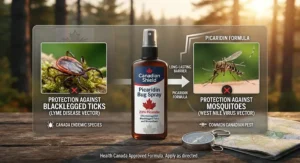
If you’ve ever stood in the bug spray aisle at Canadian Tire staring at six nearly identical bottles, you know the problem isn’t finding a picaridin bug spray — it’s figuring out which one is actually worth your money. Some are aerosols. Some are pump mists. Some are lotions built for kids’ sensitive skin, and some are engineered for eight-hour bushwhacking sessions in tick country. They are not interchangeable, whatever the label art suggests.
This guide digs into seven real, currently available picaridin (icaridin) products sold to Canadians, breaks down what the concentration numbers actually mean once you’re standing in a mosquito cloud at dusk, and walks through the Health Canada PMRA registration rules that decide what’s legally allowed on your skin. We’ll also look honestly at where picaridin beats DEET, where it doesn’t, and how to pick between a spray and a lotion depending on who’s wearing it. No fluff, no invented five-star reviews — just what the specs, the aggregated review sentiment, and Canadian regulatory guidance actually say.
Quick Comparison Table
For readers in a hurry, here’s the condensed version before we go deep on each product.
| Product | Format | Concentration | Best For | Price Range (CAD) |
|---|---|---|---|---|
| Watkins Great Outdoors Icaridin Spray | Pump spray | 20% icaridin | Budget everyday protection | Under C$16 |
| OFF! Clean Feel Picaridin (Fragrance Free) | Pump/aerosol | 20% picaridin | Sensitive-nose users | C$14-20 |
| Natrapel Icaridin Eco-Spray | Pump spray | 20% icaridin | Families with young kids | C$16-24 |
| Sawyer Premium Picaridin Lotion | Lotion | 20% picaridin | Dry-skin, no-mist application | C$15-24 (twin pack) |
| Ben’s Picaridin Hunting Formula | Fine-mist EcoSpray | 20% picaridin | Sweaty, high-exertion trips | C$20-28 |
| Ranger Ready Picaridin Scent Zero | Fine-mist spray | 20% picaridin | Odour-sensitive hikers | C$22-30 |
| Proven 12hr Picaridin Spray | Pump spray | 20% picaridin | Travel and portability | C$20-30 |
Reading across this table, the split isn’t really “good versus bad” — every one of these uses the same 20% icaridin/picaridin active ingredient, which is the concentration Health Canada associates with the longest labelled protection window. What separates them is delivery format, scent profile, and how the company packages that same active ingredient for a specific use case. Watkins Great Outdoors Icaridin Spray and OFF! Clean Feel Picaridin anchor the budget end for casual backyard use, while Ranger Ready Picaridin Scent Zero and Proven 12hr Picaridin Spray target people who need a more refined, low-odour application for repeated all-day wear.
💬 Just one click — help others make better buying decisions too!😊
Top 7 Picaridin Bug Sprays: Expert Analysis
Below are seven real, currently sold picaridin (icaridin) products spanning budget, mid-range, and premium tiers, plus spray and lotion formats. Every spec is paired with what it actually means for a Canadian backyard, campsite, or cottage dock.
1. Watkins Great Outdoors Icaridin Spray — best budget everyday pick
The standout here is simple: full-strength 20% icaridin at one of the lowest price points on the Canadian market, in a straightforward pump bottle you’ll actually remember to grab on your way out the door. That 20% concentration puts it at Health Canada’s upper registered tier, which is generally associated with roughly eight hours of mosquito protection rather than the three-to-five hours you get from lighter formulas. In practice, that means one application can realistically cover an entire evening barbecue or a full day of yard work without a midday reapplication scramble. This is the spray to keep by the back door for spontaneous outdoor time — it’s not trying to be a technical backcountry product, and that’s fine, because most Canadians don’t need one for a Tuesday evening on the deck. Available reviews are limited compared to the bigger national brands, but the ones that exist consistently mention reliable mosquito and tick protection at the cottage, with no complaints about the DEET-typical greasy residue. What most buyers overlook about a repellent this affordable is that “budget” doesn’t mean “diluted” — the active ingredient percentage is identical to sprays costing twice as much.
Pros:
- ✅ Full 20% icaridin at a genuinely low price point
- ✅ Simple pump spray, no aerosol propellant smell
- ✅ Safe labelling down to 6 months of age
Cons:
- ❌ Smaller review pool than major brands
- ❌ Bottle sizes run smaller, meaning more frequent repurchasing
Watkins typically sits under C$16 for a standard bottle, and at that range it’s hard to beat on a pure cost-per-application basis — this is the pick if your priority is dependable protection without premium packaging.
2. OFF! Clean Feel Picaridin (Fragrance Free) — best for sensitive noses
The fragrance-free formulation is the headline feature, and it matters more than it sounds: a lot of repellent complaints aren’t about efficacy, they’re about smell fatigue after hours of wear. Formulated with 20% picaridin, the product is built to dry quickly without leaving the sticky film that older DEET aerosols are known for, and the brand’s own product materials cite protection lasting up to eight hours per application. Realistically, that means one spray before a hike should carry you through most day trips without a reapplication. This is a strong pick for anyone who’s used DEET-based OFF! products in the past and wants the same trusted name without the chemical odour that lingers on clothing for days. Reviewers on retail deal forums who’ve used the fragrance-free formula frequently describe it as effective specifically against ankle-level mosquito bites, a common problem zone, and note the quick-drying feel as a genuine improvement over older aerosol lines from the same brand. It comes in both pump and aerosol delivery depending on the SKU, so double-check which one you’re ordering.
Pros:
- ✅ Zero added fragrance — ideal for scent-sensitive skin
- ✅ Fast-drying, non-sticky finish
- ✅ Trusted, widely stocked national brand
Cons:
- ❌ Aerosol versions use propellant, which some users avoid
- ❌ Slightly pricier than the no-name budget sprays
Expect to pay in the C$14-20 range depending on bottle size and format; the value proposition here is brand trust plus a genuinely improved formula over legacy DEET aerosols.
3. Natrapel Icaridin Eco-Spray — best for families with young children
Natrapel’s standout is regulatory, not just chemical: the Public Health Agency of Canada lists icaridin as the preferred active ingredient for travellers and children between six months and twelve years old, and this product is built specifically around that 20% icaridin formulation. In real terms, that PHAC guidance exists because icaridin carries a lower irritation profile on young skin than higher-strength DEET, while still delivering up to 12 hours of labelled mosquito and tick protection per application. For a family piling into a minivan for a cottage weekend, this is the bottle you hand to the parent doing sunscreen-and-bug-spray duty on four kids before breakfast. The refreshing, non-oily scent profile also gets consistently favourable mentions from buyers, particularly compared to the stronger chemical smell some remember from older DEET lotions. Where it may fall short is for adults doing heavy-exertion activities like trail running, where sweat can shorten the effective window regardless of the label’s stated duration — that’s a physiology issue common to every repellent, not unique to this one.
Pros:
- ✅ PHAC-referenced as preferred for ages 6 months to 12 years
- ✅ Up to 12-hour labelled protection window
- ✅ Non-oily, family-friendly scent
Cons:
- ❌ Small 100 mL bottles empty fast with multiple kids
- ❌ Less ideal for heavy-sweat, high-exertion adult use
Pricing generally lands in the C$16-24 range depending on pack size; given the PHAC-aligned age guidance, this is arguably the safest default pick for households with young kids.
4. Sawyer Premium Picaridin Lotion — best lotion format for controlled application
The standout is the delivery method itself: this is a lotion, not a spray, which means zero mist drift, zero risk of inhaling airborne product, and precise control over exactly where the 20% picaridin ends up on skin. That matters more than it sounds for parents applying repellent to a squirming toddler, or for anyone who’s ever accidentally sprayed themselves in the eyes on a windy dock. The lotion format also tends to bond more evenly across skin than a spray mist, which can leave thin, uneven coverage if you’re rushing the application. This product has been independently recognized by outside reviewers — it was named a top-rated bug repellent by a major consumer publication in prior testing — and carries one of the largest verified review bases of any picaridin product sold in North America, with an aggregate rating consistently sitting in the high-4-star range across thousands of ratings on major online marketplaces. Reviewers commonly note that the lotion format feels more “cosmetic” than repellent-like, without the alcohol sting some sprays carry on sunburned or freshly shaved skin.
Pros:
- ✅ No mist, no inhalation risk, precise application
- ✅ Large, consistently high review base
- ✅ Gentle enough for sunburned or sensitive skin
Cons:
- ❌ Slower to apply across large skin areas than a spray
- ❌ Feels greasier initially than a spray until fully absorbed
Twin four-ounce packs typically run C$15-24, which works out to strong value per application — this is the pick whenever precision matters more than speed.
5. Ben’s Picaridin Hunting Formula — best for high-sweat, high-exertion trips
Built for hunters and backcountry users, the standout feature is the sweat-resistant claim paired with a fine-mist EcoSpray sprayer that atomizes the 20% picaridin formula more evenly than a standard trigger pump. What that means practically: repellents can wash off faster once real perspiration is involved, and a formula explicitly engineered around that use case is a meaningfully different product from one designed for a backyard barbecue. The label cites up to 12 hours of protection, and the fine-mist delivery reduces the “wet slap” feeling you get from older aerosol cans when you’re trying to coat exposed skin quickly before first light on a hunt. This is squarely a premium, purpose-built product rather than an everyday convenience buy, and the packaging — three 6 fl oz bottles per pack — reflects that it’s aimed at people going through repellent quickly across a season of consistent outdoor exertion. Buyers researching this line tend to be existing users of the brand’s DEET products switching over specifically for the non-plastic-damaging, non-greasy properties picaridin offers over their old formula.
Pros:
- ✅ Sweat-resistant formulation for high-exertion use
- ✅ Fine-mist EcoSpray for more even coverage
- ✅ Multi-bottle packs suit frequent, season-long use
Cons:
- ❌ Overkill and overpriced for casual backyard use
- ❌ Scent profile is more “outdoor gear” than “everyday wear”
Expect roughly C$20-28 for a multi-pack; the value case is strongest if you’re already burning through repellent every week of hunting or fishing season.

6. Ranger Ready Picaridin Scent Zero — best for odour-sensitive all-day wear
The standout is right in the name: a “Scent Zero” formulation that neutralizes the faint natural odour picaridin can carry, engineered for people who notice and dislike even mild repellent smell during long wear. At 20% picaridin in a non-aerosol, 360-degree fine-mist trigger sprayer, the brand states roughly 70 full-body applications per 8-ounce bottle, and 12-hour labelled protection against ticks and mosquitoes specifically — a distinction worth noting, since gnats, biting flies, and no-see-ums are rated separately at roughly eight hours on the same label. That’s a more granular breakdown than most competitors publish, and it suggests the company has done real per-insect testing rather than a single blanket claim. It’s also marketed as safe to use during pregnancy and for children over one year, which broadens who in a household can actually use the same bottle. This is a strong pick for long hiking days where you’d otherwise be tempted to skip reapplication because the smell is grating by hour six.
Pros:
- ✅ Near-odourless “Scent Zero” formulation
- ✅ Separate, more granular protection claims by insect type
- ✅ TSA-compliant size for travel
Cons:
- ❌ Among the pricier options on this list
- ❌ Non-aerosol trigger requires more manual pumping for full coverage
Typically priced C$22-30, this is the premium pick for anyone who has quietly stopped reapplying other repellents purely because of the smell.
7. Proven 12hr Picaridin Spray (Odorless) — best for travel and portability
The standout feature is portability: a genuinely pocket-sized, ergonomic pump bottle built for hikers and travellers who don’t want to carry a bulky can. Formulated at roughly 20% picaridin and marketed as odourless, it’s designed to disappear into a daypack or purse without weighing anything down, and the label states up to 12 hours of protection against mosquitoes and ticks. A major U.S. consumer outlet that tested a pool of insect repellents against CDC- and EPA-approved active ingredients singled this product out as one of just three standout options after months of hands-on testing, citing its light, easy-to-forget-you’re-wearing-it feel and a nozzle that applies consistently even though the non-aerosol pump gets trickier to use upside down. That kind of third-party testing carries more weight than manufacturer claims alone, since the reviewer wasn’t paid to feature the product and tested multiple competitors side by side. The trade-off is that its smaller bottle size means more frequent repurchasing if you’re using it as your only repellent for extended trips rather than as a travel companion to a larger bottle at home.
Pros:
- ✅ Independently tested and recommended by a major outlet
- ✅ Genuinely pocket-portable pump design
- ✅ Odourless formulation, easy on sensitive noses
Cons:
- ❌ Smaller bottle size means faster reordering
- ❌ Pump becomes less consistent when sprayed upside down
Priced around C$20-30, this is the pick for travellers who want a repellent small enough to forget is even in the bag.
Top 7 Products at a Glance
| Product | Protection Claim | Format | Best For |
|---|---|---|---|
| Watkins Great Outdoors Icaridin Spray | Up to 8 hrs | Pump spray | Budget backyard use |
| OFF! Clean Feel Picaridin | Up to 8 hrs | Pump/aerosol | Fragrance-sensitive users |
| Natrapel Icaridin Eco-Spray | Up to 12 hrs | Pump spray | Families with young kids |
| Sawyer Premium Picaridin Lotion | Up to 12 hrs | Lotion | Precise, mess-free application |
| Ben’s Picaridin Hunting Formula | Up to 12 hrs | Fine-mist spray | Sweaty, high-exertion trips |
| Ranger Ready Picaridin Scent Zero | Up to 12 hrs (ticks/mosquitoes) | Fine-mist spray | All-day, odour-sensitive wear |
| Proven 12hr Picaridin Spray | Up to 12 hrs | Pump spray | Travel and portability |
Stacked side by side, the labelled protection windows cluster around the same 8-to-12-hour range you’d expect from any legitimate 20% icaridin formula — the real differentiation happens in format and delivery rather than raw efficacy numbers. If you’re buying for a family with small children, Natrapel Icaridin Eco-Spray or Sawyer Premium Picaridin Lotion make the most sense given their gentler application methods, while Ranger Ready Picaridin Scent Zero and Proven 12hr Picaridin Spray earn their premium price tags through refinement rather than a fundamentally different active ingredient.
Practical Usage Guide: Getting the Most Out of Any Picaridin Bug Spray
Buying the right bottle is half the battle — application technique accounts for a surprising amount of real-world performance variance. Start by applying to dry skin roughly 15-20 minutes before heading outdoors; picaridin needs a moment to bind properly, and spraying directly before walking into a swarm reduces effectiveness compared to giving it time to settle. Hold sprays roughly 15-20 cm from skin and use a light, even sweep rather than saturating one spot — over-application doesn’t extend protection time meaningfully, it just wastes product.
A common first-30-days mistake is treating picaridin like sunscreen and applying it once in the morning for an all-day trip. Even at the 12-hour labelled maximum, sweat, swimming, and towel-drying all shorten real-world duration, so plan on reapplying after water exposure or heavy sweating regardless of the stated window. If you’re layering repellent with sunscreen, apply sunscreen first and let it absorb for about 20 minutes before adding repellent on top — reversing that order can reduce sunscreen’s SPF effectiveness. For clothing application, most picaridin sprays are gear-safe and won’t degrade synthetic fabrics or plastic tackle-box compartments the way high-concentration DEET can, which is a genuine practical advantage worth exploiting if you’re treating hiking pants or bug nets. Store bottles away from direct heat and check the expiry date each spring; active ingredient concentration can degrade in a hot garage or car trunk over a Canadian summer, and a repellent that’s lost potency won’t necessarily look or smell different.
Real-World Scenarios: Matching the Product to the Trip
The cottage weekend parent: You’re managing three kids, sunscreen, and a cooler, and you need something foolproof. Natrapel Icaridin Eco-Spray or Sawyer Premium Picaridin Lotion both fit here — the PHAC-aligned age guidance and lower mist-drift risk of the lotion format matter more than raw protection hours when you’re applying repellent to squirming children multiple times a day.
The budget-conscious backyard griller: If your outdoor exposure is mostly a deck, a barbecue, and the occasional lawn mow, you don’t need a premium hunting formula. Watkins Great Outdoors Icaridin Spray or OFF! Clean Feel Picaridin deliver the same 20% active ingredient at a fraction of the cost of specialty backcountry sprays, and that’s genuinely the smarter purchase for this use case.
The multi-day backcountry hiker: Sweat resistance, tick-specific claims, and application efficiency all matter more once you’re several kilometres from a car. Ben’s Picaridin Hunting Formula and Ranger Ready Picaridin Scent Zero are built around exactly this scenario, with fine-mist sprayers designed for repeated coverage over long, physically demanding days.
How to Choose a Picaridin Bug Spray
- Check the concentration. Health Canada-registered picaridin products commonly come in 10% and 20% strengths; the 20% tier is associated with roughly double the protection duration of the 10% tier.
- Match the format to the user. Sprays apply faster over large areas; lotions offer more control for children or sensitive skin.
- Confirm the minimum age on the label. Icaridin products are generally not recommended under six months of age — always defer to the specific product label over general guidance.
- Consider your activity’s sweat and water exposure. High-exertion or swimming-heavy trips call for more frequent reapplication regardless of the labelled duration.
- Look for tick-specific claims separately from mosquito claims. Some labels, like Ranger Ready’s, break these out individually, which is useful if ticks are your primary concern.
- Weigh scent tolerance. If you’ve abandoned a repellent before because of smell fatigue, prioritize a “scent zero” or odourless formulation even at a higher price point.
- Buy the size that matches your usage pattern. A single family-weekend bottle and a season-long backcountry supply are very different purchases — don’t overbuy a premium product you’ll only use twice a year.

Picaridin vs DEET: Which Wins for Canadian Conditions?
DEET has been the default active ingredient in Canadian bug spray since the 1950s, and it remains genuinely effective — Health Canada’s own guidance credits properly concentrated DEET with strong, well-studied protection against both mosquitoes and ticks. The trade-offs are well documented too: a distinctive chemical smell, a greasy skin feel, and a known ability to degrade certain plastics and synthetic fabrics over repeated contact. Picaridin was developed specifically to address those complaints while matching DEET’s efficacy at comparable concentrations.
| Factor | Picaridin (20%) | DEET (20-30%) |
|---|---|---|
| Skin feel | Non-greasy, dries fast | Often greasy/sticky |
| Odour | Mild to none | Noticeable chemical smell |
| Gear safety | Won’t damage most plastics | Can degrade plastics, synthetics |
| Protection duration | Up to ~8 hours | Up to ~6 hours (30%) |
| Minimum age (Health Canada guidance) | 6 months | 6 months (10%), 12 years (20-30%) |
The table makes the practical case fairly clear: at equivalent strength, picaridin tends to edge out DEET on comfort and gear compatibility without sacrificing much on raw duration, which is exactly why so many Canadian brands — from Watkins Great Outdoors Icaridin Spray to Ranger Ready Picaridin Scent Zero — have built entire product lines around it. Where DEET can still make sense is in extremely high-risk tick environments where some users report a stronger subjective comfort with a decades-longer track record, though current Health Canada guidance treats properly used icaridin as comparably effective. Neither ingredient is “better” in every scenario — the honest answer is that picaridin wins on user experience for most everyday Canadian outdoor activities, while DEET remains a reasonable, well-studied alternative for anyone who prefers its history.
Picaridin Spray vs Lotion: Which Format Wins?
This is one of the more practical decisions buyers overlook, and it deserves its own breakdown rather than a single line in a buying guide. Spray formats — the majority of products on this list — apply quickly over large skin areas and work well for adults covering exposed arms, legs, and necklines in one motion. The trade-off is mist drift: sprays can land unevenly in wind, and there’s a real inhalation consideration if applied too close to the face, which is why every label on this list explicitly instructs spraying into hands first before applying near the face.
Lotion formats, represented here by Sawyer Premium Picaridin Lotion, solve that drift problem entirely. Because the product is rubbed on rather than misted, there’s no airborne exposure risk and application can be more targeted — useful for parents treating a toddler’s exposed skin without any risk of overspray near the eyes. The trade-off runs the other way: lotions take longer to apply across large surface areas and can feel heavier on skin initially before fully absorbing, which matters if you’re trying to get a group of hikers out the door quickly. For most single adults doing solo outdoor activities, a spray is the faster and generally preferred choice; for parents applying repellent to children, or for anyone with skin sensitivities who wants precise control, a lotion format is the more thoughtful pick even if it costs a few extra seconds per application.
Common Mistakes When Buying Picaridin Bug Spray
The most frequent mistake is assuming all “picaridin bug spray” products are interchangeable because they share an active ingredient — as this guide has shown, concentration, format, and per-insect claims vary meaningfully between products, and matching those details to your actual use case matters more than brand recognition alone. A second common error is buying based on bottle size alone without checking concentration; a larger bottle of 10% icaridin will protect for meaningfully less time per application than a smaller bottle of 20%, so the bigger container isn’t automatically the better value. Third, many buyers skip reading the minimum-age labelling entirely and assume “family-friendly” marketing language covers infants, when most icaridin products explicitly exclude children under six months regardless of how the packaging is styled. Fourth, some shoppers stockpile repellent at end-of-season clearance prices without checking expiry dates, only to find reduced efficacy the following summer once the active ingredient has degraded in storage. Finally, a subtler mistake is judging a product purely on price without factoring in applications-per-bottle — a pricier multi-pack, like Ben’s Picaridin Hunting Formula, can work out cheaper per use than a small budget bottle purchased repeatedly across a season.
Health Canada, PMRA Registration & Safety Rules You Need to Know
Every legitimate personal insect repellent sold in Canada — picaridin, DEET, or otherwise — must carry a Pest Control Product (PCP) registration number issued by Health Canada’s Pest Management Regulatory Agency. That registration process requires manufacturers to demonstrate the product doesn’t pose an unacceptable risk to human health when used as directed, and it’s the reason you should never trust a repellent, imported or otherwise, that doesn’t display a PCP number on its label. The PMRA maintains a public pesticide label search tool where anyone can look up a product’s registered label, approved claims, and application instructions directly rather than relying on marketing copy.
For icaridin specifically, Health Canada’s registered concentrations top out at 20% for consumer use, and general guidance associates that strength with roughly eight hours of protection against mosquitoes, versus shorter windows at the 10% tier. Icaridin products are typically not recommended for infants under six months of age, and — as covered earlier — the Public Health Agency of Canada names icaridin as the preferred repellent choice specifically for travellers aged six months to twelve years, which is a notable, government-referenced endorsement that DEET at high concentrations doesn’t carry for that age group. According to HealthLinkBC’s consumer guidance on insect repellents, buyers should only purchase repellents carrying a valid PCP number intended specifically for use on humans, since products labelled as general insecticides are not formulated or tested for skin application. None of the seven products reviewed above are exempt from this — every legitimate icaridin spray or lotion sold at a Canadian retailer should show a PCP number somewhere on the packaging, and it’s worth checking for it before you buy, especially with lesser-known or imported listings.
Mosquito-Borne Illness Protection: Why Canadians Need Repellent
It’s tempting to treat bug spray as a comfort product rather than a health one, but Canadian public health data doesn’t support that framing. West Nile virus is present in mosquito populations across much of southern Canada in a typical summer, transmitted when mosquitoes bite infected birds and then bite humans, and while most infections are mild or asymptomatic, a smaller percentage develop serious neurological complications. According to Toronto Public Health’s guidance on reducing West Nile virus risk, consistent repellent use combined with reducing standing water around the home remains the most effective personal prevention strategy available, since there’s no vaccine for the general public.
Ticks add a second, growing layer of concern. Blacklegged tick populations carrying Lyme disease have expanded their range significantly across parts of Ontario, Quebec, and the Maritimes over the past decade, which is part of why several products on this list — Ranger Ready Picaridin Scent Zero and Ben’s Picaridin Hunting Formula among them — specifically call out tick protection windows separately from mosquito claims. For anyone hiking through tall grass or wooded trails between spring and fall, a 20% icaridin product paired with a post-hike tick check is a genuinely evidence-supported combination, not just marketing language. The practical takeaway is straightforward: consistent, correctly applied repellent use isn’t about eliminating an itchy bite, it’s a real risk-reduction tool against diseases that circulate in Canadian mosquito and tick populations every season.

Picaridin Repellent for Everyday Use vs Backcountry Trips
Not every outing calls for the same product, and treating “everyday use” and “serious backcountry use” as the same purchasing decision is where a lot of buyers overspend or underprotect. For everyday use — a backyard barbecue, a walk with the dog at dusk, gardening on a summer evening — a straightforward, budget-friendly spray like Watkins Great Outdoors Icaridin Spray or OFF! Clean Feel Picaridin covers the need completely. These situations rarely involve heavy sweating or multi-hour continuous exposure, so the baseline 20% concentration in an affordable bottle does the job without paying for features you won’t use.
Backcountry and high-exertion trips are a different calculation entirely. If you’re several hours from the trailhead, sweating heavily, and potentially reapplying without easy access to a mirror or sink, the sweat-resistant formulation and fine-mist delivery of Ben’s Picaridin Hunting Formula or the granular per-insect protection claims of Ranger Ready Picaridin Scent Zero justify their higher price point. As a simple decision rule: if your outdoor exposure fits inside a single afternoon with minimal sweating, buy the affordable everyday option; if you’re planning multi-hour exertion, overnight camping, or dense tick habitat, the premium backcountry-oriented formulas earn their extra cost through better sweat resistance and more targeted claims.
🔍 Take your outdoor season to the next level with the picks above — click through to check current pricing and availability before your next trip!
Long-Term Cost & Affordable Picaridin Bug Spray: Getting the Best Value
Judging a repellent purely on sticker price misses the real cost-per-use math. A small, affordable picaridin bug spray bottle used every other week across a Canadian summer might need replacing two or three times, while a larger multi-pack from a premium line could cover the same season for a similar total spend. When comparing options, divide the total bottle volume by the number of typical full-body applications — most 100 mL sprays offer roughly 15-25 applications depending on how liberally you apply — and compare that per-application cost across products rather than the shelf price alone.
For most households, the most affordable long-term approach is buying a genuinely budget-friendly everyday spray, like Watkins Great Outdoors Icaridin Spray, for casual use, and reserving a premium option, like Proven 12hr Picaridin Spray, specifically for travel or higher-stakes trips where the extra refinement earns its keep. This tiered approach avoids both common financial mistakes: overspending on premium repellent for low-risk backyard use, and underspending on a thin, frequently-repurchased bottle that ends up costing more per season than a single larger multi-pack would have. Storage matters for long-term value too — keeping bottles out of direct sun and heat preserves active ingredient concentration, meaning a well-stored bottle purchased on a seasonal sale genuinely stretches further than one left baking in a hot car trunk between uses.

Frequently Asked Questions
❓ Is picaridin bug spray safe for kids?
❓ How long does picaridin bug spray actually last?
❓ Is picaridin better than DEET for ticks?
❓ Can I use picaridin spray and sunscreen together?
❓ Does picaridin bug spray expire?
Conclusion
Picking the right picaridin bug spray really comes down to matching format and concentration to how you’ll actually use it, not chasing the flashiest label on the shelf. For most Canadian households, a straightforward, affordable everyday spray like Watkins Great Outdoors Icaridin Spray or OFF! Clean Feel Picaridin will comfortably handle backyard evenings and casual outings. Families with young children are better served by the gentler, PHAC-aligned application of Natrapel Icaridin Eco-Spray or the mist-free precision of Sawyer Premium Picaridin Lotion. And for anyone heading into serious backcountry, tick-dense trails, or long, sweaty days outdoors, Ben’s Picaridin Hunting Formula, Ranger Ready Picaridin Scent Zero, and Proven 12hr Picaridin Spray each bring genuine, purpose-built refinements that justify their higher price tags.
Whichever bottle ends up in your bag, the underlying science is consistent: a properly registered, 20% icaridin product, applied correctly and reapplied after sweat or water exposure, is a real and meaningfully effective tool against mosquito and tick bites — and the diseases they can carry — across a Canadian summer. Check the PCP number, match the format to who’s wearing it, and reapply more often than the label’s maximum suggests if you’re sweating heavily or swimming.
Recommended for You
- 7 Best Paddle Leashes for Canoe Fishing in 2026: Buyer’s Guide
- Best Canoe Seat Cushion for Comfort: 7 Top Picks (2026)
- Kayak Paddle Under $150 CAD: 7 Solid Picks That Won’t Sink Your Budget (2026)
Disclaimer: This article contains affiliate links. As an Amazon Associate, I earn from qualifying purchases. If you purchase products through these links, we may earn a small commission at no additional cost to you.
✨ Found this helpful? Share it with your friends! 💬🤗
