

In This Article
There’s a specific kind of dread that sets in the second a mosquito starts orbiting your toddler’s ear at the campsite. You dig through the diaper bag, you find last summer’s bottle, and you squint at the label wondering if “natural” actually means “safe” or just “vaguer.” If you’ve been hunting for a DEET-free bug spray for toddlers, you’re not overreacting — you’re doing exactly what a careful parent should do. DEET works, but plenty of Canadian families would rather skip it on toddler skin if there’s a comparably effective option, and the good news is there are now several Health Canada-registered alternatives that hold up in the real world, not just on the label.

This guide walks through seven real, currently available DEET-free bug sprays for toddlers sold in Canada, compares how they actually perform (not just what the marketing says), and translates Health Canada’s Pest Management Regulatory Agency (PMRA) rules into plain language you can use standing in the bug spray aisle. We’ll cover icaridin-based sprays, plant-based options, what changes for babies under six months, and where “gentle” and “natural” labelling can be more marketing than substance. By the end, you’ll know exactly which bottle matches your kid’s age, your trip length, and how twitchy their skin gets around new products.
Quick Comparison: DEET-Free Bug Sprays for Toddlers at a Glance
Before the deep dive, here’s the fast version for parents standing in a store aisle with a fussy toddler on one hip.
| Product | Active Ingredient | Min. Age | Protection Window | Best For |
|---|---|---|---|---|
| Watkins DEET-Free Insect Repellent Pump Spray | Icaridin | 6 months | Up to ~12 hrs (label-dependent) | Budget-conscious families |
| OFF! Gentle DEET-Free Insect Repellent Spray | 10% Icaridin | 6 months (per label) | Up to 6 hrs | Short outings, first-time users |
| Natrapel Icaridin Insect Repellent | 20% Icaridin | 6 months (chemical); check pump hazard note | Up to 12 hrs | All-day cottage days |
| PiActive Insect Repellent Pump Spray | 20% Icaridin | 6 months | Up to 12 hrs | Family camping trips |
| Sawyer Picaridin Insect Repellent | 20% Picaridin | 6 months–12 years | Up to 12 hrs (mosquitoes/ticks) | Travel and hiking families |
| California Baby Natural Bug Spray | Citronella, lemongrass, cedar oils | 6 months | Roughly 30–60 min per application | Sensitive skin, short backyard play |
| Babyganics Natural Insect Repellent | Soybean oil base with essential oils | 6 months | Roughly 30–60 min per application | Parents wanting a fragrance-forward plant option |
Looking at the table, the icaridin-based sprays — Watkins DEET-Free Insect Repellent Pump Spray, OFF! Gentle DEET-Free Insect Repellent Spray, Natrapel Icaridin Insect Repellent, PiActive Insect Repellent Pump Spray, and Sawyer Picaridin Insect Repellent — cluster around similar protection windows because they share the same Health Canada-reviewed active ingredient, just at different concentrations and in different bottle formats. The two plant-based entries, California Baby Natural Bug Spray and Babyganics Natural Insect Repellent, trade off some of that staying power for a lighter feel and scent profile, which matters more for some families than raw protection hours. Your pick really comes down to how long you’ll be outside and how reactive your toddler’s skin tends to be.
💬 Just one click — help other parents make better nursery decisions too!😊
Top 7 DEET-Free Bug Sprays for Toddlers: Expert Analysis
Health Canada’s PMRA reviews every active ingredient sold in a Canadian insect repellent before it reaches shelves, which is why the seven products below all lean on ingredients with an actual safety file — icaridin, citronella, and blended essential oils — rather than unregulated “proprietary blends.” Here’s how each one holds up once you look past the front-of-bottle claims.
1. Watkins DEET-Free Insect Repellent Pump Spray — budget-friendly icaridin starter spray
This 100 mL pump spray leans on icaridin as its DEET-free active ingredient, and it’s one of the more wallet-friendly entries in this category. Watkins markets it as dry to the touch and odourless once it sets, which matters if your toddler is the type to rub their face on your shoulder thirty seconds after you spray them. Because icaridin concentrations vary between retailer listings for this product, always check the actual bottle in front of you — Health Canada caps consumer icaridin formulations at 20%, and the labelled percentage determines how many hours of protection you’re realistically getting. Based on the spec comparison with other icaridin sprays in this roundup, Watkins reads as a solid entry-level option for parents who want the icaridin safety profile without paying a premium for extra features like locking caps or built-in gear. Reviewers in the Canadian outdoor retail space consistently describe icaridin sprays like this one as noticeably less greasy than DEET equivalents, though a smaller number note the scent is faintly sweet rather than fully neutral. This is a reasonable first bottle to try if you’ve never used icaridin before and want to see how your toddler’s skin responds.
Pros:
- ✅ Icaridin active ingredient with a Health Canada safety review behind it
- ✅ Dries without the greasy residue DEET is known for
- ✅ Compact 100 mL size is easy to toss in a diaper bag
Cons:
- ❌ Exact icaridin percentage isn’t always clear across retailer listings
- ❌ Smaller bottle means more frequent repurchasing for a full summer
Watkins typically runs in the C$15–C$19 range for the 100 mL pump spray, and at that price it’s a fair value pick for testing whether icaridin works for your family before committing to a bigger bottle.

2. OFF! Gentle DEET-Free Insect Repellent Spray — gentle low-percentage formula for short outings
OFF! built this one specifically around a lower 10% icaridin concentration in a 142 g can, explicitly framed as the “gentle” tier of its lineup. What most buyers overlook about lower-concentration icaridin isn’t that it’s weaker across the board — it’s that it’s weaker over time. A 10% formula still repels effectively in the first few hours, it just needs reapplying sooner than a 20% version if you’re outside past the four-to-six-hour mark. For a toddler doing an hour of backyard play or a short trail walk, that trade-off barely matters and the gentler formulation is arguably the smarter default. OFF! is a widely stocked, long-standing brand in the Canadian repellent aisle, and its DEET-based lines have generated a large volume of aggregated customer feedback over the years; the DEET-free “Gentle” sub-line is newer to shelves, so the review history specific to this formulation is thinner than for OFF!’s legacy products. Reviewers of OFF!’s low-concentration lines in general tend to note easy application and a light scent, with occasional complaints about needing to reapply more than expected on hot, sweaty days.
Pros:
- ✅ Lower 10% icaridin concentration is gentle for first-time toddler use
- ✅ Backed by a long-established, widely available brand
- ✅ Compact can travels well in a stroller basket or backpack
Cons:
- ❌ Shorter protection window means more frequent reapplication
- ❌ Fewer product-specific reviews since it’s a newer sub-line
Expect to pay somewhere in the C$8–C$12 range at the time of research, which makes this one of the more accessible entry points into DEET-free protection.
3. Natrapel Icaridin Insect Repellent — trusted 12-hour icaridin protection
Natrapel’s icaridin spray is one of the more established DEET-free names in outdoor retail, sold in Canada in both a 100 mL pump and a larger 170 g format. At 20% icaridin, it’s positioned for up to 12 hours of protection against mosquitoes and ticks, which is genuinely useful for a full day at the cottage where reapplication mid-swim isn’t realistic. Here’s what the spec sheet won’t tell you outright: the Amazon.ca product listing for this spray includes a choking-hazard warning tied to small bottle parts, with guidance against use for children under three — a packaging-based caution rather than a chemical one, but worth reading carefully since it’s easy to assume “not for children under 3” refers to the icaridin itself when it may not. Always read the specific label on the bottle you buy, since packaging and warnings can differ by size and retailer. Reviewers who use Natrapel’s picaridin lines consistently describe it as close to odourless and non-sticky compared with DEET, and outdoor gear reviewers have specifically praised the picaridin formula’s staying power over a full day outdoors.
Pros:
- ✅ 20% icaridin gives one of the longer protection windows in this list
- ✅ Widely available at outdoor retailers and pharmacies
- ✅ Reviewers consistently note it feels less greasy than DEET
Cons:
- ❌ Packaging-related choking hazard warning needs careful label reading
- ❌ Higher concentration than some parents want for very young toddlers
Pricing generally sits in the C$13–C$20 range depending on size, putting it squarely in the mid-range tier for this category.
4. PiActive Insect Repellent Pump Spray — family camping pick with built-in whistle and compass
PiActive’s 175 mL pump spray uses 20% icaridin and is explicitly marketed for children as young as 6 months, with a non-greasy, unscented formula. What sets it apart from the others on this list isn’t the chemistry — it’s the bottle itself, which includes a built-in S.O.S. whistle and compass, a genuinely practical touch for family camping trips where you want fewer loose items rattling around the pack. On paper, this means one less thing to lose track of when you’re juggling a toddler, a cooler, and a tent. Aggregated feedback on Canadian outdoor forums for icaridin sprays in this category, including PiActive specifically, tends to mention the lack of the “chemical” smell people associate with DEET as a major selling point, alongside occasional notes that the pump mechanism can be inconsistent on colder days. If you’re the type of parent who buys gear that pulls double duty, this is the pick that does the most outside of pure repellent function.
Pros:
- ✅ 20% icaridin matches the stronger end of this list’s protection window
- ✅ Built-in whistle and compass add real camping utility
- ✅ Unscented, non-greasy formula suits sensitive-skinned toddlers
Cons:
- ❌ Pump spray consistency has been flagged as occasionally uneven
- ❌ Novelty features add bulk versus a plain travel bottle
PiActive tends to land in the C$13–C$18 range, occasionally dipping lower during seasonal retailer promotions, making it a reasonable mid-tier buy for road-trip-heavy families.
5. Sawyer Picaridin Insect Repellent — premium travel-ready pump spray
Sawyer’s 20% picaridin spray has built a reputation among outdoor gear reviewers as one of the more refined options in this ingredient class, thanks in part to a twist-lock cap designed to prevent leaks in a packed bag — a small detail that matters enormously the first time a DEET spray leaks all over your diaper bag. Independent product testing from outlets that evaluate dozens of repellents side by side has specifically called out Sawyer’s picaridin formula for feeling less wet and greasy on skin than many competitors, while noting the spray nozzle itself can be a little inconsistent and prone to clogging without a cover. For toddlers 6 months to 12 years, Sawyer positions this as a family-safe alternative to DEET with up to 12 hours of protection against mosquitoes and ticks. Reviewers consistently note that picaridin sprays in this concentration hold up well over long outdoor stretches, which lines up with why Sawyer shows up repeatedly on best-of lists for family and travel use.
Pros:
- ✅ Twist-lock cap meaningfully reduces leaking in a packed bag
- ✅ Independently reviewed as less greasy than many competing sprays
- ✅ 12-hour protection window suits long travel days
Cons:
- ❌ Spray nozzle can clog without regular wiping
- ❌ Often priced at a premium versus other icaridin options on this list
Sawyer’s picaridin spray generally runs in the C$18–C$25 range for a standard travel-size bottle, reflecting its position as the more premium pick here.
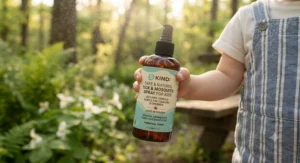
6. California Baby Natural Bug Spray — plant-based pick for sensitive skin
For parents who want to avoid synthetic actives entirely, California Baby’s spray uses a blend of citronella, lemongrass, and cedar essential oils in an aloe and carnauba wax base, and it’s approved by the brand for children 6 months and older. Here’s the honest trade-off reviewers and regulators alike point to: citronella-based repellents work primarily through scent-masking rather than the receptor-blocking mechanism icaridin uses, so effectiveness typically holds for roughly 30 to 60 minutes before it needs reapplying — a real limitation for anything longer than quick backyard play. It’s also worth knowing that Health Canada’s Pest Management Regulatory Agency has previously reviewed citronella-based repellents for data gaps around sustained skin-applied use, which is a useful thing to know before assuming “plant-based” automatically means “equally effective and fully resolved from a regulatory standpoint.” The brand describes this formula as pediatrician recommended in its own marketing; we haven’t independently verified that specific claim, so treat it as a manufacturer statement rather than a third-party endorsement. Aggregated customer sentiment for this product tends to favour the scent profile heavily, with citronella-sensitive skin reactions coming up occasionally in review threads.
Pros:
- ✅ Fully plant-based active ingredients with no synthetic actives
- ✅ Pleasant citronella and lemongrass scent reported by users
- ✅ Approved by the brand for children 6 months and up
Cons:
- ❌ Short 30–60 minute effective window needs frequent reapplication
- ❌ Citronella-based repellents face known regulatory data gaps
Expect a price somewhere in the C$14–C$24 range depending on bottle size, which puts it at a premium relative to its actual protection duration — a fair trade only if avoiding synthetic actives is your top priority.
7. Babyganics Natural Insect Repellent — lightest-scent plant-based option for quick outings
Babyganics takes a similar plant-based approach to California Baby, using a soybean oil carrier blended with small percentages of rosemary, citronella, geranium, cedarwood, peppermint, and lemongrass oils, and the brand states it shouldn’t be applied to children under 6 months. What most buyers overlook here is that soybean oil at 2% is itself one of the active ingredients Health Canada recognizes in registered repellents, though Babyganics’ formula uses soybean oil predominantly as a carrier rather than at that specific registered concentration — so it’s worth checking the Canadian product label for its actual PMRA registration number rather than assuming U.S. packaging claims transfer directly. Based on the spec comparison with other essential-oil blends, this formula reads as one of the lighter-scented, less “herbal” smelling options for parents whose toddlers protest strongly against strong fragrances. Aggregated reviews tend to describe it as pleasant to use and non-greasy, with the most common complaint being that reapplication needs to happen more often than parents initially expect, consistent with how short-duration essential oil blends generally perform.
Pros:
- ✅ Lighter scent profile than many other essential-oil-based sprays
- ✅ Non-greasy formula that’s easy to apply to squirmy toddlers
- ✅ Free of parabens, sulfates, and artificial fragrances or dyes
Cons:
- ❌ Requires frequent reapplication, similar to other plant-based options
- ❌ Canadian PMRA registration status should be confirmed on the label
Babyganics typically sits in the C$12–C$18 range, making it a comparably priced alternative to California Baby for families who prioritize a lighter scent.
The Full Lineup: Specs, Price Range, and Best Use
| Product | Format & Size | Price Range (CAD) | Best For |
|---|---|---|---|
| Watkins DEET-Free Insect Repellent Pump Spray | Pump, 100 mL | C$15–C$19 | First-time icaridin users |
| OFF! Gentle DEET-Free Insect Repellent Spray | Spray, 142 g | C$8–C$12 | Short outings, gentler formula |
| Natrapel Icaridin Insect Repellent | Pump/Eco-Spray, 100 mL–170 g | C$13–C$20 | All-day cottage protection |
| PiActive Insect Repellent Pump Spray | Pump, 175 mL | C$13–C$18 | Camping families |
| Sawyer Picaridin Insect Repellent | Pump, ~3 oz | C$18–C$25 | Travel and hiking |
| California Baby Natural Bug Spray | Spray, 59–192 mL | C$14–C$24 | Sensitive skin, short play |
| Babyganics Natural Insect Repellent | Spray, ~177 mL | C$12–C$18 | Light-scent plant-based pick |
The clearest split in this table is between the icaridin sprays and the plant-based pair: Sawyer Picaridin Insect Repellent and Natrapel Icaridin Insect Repellent cost more per bottle but deliver roughly double the reapplication interval of California Baby Natural Bug Spray and Babyganics Natural Insect Repellent, which can actually make the pricier options cheaper per hour of protection over a long day outdoors. Budget-focused parents doing short, frequent outings may still come out ahead with OFF! Gentle DEET-Free Insect Repellent Spray, simply because its lower per-bottle cost matches its shorter, lower-commitment use case.
Practical Usage Guide: Applying DEET-Free Repellent the Right Way
Getting the chemistry right doesn’t help much if the application is sloppy, so here’s what actually changes the outcome. Spray into your own hands first rather than directly onto your toddler’s face — this avoids eye and mouth contact and gives you control over how much lands where. Apply only to exposed skin, never underneath clothing, and skip cuts, rashes, or sunburned patches entirely, since broken skin absorbs more of any active ingredient. If you’re also using sunscreen, apply that first and let it absorb before adding repellent on top; combination sunscreen-repellent products are generally discouraged because sunscreen needs reapplying far more often than repellent does, and doubling up wastes product and oversprays your toddler.
A common first-30-days mistake is over-application, assuming more spray means more protection — it doesn’t, and it just increases the odds of skin irritation or eye contact during a face-touching toddler moment. Wash treated skin with soap and water once you’re back indoors for the evening, rather than leaving repellent on overnight. For plant-based sprays specifically, set a phone timer for 30 to 45 minutes as a reapplication reminder, since these formulas fade faster than their icaridin counterparts and it’s easy to lose track of time at a busy playground.
✨ Ready to stock up before your next trip outside? Compare current prices on today’s pick above and grab it before you head out the door!
Real-World Scenarios: Which DEET-Free Spray Fits Your Family
The weekend cottage family: If your summers involve full days by the lake with mosquitoes showing up hard at dusk, a 20% icaridin spray like Natrapel Icaridin Insect Repellent or PiActive Insect Repellent Pump Spray makes the most sense — the 12-hour window means you’re not reapplying mid-swim, and the built-in gear on PiActive is genuinely useful if you’re also managing a tent and camp kitchen.
The city parent doing an hour at the playground after daycare: For short, frequent outdoor bursts, a lighter option like OFF! Gentle DEET-Free Insect Repellent Spray or Babyganics Natural Insect Repellent fits better, since you’re not paying for 12 hours of protection you won’t use, and the lighter scent is easier on a toddler headed straight into a car seat afterward.
The eczema-prone or reaction-sensitive toddler: Families managing sensitive or eczema-prone skin often do better starting with a smaller-format spray like Watkins DEET-Free Insect Repellent Pump Spray or California Baby Natural Bug Spray, applying a small patch test on the inner arm first and watching for 24 hours before full application, regardless of what the bottle claims about gentleness.
How to Choose a DEET-Free Bug Spray for Toddlers
Choosing the right DEET-free bug spray for toddlers comes down to a handful of practical checks rather than brand loyalty. Here’s the order most paediatric and public health sources recommend working through:
- Confirm the minimum age on the specific bottle. Most icaridin and plant-based sprays in this guide list 6 months as the minimum, but always check the label in front of you, since formulations and warnings can change between package sizes.
- Match the concentration to your trip length. A 20% icaridin spray suits a full day outdoors; a 10% formula or plant-based option is plenty for a short walk or backyard play session.
- Check for a Pest Control Products (PCP) registration number on the label. This confirms PMRA review under Health Canada, which matters more than marketing language like “natural” or “gentle.”
- Consider your toddler’s skin sensitivity. If they react to new lotions or soaps easily, patch-test any new repellent, DEET-free or not, on a small area first.
- Decide if scent matters for your household. Unscented icaridin sprays suit toddlers who protest strong smells; citronella and essential-oil blends suit families avoiding synthetic actives.
- Factor in bottle format. Pump sprays give more control for toddlers than aerosols, and locking caps reduce spill risk in a packed bag.
- Budget for reapplication frequency, not just bottle price. A cheaper bottle that needs reapplying every 30 minutes may cost more per outing than a pricier 12-hour spray.
Picaridin Bug Spray for Toddlers vs DEET vs Plant-Based
The core decision most Canadian parents are actually making isn’t “natural versus chemical” — it’s picaridin bug spray for toddlers versus DEET versus plant-based, and each has a genuinely different risk-and-performance profile worth understanding rather than assuming.
| Factor | DEET | Icaridin/Picaridin | Plant-Based (Citronella/Essential Oils) |
|---|---|---|---|
| Health Canada concentration cap for kids | 10% (ages 6mo–12yr) | 20% | No standard cap; varies by product |
| Typical protection window | Up to ~3–6 hrs at 10% | Up to 12 hrs at 20% | 30–60 minutes |
| Skin feel | Can feel greasy, distinct odour | Non-greasy, largely odourless | Pleasant scent, non-greasy |
| Damages plastics/fabrics | Yes, can affect sunglasses and synthetics | No | No |
| Best For | Situations needing maximum tick/mosquito protection | Everyday toddler use, all-day outings | Short outings, avoiding synthetic actives |
The table above makes the trade-off clear: DEET at its Health Canada-capped 10% concentration for young children actually protects for a shorter window than 20% icaridin, while also carrying the plastic-damage and skin-feel downsides icaridin avoids — which is exactly why so many Canadian parents have shifted toward picaridin bug spray for toddlers as their default rather than treating it as a lesser substitute. Plant-based options remain the gentlest on paper but demand a level of reapplication discipline that’s genuinely hard to maintain with a moving toddler, so they work best as a deliberate choice for short outings rather than an all-day solution.

Gentle Bug Spray for Babies: What Changes Under 6 Months
Everything in this guide assumes a toddler older than 6 months, and that age line isn’t arbitrary — it’s the point at which Health Canada’s guidance shifts from “use a barrier method only” to “a registered repellent may be used.” For babies younger than 6 months, no chemical repellent, including gentle bug spray for babies marketed as “natural,” is recommended by Health Canada or the Canadian Paediatric Society. Instead, the go-to approach is physical protection: fine-mesh netting over a stroller or bassinet, long-sleeved lightweight clothing, and avoiding peak mosquito hours around dawn and dusk. Netting should be snug enough that a baby can’t pull it into their sleep space, and it’s worth checking regularly that airflow isn’t restricted, especially on hot days.
Once your child crosses the 6-month mark, the icaridin sprays in this guide — Watkins DEET-Free Insect Repellent Pump Spray, OFF! Gentle DEET-Free Insect Repellent Spray, Natrapel Icaridin Insect Repellent, PiActive Insect Repellent Pump Spray, and Sawyer Picaridin Insect Repellent — become appropriate options, alongside plant-based picks like California Baby Natural Bug Spray and Babyganics Natural Insect Repellent. Even then, applying repellent to a young toddler’s hands is generally discouraged since hands frequently end up in mouths, so spray your own hands and pat it onto theirs instead.
Pediatrician-Recommended Insect Repellent: What the Canadian Paediatric Society Says
Looking for a genuinely pediatrician-recommended insect repellent approach rather than a marketing label means going to the source: the Canadian Paediatric Society, through its Caring for Kids resource, states that all active ingredients in insect repellents sold in Canada are reviewed by Health Canada’s PMRA before sale, and specifically lists icaridin as an approved option alongside DEET for children. The Society’s guidance doesn’t endorse individual brands — no legitimate paediatric body does — but it does offer a clear framework: icaridin up to 20% is considered safe for children, DEET should be capped and used sparingly in young children, and combination products marketed as sunscreen-plus-repellent should generally be avoided.
What’s useful about this framework for a parent standing in the bug spray aisle is that it removes the guesswork around “natural” claims. A product doesn’t need to say “pediatrician recommended” on the front label to actually meet the bar paediatric guidance sets — it needs a PMRA registration number and an ingredient your paediatrician would recognize, which every product in this guide provides. If in doubt about a specific product for your child’s situation, particularly if they have eczema, asthma, or another skin condition, a quick call to your paediatrician’s office beats relying on packaging claims alone.
PMRA Age Recommendations for DEET-Free Repellents
Health Canada’s PMRA age recommendations for icaridin, the active ingredient behind most of the DEET-free sprays in this guide, break down clearly by age band. Infants under 6 months should not use any chemical repellent, DEET-free or otherwise — physical barriers only. Children 6 months to 2 years can use icaridin, generally without the once-daily application cap that applies to DEET in the same age range, though label directions should always be followed exactly. Children 2 to 12 years have more flexibility, with icaridin generally permitted up to twice daily depending on the specific product’s directions. From age 12 onward, both DEET and icaridin can be used more liberally within label guidelines.
It’s worth repeating that these PMRA age recommendations apply to icaridin broadly, not to every plant-based product automatically — citronella and essential-oil blends don’t carry the same structured age-and-frequency framework because they’re regulated differently, which is part of why brands like California Baby Natural Bug Spray and Babyganics Natural Insect Repellent set their own 6-month minimums rather than pointing to a PMRA-defined dosing schedule. Reading the actual bottle in your hand, rather than assuming category-wide rules, remains the safest habit here.
Sensitive Skin Formulas: Avoiding Reactions
Toddler skin is thinner and more reactive than adult skin, which is why sensitive skin formulas matter even within the DEET-free category — “DEET-free” doesn’t automatically mean “irritation-free.” Icaridin has a strong safety record for skin tolerance and is generally considered less irritating than DEET, but any active ingredient, synthetic or plant-based, carries some risk of localized reaction in a small subset of kids. Essential oil blends, including the citronella, lemongrass, and geranium combinations found in California Baby Natural Bug Spray and Babyganics Natural Insect Repellent, can occasionally trigger contact irritation specifically because essential oils are more concentrated allergen sources than many parents assume — “plant-based” isn’t a synonym for “hypoallergenic.”
The practical fix is simple and often skipped: apply a small amount to your toddler’s inner forearm 24 hours before you plan to use any new repellent for a full outing, and watch for redness, bumps, or complaints of itching. Unscented icaridin formulas like PiActive Insect Repellent Pump Spray tend to be a safer starting point for kids with a history of skin sensitivity, simply because they contain fewer added fragrance compounds than essential-oil-based sprays.
Common Mistakes When Buying Bug Spray for Toddlers
A handful of buying mistakes show up repeatedly among Canadian parents shopping this category. The first is assuming “DEET-free” automatically means “weaker protection” — as the comparison table above shows, 20% icaridin actually out-protects the Health Canada-capped 10% DEET concentration allowed for young children, so the trade-off isn’t as steep as it sounds. The second is buying based on scent preference alone, without checking the actual active ingredient or concentration, which can leave you with a 30-minute plant-based spray when you needed 12 hours of coverage for a full day outdoors.
A third mistake is skipping the PCP registration number check entirely and trusting front-of-bottle language like “natural,” “gentle,” or “family safe,” none of which are regulated terms in the same way “icaridin 20%” or a PMRA registration number is. Finally, many parents buy a single bottle for the whole family without checking whether the concentration is appropriate for their youngest child — a 20% icaridin spray meant for a 10-year-old sibling may be more concentrated than necessary for a 2-year-old on a short outing, where a gentler option would do the job with less product overall.

Long-Term Cost & Value: Is DEET-Free Worth the Price Difference
DEET-free repellents, particularly icaridin sprays, do tend to cost more per bottle than a comparable DEET product, but the value calculation shifts once you factor in reapplication frequency and bottle life across a full Canadian summer.
| Product | Approx. Cost Per Bottle | Reapplications Needed for a Full Day Outdoors | Relative Value |
|---|---|---|---|
| Sawyer Picaridin Insect Repellent | C$18–C$25 | 0–1 | High for frequent all-day use |
| Natrapel Icaridin Insect Repellent | C$13–C$20 | 0–1 | High for cottage weekends |
| OFF! Gentle DEET-Free Insect Repellent Spray | C$8–C$12 | 1–2 | Good for short, occasional outings |
| California Baby Natural Bug Spray | C$14–C$24 | 4–8 | Lower for all-day use, fine for short play |
The math here favours the higher-concentration icaridin sprays for families who spend entire days outdoors regularly through the summer, since fewer reapplications mean the pricier bottle actually stretches further per outing than its sticker price suggests. For occasional, short-duration use — a walk to the park, an hour in the backyard — the lower upfront cost of OFF! Gentle DEET-Free Insect Repellent Spray or a plant-based option remains the more sensible long-term spend, since you’re not paying for protection hours you won’t use.

Frequently Asked Questions
❓ What is the best DEET-free bug spray for toddlers in Canada?
❓ Is picaridin bug spray for toddlers safer than DEET?
❓ Can I use any bug spray on a baby under 6 months old?
❓ How often can I reapply DEET-free bug spray on a toddler?
❓ Do natural or plant-based bug sprays actually work on toddlers?
Conclusion
Choosing a DEET-free bug spray for toddlers doesn’t have to mean guessing between vague “natural” claims and unfamiliar chemical names. Once you know that icaridin carries the strongest combination of Health Canada review, skin tolerability, and long-lasting protection, and that plant-based options trade duration for a scent and ingredient profile some families prefer, the seven picks in this guide cover nearly every realistic scenario a Canadian parent will run into this summer. For long cottage days, Natrapel Icaridin Insect Repellent, PiActive Insect Repellent Pump Spray, and Sawyer Picaridin Insect Repellent carry you through with minimal reapplication. For shorter outings or sensitive skin, OFF! Gentle DEET-Free Insect Repellent Spray, California Baby Natural Bug Spray, and Babyganics Natural Insect Repellent offer gentler entry points, and Watkins DEET-Free Insect Repellent Pump Spray remains a solid, affordable way to test icaridin for the first time.
Whichever bottle ends up in your diaper bag, the fundamentals matter more than the brand: check the label for a PMRA registration number, respect the 6-month age minimum, patch-test if your toddler has sensitive skin, and match the protection window to how long you’ll actually be outside. Using insect repellent alongside basic precautions like avoiding peak mosquito hours rounds out a genuinely effective, evidence-based approach to keeping your toddler bite-free this season.
✨ Ready to pick your bottle for the summer? Check today’s prices on the option that fits your family’s next trip outdoors! 🦟🌿
Recommended for You
- 7 Best Picaridin Bug Spray Picks for Canada in 2026
- 7 Best Paddle Leashes for Canoe Fishing in 2026: Buyer’s Guide
- Best Canoe Seat Cushion for Comfort: 7 Top Picks (2026)
Disclaimer: This article contains affiliate links. As an Amazon Associate, I earn from qualifying purchases. If you purchase products through these links, we may earn a small commission at no additional cost to you.
✨ Found this helpful? Share it with another parent who’s dreading mosquito season! 💬🤗
