
In This Article
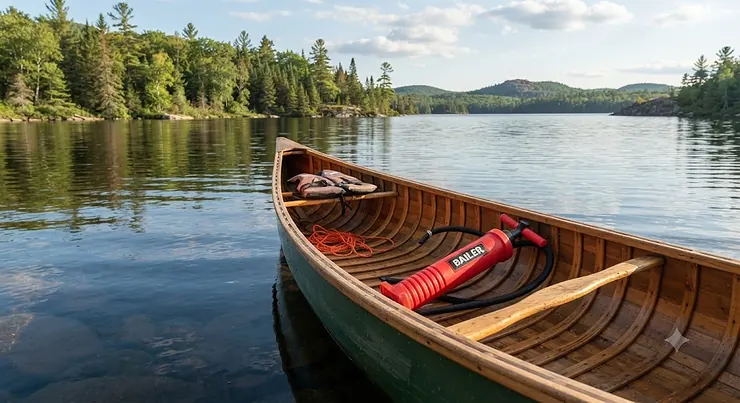
There’s a very specific sound a canoe makes when it starts taking on water — a soft slosh that turns into a rhythmic gulp with every stroke. If you’ve heard it, you already know why a bailing pump for canoe use isn’t some optional accessory you toss in with the sunscreen and bug spray. It’s the difference between “well, that was exciting” and a genuinely bad afternoon on a Canadian lake. Rain squalls roll in fast on places like Georgian Bay and the boundary lakes of Quetico, wakes from passing powerboats slap over low gunwales, and even a routine put-in can leave an inch of water pooling under your feet before you’ve paddled a hundred metres. A good bailer or hand pump turns that slow creep of water into a non-event. This guide breaks down seven real, currently available options — from simple hand pumps to a dedicated bailing sponge for kayak and canoe use — with honest analysis based on published specs and aggregated review sentiment, not marketing copy. We’ll also dig into the bilge pump vs hand pump debate, walk through swamped canoe recovery step by step, and talk about what changes when storm and rough water paddling turns from theory into your actual Tuesday evening. Every price mentioned below is a range in Canadian dollars, since exact Amazon pricing shifts constantly — always check the current listing before you buy.
Quick Comparison Table: Bailing Pumps for Canoe at a Glance
| Product | Type | Flow / Capacity | Price Range (CAD) | Best For |
|---|---|---|---|---|
| Beckson Thirsty-Mate 18″ Manual Pump | Manual hand pump | ~8 GPM | C$45-C$60 | Narrow hulls, reliability |
| Better Boat Manual Bilge Pump (39″ hose) | Siphon hand pump | ~20 GPM | C$25-C$35 | Budget-conscious paddlers |
| HIKULA Manual Bilge Pump | Siphon hand pump | Medium flow | C$25-C$35 | Compact storage |
| Attwood Manual Bilge Pump | Manual hand pump | Medium-high flow | C$35-C$50 | Trusted brand, family trips |
| SeaSense Hand Bilge Pump | Self-priming manual | Medium flow | C$25-C$35 | First-time buyers |
| Seattle Sports Paddler’s Bilge Pump | Manual hand pump | High flow | C$35-C$50 | Whitewater and rough water |
| Skwoosh Bilge Sponge | Bailing sponge | ~32 oz absorption | C$15-C$25 | Backup and fine cleanup |
Look at that spread for a second, because it tells a story. On one end you’ve got a sponge that costs less than a movie ticket and does one thing beautifully — soaking up the last inch of water a pump can’t reach. On the other end sits the Seattle Sports Paddler’s Bilge Pump, built for the kind of moment where you need gallons gone in seconds, not ounces mopped up over a lazy afternoon. The middle of the table — the Better Boat, HIKULA, and SeaSense pumps — is where most recreational canoeists actually live, trading a bit of raw output for a price that doesn’t sting. None of these numbers should be read as guarantees; actual flow rates depend on stroke rate, hose kinks, and how tired your arm is twenty minutes into a downpour.
💬 Just one click — help others make better buying decisions too!😊
Top 7 Bailing Pumps for Canoe: Expert Analysis
1. Beckson Thirsty-Mate 18″ Manual Pump — narrowest profile for tight hulls
The Beckson Thirsty-Mate carves out its niche with a slim, self-priming design that reaches into bilge spaces other pumps simply can’t fit into. That narrow profile matters more than it sounds: canoe hulls taper toward the bow and stern, and a bulky pump body just can’t chase water into that last low pocket. Built from ABS plastic with a tee-handle grip, it’s rated around 8 gallons per minute on paper, though real-world output depends heavily on how fast you’re stroking. Based on the spec comparison with wider hand pumps, this one trades outright volume for reach and durability — a fair trade for solo trippers who value gear that won’t crack after a season of freeze-thaw storage in a garage. Reviewers consistently note that the foot valve is easy to remove and clean when it picks up sand or grit, which matters on rocky Canadian Shield put-ins. A separate foam float sleeve is sold to keep it from sinking if it slips overboard, and buyers who skip that accessory often mention losing an earlier pump this way. What most buyers overlook is that the base model ships without a hose, so you’re pumping water directly over the gunwale rather than routing it away from your gear — worth factoring into the price when comparing listings.
Pros:
- ✅ Slim profile reaches narrow bilge pockets other pumps miss
- ✅ Self-priming, no hose needed for basic use
- ✅ Foot valve disassembles easily for cleaning
Cons:
- ❌ Base version has no discharge hose included
- ❌ Lower flow rate than wider-bore competitors
At around C$45-C$60, the Beckson Thirsty-Mate sits mid-pack on price, and the value case rests almost entirely on longevity — this is a pump built to survive years of seasonal use rather than a single trip.
2. Better Boat Manual Bilge Pump (39″ Hose) — best budget siphon for casual paddlers
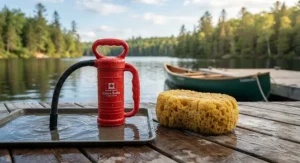
The Better Boat Manual Bilge Pump leans into simplicity: a hand-operated siphon design with a 39-inch hose that routes water well clear of your feet and gear bags. That extra hose length is the standout feature here, and it’s genuinely useful on a canoe where the paddler is often sitting or kneeling low, close to the water pooling around them. Rated for roughly 20 gallons per minute of suction, the marine-grade plastic construction is built to float if dropped, a small but sensible detail for anyone who’s ever fumbled gear mid-paddle-stroke. On paper, this puts it ahead of narrower pumps for raw speed, though the trade-off is a bulkier body that takes up more pack space. Here’s what to weigh: this is squarely a fair-weather and occasional-splash tool rather than a storm-day workhorse, and aggregated buyer feedback tends to praise the price-to-performance ratio while flagging that the plastic fittings feel less robust than metal-reinforced alternatives. For weekend cottage paddlers and family canoe outings where the worst-case scenario is a rain shower rather than open-water swells, it covers the job without overspending.
Pros:
- ✅ Long 39-inch hose keeps water away from gear
- ✅ High rated suction for the price point
- ✅ Floats if accidentally dropped overboard
Cons:
- ❌ Plastic fittings feel less durable long-term
- ❌ Bulkier to store than slimmer pump designs
Priced around C$25-C$35, this is one of the lowest-cost pumps in this roundup, and for casual lake paddling it delivers real value without asking you to spend on features you won’t use.
3. HIKULA Manual Bilge Pump — best compact option for tight storage
The HIKULA Manual Bilge Pump is built around a 17-inch medium body with a reversible hose, and that reversibility is the detail worth pausing on — you can route the discharge either direction depending on how you’ve packed the canoe that day. Aggregated spec sheets put this in the same general flow-rate territory as other hand-siphon designs, but the shorter overall length means it tucks into a day bag or a canoe’s centre thwart bag far more easily than longer pumps. What the spec sheet won’t tell you, but reviewers note, is that the shorter handle stroke means more pumps-per-litre compared to longer-bodied competitors, so clearing a significant swamping takes noticeably more arm effort. That’s a reasonable trade for paddlers who prioritize pack weight and space over raw speed — think canoe-tripping into backcountry sites where every cubic inch in the barrel pack is contested. Based on the spec comparison with the Better Boat pump above, the HIKULA sacrifices some hose length for a smaller footprint, which suits solo and ultralight trippers better than families managing a loaded three-person canoe.
Pros:
- ✅ Compact 17-inch body saves pack space
- ✅ Reversible hose adapts to your seating setup
- ✅ Portable siphon design, easy one-hand operation
Cons:
- ❌ Shorter stroke means more effort for large volumes
- ❌ Yellow colourway can be harder to spot in low light
In the C$25-C$35 range, it competes directly with the Better Boat pump on price; the choice between them mostly comes down to whether pack space or hose length matters more for your trip style.
4. Attwood Manual Bilge Pump (24″ with 32″ Hose) — best trusted-brand pick for families
Attwood is a name that shows up constantly in Canadian marine supply stores, and that brand recognition isn’t accidental — the company has built manual and electric bilge pumps for small craft for decades. This 24-inch model ships with a 32-inch hose, giving you enough reach to discharge water over a raised gunwale or past a loaded gear pile without repositioning constantly. Based on the spec comparison with shorter pumps in this list, the longer body typically means a longer stroke and more water moved per pump cycle, which translates to real time saved when you’re bailing out a genuinely swamped canoe rather than just a splashy afternoon. Reviewers consistently report solid build quality and describe the pump surviving multiple seasons of lake use without cracking, a meaningful data point given how many cheaper plastic pumps get tossed after one winter of improper storage. What most buyers overlook is that the longer hose can kink if coiled too tightly in a dry bag, reducing flow until it’s straightened out — worth a quick check before you actually need the pump in an emergency. For family canoe trips where an adult is doing the bailing while kids and gear stay put, the extra reach and stroke volume genuinely matter.
Pros:
- ✅ Established marine brand with strong track record
- ✅ Longer stroke moves more water per pump
- ✅ 32-inch hose reaches over loaded gunwales
Cons:
- ❌ Hose can kink if packed too tightly
- ❌ Larger footprint than compact competitors
Sitting around C$35-C$50, the Attwood pump asks a modest premium over budget siphon pumps, and the brand consistency and stroke volume make a reasonable case for that extra cost on longer or more frequent trips.
5. SeaSense Hand Bilge Pump — best entry point for first-time buyers
The SeaSense Hand Bilge Pump has built a reputation as an accessible, no-frills entry into manual bailing, and its self-priming design means you’re not fumbling with priming steps mid-paddle when seconds count. Marketed for small boats, kayaks, and canoes alike, the versatility here comes from a simple, general-purpose build rather than any single standout spec. On paper, its flow rate lands in the same middle tier as the Better Boat and HIKULA pumps, but aggregated review sentiment points to consistent satisfaction among buyers who wanted “something that just works” rather than a purpose-built whitewater tool. Here’s what to weigh: this pump doesn’t try to be the fastest or the most compact option on this list, and that’s arguably its strength — it’s the pump most likely to sit forgotten in a gear bag for a year and still function perfectly when you finally need it, which is exactly the kind of reliability recreational paddlers actually want. For someone buying their first bailer after a scary splash on a windy lake, this is a sensible, low-risk starting point.
Pros:
- ✅ Self-priming, ready to use immediately
- ✅ Works across kayaks, canoes, and small boats
- ✅ Strong aggregate satisfaction among first-time buyers
Cons:
- ❌ No standout speed or capacity advantage
- ❌ Basic hose quality compared to premium models
At roughly C$25-C$35, it’s priced to compete directly with other budget pumps, and for a first purchase, the low financial risk paired with dependable aggregated feedback makes it an easy recommendation.
6. Seattle Sports Paddler’s Bilge Pump — best for storm and rough water paddling
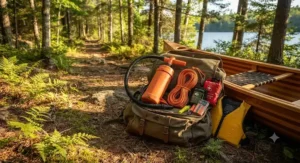
When conditions turn — wind kicking up whitecaps, a following sea slapping over the stern — the Seattle Sports Paddler’s Bilge Pump is the one built for that moment. Its standout feature is a super-comfortable, easy-grip rubber over-molded handle paired with a high-visibility neon green body, a detail that matters far more than it sounds like on paper: a pump you can find instantly in a swamped, chaotic cockpit or canoe bottom is a pump that actually gets used in an emergency, rather than one you’re groping for under grey floor water. Based on the spec comparison with simpler siphon pumps, the reinforced handle and body construction are clearly engineered for repeated, high-pressure use rather than occasional light bailing. It doesn’t include a hose by default, though the output valve accepts a 1-inch internal diameter hose if you want to route water further from your gear. Reviewers and paddling-safety guides consistently describe this as close to a necessity for anyone paddling exposed water, sea kayak routes, or Canadian Shield lakes known for fast-building afternoon squalls. This is precisely the product category referenced in storm and rough water paddling planning — the pump you want mounted and ready before conditions deteriorate, not dug out of a dry bag after the fact.
Pros:
- ✅ High-visibility body easy to spot in a swamped hull
- ✅ Comfortable rubber grip for sustained emergency pumping
- ✅ Reinforced build for repeated hard use
Cons:
- ❌ No hose included by default
- ❌ Higher price than basic siphon pumps
Expect a price range around C$35-C$50; for anyone regularly paddling open water, whitewater, or coastal routes, the added visibility and durability justify sitting near the top of this list on capability rather than budget.
7. Skwoosh Bilge Sponge — best bailing sponge for kayak and canoe cleanup
Not every job calls for a pump, and that’s where the Skwoosh Bilge Sponge earns its spot on this list. Measuring roughly 8.5 by 5 by 2 inches with a 100% viscose cover, it’s designed to soak up over 32 ounces of water — genuinely useful for the last stubborn puddle that pools under a seat where no pump nozzle can reach. Its standout feature is a quick-drying design that resists the mildew smell cheap kitchen sponges develop after a few humid trips in a dry bag. Based on the spec comparison with mechanical pumps, a sponge obviously can’t compete on volume or speed against a genuinely swamped canoe, but that’s not really the point of a bailing sponge for kayak or canoe use — it’s a finishing tool, not a rescue tool. Reviewers consistently describe it as the accessory they didn’t know they needed until their pump left an inch of water sitting in the hull. Made in the USA and available in a couple of colourways, it’s lightweight enough that leaving it in permanently costs you nothing in pack weight. Pair it with any of the pumps above rather than choosing one or the other — that combination genuinely covers both ends of the bailing job.
Pros:
- ✅ Absorbs standing water pumps can’t fully clear
- ✅ Quick-drying, resists lingering odour
- ✅ Negligible pack weight, easy to store permanently
Cons:
- ❌ Useless against large-volume swamping alone
- ❌ Needs regular rinsing to maintain absorbency
At around C$15-C$25, this is the cheapest item on the list and arguably the best value-per-dollar addition, precisely because it’s designed to complement a pump rather than replace one.
Practical Usage Guide: Setting Up and Using Your Bailing Pump
Getting a new bailer home is only half the job — how you set it up determines whether it actually works when you need it. Start by dry-testing every pump before your first real trip: prime it in a bucket of water at home, confirm the foot valve seats properly, and check that any included hose doesn’t kink at the fittings. Canoeists who skip this step are consistently the ones surprised when a pump underperforms mid-trip, because a sticky valve or a folded hose can quietly cut flow rate in half. Once on the water, secure your pump with a short leash or carabiner clipped to a thwart — a pump that slides to the bottom of a lake during a capsize does you no good during the recovery that follows. For maintenance, rinse hand pumps in fresh water after every trip involving sand, mud, or salt, since grit is the number one cause of premature valve wear based on aggregated review complaints across nearly every model in this roundup. Store pumps loosely coiled rather than tightly wound to prevent hose memory-kinking over winter storage, and periodically pump a few strokes of clean water through the mechanism even during off-season storage to keep seals from drying out. A common first-30-days mistake is assuming a pump needs no attention until it fails — a two-minute check before each trip catches 90 percent of problems before they become on-water emergencies.
Real-World Scenarios: Matching the Bailer to Your Paddling Style
The cottage weekend paddler: You’re taking the canoe out for calm-morning fishing trips and the occasional light rain shower on a sheltered lake. A budget siphon pump like the Better Boat Manual Bilge Pump or the SeaSense Hand Bilge Pump, backed up by the Skwoosh Bilge Sponge for final cleanup, covers this use case completely without overspending on capability you won’t use.
The backcountry tripper: Multi-day routes through Algonquin or the Boundary Waters mean every gram in your pack matters, and portages test how compactly your gear stows. The HIKULA Manual Bilge Pump‘s smaller footprint suits this profile, especially paired with the sponge for lightweight, dual-purpose bailing that doesn’t eat into limited pack space.
The open-water and whitewater paddler: Exposed lake crossings, fast-building squalls, and technical river sections mean swamping is a real possibility rather than a hypothetical. This is exactly where the Seattle Sports Paddler’s Bilge Pump earns its keep, alongside the higher-capacity Attwood Manual Bilge Pump as a secondary or shared-canoe option for family or group trips carrying more gear and more risk exposure.
Problem → Solution: Common Bailing and Swamping Issues
Problem: Water pools faster than you can bail by hand. A cupped hand or improvised bailer moves only a fraction of what a purpose-built pump can. Solution: carry a manual pump rated for at least 15-20 GPM, such as the Attwood Manual Bilge Pump, and practise using it before you actually need it under pressure.
Problem: Your pump clogs with sand or debris. Rocky Canadian Shield put-ins are notorious for this. Solution: choose a model with an easily removable foot valve, like the Beckson Thirsty-Mate, and rinse it after every trip on grit-heavy shorelines.
Problem: The last inch of water won’t come up through the pump. Most hand pumps can’t fully empty a hull down to bare fibreglass or aluminum. Solution: finish the job with a Skwoosh Bilge Sponge, which handles the shallow residual water pumps physically can’t draw.
Problem: You can’t find your pump in a swamped, chaotic hull. Dark-coloured pumps disappear against wet gear and grey water. Solution: choose a high-visibility model like the Seattle Sports Paddler’s Bilge Pump, or add reflective tape to any darker pump you already own.
Problem: Your pump was working fine last summer and now barely moves water. Dried-out seals or a kinked hose from tight winter storage are the usual culprits. Solution: run fresh water through the mechanism a few times each spring before your first trip, and store hoses loosely coiled.

How to Choose a Bailing Pump for Canoe
- Match capacity to your worst realistic scenario — a calm-lake paddler needs far less GPM than someone crossing open water where a genuine swamping is possible.
- Check for hose length and routing — a longer hose keeps discharge water away from packs and dry bags, which matters more than raw flow rate on a loaded canoe.
- Prioritize a removable, cleanable foot valve — sand and grit are the leading cause of pump failure based on aggregated review complaints across every budget tier.
- Consider visibility — a bright pump body is easier to locate during an actual emergency than a dark one buried under gear.
- Weigh pack space against capacity — backcountry trippers should lean compact, while car-camping or cottage paddlers can afford a bulkier, higher-output pump.
- Add a sponge regardless of which pump you choose — no hand pump fully clears standing water, and a Skwoosh Bilge Sponge or equivalent finishes the job for a few extra dollars.
- Factor in your province’s equipment rules — a bailing device is a federal safety requirement for paddle craft in Canada, so buying one isn’t optional if you want to stay compliant, a point covered in more detail in the Transport Canada Safe Boating Guide.
Bilge Pump vs Hand Pump: Which Wins for Canoeing?
The bilge pump vs hand pump question sounds like it should have a clean answer, but for canoes specifically, it mostly doesn’t — because “bilge pump” on the water almost always means an electric, battery-powered unit designed for boats with a hull cavity to mount one in, while a “hand pump” is the manual, muscle-powered tool most canoeists actually carry. Electric bilge pumps like the 12-volt units common on larger powerboats move impressive volumes automatically, but they need a permanent mounting point, wiring, and a battery — none of which a typical open canoe has room or need for. On paper, that makes the comparison lopsided for paddle craft: a manual hand pump wins almost every practical category for canoeing, since it requires no power source, works instantly after a capsize with cold, wet hands, and weighs a fraction of an electric setup with its battery and wiring. Where electric bilge pumps do make sense is on larger canoes rigged for extended expedition use with a sealed battery box, or on companion support boats running alongside a canoe group. For the overwhelming majority of recreational and even backcountry canoeists, though, a quality manual pump like the Attwood Manual Bilge Pump or the Beckson Thirsty-Mate does everything an electric bilge pump would, without the added weight, cost, or failure points that come with batteries and wiring in a wet environment.
Bailing Sponge for Kayak vs Bailing Pump for Canoe
It’s tempting to treat a bailing sponge for kayak and canoe use as a lesser, budget substitute for a pump, but that framing misses how each tool actually performs. A pump excels at moving large volumes fast — genuinely useful the moment a wave comes over the gunwale or a canoe takes on serious water after a capsize. A sponge, by contrast, can’t move more than roughly a quart at a time before it needs wringing out, making it hopeless against a real swamping on its own. What most buyers overlook is that a sponge does something no hand pump can: it reaches flush against the hull floor and soaks up the thin residual film of water a pump’s intake simply can’t draw, since every pump needs a minimum water depth to prime and pull. For kayakers specifically, where cockpit space is tight and a full-size pump can be awkward to manoeuvre one-handed while bracing a paddle, a sponge like the Skwoosh Bilge Sponge often gets reached for first for routine splash management, with the pump reserved for anything more serious. The honest answer, based on how each tool is actually built and reviewed, is that these aren’t competing products — they’re complementary ones, and most experienced paddlers carry both rather than choosing one over the other.
Storm and Rough Water Paddling: Bailing Under Pressure
Storm and rough water paddling changes the entire calculus around bailing gear, because the assumptions that hold on a calm afternoon — you have time, you have both hands free, you can see clearly — stop applying the moment wind and waves pick up. In these conditions, a pump needs to be reachable one-handed, ideally clipped somewhere you can grab it without looking, since visibility often drops along with the weather. This is precisely why high-visibility, ergonomic designs like the Seattle Sports Paddler’s Bilge Pump earn their premium over basic siphon models — a comfortable, over-molded grip matters enormously when your hands are cold, wet, and shaking with adrenaline. Practically, experienced paddlers recommend keeping the bow or stern pointed into oncoming waves while bailing, since a beam-on position in rough water dramatically increases the chance of a second capsize mid-recovery. Pump in short, controlled bursts rather than frantic continuous strokes — panic-pumping tends to introduce air into the mechanism and actually reduces flow. If conditions are deteriorating and water is coming in faster than you can remove it, prioritize getting to shore or a lee shoreline over fully bailing first; a partially swamped, stable canoe moving toward safety beats a dry canoe pinned in place by worsening weather. The Canadian Red Cross’s long-running research on immersion deaths consistently identifies rough water and wind as major contributing factors in boating fatalities, which is part of why checking conditions before departure matters as much as any gear choice — see the Canadian Red Cross drowning research for the full picture.
Swamped Canoe Recovery: What to Do When You Go Over
Swamped canoe recovery follows a fairly consistent sequence regardless of where in Canada you’re paddling, and knowing it before you need it is the whole point of practising in calm water first. First, account for every person in the canoe — check for injuries, confirm everyone has a secured PFD, and only then turn attention to the boat itself; people always come before gear. Second, if the canoe is inverted, swim it upright by pushing down on one gunwale from underneath, keeping your body low and using buoyancy rather than brute strength. Third, stabilize the swamped hull — a solo paddler can often re-enter over the centreline using a kick-and-pull motion, while a partner can hold the opposite gunwale steady during re-entry; a loaded canoe is measurably harder to right and drain than an empty one, so expect more effort with gear aboard. Fourth, once back aboard or alongside, this is where your bailing pump for canoe use earns its keep — clear the bulk of the water with steady pumping, keeping the bow pointed into any waves for stability, then finish the last shallow film with a sponge if you’re carrying one. Finally, reassess before continuing: check that gear is still secured, confirm nobody is showing signs of cold-water shock, and only resume paddling once the canoe feels stable underfoot. Practising this whole sequence in a controlled, warm-water setting before you ever need it in real conditions is standard advice across Canadian paddling safety courses, and it’s the single biggest factor in turning a capsize from a crisis into a manageable inconvenience.
Common Mistakes When Buying a Bailing Pump for Canoe
The single most common mistake is buying based on price alone and ending up with a pump so slow it’s functionally useless in an actual emergency — a C$15 pump that moves a trickle of water isn’t cheaper than a C$40 pump that actually clears a swamped hull, it’s just a different way of spending money on gear you can’t rely on. A close second is skipping the sponge entirely, assuming a pump alone finishes the job; based on how pump intakes are designed, none of them fully clear standing water, so pairing a pump with a Skwoosh Bilge Sponge or similar consistently outperforms either tool alone. Buyers also frequently overlook hose length until they’re standing knee-deep discharging water directly onto their own packed gear — checking hose specs before purchase avoids this entirely. Another recurring issue is buying a pump and never test-priming it before the first real trip, only to discover a sticky valve or manufacturing defect at the worst possible moment. Finally, some paddlers assume any bucket or improvised container satisfies Transport Canada’s bailing device requirement; while technically a bucket can qualify, a purpose-built pump or sponge is dramatically more effective and arguably the safer choice regardless of what satisfies the letter of the regulation.
Long-Term Cost & Maintenance
Looking at total cost of ownership rather than sticker price changes the calculus on several of these products. A budget siphon pump in the C$25-C$35 range that needs replacing every season or two due to cracked plastic fittings can end up costing more over five years than a single C$50 Attwood Manual Bilge Pump built to survive repeated seasonal use. Maintenance costs are minimal across the board — a rinse after sandy trips and occasional fresh-water priming during storage — but neglecting even that basic upkeep is the leading cause of premature failure based on aggregated review complaints across every product in this roundup. Sponges have essentially no maintenance cost beyond periodic rinsing and air-drying, which is part of why pairing one with any pump remains the best value proposition in this entire category: for roughly C$15-C$25 once, you add years of finishing-touch bailing capability that a pump alone can’t replicate. When budgeting for a canoe trip’s safety gear, treating your bailing pump for canoe use as a multi-year investment rather than a disposable accessory tends to produce better outcomes and, ultimately, lower total spending.
Safety, Regulations & Compliance Guide
Federal regulations in Canada require paddle craft, including canoes and kayaks, to carry a bailing device alongside a properly sized personal flotation device, a sound-signalling device, a watertight flashlight, and a buoyant heaving line, as laid out under Transport Canada’s requirements for human-powered craft. A bailing device can technically be as simple as a bucket, but a dedicated pump or sponge is dramatically more effective in an actual emergency, which is really the point of the requirement in the first place — compliance on paper matters far less than whether the gear works when you need it. Beyond federal rules, always check provincial requirements too, since helmet, licensing, and age rules for paddle craft vary by province even though core safety equipment requirements are largely federal. Cold water adds another layer of risk that gear alone can’t fully offset: Canadian data consistently shows recreational boating deaths cluster heavily in cold or very cold water conditions, underscoring why dressing for water temperature, not air temperature, matters as much as carrying the right bailing equipment. For a full rundown of requirements and recommended practices before you launch, Transport Canada’s Safe Boating Guide remains the definitive Canadian reference, and it’s worth a read even for experienced paddlers who assume they already know the rules.
✨ Ready to gear up? Check current listings for any pump above and make sure you’re covered before your next launch! 🛶
Frequently Asked Questions
❓ Is a bailing pump required by law for canoes in Canada?
❓ What's the difference between a bilge pump and a hand pump for a canoe?
❓ Can I use a bailing sponge instead of a pump?
❓ How fast can a manual bilge pump clear a swamped canoe?
❓ Where should I store my canoe bailing pump while paddling?
Conclusion
There’s no single “best” bailing pump for canoe use — there’s only the right pump for your specific trips, paddling conditions, and how much pack space you’re willing to give up. Casual cottage paddlers do perfectly well with a budget siphon pump like the SeaSense Hand Bilge Pump, backed by a Skwoosh Bilge Sponge for the finishing touch, while anyone regularly facing open water, storms, or whitewater should lean toward a higher-capacity, high-visibility option like the Seattle Sports Paddler’s Bilge Pump. What matters more than which specific product you choose is that you actually carry one, test it before you need it, and understand the swamped canoe recovery sequence well enough to execute it calmly under pressure. Gear alone doesn’t prevent capsizes — good judgment about weather, water temperature, and load does that — but the right bailing tool is what turns an unavoidable splash of bad luck into a minor delay rather than a genuine emergency.
✨ Don’t Miss These Exclusive Deals!
🔍 Take your canoe safety kit to the next level with the pumps and sponges covered above. Click through to check current pricing and availability, and paddle out knowing you’re genuinely prepared. 🛶
Recommended for You
- Waterproof Whistle for Kayaking: 7 Top Picks for Canada (2026)
- Throw Bag for Canoe Rescue: 7 Life-Saving Picks for 2026
- Adult PFD vs Fishing PFD for Paddling: 7 Picks for 2026
Disclaimer: This article contains affiliate links. As an Amazon Associate, I earn from qualifying purchases. If you purchase products through these links, we may earn a small commission at no additional cost to you.
✨ Found this helpful? Share it with your fellow paddlers! 💬🛶
