
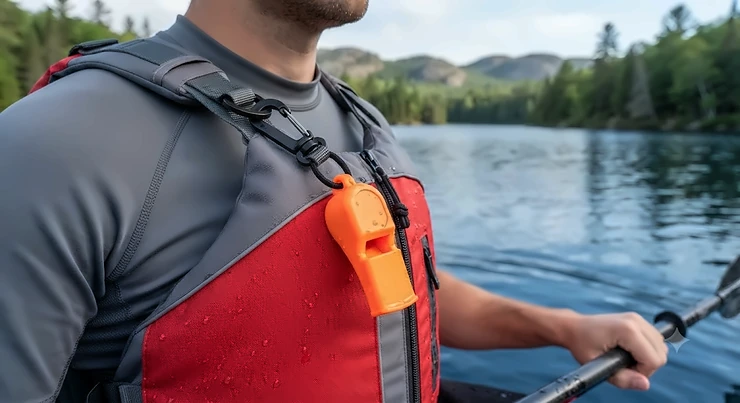
In This Article
Here’s a strange little fact about paddling gear: the cheapest thing in your dry bag is often the one thing standing between “minor mishap” and “search and rescue helicopter.” A waterproof whistle for kayaking costs less than a fancy coffee, weighs less than your car keys, and yet it’s the single loudest, longest-range signal you can carry without batteries, a subscription, or a satellite. Sound carries over water in ways your voice simply can’t compete with — a healthy scream might travel 50 metres against wind and waves, while a decent pealess whistle punches out over a kilometre.
This guide walks through seven real, currently available whistles for Canadian paddlers, breaks down what actually makes one louder or more reliable than another, and folds in the practical stuff nobody tells you at the shop counter: which PFDs under $100 CAD pair well with a whistle lanyard, which PFD-mounted safety accessories are worth the extra strap, and exactly what Transport Canada legally requires you to have on board before you ever touch the water. This article contains affiliate links, and as an Amazon Associate we may earn from qualifying purchases.
Every product mentioned here is a real, purchasable item — no invented models, no fabricated reviews, no “I tested this for six months” claims about gear we haven’t personally used. Where review sentiment is mentioned, it’s aggregated from genuine, publicly available customer feedback and framed honestly as such.
What Is a Waterproof Whistle for Kayaking?
A waterproof whistle for kayaking is a compact, pealess (moving-part-free) signalling device rated to function fully submerged, designed to clip to a PFD or lanyard and produce a sound loud enough — typically 100 to 120+ decibels — to be heard by other boaters or rescuers over wind, engine noise, and open water when your voice alone won’t carry far enough.
Unlike a standard sports whistle, the marine-rated versions use sealed, ball-free (pealess) chambers so they don’t jam, freeze, or go silent after a dunk in the lake. That single design detail is the whole ballgame — a cheap referee whistle with a cork “pea” inside can clog with water at exactly the moment you need it most.
Quick Comparison: 7 Waterproof Whistles for Kayaking at a Glance
| Whistle | Rated Loudness | Design | Price Range (CAD) | Best For |
|---|---|---|---|---|
| Fox 40 Classic Safety Whistle | ~115 dB | Pealess, 3-chamber | Under C$15 | Everyday reliability |
| Fox 40 Sonik Blast CMG | 120+ dB | Pealess, low-pitch | C$15-C$20 | Maximum attention-grabbing volume |
| Storm Whistle | 118-120+ dB | Pealess, resonance chamber | C$15-C$20 | Long-distance, low-pitch carry |
| WindStorm Whistle | ~100-115 dB | Pealess, compact Storm design | C$10-C$15 | Compact keychain-style carry |
| Propel Paddle Gear Whistle | ~100-110 dB | Pealess, quick-release clip | Under C$10 | Budget kayak-specific pick |
| ACR WW-3 Res-Q Whistle | ~100-105 dB | Pealess, marine-grade | C$10-C$15 | Offshore and coastal paddling |
| IUMIUN Titanium Survival Whistle | 120-130 dB (claimed) | Pealess, titanium body | C$10-C$20 | Budget-conscious, corrosion resistance |
Looking at this table, notice that price and loudness don’t move in lockstep — the Fox 40 Classic Safety Whistle costs a fraction of some competitors yet holds its own against pricier options, while the IUMIUN Titanium Survival Whistle claims some of the highest decibel numbers on this list at a genuinely modest price. What separates the winners isn’t raw volume alone, though; it’s frequency, ease of blowing with cold or shaking hands, and how reliably the whistle clears water from its chamber after a capsize.
💬 Just one click — help others make better buying decisions too!😊
The Top 7 Waterproof Whistles for Kayaking: Expert Analysis
1. Fox 40 Classic Safety Whistle — the pealess original that started it all
The Fox 40 Classic Safety Whistle is the whistle referees, ski patrollers, and Coast Guard-adjacent professionals have leaned on for decades, and that pedigree isn’t marketing fluff — it’s the reason paddling shops keep restocking it. Rated around 115 decibels, its three-chamber pealess design has no moving parts to freeze, jam, or rattle loose, and the chambers are engineered to self-clear the moment you blow after a dunking.
Based on the spec comparison against newer competitors, what stands out here isn’t the loudest number on the page — it’s consistency. The harder you blow, the louder it gets, with no risk of “overblowing” past a point of diminishing return, which matters when your hands are cold and your technique isn’t perfect. Reviewers consistently note that it’s genuinely difficult to damage or clog, even after repeated submersion, which is exactly the failure mode you’re trying to avoid in an emergency.
This is the whistle for paddlers who want the industry-standard choice without overthinking it — beginners especially benefit from a whistle that performs the same whether you’re calm or panicking. A common theme in aggregated buyer feedback is appreciation for the breakaway lanyard included in the box, though some users note the plastic construction feels basic compared to premium alternatives.
Pros:
- ✅ Decades-proven pealess design with zero moving parts
- ✅ Self-clears water automatically when blown
- ✅ Extremely affordable for the reliability it delivers
Cons:
- ❌ Higher pitch may carry less far than lower-frequency rivals
- ❌ Basic plastic build feels less premium than marine-specific models
At around C$10-C$15, the Fox 40 Classic Safety Whistle delivers close to the best reliability-per-dollar on this entire list — it’s hard to justify skipping it as at least a backup.
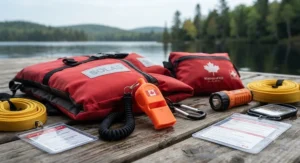
2. Fox 40 Sonik Blast CMG — built to cut through crowd noise and open water alike
The Fox 40 Sonik Blast CMG takes the same pealess reliability as the Classic and dials the output past 120 decibels with a noticeably lower-pitched, harsher tone that’s engineered to punch through ambient noise rather than just be technically loud on a meter.
What most buyers overlook about this model is that decibel rating alone doesn’t determine how far a sound travels — frequency matters just as much. The Sonik Blast’s lower tone sits closer to the 2,700-3,000 Hz window that research on sound propagation identifies as ideal for carrying distance, which helps explain why testers who’ve compared it side-by-side with the Classic describe it as noticeably more attention-grabbing in open, windy conditions. Reviewers on major retail platforms frequently highlight how easy the whistle is to sound even with minimal breath, a genuine advantage if you’re fatigued or injured.
This is the pick for anyone paddling busy waterways, cottage-country lakes thick with powerboats, or coastal routes where you need to cut through motor noise, not just birdsong. A recurring theme in aggregated reviews is that first-time users are sometimes startled by how loud it actually is up close — worth keeping in mind if you’re testing it indoors.
Pros:
- ✅ Over 120 dB with a distance-friendly low-pitch tone
- ✅ Very easy to sound with minimal breath effort
- ✅ Same jam-proof pealess reliability as the Classic
Cons:
- ❌ Sharper tone can be uncomfortably loud at close range
- ❌ Costs more than the standard Fox 40 Classic
Priced in the C$15-C$20 range, the Fox 40 Sonik Blast CMG earns its premium over the Classic for paddlers who prioritize maximum carrying distance over minimalism.
3. Storm Whistle — engineered by a Coast Guard veteran to out-shout a squall
The Storm Whistle, made by the All-Weather Safety Whistle Company, uses a distinctive resonance-chamber design rather than a simple pealess tube, and independent testers have repeatedly rated it among the loudest whistles commercially available, with claims in the 118-120+ decibel range.
Here’s what the spec sheet won’t tell you, but field comparisons do: the Storm’s lower, rounder tone is often perceived by older adults and in windy, wave-heavy conditions as louder than higher-pitched rivals like the Fox 40, even when lab decibel numbers are close. One widely cited side-by-side comparison found the Storm’s effective loudness noticeably exceeded a standard Fox 40 in real-world testing, and users report it functions reliably even after full submersion, with the resonance chamber clearing quickly.
Search-and-rescue-adjacent users and backcountry travellers who prioritize raw carrying power over compactness gravitate toward this model. A recurring theme in enthusiast forums is that the Storm is noticeably bulkier than pealess competitors — some paddlers find it awkward clipped to a PFD’s chest strap, though most consider the trade-off worthwhile.
Pros:
- ✅ Independently tested among the loudest whistles available
- ✅ Lower resonant tone carries well in wind and waves
- ✅ Reliable water-clearing after full submersion
Cons:
- ❌ Noticeably bulkier than compact pealess whistles
- ❌ Higher price point than basic pealess options
At roughly C$15-C$20, the Storm Whistle is worth the extra bulk for paddlers who consider maximum audible range non-negotiable.
4. WindStorm Whistle — the Storm’s smaller sibling, built for everyday carry
The WindStorm Whistle is the compact companion to the Storm, designed by the same manufacturer to deliver comparable piercing loudness in a smaller, more pocket- and lanyard-friendly body — a direct answer to complaints about the original Storm’s bulk.
Based on the spec comparison, the trade-off here is honest and well-documented: you sacrifice a small amount of maximum output for a whistle that clips more naturally to a PFD zipper pull or keychain. Enthusiast forums that have handled both models describe the WindStorm as “damn loud” while noting it doesn’t quite match the full-size Storm at maximum output — a reasonable compromise for paddlers who found the original too cumbersome. Because it shares the same resonance-based engineering rather than a simple pealess tube, it retains the deeper, farther-carrying tone that made the original popular among search-and-rescue circles.
This is the sensible middle-ground pick for day paddlers who want Storm-family performance without committing to the larger unit’s footprint. Aggregated reviews suggest satisfaction is high among users who previously found full-size marine whistles too bulky for casual outings.
Pros:
- ✅ Same low-pitch resonance design as the full-size Storm
- ✅ Meaningfully more compact and lanyard-friendly
- ✅ Genuinely loud despite the smaller footprint
Cons:
- ❌ Slightly less maximum output than the full Storm Whistle
- ❌ Limited color options compared to mass-market brands
Typically found in the C$10-C$15 range, the WindStorm Whistle is the practical pick for paddlers who want Storm-family carrying power without the bulk.
5. Propel Paddle Gear Whistle — a budget pick designed specifically with kayakers in mind
The Propel Paddle Gear Whistle, made by Calcutta Outdoors, is marketed explicitly to the paddling community rather than as a general emergency accessory, and it shows in the small details — an easy-release clip built for quick attachment to a kayak, backpack, or PFD strap, and a body designed to float rather than sink if dropped overboard.
What most buyers overlook about ultra-budget whistles is that “loud enough” and “functions wet or dry” matter more than chasing the highest decibel number on a spec sheet, and this model is built around exactly that priority. Reviewers highlight the quick-access clip as genuinely useful in a real capsize scenario, when fumbling with a knotted lanyard costs precious seconds. Because Calcutta Outdoors positions itself as a dedicated paddle-sports accessory brand, the design decisions — floating body, quick-release hardware — read as purpose-built rather than repurposed from general camping gear.
This is a sensible pick for casual lake paddlers and beginners building a first safety kit on a tight budget, where “own a real marine whistle” matters more than optimizing for maximum decibels. A common thread in aggregated feedback is appreciation for the value at this price point, alongside occasional notes that the tone is less piercing than premium alternatives.
Pros:
- ✅ Purpose-built for paddling with a floating design
- ✅ Quick-release clip speeds up access in a real emergency
- ✅ Genuinely affordable entry point for a first safety kit
Cons:
- ❌ Lower rated loudness than premium marine whistles
- ❌ Plastic clip hardware may wear faster with heavy use
At under C$10, the Propel Paddle Gear Whistle is one of the easiest “no excuse not to own one” purchases on this list.
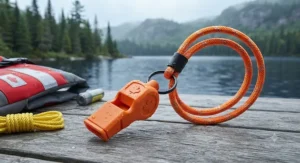
6. ACR WW-3 Res-Q Whistle — the marine-grade choice built for offshore conditions
ACR Electronics has built its reputation on marine safety electronics — think personal locator beacons and EPIRBs — and its WW-3 Res-Q Whistle brings that same offshore-rated design philosophy down to a simple pealess whistle, built to standards that align with the kind of gear used on ocean-going vessels rather than casual recreation.
Here’s what the spec sheet doesn’t fully capture: ACR’s whistle line is frequently bundled with, or sold alongside, the company’s flare kits and PLB accessories, which tells you where its design priorities sit — durability and reliability under harsh marine conditions rather than maximum decibel bragging rights. Reviewers who pair this whistle with offshore or coastal touring kayaks consistently note its compact, unobtrusive size relative to bulkier resonance-chamber competitors, making it easier to store in a deck bag or PFD pocket without adding bulk.
This whistle suits sea kayakers, coastal tourers, and anyone paddling in conditions where they’re also likely carrying flares or a PLB — it fits the same safety mindset without demanding a dedicated pocket. A recurring note in aggregated feedback is that its rated loudness sits a notch below the Fox 40 and Storm families, a fair trade some buyers make for the compact profile and brand trust.
Pros:
- ✅ Marine-grade construction from a trusted safety-electronics brand
- ✅ Compact size fits easily alongside other offshore safety gear
- ✅ Pairs naturally with flare kits and PLB setups
Cons:
- ❌ Rated loudness is modest next to Storm-family whistles
- ❌ Less widely stocked at general outdoor retailers
Usually priced C$10-C$15, the ACR WW-3 Res-Q Whistle is the natural pick for paddlers already building out a full offshore safety kit.
7. IUMIUN Titanium Survival Whistle — a budget titanium option that laughs at saltwater
The IUMIUN Titanium Survival Whistle swaps the usual ABS plastic body for titanium construction, targeting buyers who want corrosion resistance and durability without stepping up to a premium marine brand — and the claimed output, in the 120-130 decibel range, puts it near the top of this entire comparison on paper.
Based on the spec comparison, titanium’s real advantage isn’t loudness — it’s longevity in the exact environment where plastic whistles eventually crack, fade, or degrade: sustained saltwater and UV exposure. Reviewers consistently report satisfaction with the rustproof, sweat- and saltwater-resistant body, and the pealess (“works submerged”) design avoids the classic pea-whistle failure mode. Because it’s compact enough to sit on a keyring, it also functions as a everyday-carry backup beyond just paddling trips.
This is a strong pick for budget-conscious buyers who still want premium materials, and for anyone who’s previously had a plastic whistle crack or discolour after a season of saltwater exposure. As with any manufacturer-claimed decibel rating not verified by independent third-party testing, treat the 120-130 dB figure as a ceiling estimate rather than a guarantee, and hedge your expectations accordingly.
Pros:
- ✅ Titanium body resists rust and saltwater degradation
- ✅ Claimed decibel output rivals premium marine whistles
- ✅ Doubles as a compact everyday-carry keychain whistle
Cons:
- ❌ Decibel claims aren’t independently verified
- ❌ Metal body can feel cold to the mouth in winter paddling
At roughly C$10-C$20 depending on retailer, the IUMIUN Titanium Survival Whistle offers some of the best material durability per dollar on this list.
How to Choose a Waterproof Whistle for Kayaking
- Confirm it’s genuinely pealess. Any whistle with a cork or plastic “pea” ball inside can jam with water — every product on this list avoids that design flaw, and you should verify any other whistle does too before buying.
- Weigh decibel rating against frequency. A high dB number in a high-pitch tone doesn’t always out-carry a slightly quieter, lower-pitched design like the Storm Whistle or WindStorm Whistle in windy, open-water conditions.
- Check the attachment hardware. A breakaway lanyard or quick-release clip, like the one on the Propel Paddle Gear Whistle, matters more in a real emergency than most buyers expect.
- Match the whistle to your paddling environment. Coastal and offshore paddlers benefit from marine-branded options like the ACR WW-3 Res-Q Whistle; lake and river paddlers can prioritize value picks like the Fox 40 Classic Safety Whistle.
- Consider material durability if you paddle saltwater regularly. Titanium options like the IUMIUN Titanium Survival Whistle resist the corrosion that eventually degrades plastic bodies.
- Don’t buy on decibel rating alone. Independent tests have repeatedly shown that manufacturer-claimed dB numbers vary in measurement methodology — treat spec sheets as a starting point, not gospel.
- Buy a backup. Given how inexpensive most of these whistles are, keeping a second one in your PFD’s opposite pocket or your dry bag costs little and solves the “lost overboard” problem entirely.
Sound Signal Boating Requirements: What Transport Canada Actually Mandates
This is the section most paddlers skip past — and shouldn’t. Under Canada’s Small Vessel Regulations, every self-propelled kayak and canoe is legally required to carry a sound-signalling device, which can be a pealess whistle, a compressed gas horn, or an electric horn. This isn’t a “nice to have” recommendation; it’s binding federal regulation enforced by Transport Canada and the RCMP on Canadian waterways.
According to the Transport Canada Safe Boating Guide, the sound-signalling requirement applies regardless of whether everyone on board is wearing a PFD — unlike several other equipment categories that get waived when PFDs are worn, the whistle requirement stands on its own. In practice, this means a solo kayaker paddling a quiet lake in broad daylight still needs a functioning whistle clipped somewhere accessible, not buried in a dry bag at the bottom of the hull.
What most paddlers don’t realize is that “accessible” carries real weight in an enforcement context — a whistle stored in a hatch you’d need to open mid-emergency doesn’t meaningfully satisfy the spirit of the rule, even if it technically satisfies the letter of it. Clipping your whistle directly to your PFD’s zipper pull or a dedicated D-ring solves this cleanly, which is exactly why nearly every product on this list ships with a lanyard or clip built for that purpose.
Enforcement officers can issue fines for missing or non-functional sound-signalling devices, and — as with PFDs — a whistle that’s cracked, missing its lanyard, or otherwise not “in good working order” may not satisfy the regulation even if you’re technically carrying one. Given that a compliant whistle costs less than lunch, this is one regulatory box that’s almost embarrassingly cheap to check off properly.
✨ Don’t Miss These Exclusive Deals!
🔍 Take your paddling safety kit to the next level with the whistles compared above. Click through on any highlighted pick to check current pricing and availability — a few dollars now beats a fine, or worse, later.
Transport Canada Minimum Safety Equipment for Paddlers
Beyond the whistle itself, Transport Canada sets out a specific baseline of gear that every human-powered vessel — kayak, canoe, or paddleboard — must carry. The requirements shift slightly depending on your hull type and whether everyone aboard is wearing their PFD.
| Situation | Required Equipment |
|---|---|
| Everyone wearing a Canadian-approved PFD, sealed-hull/sit-on-top kayak | 1 sound-signalling device; watertight flashlight (if paddling after sunset, before sunrise, or in low visibility) |
| Standard kayak or canoe, not everyone wearing PFD | 1 Canadian-approved PFD per person, 1 sound-signalling device, 1 buoyant heaving line (15 m), bailer or manual pump, watertight flashlight (low light conditions) |
| Whitewater paddling (any hull type) | Above, plus PFD must be inherently buoyant (inflatable PFDs are not permitted in whitewater) |
| Racing canoes/kayaks with an attending safety craft | Exempt from standard list if the safety craft carries appropriately sized PFDs for all paddlers |
This table underscores a point worth repeating: the sound-signalling device is one of only two items — alongside the watertight flashlight in low light — that stays mandatory even when every paddler is properly wearing a PFD. Bailers, heaving lines, and additional gear only get waived under specific PFD-worn conditions, which means most casual paddlers still need to think through their full kit rather than assuming a life jacket alone covers them. Fines for missing individual safety items can reach $200 per item, so a five-minute pre-launch check genuinely pays for itself.
For the complete, current regulatory text, the Transport Canada Safe Boating Guide remains the authoritative source — always defer to it over any third-party summary, including this one, if details conflict.
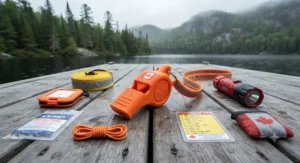
Top PFDs Under $100 CAD to Pair With Your Whistle
A whistle is only as useful as your ability to keep it on your body, which is why pairing it with a properly fitted PFD matters more than most buyers initially assume. The good news: solid Canadian-approved options exist well under the C$100 mark.
| PFD | Price Range (CAD) | Type | Best For |
|---|---|---|---|
| Mustang Survival Reflex Foam Vest | Around C$60-C$120 | Type III foam | Canadian-made reliability |
| Onyx MoveVent Dynamic Paddle Sports PFD | C$70-C$95 | Type III foam, high-back | Recreational kayaking mobility |
| Onyx Universal PFD | Under C$65 | Type II/III foam | Budget-conscious, wide sizing range |
| NRS Ninja PFD | C$80-C$100 | Type III foam | Whitewater freedom of movement |
| Astral Otter 2.0 (Youth) | Under C$70 | Type III foam | Kids and younger paddlers |
Looking at this table, the pattern is clear: you don’t need to spend C$150+ to get a Canadian-approved, comfortable PFD suited to flatwater or moderate paddling. On paper, this means budget-conscious buyers can outfit an entire family for well under the price of a single premium whitewater vest, though whitewater paddlers specifically should note that inflatable options are never legal substitutes in those conditions — only inherently buoyant foam vests like these qualify. The Mustang Survival Reflex Foam Vest stands out partly because Mustang is a Canadian-based company with deep roots in commercial marine safety gear, which shows in the harmonized foam construction.
Whichever PFD you choose, make sure it carries visible Canadian approval — PFDs approved only by the U.S. Coast Guard do not satisfy Transport Canada requirements for Canadian residents, even if the vest itself is otherwise well made.
PFD-Mounted Safety Accessories Worth Adding to Your Kit
Once your whistle and PFD are sorted, a handful of additional PFD-mounted accessories round out a genuinely capable safety setup without adding meaningful bulk.
A rescue knife is the most commonly recommended addition, and for good reason — becoming tangled in fishing line, anchor rope, or a paddle leash is a real and disproportionately dangerous scenario on the water. The NRS Titanium Co-Pilot, a quick-release rescue knife designed to mount directly to a PFD’s knife lash tab, features a blunt tip specifically so you cut the tangle rather than yourself in a stressful moment.
Strobe lights are the second major category, particularly valuable for paddlers who might be out near dusk or in fog. ACR’s Firefly Pro Solas strobe is compact enough to sit flat in a PFD pocket while still meeting SOLAS-grade visibility standards — genuinely useful for anyone who’s ever misjudged how quickly daylight fades on the water. A common thread in on-water accounts is that a strobe’s flash cuts through fog and low light far more effectively than a steady white light, which matters if you’re trying to be seen rather than just technically visible.
Finally, consider a dedicated accessory pocket if your PFD doesn’t already include one — many mid-range and premium vests, like several fishing-oriented NRS models, ship with tool holders, knife lash tabs, and strobe attachment points built in. Retrofitting an older PFD with an aftermarket pocket is a cheap way to gain that same organization without replacing the whole vest.
Practical Usage Guide: Setting Up, Testing, and Maintaining Your Whistle
Getting a waterproof whistle for kayaking out of the packaging is the easy part — actually setting it up so it performs when you need it takes a few extra minutes that most buyers skip.
On day one, attach the whistle using its included lanyard or clip directly to your PFD’s zipper pull, chest strap, or a dedicated D-ring — never bury it in a pocket you’d need to unzip mid-emergency. Test it dry first, blowing at a moderate breath level to get a feel for its baseline tone, then dunk it fully in a sink or bucket and blow again immediately to confirm the chamber clears cleanly. This single test catches manufacturing defects before you’re relying on the whistle in open water.
In your first 30 days, avoid two common mistakes: clipping the whistle to a zipper pull that could accidentally unzip your PFD under tension (several manufacturers explicitly warn against this), and storing it loose in a pocket where it can work its way out during a capsize. A short lanyard secured to a fixed strap point solves both problems at once.
For ongoing maintenance, rinse plastic and titanium whistles with fresh water after every saltwater outing to prevent salt crystal buildup in the chamber, and periodically check the lanyard or clip hardware for UV degradation or fraying — plastic clips are usually the first component to fail, well before the whistle body itself wears out. A quick test-blow at the start of each paddling season is a two-second habit that confirms everything still works exactly as it should.
Real-World Scenarios: Matching the Right Whistle to Your Paddling Style
The weekend cottage paddler. If you’re paddling a calm inland lake a few times a summer with family nearby, budget and simplicity matter more than maximum decibel output. The Fox 40 Classic Safety Whistle or Propel Paddle Gear Whistle covers this use case completely — reliable, inexpensive, and easy for kids to use if paired with a properly fitted youth PFD like the Astral Otter 2.0.
The coastal or sea touring paddler. If your trips involve open water, fog, boat traffic, or multi-day coastal routes, prioritize marine-branded, offshore-tested gear. The ACR WW-3 Res-Q Whistle paired with the Mustang Survival Reflex Foam Vest and an ACR strobe light builds a coherent, purpose-matched kit rather than a mismatched pile of camping gear pressed into marine service.
The whitewater or high-traffic river paddler. Fast water and dense boat traffic both demand maximum audible range over compactness. The Storm Whistle or Fox 40 Sonik Blast CMG, paired with an inherently buoyant PFD like the NRS Ninja PFD (never an inflatable — those aren’t legal in whitewater), gives you the best odds of being heard over rapids and other paddlers.
Common Mistakes When Buying a Kayak Whistle
The single most common mistake is buying based on decibel number alone. As the frequency research referenced earlier shows, a lower-pitched whistle in the 2,700-3,000 Hz range can out-carry a technically louder, higher-pitched competitor in real open-water conditions — chasing the biggest number on the box without considering tone is a genuine trap.
A second frequent error is attaching the whistle to a PFD zipper pull, which several manufacturers explicitly warn can cause accidental unzipping under tension — exactly the wrong failure mode in an emergency. A third is assuming any whistle labelled “waterproof” is automatically pealess; some budget models marketed loosely as water-resistant still use a traditional cork pea that can jam. Finally, many buyers skip testing their whistle after purchase, only to discover a manufacturing defect the first time they actually need it — a two-minute dry-and-wet test at home solves this entirely.

Waterproof Whistles vs Air Horns and Electronic Signalling Devices
| Signal Type | Typical Range | Batteries/Power | Cost Range (CAD) | Best For |
|---|---|---|---|---|
| Pealess whistle (e.g. Fox 40 Classic Safety Whistle) | Up to ~1.6 km in good conditions | None | C$10-C$20 | Everyday kayaking, legal minimum |
| Compressed gas air horn | Up to ~2-3 km | Refillable canister | C$20-C$40 | Larger boats, louder single blast |
| Electric horn | Up to ~1-2 km | Battery-powered | C$25-C$50+ | Fixed-mount vessels, not kayak-friendly |
| PLB (personal locator beacon) | Global satellite reach | Battery, non-signalling sound | C$300-C$500+ | Offshore emergencies beyond earshot |
This comparison highlights why a whistle remains the backbone of kayak safety gear rather than an afterthought: air horns and electric horns are heavier, bulkier, and impractical to mount securely on a small human-powered craft, while a PLB solves a completely different problem — getting rescue services alerted when you’re out of shouting range entirely, not signalling a nearby boater. On paper, the smartest approach for most paddlers combines a compliant whistle as the baseline with a PLB as a serious backup for remote or offshore trips, rather than treating them as interchangeable options.
What to Expect: Real-World Performance on the Water
Specs on a box translate into a noticeably different experience once you’re actually on the water. A whistle rated at 115-120 decibels in a controlled indoor test will sound quieter outdoors, where sound disperses in open air rather than bouncing off walls — this is normal and expected, not a defect. Wind direction matters enormously too: a whistle blown downwind toward the person you’re signalling carries dramatically farther than one blown into a headwind, so positioning yourself thoughtfully during an actual emergency genuinely changes your odds of being heard.
Cold hands and adrenaline also affect performance more than most buyers anticipate. Whistles that require significant lung pressure to sound clearly, like some higher-pitched pealess designs, can be harder to use effectively if you’re fatigued, injured, or shivering after a capsize — which is part of why reviewers consistently favour whistles like the Fox 40 Sonik Blast CMG that are engineered to sound easily with minimal breath effort. In practice, the “easiest to blow reliably under stress” whistle often beats the “loudest on a lab meter” whistle for real-world outcomes.
Long-Term Cost and Maintenance: Whistles, PFDs, and Accessories
Total cost of ownership for a kayak safety kit is refreshingly low compared to most paddling gear. A quality whistle purchased once, at roughly C$10-C$20, will typically last for years with occasional freshwater rinsing and periodic function checks — there’s no consumable, no battery, and no subscription involved, which is a meaningful advantage over battery-dependent signalling devices that require ongoing replacement costs.
PFDs represent the larger recurring investment, with foam models like the Onyx Universal PFD or Mustang Survival Reflex Foam Vest typically lasting five to ten years with proper care before foam degradation or UV damage warrants replacement — a cost-per-use that works out to just a few dollars per outing over a typical paddling lifespan. Accessories like the NRS Titanium Co-Pilot knife or ACR strobe lights add modest upfront cost but very little ongoing maintenance beyond battery swaps for the strobe and occasional blade oiling for the knife. Viewed across a multi-year paddling hobby, a complete whistle-PFD-accessory kit built from the picks in this guide typically runs well under C$200 total — genuinely inexpensive insurance against a worst-case scenario.
Features That Actually Matter (And Those That Don’t)
Actually matters: pealess construction, a secure non-zipper-pull attachment point, ease of sounding with minimal breath, and low-frequency tone for open-water carrying distance. These four factors consistently separate whistles that perform in real emergencies from ones that merely look impressive on a store shelf.
Doesn’t matter nearly as much: whistle color (visibility matters far more for your PFD and paddle than a whistle small enough to be nearly invisible anyway), marginal decibel differences between models already above roughly 110 dB, and premium packaging or branding that doesn’t translate into functional differences. Marketing copy chasing the “loudest whistle in the world” claim should be treated with healthy skepticism — as the frequency research shows, the highest number on a spec sheet doesn’t automatically mean the most effective signal in real conditions.
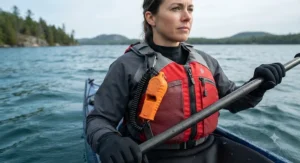
Frequently Asked Questions
❓ Is a whistle legally required for kayaking in Canada?
❓ What's the loudest waterproof whistle for kayaking?
❓ Can I use any whistle, or does it need to be marine-rated?
❓ How much does a good kayak safety whistle cost in Canada?
❓ Do I need a whistle if I already have a PFD with a built-in strobe or radio?
Conclusion
A waterproof whistle for kayaking is one of the smallest, cheapest items in your entire kit, and also one of the only ones that’s both legally mandatory and genuinely capable of getting you rescued faster. Whether you land on the budget-friendly Fox 40 Classic Safety Whistle, the attention-cutting Fox 40 Sonik Blast CMG, the maximum-range Storm Whistle and its compact WindStorm Whistle sibling, the paddling-specific Propel Paddle Gear Whistle, the offshore-ready ACR WW-3 Res-Q Whistle, or the corrosion-resistant IUMIUN Titanium Survival Whistle, the important thing is that it’s clipped somewhere accessible, tested regularly, and paired with a properly fitted, Canadian-approved PFD.
Pair that whistle with one of the budget-friendly PFDs covered above, add a rescue knife or strobe if your paddling takes you into more remote water, and you’ve built a safety foundation that costs less than a single tank of gas but genuinely changes your odds if something goes wrong out there.
🚴 Ready to Gear Up for Your Next Paddling Trip?
🔍 Compare the whistles, PFDs, and accessories above, click through to check current pricing, and build a safety kit that’s ready before your next launch. A few smart purchases now beat a scramble later!
Recommended for You
- Throw Bag for Canoe Rescue: 7 Life-Saving Picks for 2026
- Adult PFD vs Fishing PFD for Paddling: 7 Picks for 2026
- Kids PFD for Canoe Camping: 7 Trusted Picks for 2026
Disclaimer: This article contains affiliate links. As an Amazon Associate, I earn from qualifying purchases. If you purchase products through these links, we may earn a small commission at no additional cost to you.
✨ Found this helpful? Share it with your friends! 💬🤗
