In This Article
Picture this: you’ve driven three hours to Algonquin Provincial Park, set up camp under towering pines, and now you’re unzipping a sleeping bag that feels like a winter cocoon in July. Within an hour, you’re sweating, tossing, and seriously regretting your gear choices. What most Canadian campers don’t realize is that using a three-season or winter bag during summer months isn’t just uncomfortable—it’s the fastest way to ruin a camping trip.
A proper summer sleeping bag is designed for warm-weather camping, typically rated for comfort between 10°C and 20°C (50°F to 68°F). Unlike their heavier counterparts, these bags prioritize breathability and ventilation over maximum insulation. For Canadian summers—which can still dip to 5°C (41°F) at night in places like Banff or Jasper—you need a bag that strikes the right balance: light enough for July heat waves in Ontario, yet capable of handling cool mountain evenings in British Columbia.
The summer sleeping bag market has exploded in 2026, with innovations in breathable fabrics, compact compression, and temperature regulation that simply didn’t exist five years ago. Whether you’re car camping with the family at a provincial park or backpacking the West Coast Trail, there’s a summer sleeping bag engineered for your specific needs—and your specific Canadian climate.
Quick Comparison: Top Summer Sleeping Bags at a Glance
| Product | Weight | Comfort Rating | Price Range (CAD) | Best For |
|---|---|---|---|---|
| Coleman Brazos | 1.4 kg (3.1 lbs) | 10°C (50°F) | $40-$60 | Budget families, car camping |
| TETON Sports Celsius Junior | 1.1 kg (2.4 lbs) | 12°C (54°F) | $55-$75 | Kids, warm-weather camping |
| Sea to Summit Spark SP30 | 482 g (17 oz) | -1°C (30°F) | $450-$550 | Ultralight backpacking |
| Naturehike Ultralight | 700 g (1.54 lbs) | 15°C (59°F) | $85-$110 | Budget backpackers |
| REI Co-op Magma 30 | 709 g (25 oz) | -1°C (30°F) | $500-$600 | Serious hikers |
| SWTMERRY 3-Season | 1.4 kg (3 lbs) | 10-20°C (50-68°F) | $45-$70 | Versatile car camping |
| Western Mountaineering SummerLite | 539 g (19 oz) | 0°C (32°F) | $650-$750 | Premium ultralight |
💬 Just one click — help others make better buying decisions too! 😊
✨ Don’t Miss These Exclusive Deals!
🔍 Take your summer camping to the next level with these carefully selected products. Click on any highlighted item to check current pricing and availability on Amazon.ca. These bags will help you create authentic outdoor memories your family will love!
Top 7 Summer Sleeping Bags: Expert Analysis for Canadian Campers
1. Coleman Brazos – The Canadian Family Favourite
The Coleman Brazos has earned its reputation as Canada’s go-to budget sleeping bag for good reason. This rectangular bag features a polyester shell with hollow-core insulation and a comfort rating of 10°C (50°F), making it ideal for Ontario summers and coastal BC camping from June through September.
What makes the Brazos particularly clever for Canadian conditions is its oversized 213 cm (84-inch) length—tall enough for most adults without that claustrophobic foot-compression you get with cheaper bags. The Fiberlock construction prevents insulation from shifting during those long drives to provincial parks, and the ZipPlow system actually works (unlike budget zippers that snag every third pull). At 1.4 kg (3.1 lbs), it’s too heavy for backpacking, but for car camping families loading up the Subaru for Killarney or Riding Mountain, weight isn’t the concern.
Canadian buyers appreciate that this bag performs reliably down to about 7°C (45°F) with a base layer—crucial for those unexpectedly cool August nights in Muskoka. The machine-washable design matters more than most reviews mention; after a muddy weekend with kids, you can toss it in the washer without voiding any warranty or destroying the insulation.
Pros:
✅ Exceptional value under $60 CAD
✅ Durable construction survives family camping abuse
✅ Machine-washable for easy maintenance
Cons:
❌ Too bulky for backpacking (packed size: 38 cm × 23 cm)
❌ Limited to warm-weather use only
Price & Verdict: Around $40-$60 CAD. If you’re camping with kids at provincial parks and need multiple bags without spending $500, the Coleman Brazos delivers unbeatable value. It won’t impress ultralight enthusiasts, but it’ll keep your family warm for years.
2. TETON Sports Celsius Junior – Smart Choice for Growing Campers
The TETON Sports Celsius Junior addresses a gap many Canadian parents discover too late: kids’ bags that actually fit kids. Sized at 170 cm (67 inches), this mummy-style bag accommodates children from ages 6-14 without the excess material that creates cold spots in adult bags.
The clever part about the Celsius Junior is its SuperLoft Elite insulation—a proprietary hollow-fibre fill that mimics down’s loft while maintaining performance in damp conditions. Anyone who’s camped with kids in the Maritimes or coastal rainforests knows that “waterproof” gear gets tested constantly. This bag’s synthetic fill continues insulating even when moisture inevitably seeps in from wet swimsuits, spilled juice boxes, or morning condensation.
Temperature-wise, TETON rates it at 12°C (54°F) comfort, but Canadian reviewers consistently report good performance down to 8°C (46°F) when paired with a fleece liner. The draft tube along the zipper actually makes a measurable difference—something budget kids’ bags typically skip. At 1.1 kg (2.4 lbs), it’s light enough that a 10-year-old can carry it from the car to the campsite without complaining.
Pros:
✅ Properly sized for children (no excess material creating cold spots)
✅ Synthetic insulation performs in damp Canadian conditions
✅ Compression stuff sack included
Cons:
❌ Kids outgrow it by age 14-15
❌ Only available in limited colours
Price & Verdict: Around $55-$75 CAD. For Canadian families with school-age kids, this represents smart value—you’ll get 4-6 seasons of use before they outgrow it, and the durable construction means it survives hand-me-downs to younger siblings.
3. Sea to Summit Spark SP30 – Ultralight Royalty
The Sea to Summit Spark SP30 weighs just 482 grams (17 ounces)—roughly the same as a Nalgene water bottle. For perspective, that’s 65% lighter than the Coleman Brazos. This isn’t just weight savings; it’s a fundamental shift in what’s possible for long-distance backpacking across Canadian wilderness.
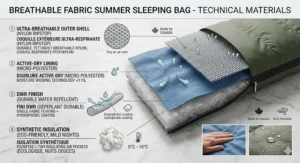
The secret lies in 850+ fill-power RDS-certified goose down combined with an Ultra-Dry treatment that maintains loft even when humidity hits. The 10-denier nylon shell feels gossamer-thin (because it is), but Sea to Summit reinforces high-wear zones with 15-denier fabric. Canadian thru-hikers on the Great Divide Trail report this bag packing down to the size of a Nalgene bottle, leaving precious pack space for the extra layers you actually need in the Rockies.
Temperature rating sits at -1°C (30°F), which seems warm for a “summer” bag until you consider Canadian alpine conditions. A July backpacking trip to Lake O’Hara or Tonquin Valley can easily see overnight lows of 2-5°C (35-41°F)—the Spark handles these conditions while weighing half what budget bags do. The half-length zipper reduces weight but limits ventilation on truly hot nights; you’re trading flexibility for grams saved.
Pros:
✅ Exceptional 482g weight transforms backpacking comfort
✅ Packs smaller than any bag in this roundup
✅ Premium down insulation with water-resistant treatment
Cons:
❌ Ultra-thin fabric requires careful handling (no sharp tent corners)
❌ Premium price ($450-$550 CAD) creates sticker shock
Price & Verdict: Around $450-$550 CAD. The Spark SP30 represents an investment, but for serious Canadian backpackers tackling multi-day trips where pack weight determines daily distance, it’s transformative. Not for casual car campers.
4. Naturehike Ultralight – Budget Backpacker’s Dream
The Naturehike Ultralight has become the dark horse favourite among Canadian budget backpackers. At 700 grams (1.54 lbs) and usually priced around $85-$110 CAD, it delivers 80% of premium bag performance at 15% of the cost. Chinese manufacturer Naturehike has refined this design over multiple iterations, and the 2026 version shows genuine improvements in zipper quality and baffle construction.
The shell uses 20-denier ripstop nylon—thicker than premium bags like the Spark, but significantly more durable for Canadian Shield camping where granite and pine needles test gear constantly. The 400-fill synthetic down substitute won’t match real down’s warmth-to-weight ratio, but it maintains loft in damp conditions that would devastate untreated down. Comfort rating of 15°C (59°F) means this bag shines for July/August camping below treeline across most of Canada.
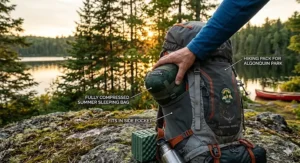
What surprises most buyers is the compression capability—it squishes down to roughly 25 cm × 15 cm, small enough to fit inside most 40L backpacking packs alongside your shelter and food. Canadian reviewers consistently praise the included compression stuff sack, which actually compresses (unlike the flimsy sacks that come with some budget bags).
Pros:
✅ Outstanding value at $85-$110 CAD
✅ Durable 20D fabric survives Canadian wilderness abuse
✅ Effective compression to compact size
Cons:
❌ Zipper occasionally snags on fabric (improving in newer batches)
❌ Synthetic fill adds 200g versus equivalent down bags
Price & Verdict: Around $85-$110 CAD. For Canadian backpackers on tight budgets—students, first-time buyers, or those assembling backup gear—the Naturehike Ultralight punches well above its weight class. You’re sacrificing premium materials for proven performance.
5. REI Co-op Magma 30 – The Goldilocks Option
The REI Co-op Magma 30 occupies that “just right” territory between budget bags and premium ultralight models. At 709 grams (25 ounces) for the regular length, it’s noticeably lighter than car camping bags but doesn’t demand the obsessive care required by sub-500g options. REI’s 850-fill down provides excellent warmth at -1°C (30°F), making this bag suitable for three-season use across most of Canada.
Here’s what sets the Magma apart for Canadian buyers: REI offers it in nine different sizes, from petite through extra-long, ensuring proper fit regardless of your height. A bag that’s too long forces your body to heat unnecessary space (reducing effective warmth), while too-short bags compress insulation at your feet creating cold spots. This matters more than spec sheets suggest—proper fit can make a 5°C difference in real-world comfort.
The recycled 15-denier nylon shell balances weight savings with reasonable durability, though it’s not bombproof like car camping bags. Canadian Mountain Equipment Co-op (MEC) reviewers note the water-resistant down maintains performance during coastal camping better than untreated alternatives. The full-length zipper trades some weight for versatility—on warm August nights in southern Ontario, you can fully open it for ventilation.
Pros:
✅ Nine sizes ensure proper fit for all body types
✅ 850-fill down delivers serious warmth for the weight
✅ Full-length zipper enables temperature regulation
Cons:
❌ Premium pricing ($500-$600 CAD) excludes budget shoppers
❌ REI’s Canadian shipping can add costs/delays
Price & Verdict: Around $500-$600 CAD. The Magma 30 represents REI’s refined approach to lightweight bags—not the absolute lightest, but optimized for real-world use by experienced campers who value reliable performance over marginal weight savings.
6. SWTMERRY 3-Season – Versatile All-Rounder
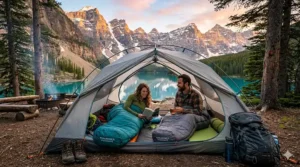
The SWTMERRY 3-Season rectangular bag tackles the “one bag for multiple uses” challenge better than most budget options. With a comfort range spanning 10-20°C (50-68°F), it handles warm July nights in Manitoba and cooler September evenings in Nova Scotia without requiring a separate bag for each season.
Construction uses waterproof polyester taffeta shell (not just water-resistant) paired with hollow-fibre insulation that continues working when damp. The full-length dual zippers deserve specific mention—they enable using this bag as a comforter when fully unzipped, perfect for warm car camping when you just need light coverage. Canadian families appreciate this flexibility; one reviewer described using it as a blanket for backyard stargazing between camping trips.
At 1.4 kg (3 lbs), it’s definitely car-camping weight, not backpacking. But the comfort-focused rectangular cut (84 inches × 33 inches) provides sleeping room that mummy bags can’t match. Taller Canadians (over 6 feet) consistently report actually fitting comfortably, which matters more than weight when you’re sleeping in the back of your truck at a fishing camp in northern Saskatchewan.
Pros:
✅ Dual zippers convert to blanket for maximum versatility
✅ True waterproof shell (not just water-resistant coating)
✅ Rectangular cut accommodates taller/broader sleepers
Cons:
❌ Compression stuff sack sold separately
❌ Rectangular shape less thermally efficient than mummy bags
Price & Verdict: Around $45-$70 CAD. For Canadian campers who want one affordable bag for everything from summer provincial parks to autumn cabin trips, the SWTMERRY 3-Season delivers practical versatility. It won’t win ultralight awards, but it’ll serve reliably for years.
7. Western Mountaineering SummerLite – Premium Ultralight Excellence
The Western Mountaineering SummerLite represents the pinnacle of American sleeping bag craftsmanship. At 539 grams (19 ounces), it’s only slightly heavier than the Spark SP30 but uses fully-baffled construction instead of sewn-through seams—eliminating cold spots entirely. This matters most to Canadian alpinists tackling the Columbia Icefields or Bugaboos where even summer nights demand reliable insulation.
Western Mountaineering’s 850+ fill down uses continuous baffles with offset quilting, preventing down migration that plagues cheaper bags after 50+ nights. The differential cut (outer shell larger than inner) ensures loft isn’t compressed when you move, maintaining R-value throughout the night. These details sound technical, but they translate to measurably better warmth—Canadian thru-hikers report this 0°C (32°F) bag performs like other brands’ -5°C bags.
The price—typically $650-$750 CAD—creates immediate objections until you consider Western Mountaineering’s lifetime warranty and reputation for bags lasting 15+ years. Divide that cost across 200 nights of use, and you’re paying $3.25-$3.75 CAD per night for premium sleep. The wider cut (compared to the Spark) suits side sleepers better, though it adds 60 grams versus ultra-tapered designs.
Pros:
✅ Fully-baffled construction eliminates all cold spots
✅ Legendary durability (15+ year lifespan typical)
✅ Wider cut accommodates side sleepers comfortably
Cons:
❌ Premium pricing ($650-$750 CAD) limits accessibility
❌ Availability in Canada can be spotty (often special order)
Price & Verdict: Around $650-$750 CAD. The Western Mountaineering SummerLite isn’t for everyone—it’s for serious Canadian backpackers who recognize that exceptional gear costs more initially but delivers value through decades of reliable performance. If you’re camping 20+ nights annually in challenging conditions, this investment pays dividends.
How to Set Up Your Summer Sleep System for Canadian Conditions
Most first-time Canadian campers make the same mistake: they focus entirely on the sleeping bag while ignoring the system. Your bag is only 50% of the warmth equation—the other 50% comes from your sleeping pad, clothing layers, and shelter quality. Here’s how to optimize each component for Canadian summer camping.
Start with Proper Pad Selection
Ground temperatures in Canadian Shield country (Ontario, Manitoba, northern Quebec) rarely exceed 10°C (50°F) even when air temps hit 25°C (77°F). Without adequate pad R-value, you’ll lose 60% of your body heat through conduction regardless of how warm your bag is. For summer camping, target minimum R-value of 3.0; if you’re camping above 1,500 metres elevation (Rockies, Coast Mountains), bump that to R-value 4.0. The math is simple: every R-value point equals roughly 5°C (9°F) of ground insulation.
Layer Your Clothing Strategically
Sleeping bag temperature ratings assume you’re wearing base layers (long underwear). In practice, most Canadian campers sleep in whatever they wore during the day—a critical error. Moisture from daytime activities (hiking, paddling) reduces insulation effectiveness by 30-40%. Change into dry merino wool or synthetic base layers before bed. Keep a dedicated “sleep layer” that never gets worn during the day; this simple habit can add 5°C (9°F) to your bag’s effective rating.
Optimize Your Shelter Setup
A quality tent adds 5-7°C (9-13°F) to your sleep system versus cowboy camping. Canadian summer storms arrive quickly—especially in mountain regions—so proper rain fly setup isn’t optional. Position your tent to minimize wind exposure; even 10 km/h winds create convective cooling that makes a 15°C night feel like 10°C inside your bag. In provincial park campgrounds, sheltered sites near tree lines block wind better than exposed waterfront sites (though those morning lake views are tempting).
Case Study: Matching Bags to Canadian Camping Scenarios
Scenario 1: The Toronto Family – Provincial Park Car Camping
Alex and Jordan take their two kids (ages 8 and 11) to Sandbanks Provincial Park six weekends per summer. Budget: $250 CAD total for all sleeping bags. Their solution: two Coleman Brazos bags for parents ($120 CAD combined) and two TETON Sports Celsius Junior bags for kids ($130 CAD combined). This setup handles Ontario summer nights (12-18°C typical) comfortably. Car camping means weight doesn’t matter, so they prioritized durability and machine-washable construction—essential with kids who inevitably spill/soil gear. The rectangular Brazos bags can zip together for couples camping, adding versatility.
Scenario 2: The Vancouver Island Backpacker – Multi-Day Coastal Trails
Sarah tackles the Juan de Fuca Trail and West Coast Trail annually, covering 75+ kilometres with 5-7 days on trail. Her priorities: minimal pack weight and moisture resistance. She invested $520 CAD in the Sea to Summit Spark SP30, recognizing that saving 800 grams versus budget bags means carrying less weight over 75 km—roughly equivalent to 60,000 kg-metres of effort saved. The Ultra-Dry down treatment handles coastal humidity better than untreated alternatives. She pairs it with a Sea to Summit Ultralight Insulated pad (R-value 3.3) creating a 900-gram sleep system that packs into 4 litres—leaving room for 7 days of food in her 50L pack.
Scenario 3: The Calgary Mountain Enthusiast – Alpine Backpacking
Marcus spends 25+ nights annually above treeline in the Rockies, from Lake Louise to Jasper. Temperature swings are dramatic: 20°C (68°F) days dropping to 2°C (35°F) nights. He uses the REI Co-op Magma 30 rated to -1°C, which handles these conditions with a light fleece liner added for insurance. The nine-size range meant he could get a “long” version for his 188 cm (6’2″) frame—critical because short bags compress insulation at your toes creating cold spots. At 709 grams, it’s light enough for 20 km daily mileage but durable enough to survive 50+ nights per season against granite and scree.
Common Mistakes Canadian Campers Make (And How to Avoid Them)
Mistake #1: Buying Winter Bags for Summer Use
Nearly 40% of first-time Canadian campers purchase 0°C or -10°C bags thinking “warmer is safer.” The reality: over-insulated bags trap excess heat and moisture, leading to sweaty, uncomfortable nights and eventual insulation degradation from constant dampness. A summer bag rated 10-15°C (50-59°F) with a fleece liner added for cool nights outperforms a winter bag used year-round. The fix: buy season-specific bags or invest in one quality 3-season bag (rated 0-10°C) plus a lightweight summer quilt.
Mistake #2: Ignoring Canadian Metric Specifications
Many budget bags list only Fahrenheit ratings, forcing conversions. When shopping Amazon.ca, prioritize bags with Celsius ratings prominently displayed—it indicates the manufacturer considers Canadian markets seriously enough to provide proper specifications. Temperature confusion leads to buying bags rated 30°F (sounds cold!) when it’s actually -1°C, far too warm for hot July nights. Always verify both Fahrenheit and Celsius ratings before purchasing.
Mistake #3: Forgetting About Humidity
British Columbia, Maritime provinces, and Great Lakes regions experience summer humidity that reduces insulation effectiveness by 20-30% compared to dry conditions. A bag rated 10°C in dry Alberta performs closer to 13°C in humid Ontario. Coastal campers should prioritize synthetic insulation or treated down (DWR, Ultra-Dry) over standard untreated down. This single specification difference explains why two identically-rated bags perform differently at Tofino versus Drumheller.
Mistake #4: Neglecting Sleeping Pad R-Value
Your sleeping bag’s underside compresses flat beneath your body weight, providing nearly zero insulation. Canadian ground temperatures lag air temps by weeks—even in late July, northern Ontario soil hovers around 8-10°C (46-50°F). Without a pad rated R-3.0 minimum, you’ll lose more heat through ground conduction than your bag can replace. Budget $100-$150 CAD for a quality pad; it’s equally important as the bag itself.
Understanding Temperature Ratings: The Canadian Context
Canadian retailers selling sleeping bags must follow both manufacturer specifications and our unique climate realities. Most bags use ISO 23537 or EN 13537 testing standards, which provide three ratings: comfort (temperature where average “cold sleeper” stays comfortable), lower limit (where average “warm sleeper” remains comfortable), and extreme (survival threshold, not camping comfort).
For Canadian conditions, here’s the practical translation: if a bag lists a comfort rating of 10°C (50°F), that’s the temperature where most people sleep comfortably in base layers on an insulated pad inside a tent. Camping in just a bivy sack or tarp? Subtract 5°C from that rating. Planning to sleep in street clothes instead of dedicated base layers? Subtract another 3-5°C. These adjustments matter more in Canadian wilderness where weather changes rapidly and cell service disappears.
The Ontario Parks sleeping bag guide recommends choosing bags rated 5-10°C colder than expected nighttime lows. This buffer accounts for individual variation (some people sleep cold) and unexpected weather shifts. A late August cold front can drop temperatures 10°C overnight in places like Algonquin or Killarney—your “comfortable” 15°C bag suddenly feels inadequate at 5°C.
For deeper technical understanding of how ISO ratings work, REI’s comprehensive guide explains the laboratory testing process and why real-world performance varies from lab numbers. Canadian outdoor retailer MEC also offers detailed specifications on choosing bags for our specific climate zones—from coastal rainforests to prairie grasslands to alpine tundra.
Summer Sleeping Bag Features That Actually Matter
Manufacturers load product descriptions with marketing jargon, but only a few features genuinely impact your Canadian camping experience. Here’s what to prioritize:
Draft Tubes and Collars
These insulated barriers along zippers and around your neck prevent warm air from escaping. Budget bags often skip draft tubes to save $10-$15, but you’ll feel that missing warmth on 8°C (46°F) nights. Quality draft tubes add 3-5°C to effective temperature rating—worth the modest price increase. Look for continuous draft tubes (one piece running the full zipper length) rather than segmented versions that create small gaps.
Zipper Quality and Length
YKK zippers dominate quality sleeping bags for good reason: they don’t snag, bind, or separate after 100+ uses. Cheaper alternatives fail within 2-3 seasons. Full-length zippers enable temperature regulation (partially unzip on warm nights) but add 100-150 grams versus half-length versions. For Canadian conditions with dramatic day-night temperature swings, full-length wins despite the weight penalty.
Hood Design
Mummy bags include hoods; rectangular bags typically don’t. Your head accounts for 25% of body heat loss, so adjustable hoods with drawcords materially improve warmth. Look for hoods with elastic binding that snugs around your face without strangling you—some budget designs pull too tight or too loose. Premium bags like Western Mountaineering use differential cuts where the hood’s outer circumference exceeds the inner, preventing compression when cinched.
Stuff Sack vs. Storage Sack
Every sleeping bag should include two sacks: a compression stuff sack for transport, and a large mesh storage sack for home storage. Keeping bags compressed between trips crushes insulation permanently, reducing loft and warmth. This applies to both down and synthetic fills. After each camping trip, wash if needed, dry thoroughly, and store loosely in the mesh sack. This simple habit extends bag lifespan from 5 years to 15+ years.
Comparing Summer Sleeping Bags vs. Traditional 3-Season Bags
| Feature | Summer Bags (10-20°C) | 3-Season Bags (0-10°C) | When Summer Wins | When 3-Season Wins |
|---|---|---|---|---|
| Weight | 0.5-1.5 kg typical | 1.0-2.0 kg typical | Backpacking, weight-critical trips | Car camping, uncertain weather |
| Insulation | 200-400g fill | 400-700g fill | Hot nights, ventilation priority | Cool nights, shoulder seasons |
| Pack Size | 2-4 litres compressed | 4-8 litres compressed | Limited pack space, multi-day trips | Ample storage, shorter trips |
| Versatility | Narrow temp range | Broad temp range | Dedicated summer use | Year-round camping |
| Price (CAD) | $40-$600 | $80-$800 | Budget constraints | Single-bag solution |
The data reveals a clear pattern: summer bags sacrifice versatility for weight savings and pack size. For Canadian campers who only venture out during July-August in lowland areas (southern Ontario, Fraser Valley, southern Prairies), dedicated summer bags deliver better performance. However, anyone camping in mountains, northern regions, or extending seasons into May/September benefits from 3-season bag flexibility. The temperature buffer matters more than weight when you’re 40 km from the nearest road and a cold front moves in.
Long-Term Value: Cost Per Night Analysis for Canadian Campers
Looking beyond sticker prices reveals sleeping bags’ true economics. Here’s the cost-per-night breakdown assuming various usage patterns common among Canadian campers:
Budget Tier ($40-$110 CAD): Coleman Brazos / Naturehike Ultralight
- Initial investment: $75 CAD average
- Expected lifespan: 50-75 nights (5-7 years casual use)
- Cost per night: $1.00-$1.50 CAD
- Best for: Families camping 8-12 nights annually
Mid-Tier ($450-$600 CAD): Sea to Summit Spark / REI Magma
- Initial investment: $525 CAD average
- Expected lifespan: 150-200 nights (10-15 years active use)
- Cost per night: $2.63-$3.50 CAD
- Best for: Dedicated backpackers, 20+ nights annually
Premium Tier ($650-$750 CAD): Western Mountaineering SummerLite
- Initial investment: $700 CAD average
- Expected lifespan: 200-300 nights (15-20+ years heavy use)
- Cost per night: $2.33-$3.50 CAD
- Best for: Serious enthusiasts, 30+ nights annually
The surprising insight: premium bags deliver similar cost-per-night as mid-tier options because they last significantly longer. If you’re camping 25+ nights annually—common among Canadian hiking clubs, guiding outfits, and thru-hiking enthusiasts—spending $700 CAD on a Western Mountaineering bag that lasts 15 years costs less per night than replacing a $100 budget bag every 3 years. The math changes entirely for casual campers (under 10 nights annually) where budget bags win decisively.
Maintenance Tips for Canadian Climate Challenges
Canadian conditions—humidity fluctuations, temperature swings, occasional rain—demand specific care protocols to maximize sleeping bag longevity:
Post-Trip Drying Protocol
Never pack a damp bag for storage. After camping, especially in humid regions (Maritimes, BC coast, Great Lakes), hang your bag indoors for 48-72 hours before storing. Basements and garages stay too humid—use a spare bedroom or large closet. Down bags require extra care; if camping in rain, consider professional cleaning ($40-$60 CAD) rather than home washing, which can damage delicate baffles.
Winter Storage Strategy
Store bags loosely in oversized mesh sacks, never compressed. A compressed bag loses 15-20% of its loft within a single season, reducing temperature rating permanently. If storage space is limited, hanging bags from coat hangers works well—the weight naturally maintains loft without compression. Keep them away from moisture sources (laundry rooms, bathrooms) and away from rodents who love nesting in warm synthetic fills.
Washing Down-Filled Bags
Canadian tap water varies wildly in hardness from Vancouver (soft) to Winnipeg (very hard). Hard water reduces down’s loft over time. Use specialized down wash (Nikwax, Granger’s) rather than regular detergent, which strips natural oils. Wash in large-capacity front-loaders only; top-loaders with agitators damage baffles. Dry on low heat with tennis balls or dryer balls to restore loft—this takes 3-4 hours minimum. Rush drying creates clumping.
❓ FAQ: Summer Sleeping Bags for Canadian Camping
❓ Can I use a summer sleeping bag in the Canadian Rockies?
❓ How do I know if a sleeping bag will fit in my backpack?
❓ Are synthetic or down sleeping bags better for Canadian summers?
❓ What's the difference between comfort rating and lower limit rating?
❓ Can summer sleeping bags be used in Canadian winter if I add layers?
Conclusion: Making Your Summer Sleeping Bag Decision
Choosing the right summer sleeping bag for Canadian camping ultimately depends on three factors: where you’re camping (provincial parks vs. backcountry), how often you camp (casual vs. dedicated), and your budget constraints. The good news is that 2026 offers exceptional options across all price ranges.
For Canadian families car camping at provincial parks 5-10 nights per summer, the Coleman Brazos ($40-$60 CAD) or SWTMERRY 3-Season ($45-$70 CAD) deliver reliable performance without breaking the bank. These bags prioritize durability and comfort over weight savings—exactly what car camping demands. Machine-washable construction and rectangular cuts make them practical for families where gear inevitably gets dirty and multiple sleepers have different comfort preferences.
Backpackers tackling Canadian wilderness trails face different calculations. Every gram matters over multi-day trips, making premium bags like the Sea to Summit Spark SP30 ($450-$550 CAD) or Western Mountaineering SummerLite ($650-$750 CAD) worthwhile investments despite eye-watering prices. The 700-800 gram weight savings versus budget bags translates to noticeable comfort over 40+ kilometre approaches. For this category, the Naturehike Ultralight ($85-$110 CAD) offers compelling value—80% of premium performance at 15% of the cost.
Don’t forget that your sleeping bag represents just one component of an effective sleep system. Invest equally in a quality sleeping pad (R-value 3.0 minimum), proper base layers, and reliable shelter. Canadian conditions—dramatic temperature swings, unexpected weather, and variable humidity—reward campers who build complete systems rather than relying on a single expensive bag to solve all challenges.
The summer camping season beckons. Whether you’re planning family weekends at Sandbanks, backpacking the Skyline Trail, or exploring Jasper’s backcountry, the right sleeping bag transforms uncomfortable nights into restorative sleep that fuels tomorrow’s adventures.
Recommended for You
- 7 Best Budget Winter Camping Gear Options for Canadians 2026
- Winter Camping Essentials Checklist: 7 Must-Haves for Canada 2026
- 7 Best Avalanche Probe and Shovel Kits Canada 2026
Disclaimer: This article contains affiliate links. As an Amazon Associate, I earn from qualifying purchases. If you purchase products through these links, we may earn a small commission at no additional cost to you.
✨ Found this helpful? Share it with your friends! 💬🤗
