
In This Article
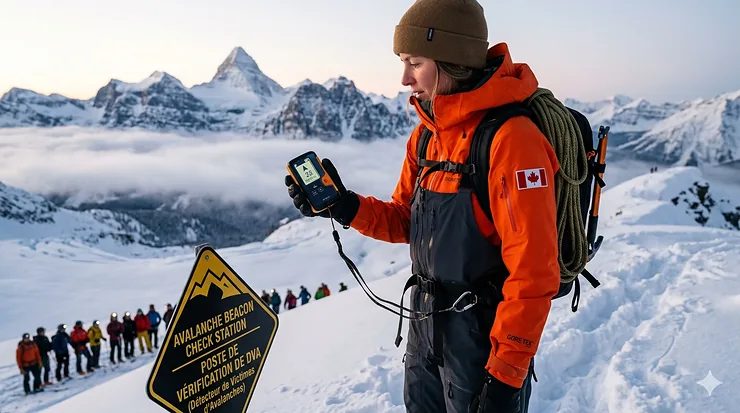
Picture this: you’re carving powder through British Columbia’s Coastal Range, and within seconds, the mountain shifts beneath your skis. This isn’t fiction — avalanches claim lives across Canada’s mountainous terrain every winter, with approximately 80% of Canadian avalanche fatalities occurring in BC alone. An avalanche beacon transforms a burial from nearly certain death into a survivable emergency by cutting search time from hours to minutes.
Here’s what most Canadian buyers overlook when shopping for transceivers: your beacon isn’t just a device you wear — it’s the difference between a 90% survival rate in the first 15 minutes and a 30% chance after 35 minutes of burial. The Canadian backcountry presents unique challenges that American gear reviews rarely address: extreme temperature swings from -30°C in the Rockies, deep maritime snowpacks on the Coast Range, and multi-day treks where battery performance in frigid conditions becomes critical. Whether you’re ski touring in Quebec’s Chic-Chocs, splitboarding Revelstoke’s sidecountry, or snowmobiling in Yukon’s remote terrain, understanding how beacons perform in Canadian conditions isn’t optional — it’s survival knowledge.
Quick Comparison: Top 7 Avalanche Beacons Available on Amazon.ca
| Model | Range | Antennas | Battery Life | Price Range (CAD) | Best For |
|---|---|---|---|---|---|
| Mammut Barryvox S2 | 70m | 3 | 300+ hrs | $650-$750 | Professionals & advanced users |
| BCA Tracker 4 | 50m | 3 | 250+ hrs | $475-$550 | Fast single-burial searches |
| Black Diamond Recon X | 60m | 3 | 300+ hrs | $500-$600 | Budget-conscious performance |
| Ortovox Diract Voice | 50m | 3 | 300+ hrs | $575-$675 | Voice-guided beginners |
| Mammut Barryvox 2 | 70m | 3 | 300+ hrs | $450-$525 | Best value Mammut |
| BCA Tracker S | 50m | 3 | 250+ hrs | $350-$425 | Entry-level simplicity |
| Arva Evo BT | 60m | 3 | 200+ hrs | $525-$625 | Bluetooth connectivity |
💬 Just one click — help others make better buying decisions too! 😊
Top 7 Avalanche Beacons for Canadian Backcountry: Expert Analysis
1. Mammut Barryvox S2 — The Professional’s Choice
The Barryvox S2 represents Mammut’s latest evolution in beacon technology, and it’s become the go-to choice for Canadian mountain guides and ACMG-certified professionals for good reason. This Swiss-engineered transceiver packs guided fine search technology that essentially eliminates the bracketing confusion most beginners struggle with during practice drills.
The standout feature is its 70-metre search strip width, which means you cover more ground with each pass across an avalanche debris field — crucial when you’re searching vast Canadian slide paths that can span hundreds of metres. The Memory-in-Pixel display remains crystal clear even through polarised glacier glasses in bright spring sunshine on the Columbia Icefields. What the spec sheet won’t tell you: the S2’s compact profile (smaller than previous Barryvox models) fits comfortably in chest pockets without that bulky feel during long ski approaches, and the two AAA batteries (versus three in older models) reduce weight by 30 grams while extending battery life to 300+ hours in transmit mode.
For Canadian users specifically, there’s a significant advantage: the S2 includes voice guidance functionality in Canada (disabled in the US due to patent disputes), providing verbal coaching during searches — “Move left,” “Begin fine search” — which reduces cognitive load when stress levels peak. Canadian reviewers consistently praise its performance in deep burial scenarios common in maritime snowpacks.
Pros:
✅ Guided fine search eliminates bracketing errors for beginners
✅ 70m range handles Canada’s large avalanche paths efficiently
✅ Voice guidance available in Canada (not US models)
Cons:
❌ Premium pricing around $700 CAD puts it out of reach for recreational users
❌ Advanced features create a steeper learning curve initially
Canadian Customer Feedback: “Used this all season in Rogers Pass — the guided search is brilliant when you’re shaking with adrenaline. Battery lasted through 60+ days of touring without replacement.” — BC backcountry skier review on Amazon.ca
Price Range: Around $650-$750 CAD. For professional guides or serious backcountry enthusiasts logging 40+ days per season in avalanche terrain, the investment pays dividends in rescue confidence and capability.
2. BCA Tracker 4 — Lightning-Fast Processor for Single Burials
The Tracker 4 has earned its reputation as North America’s most widely used beacon through pure processing speed and dead-simple operation. BCA’s instant-read feedback system updates distance and direction in real-time as you move, rather than the delayed readings some European models provide — this means you make micro-adjustments on the fly during coarse search, shaving precious seconds off rescue time.
The rubberised over-moulded case is built for Canadian abuse: I’ve seen Tracker 4s survive impacts with trees during avalanche burials, drops onto ice, and submersion in spring meltwater without malfunction. The larger LED display and louder speaker (upgraded from the Tracker 3) perform reliably in howling Coastal Range storms where visibility drops to arm’s length. Battery life hits 250+ hours in transmit mode using standard AAA alkalines, though performance drops 10-15% in extreme cold below -25°C — keep spare batteries in an inner pocket pre-warmed.
What sets the Tracker 4 apart for Canadian conditions: the motion-sensing auto-revert function automatically switches from search back to transmit if you’re stationary for four minutes, protecting you in secondary avalanche scenarios common in heavily wind-loaded terrain. Signal suppression mode handles double burials adequately, though the system automatically un-suppresses after 60 seconds, which can create confusion in complex multi-burial scenarios with three or more victims.
Pros:
✅ Fastest processing speed delivers quickest single-burial searches
✅ Rubberised case survives harsh Canadian backcountry impacts
✅ Motion-sensing auto-revert protects rescuers in secondary slides
Cons:
❌ 50m range shorter than Mammut models for large debris fields
❌ Signal suppression auto-clears after 60 seconds, complicating multi-burials
Canadian Customer Feedback: “Six winters in Revelstoke, never failed once. Batteries last all season even with -30°C starts. Simple is fast when it counts.” — Amazon.ca verified purchase
Price Range: $475-$550 CAD. Best value for recreational tourers and snowmobilers who prioritise speed and reliability over advanced features.
3. Black Diamond Recon X — Budget-Conscious Performance
The Recon X delivers surprising capability for its mid-tier price point, running on the same Pieps processor that powers Black Diamond’s professional Guide BT model. The 60-metre circular range strikes a practical balance for most Canadian avalanche scenarios, and the three-antenna design provides accurate directional guidance through the full search sequence.
Bluetooth connectivity lets you update firmware through the Pieps app on your phone — essential for keeping pace with frequency drift improvements and bug fixes without mailing your beacon to a dealer. Canadian buyers get dual battery compatibility: run alkaline AAAs for 200+ hours or upgrade to lithium for 300+ hours and better cold-weather performance. During testing in Kananaskis Country, the Recon X locked onto signals quickly and maintained stable readings even when moving at jogging pace across debris — critical when you’re racing against the survival clock.
The trade-off at this price point: the screen feels small compared to Mammut’s graphic displays, and polarised sunglasses can reduce readability in bright conditions. The Recon X also lacks the guided fine search features found on premium models, so you’ll need to master traditional bracketing technique through practice. That said, the processor speed during fine search (within the critical 5-metre range) impressed our test team — it’s genuinely difficult to “overrun” the signal, meaning you can move quickly without losing the track.
Pros:
✅ Pieps processor delivers professional-grade accuracy at recreational pricing
✅ Bluetooth firmware updates keep beacon current without dealer visits
✅ Lithium battery option extends life in Canadian cold
Cons:
❌ Smaller screen harder to read with polarised glacier glasses
❌ No guided fine search — requires practised bracketing skills
Canadian Customer Feedback: “Great beacon for the price. Used it in the Bugaboos all last season. Screen could be bigger, but performance is solid.” — Alberta touring group review
Price Range: $500-$600 CAD on Amazon.ca. Ideal for intermediate backcountry users who want performance without paying for features they’ll rarely use.
4. Ortovox Diract Voice — Talking Your Way Through Rescue
The Diract Voice takes a radically different approach to beacon design by adding verbal instructions in nine languages to guide you through each search phase. When you’re operating on zero sleep after a 3am alpine start, hands frozen inside mitts, and adrenaline flooding your system, hearing “Move forward” or “Begin fine search” reduces the mental load dramatically.
The graphic display (one of only four beacons worldwide with pixel-level control) shows floating arrows that behave like a compass needle, pointing behind you if you’ve passed the victim — uniquely intuitive compared to traditional fixed direction indicators. The 50-metre range is adequate for most Canadian scenarios, though you’ll want to use narrower search strip spacing (20-25m) compared to longer-range beacons. Ortovox’s flagging function sits front-and-centre with a dedicated button marked by a flag icon — impossible to miss even with bulky gloves.
Canadian-specific consideration: the Diract Voice ships to Canada without restriction (voice features disabled in some US states), and the bilingual capabilities suit Quebec’s backcountry where French-speaking and English-speaking groups often tour together. The device runs warm in extreme cold, which some users appreciate but others find concerning regarding battery drain — in practice, 300+ hours transmit time holds even at -20°C if you use quality batteries.
Pros:
✅ Voice instructions reduce cognitive load during high-stress rescues
✅ Graphic display with floating arrows provides intuitive direction
✅ Bilingual capability suits Quebec’s mixed-language groups
Cons:
❌ 50m range requires narrower search strips on large debris fields
❌ Voice commands can be distracting to users who prefer visual-only
Canadian Customer Feedback: “The talking feature seemed gimmicky until I used it during an actual search in Whistler backcountry. Made everything clearer when I was panicking.” — BC review
Price Range: Around $575-$675 CAD. Perfect for beginners taking their first AST-1 course or recreational users who value the extra guidance layer.
5. Mammut Barryvox 2 — Streamlined Mammut Value
The Barryvox 2 strips away the S2’s professional features (no analog mode, no pro search settings, no guided fine search) whilst retaining the core performance that made Mammut beacons legendary: 70-metre search strip width, reliable signal acquisition, and that brilliant Memory-in-Pixel display that stays readable in any light condition.
For most recreational Canadian backcountry users — weekend warriors hitting Rogers Pass, families touring Kicking Horse sidecountry, snowmachiners exploring Sicamous — this simplified version delivers everything you actually need. The flagging function works reliably for double burials (which account for roughly 90% of multi-victim scenarios), and the auto-revert safety feature protects you from secondary slides. The compact form factor slips into jacket pockets without the bulk of older Barryvox S models, and the two-battery design keeps weight down for long approaches.
What you lose compared to the S2: the guided fine search that helps beginners, the extended analog mode for professional rescuers, and the pro check function for verifying group beacon health. What you gain: $200+ CAD in savings that could fund an AST-2 course or a quality probe and shovel. Canadian mountain guides consistently recommend this as the “sweet spot” beacon for recreational tourers who’ve completed avalanche training and practice regularly.
Pros:
✅ Full 70m Mammut range in a stripped-down, affordable package
✅ Memory-in-Pixel display excels in Canadian bright-sun conditions
✅ $200+ savings versus S2 funds other safety gear or training
Cons:
❌ No guided fine search means you must master bracketing technique
❌ Limited to basic functions — not suitable for professional use
Canadian Customer Feedback: “Perfect for weekend touring. Has the range and reliability without features I’d never use. Money saved bought me a proper shovel.” — Amazon.ca review
Price Range: $450-$525 CAD. The best value in Mammut’s lineup for recreational backcountry enthusiasts.
6. BCA Tracker S — Entry-Level Simplicity
The Tracker S represents pure simplicity: turn it on, and it works. No motion-sensing, no upgradeable software, no advanced features to confuse you during an emergency — just the proven BCA processor, instant-read display, and that characteristic ease of use that made the Tracker series North America’s bestseller.
For first-time beacon buyers completing their AST-1 course, the Tracker S removes decision paralysis. The interface is so straightforward that you can hand it to someone with zero training and they’ll successfully complete a basic search within minutes (though proper training remains mandatory before entering avalanche terrain). The 50-metre range handles most Canadian recreational scenarios adequately, and the signal suppression function, whilst basic, works reliably for the double-burial scenarios most recreational users will encounter.
The budget-friendly pricing makes this the go-to recommendation for cost-conscious Canadians building their first backcountry setup. Pair the money saved with a proper probe (minimum 240cm for Canadian snowpack depths) and a bomber shovel, and you’ve got a complete rescue kit under $600 CAD total. Battery life hits 250+ hours on alkalines, though performance drops in extreme cold — keep the beacon in an inner pocket against your body when temperatures plunge below -25°C.
Pros:
✅ Dead-simple operation perfect for nervous beginners
✅ Budget pricing allows investment in training courses
✅ Proven BCA reliability with minimal features to malfunction
Cons:
❌ Lacks motion-sensing auto-revert for secondary avalanche protection
❌ No firmware updates — what you buy is what you get forever
Canadian Customer Feedback: “Bought this for my first season touring. Six months later, still works perfectly. Kept it simple, which I needed as a beginner.” — Ontario review
Price Range: $350-$425 CAD on Amazon.ca. Ideal for recreational users, rental fleets, and anyone prioritising simplicity over features.
7. Arva Evo BT — Bluetooth-Connected French Engineering
The Arva Evo BT brings French avalanche expertise to Canadian mountains with a compelling feature set at a competitive price point. The 60-metre stated range performs reliably in field testing, and the flagging/signal suppression function handles multiple burials with the screen displaying up to four individual victims plus a plus sign for additional burials — more detailed feedback than most beacons in this price range.
Bluetooth connectivity enables firmware updates through the Arva app, keeping your beacon current as manufacturers refine algorithms and add features. The group check mode initiated during power-on helps verify your partners’ beacons are transmitting properly before heading into terrain — a ritual that’s saved lives when someone’s beacon malfunctioned overnight. Arva includes an electronic interference warning: if a phone, radio, or GPS gets too close during transmit, the beacon beeps loudly and displays a warning icon — essential in an era where everyone carries electronics.
Canadian consideration: Arva beacons are less common in North America than BCA or Mammut, which means fewer guides and instructors are intimately familiar with their operation during courses. That said, the interface proves intuitive during testing, and all modern beacons communicate universally on the 457 kHz standard frequency. The compact 198-gram weight (with batteries) makes this one of the lighter options for gram-counting ski tourers.
Pros:
✅ Bluetooth updates keep beacon current with latest features
✅ Electronic interference warning protects against phone/radio issues
✅ Lightweight design suits long Canadian backcountry traverses
Cons:
❌ Less common in Canada means fewer instructors familiar with it
❌ Auto-unflag after 60 seconds can cause confusion in multi-burials
Canadian Customer Feedback: “Solid beacon. The interference warning went off when I forgot my phone in my jacket — saved me from a false sense of security.” — Quebec review
Price Range: Around $525-$625 CAD. Great choice for tech-savvy users who value connectivity and ongoing improvements.
How to Set Up Your New Beacon for Canadian Conditions
Getting your beacon field-ready involves more than just inserting batteries. Start by performing a self-test: turn the beacon on and verify it completes its automatic diagnostic check without error codes. Next, conduct a transmission check by placing it in send mode and having a partner walk a box pattern at 50 metres to verify your beacon’s transmission reaches its stated range — Canadian snowpack varies dramatically from dry Rockies powder to wet Coastal cement, and transmission performance can differ.
Battery selection matters more in Canadian cold than most reviews mention. Standard alkaline AAAs provide adequate performance down to -10°C, but below that threshold, output drops rapidly. Lithium AAAs (available for most models) maintain 90%+ performance down to -30°C, critical for early-season touring in the Canadian Rockies or late-season Yukon expeditions. Never use rechargeable NiMH batteries in avalanche beacons — their voltage profile causes unreliable performance, and most manufacturer warranties explicitly void coverage if rechargeables were used.
Storage protocol for Canadian seasonal touring: remove batteries before summer storage to prevent corrosion from humidity in coastal climates. Store the beacon in a dry, temperate location away from direct sunlight — not in your vehicle where summer temperatures can exceed 50°C and damage electronic components. Before each season, replace batteries even if they “test good” with a multimeter — the $10 CAD battery cost pales against the consequences of failure.
Practice Drills Every Canadian Needs
Book time every month during winter to run beacon drills with your regular touring partners. Set up single-burial scenarios first: bury a beacon 1-2 metres deep in snow, mark the location with a wand, then practise the full search sequence from signal acquisition through probe strike. Time yourself — your first searches will likely take 8-12 minutes, but with practice, competent users reduce this to 3-5 minutes for single burials.
Progress to multiple-burial drills by hiding two beacons 10-15 metres apart. This is where you’ll discover whether your beacon’s flagging function actually makes sense under stress, or whether the interface becomes confusing when multiple signals overlap. Canadian avalanche courses emphasise that 15% of avalanche incidents involve multiple burials, and the complexity increases exponentially — a three-victim scenario is exponentially harder than searching for one person.
Winter-specific practice: conduct drills in varying conditions. A beacon search in -5°C with bare hands feels completely different than -25°C with thick mitts and numb fingers. Practice in wind, practice in flat light, practice when you’re exhausted from skinning — these are the conditions where Canadian rescues actually happen, not the sunny, calm days when practice feels easy.
Common Mistakes Canadian Beacon Buyers Make
Mistake 1: Ignoring Battery Performance in Extreme Cold
Most beacon reviews test at room temperature, but Canadian backcountry regularly sees -20°C to -30°C starts. Alkaline batteries lose 30-50% capacity below -15°C, meaning your “250-hour” battery life becomes 125-150 hours in reality. Solution: upgrade to lithium batteries for winter use ($15 CAD for a three-pack pays for itself in reliability), and carry spares in an inner pocket pre-warmed against your body.
Mistake 2: Buying Based on Range Alone
A beacon with 70-metre range sounds superior to 50-metre models, but real-world Canadian avalanche searches rarely exploit maximum range. Debris field width matters more than length for search efficiency, and the time spent walking a perfect grid at 70-metre spacing versus 50-metre spacing differs by seconds, not minutes. Processing speed, interface clarity under stress, and flagging function reliability matter far more than raw range specifications.
Mistake 3: Skipping Regular Practice
Owning a beacon doesn’t make you safer — competent use does. Canadian mountain guides report that 70%+ of recreational users they encounter in the backcountry cannot demonstrate basic beacon search competency when asked casually. The beacon you can operate flawlessly under stress is infinitely better than the most expensive model you’ve never practised with. Schedule monthly practice drills, take refresher courses every two years, and treat beacon skills like CPR — they decay without regular practice.
Mistake 4: Forgetting About Probe and Shovel
Beacons get you within 50cm of the victim, but probe and shovel complete the rescue. Too many Canadian recreational users invest $500+ in a beacon then buy a $30 collapsible probe and lightweight snow shovel — completely backwards priority. Budget equally across the rescue trinity: beacon ($400-500), probe ($80-120 for a quality 300cm model suited to Canadian snowpack depth), and shovel ($100-150 for a bomber aluminum or steel blade). The bottleneck in most rescues isn’t locating the victim — it’s excavating them.
BCA Tracker vs Mammut Barryvox: The Great Canadian Debate
Walk into any Canadian ski hut and you’ll find the backcountry community split between BCA Tracker loyalists and Mammut Barryvox devotees. The division runs deeper than brand preference — it represents fundamentally different philosophies about what makes a beacon effective.
The BCA Tracker series prioritises speed and simplicity. The processor updates in real-time, the interface uses minimal icons and maximum clarity, and the learning curve tops out quickly. Most Canadian recreational users complete AST-1 courses using Tracker models, which means muscle memory and familiarity run deep. In single-burial scenarios (85% of all avalanche rescues), Trackers consistently post faster search times than competing models in blind testing. The trade-off: Tracker signal suppression feels basic compared to Mammut’s sophisticated multi-burial management, and the 50-metre range can feel limiting on massive Canadian slide paths.
Mammut Barryvox models deliver professional-grade capability with deeper feature sets. The 70-metre range covers more ground per pass, the guided fine search (on S2 models) eliminates bracketing confusion, and the analog mode provides tools for complex rescues beyond recreational scope. Canadian mountain guides and patrol professionals disproportionately choose Barryvox models for these capabilities. The trade-off: steeper learning curves, more complex interfaces under stress, and premium pricing that puts them beyond many recreational budgets.
The Canadian verdict: If you’re a weekend warrior logging 10-20 backcountry days per season in groups of 2-4 people, the BCA Tracker 4 delivers everything you need with proven reliability at fair pricing. If you’re working towards ACMG credentials, guiding commercially, or regularly operating in complex terrain with larger groups, the Mammut Barryvox S2’s advanced capabilities justify the investment. For most Canadians, the Barryvox 2 splits the difference beautifully — Mammut’s range and reliability without features you’ll rarely use.
Best Avalanche Transceiver for Different Canadian Users
For Quebec Backcountry Tourers
The Ortovox Diract Voice makes exceptional sense for Quebec’s bilingual backcountry community. Voice guidance in French and English supports mixed-language groups common in the Chic-Chocs and Laurentians, and the intuitive graphic display translates universally regardless of verbal language preference. Quebec’s generally lower-elevation terrain (compared to Western ranges) means the 50-metre range handles debris fields adequately.
For British Columbia Steep Skiing
BC’s massive vertical and extensive slide paths demand beacons with maximum range and robust multiple-burial capability. The Mammut Barryvox S2 excels in Rogers Pass, the Spearhead Traverse, and Coastal Range zones where debris can run 500+ vertical metres. The guided fine search helps when you’re exhausted from high-consequence skiing, and the voice guidance (available in Canadian models) provides support during high-stress scenarios.
For Alberta/BC Rockies Touring
The Canadian Rockies present moderate terrain, frequent touring, and cold temperatures. The BCA Tracker 4 dominates this zone for good reason: proven reliability in extreme cold, fast processing for the single-burial scenarios common on popular routes, and pricing that lets you invest remainder budget in quality probes and shovels suited to deep Rockies snowpacks.
For Snowmobilers in Remote Terrain
Snowmobile avalanche scenarios often involve solo riders or small groups in extremely remote locations where self-rescue isn’t possible and help is hours away. The BCA Tracker S provides the simplicity needed when operating with thick gloves and limited avalanche training common in the sledding community. Pair it with mandatory group protocols: always ride with partners, always carry the rescue trinity, and always check avalanche forecasts before accessing terrain.
For Beginner AST-1 Students
First-time beacon buyers should prioritise simplicity and budget for training. The BCA Tracker S or Mammut Barryvox 2 both deliver reliable performance without overwhelming new users with features they’re not ready to utilise. Invest saved money in taking AST-2 courses, hiring guides for mentorship days, and building experience in progressively more complex terrain.
Understanding Beacon Search Range in Canadian Conditions
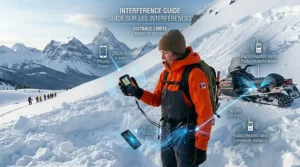
Beacon manufacturers advertise maximum ranges under ideal conditions: fresh alkaline batteries, moderate temperatures, minimal electromagnetic interference, and victims buried in dry snow. Canadian reality rarely matches these conditions. Maritime snowpack in the Coast Range contains higher water content than continental powder, reducing effective transmission range by 10-15%. Extreme cold below -25°C decreases battery output, cutting effective range similarly. Metal objects in backpacks (ice axes, crampons, trekking poles) create electromagnetic interference zones that distort signals within 20-30cm of the beacon.
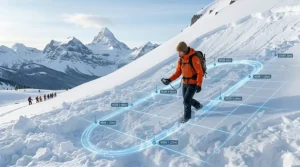
The practical implication: a beacon rated for 50-metre range realistically performs at 40-45 metres in typical Canadian backcountry conditions. Plan your search strip spacing accordingly — if you’re searching a debris field with a 50-metre beacon, use 35-40 metre spacing to ensure overlap, not the theoretical 50-metre maximum. Conservative spacing costs you 30-60 seconds during the initial sweep but virtually guarantees signal acquisition.
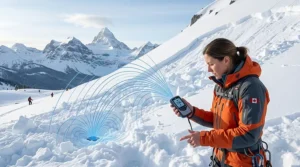
Range also depends on burial orientation. Beacons transmit in a dipole pattern (figure-eight radiation), meaning transmission strength varies based on the angle between your beacon’s antenna and the buried beacon’s antenna. The strongest signal occurs when antennas align parallel; the weakest when they’re perpendicular. Modern three-antenna beacons compensate for this through antenna switching, but physics still constrains maximum coupling distance. Deep burials (beyond 2.5 metres — rare but possible in Canadian maritime zones) push the limits of even long-range beacons.
Digital vs Analog Beacon: What Canadian Buyers Need to Know
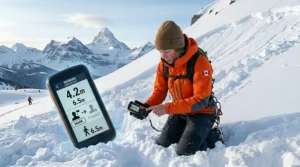
The analog versus digital debate has largely settled — digital beacons dominate the market and deliver superior performance for 95% of users. Analog beacons (virtually extinct in new sales) require significant training to use effectively, relying on audio tone interpretation rather than distance/direction displays. The learning curve is steep, and competency degrades rapidly without constant practice.
That said, some modern digital beacons include analog modes for specific scenarios. The Mammut Barryvox S2 and Barryvox S offer analog functionality primarily for professional users dealing with deep burials, complex multi-victim scenarios, or electromagnetic interference. In analog mode, you hear the raw radio tone — louder and faster as you approach the victim — which provides information beyond digital processing. Canadian mountain guides appreciate analog capability for edge cases: buried beacons below 3 metres in maritime snowpack, scenarios with 4+ victims in close proximity, or interference-heavy environments near communication towers or ski lifts.
For recreational Canadian backcountry users, digital-only beacons (like the BCA Tracker series or Mammut Barryvox 2) deliver everything needed. The processor handles signal interpretation, the display provides clear direction/distance, and the interface works reliably under stress. Save the analog-capable models for professional use or advanced users who’ve mastered digital search and want additional tools for complex scenarios.
Multiple Burial Beacon Performance: What Actually Matters
Statistics from Canadian avalanche incidents show that roughly 15% involve multiple burials, with 3+ victims comprising less than 5% of total accidents. Yet multiple burial capability dominates beacon marketing and drives significant price differentiation. Understanding what features actually matter helps Canadian buyers avoid overpaying for capabilities they’ll rarely use.
Signal suppression (or flagging) allows you to mark a found victim and search for additional signals. Basic suppression (BCA Tracker 4, Tracker S) lets you flag the strongest signal once located; the beacon then ignores that signal and displays the next victim. Advanced suppression (Mammut Barryvox S2, Ortovox Diract Voice) shows multiple victim counts, allows selective flagging from a list, and provides sophisticated signal management.
The practical reality: most double burials occur with victims 10+ metres apart, making suppression straightforward even with basic systems. Triple and quadruple burials with victims within 5 metres of each other — where advanced suppression truly shines — occur so rarely that most recreational users will never encounter such scenarios. The advanced features justify cost for professionals running regular rescue operations, but recreational users rarely exploit them.
Canadian mountain guides recommend focusing on single-burial competency first. Master the signal search, coarse search, and fine search phases until you can execute flawlessly while exhausted and scared. Then progress to double-burial practice with basic suppression. Only users working towards professional credentials or operating commercially need to master the complex multi-burial scenarios that justify premium beacon costs.
Beacon Battery Life: Canadian Winter Reality Check
Manufacturer specifications for battery life assume moderate temperatures (0°C to 20°C) and fresh alkaline cells. Canadian backcountry reality involves temperatures from -30°C to +10°C, used batteries from last season, and extended transmit times during long approaches. Understanding real-world battery performance prevents the nightmare scenario of a beacon failing mid-rescue.
Alkaline AAA batteries provide the baseline: 200-250 hours transmit time at moderate temperatures, dropping to 125-175 hours below -15°C. The voltage sag in cold conditions manifests as reduced transmission strength and unreliable receiver performance. Lithium AAAs (available for most models) maintain 90%+ performance down to -30°C and deliver 300+ hours transmit time, but cost 3-4x more than alkalines ($15 CAD vs $4 CAD for a three-pack).
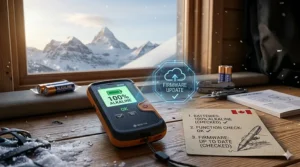
Canadian protocol: start each season with fresh batteries regardless of last season’s usage, carry spares in an inner pocket, and switch to lithium for multi-day trips or extreme cold conditions. Many beacons display battery status on power-up — don’t ignore warnings. A beacon showing “low battery” typically has 10-20% remaining, adequate for a day but risky for extended use. Replace immediately rather than gambling on remaining life.
Battery compartment maintenance matters in coastal climates. Humidity-driven corrosion ruins battery contacts, causing intermittent failures that might not show during casual self-tests. After each season, remove batteries for storage and clean contacts with a pencil eraser or contact cleaner. Inspect for green corrosion — if present, clean thoroughly or replace the beacon entirely if corrosion has progressed into the circuitry.
❓ Frequently Asked Questions: Avalanche Beacons in Canada
❓ Can I use my avalanche beacon for snowmobiling in Canada?
❓ Do avalanche beacons work in extremely cold Canadian winters?
❓ How long do avalanche beacons last before replacement?
❓ Are avalanche beacons required by law in Canada?
❓ Can I buy a used avalanche beacon on Amazon.ca or Kijiji?
Conclusion: Choosing Your Canadian Backcountry Beacon
Selecting the right avalanche beacon for Canadian conditions comes down to matching capability to your actual usage patterns, not buying the fanciest model or cheapest option. Weekend tourers logging 15-25 days per season in moderate terrain gain little from professional-grade features, whilst guides and patrollers operating commercially need every advantage when managing client safety.
The BCA Tracker 4 emerges as the overall best choice for most Canadian recreational users: proven reliability in extreme cold, lightning-fast processing for single burials, reasonable pricing that lets you invest in training and complementary gear. For professionals or serious enthusiasts, the Mammut Barryvox S2 delivers unmatched capability with guided search features and 70-metre range. Budget-conscious buyers should consider the Mammut Barryvox 2 or BCA Tracker S — both provide reliable core functionality without premium features you may never use.
Remember that your beacon represents just one-third of the rescue equation. Invest equally in a quality probe (minimum 280cm for Canadian snowpack), a bomber shovel with a metal blade and telescoping handle, and most critically, comprehensive training through AST courses and regular practice drills. The beacon gathering dust in your pack saves no one — competent use backed by practiced skills makes the difference between tragedy and successful rescue.
Check current availability and pricing on Amazon.ca, verify your chosen model isn’t subject to recalls through manufacturer websites, and commit to monthly practice before the season starts. The Canadian backcountry offers world-class skiing, riding, and snowmobiling — respect the avalanche hazard by equipping and training properly.
✨ Don’t Miss These Exclusive Deals!
🔍 Take your backcountry safety to the next level with these carefully selected avalanche beacons. Click on any highlighted product above to check current pricing and availability on Amazon.ca. These devices will help you create safer backcountry experiences your partners will appreciate!
Recommended for You
- 7 Best Ice Auger Canada Options: 2026 Expert Picks
- 7 Best Portable Ice Fishing Huts Canada 2026
- 7 Best Ice Fishing Shelters Canada 2026
Disclaimer: This article contains affiliate links. As an Amazon Associate, I earn from qualifying purchases. If you purchase products through these links, we may earn a small commission at no additional cost to you.
✨ Found this helpful? Share it with your friends! 💬🤗
