
In This Article
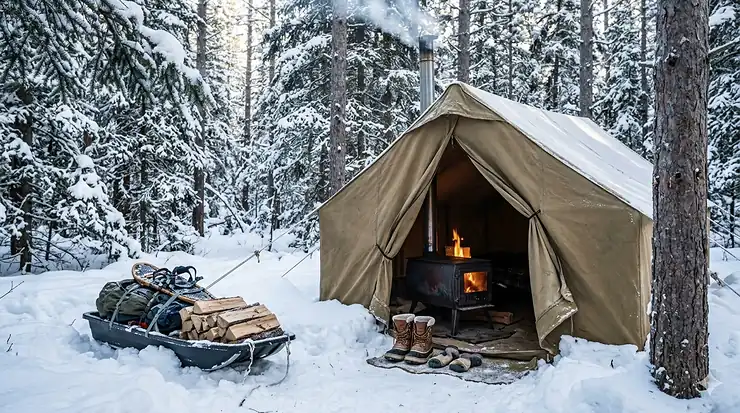
Picture this: you’re nestled in your tent somewhere in the Canadian Rockies, temperatures hovering around -15°C, and you desperately need that morning coffee. You pull out your trusty summer canister stove, press the igniter, and… nothing. The fuel’s too cold to vaporize, and you’re left shivering with no way to melt snow or cook breakfast.
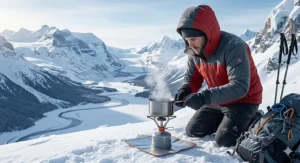
I’ve been there, and trust me—it’s not an experience you want to repeat.
A winter camping stove isn’t just a nice-to-have; it’s essential survival equipment when you’re battling Canadian winters. Unlike their three-season cousins, proper winter camping stoves are engineered to perform reliably in sub-zero temperatures, handle fierce winds that sweep across frozen lakes, and deliver consistent heat when your fingers are already going numb.
According to portable stove history documented by Wikipedia, the evolution of camping stoves has been driven largely by extreme-condition performance needs—exactly what Canadian winter campers face every season. From the rugged liquid-fuel designs that powered early Arctic expeditions to today’s sophisticated multi-fuel systems, winter stoves have become remarkably reliable machines.
But here’s the thing: not all “winter-rated” stoves are created equal. Some excel in brutal cold but weigh a tonne. Others pack light but struggle when winds pick up. The key is matching your stove to your specific winter adventures—whether that’s ice fishing on Great Slave Lake, ski touring through Kananaskis, or winter backpacking in Algonquin Park.
In this comprehensive guide, I’ll walk you through the seven best winter camping stoves available in Canada right now, compare liquid fuel versus canister options, break down the MSR WhisperLite versus XGK debate, and give you the insider knowledge you need to choose the perfect cold-weather cooking companion for 2026.
Quick Comparison Table: Top Winter Camping Stoves at a Glance
| Stove Model | Type | Weight | Fuel Type | Price (CAD) | Best For |
|---|---|---|---|---|---|
| MSR WhisperLite Universal | Multi-fuel | 399g | Liquid + Canister | $199-229 | Versatility & expedition use |
| Jetboil MiniMo | Integrated canister | 415g | Isobutane/propane | $169-199 | Fast boiling & simmer control |
| SOTO WindMaster | Canister with regulator | 87g | Isobutane/propane | $95-119 | Ultralight wind resistance |
| MSR XGK EX | Liquid fuel only | 430g | Multi-fuel | $249-279 | Extreme cold & high altitude |
| Coleman Guide Series | Dual burner | 5.4kg | Propane | $149-179 | Base camp cooking |
| Primus OmniFuel II | Multi-fuel | 341g | All fuels | $239-269 | International travel |
| Jetboil Flash | Integrated canister | 440g | Isobutane/propane | $139-159 | Speed & convenience |
💬 Just one click – help others make better buying decisions too! 😊
Top 7 Winter Camping Stoves: Expert Analysis
1. MSR WhisperLite Universal – The Ultimate All-Rounder
Specifications: 399g | 2800 BTU | Liquid fuel + canister compatible | Made in USA
If I had to choose just one stove for Canadian winter conditions, this would be it. The MSR WhisperLite Universal gives you the flexibility to run either liquid fuels (white gas, kerosene, unleaded gasoline) or isobutane canisters—a game-changer when you’re planning extended trips or traveling to remote areas where fuel availability is uncertain.
What sets this stove apart is its hybrid design. You get the cold-weather reliability of a liquid-fuel system combined with the convenience of canister fuel when conditions aren’t as brutal. The AirControl technology optimizes the fuel-air mixture regardless of which fuel you’re burning, delivering consistent performance whether it’s -5°C or -30°C.
Price Range: $199-229 CAD on Amazon.ca
Canadian Availability: Readily available with Prime shipping across Canada
Customer Feedback: Canadian backcountry users consistently praise its reliability in Yukon winters and Rocky Mountain expeditions. One reviewer from Whitehorse noted it performed flawlessly at -28°C during a two-week ski touring trip.
✅ Pros:
- Burns multiple fuel types (ultimate flexibility)
- Excellent cold-weather performance with liquid fuel
- Can simmer when using canister mode
- Field-maintainable with included repair kit
❌ Cons:
- Higher price point than single-fuel options
- Requires priming when using liquid fuels (learning curve for beginners)
2. Jetboil MiniMo – The Simmer Master
Specifications: 415g system weight | 6000 BTU regulated | 1L FluxRing pot | Piezo ignition
The Jetboil MiniMo addresses the biggest complaint about integrated canister systems: terrible simmer control. This stove actually lets you cook real food, not just boil water. I’ve successfully made risotto and gently rehydrated delicate ingredients without scorching them—something nearly impossible with most integrated systems.
Its regulator valve maintains consistent output down to -6°C, making it suitable for shoulder-season and moderate winter camping across most of Canada. The wide 1-litre pot is perfect for actual cooking rather than just adding hot water to freeze-dried meals, and the low profile provides excellent stability even when you’re cooking inside your tent vestibule.
Price Range: $169-199 CAD
Shipping: Available through Amazon.ca with fast delivery to urban centres
Customer Reviews: Ontario winter campers love this for Algonquin and Killarney trips. Several users mention using it successfully down to -10°C with proper canister management.
✅ Pros:
- Outstanding simmer control for a canister system
- Regulated for consistent performance
- Fast boil times (under 2.5 minutes)
- Push-button ignition works reliably
❌ Cons:
- Performance drops significantly below -10°C
- More expensive than basic canister stoves
3. SOTO WindMaster – Lightweight Wind Warrior
Specifications: 87g (with 4Flex) | 11000 BTU | Micro-regulator | Piezo ignition
Don’t let the featherweight fool you—the SOTO WindMaster punches well above its weight class. At just 87 grams with the 4Flex pot support, it’s one of the lightest regulated canister stoves you can buy, yet it handles Canadian prairie winds and alpine gusts better than stoves twice its size.
The secret is the concave burner head design that creates a built-in windscreen effect, plus the micro-regulator that maintains stable output as your canister pressure drops. I’ve used this extensively for winter ski touring in the Rockies, and it consistently delivers hot meals even when winds are howling at 40 km/h.
Price Range: $95-119 CAD
Canadian Distribution: Ships from Canadian fulfillment centres via Amazon.ca
User Experiences: Highly rated by PCT and CDT hikers who’ve tested it in diverse conditions. Canadian mountain guides frequently recommend it for its wind resistance and reliability.
✅ Pros:
- Exceptionally lightweight for a regulated stove
- Superior wind performance for its class
- Precise flame control
- Reliable piezo igniter
❌ Cons:
- Pot supports need assembly each use (minor annoyance)
- Performance still degrades below -15°C (physics, not design)
4. MSR XGK EX – The Expedition Workhorse
Specifications: 430g | 9000 BTU liquid fuel | Multi-fuel capable | Shaker Jet cleaning
When you’re heading into serious winter territory—think Baffin Island expeditions or Yukon wilderness trips—the MSR XGK EX is the stove professional guides reach for. This is pure liquid-fuel reliability engineered for the harshest conditions on Earth.
It burns white gas, kerosene, diesel, and unleaded gasoline with equal efficiency, making it ideal for international expeditions or remote Canadian locations where fuel choices are limited. The suspended burner design and large-diameter fuel line deliver impressive heat output—perfect for melting snow quickly when you need to produce water for a large group.
Price Range: $249-279 CAD
Availability: Stock varies seasonally; best to order in fall for winter trips
Performance Notes: Users report successful operation down to -40°C in Northwest Territories winter camping. It’s heavy, but when reliability matters more than weight, nothing beats it.
✅ Pros:
- Unmatched cold-weather performance
- Burns virtually any liquid fuel
- Fast melting and boiling (9000 BTU)
- Legendary durability
❌ Cons:
- Heavy compared to canister options
- Louder operation (roaring sound)
- No simmer control
5. Coleman Guide Series Dual Burner – The Base Camp King
Specifications: 5.4kg | 22,000 BTU total (2 burners) | Propane | Windscreens included
For ice fishing shacks, car camping, or established base camps, the Coleman Guide Series delivers serious cooking power. This isn’t a backpacking stove—it’s a proper camp kitchen that can handle cooking for families or groups without the constant fuel-canister juggling.
Two independent 11,000 BTU burners mean you can have soup simmering on one side while you’re frying fish on the other. The built-in windscreens actually work (unlike some competitors), and the whole thing folds into a compact case for transport.
Price Range: $149-179 CAD
Distribution: Widely available at Canadian Tire, Walmart, and Amazon.ca
User Base: Popular among ice-fishing communities across the Prairies and Ontario cottage country for winter weekends.
✅ Pros:
- High heat output for group cooking
- Stable platform for large pots
- Easy to use (like cooking at home)
- Affordable for dual-burner design
❌ Cons:
- Way too heavy for backpacking (5.4kg)
- Requires larger propane cylinders
- Takes up significant space
6. Primus OmniFuel II – The Globetrotter’s Choice
Specifications: 341g | 3000W | Burns all fuel types | ErgoPump included
The Primus OmniFuel II might be the most versatile stove on this list. It’s specifically engineered to burn gas, gasoline, diesel, kerosene, and even aviation fuel—a crucial capability if you’re planning Arctic expeditions or traveling to places where North American fuel standards don’t apply.
Swedish engineering means precise manufacturing tolerances and a reputation for reliability that spans decades. The included ErgoPump features a pressure gauge—a rare luxury that takes the guesswork out of priming. I particularly appreciate the excellent simmer control for a liquid-fuel stove, making it suitable for actual cooking rather than just water boiling.
Price Range: $239-269 CAD
Procurement: Available through specialty outdoor retailers and Amazon.ca
Professional Use: Chosen by Parks Canada wardens and mountain rescue teams for its reliability across fuel types.
✅ Pros:
- Burns literally any fuel
- Excellent build quality
- Better simmer control than most liquid-fuel stoves
- ErgoPump with pressure gauge
❌ Cons:
- Expensive initial investment
- More complex operation than canister stoves
7. Jetboil Flash – The Speed Demon
Specifications: 440g | 4500 BTU | 1L FluxRing pot | Push-button ignition
When speed matters more than anything else, the Jetboil Flash is unbeatable. This system boils half a litre of water in about 100 seconds flat—crucial when you’re cold, tired, and desperate for that hot drink after a long winter day.
The FluxRing technology and enclosed design create exceptional fuel efficiency, meaning you’ll carry less fuel weight for the same number of meals. While it’s not regulated like the MiniMo (so performance drops faster in cold), it’s significantly more affordable and still works well in moderate Canadian winters with proper canister management.
Price Range: $139-159 CAD
Market Position: Best-selling integrated system in Canada
User Demographics: Popular with weekend winter campers and those new to cold-weather camping who want reliability without complexity.
✅ Pros:
- Fastest boil times in its class
- Excellent fuel efficiency
- Simple, foolproof operation
- Colour-change heat indicator
❌ Cons:
- No pressure regulator (performance degrades with cold)
- Poor simmer control
- Limited to boiling tasks
Understanding Liquid Fuel Stove vs Canister Winter Performance
Here’s the truth that marketing departments don’t want to emphasize: in genuinely cold conditions (below -10°C), liquid fuel stoves have a significant performance advantage over canister stoves. But that doesn’t mean canister stoves are useless in winter—you just need to understand the physics.
How Temperature Affects Fuel Performance
Canister stoves rely on the fuel vaporizing inside the canister to create pressure. As noted in REI’s comprehensive backpacking stove guide, butane stops vaporizing at -1°C, while isobutane continues down to -12°C. This is why “winter” canisters contain higher ratios of propane (which vaporizes down to -42°C).
Liquid fuel stoves bypass this problem entirely. You manually pressurize the fuel bottle with the pump, so the fuel’s vaporization point doesn’t matter until it reaches the burner—where you’re intentionally heating it. This is why MSR WhisperLite and XGK stoves work flawlessly at -30°C while most canister stoves are sputtering.
The Regulator Difference
Modern regulated canister stoves like the SOTO WindMaster and Jetboil MiniMo use built-in regulators that maintain consistent gas pressure even as the canister cools and pressure naturally drops. This extends their usable temperature range significantly—typically down to -6°C to -10°C depending on the model.
Unregulated canister stoves (most budget models) suffer progressive performance degradation as temperatures drop. That lightning-fast boil time at 20°C becomes a slow simmer at -5°C.
Practical Cold-Weather Solutions
Smart winter campers using canister stoves employ several tricks:
- Sleep with your canister – body heat prevents it from getting too cold overnight
- Start with warm fuel – keep your canister in an inside pocket before use
- Use an inverted canister – liquid-feed mode provides better cold performance (requires stove compatibility)
- Choose winter blend canisters – higher propane content extends low-temp performance
But honestly? If you’re planning serious winter expeditions in Canadian conditions, a liquid fuel stove or multi-fuel system like the WhisperLite Universal provides peace of mind that’s worth the extra complexity.
MSR WhisperLite vs XGK Review: Which Expedition Stove Wins?
Both stoves are MSR legends, but they serve different purposes. I’ve used both extensively in Canadian winters, so here’s the real-world breakdown:
The WhisperLite (especially the Universal version) is your versatile expedition partner. It’s lighter (399g vs 430g), quieter, and the Universal variant’s dual-fuel capability means you can switch to canister mode for convenience when conditions permit. The trade-off? Lower heat output (2800 BTU vs 9000 BTU on the XGK).
The XGK EX is pure brute force. When you need to melt snow fast for a group, the XGK’s massive heat output is unmatched. It’s the stove you bring when reliability in absolute worst-case scenarios is non-negotiable. Think -40°C Arctic expeditions or high-altitude mountaineering where failure isn’t an option.
Real-World Performance
In moderate cold (-10°C to -20°C): The WhisperLite Universal wins for versatility. You can use canister mode for breakfast and lunch (faster, cleaner), then switch to white gas for dinner and snow melting.
In extreme cold (below -25°C): The XGK delivers more reliable performance. Its larger fuel line and higher heat output mean faster snow melting when you’re burning through fuel to produce drinking water.
For multi-week trips: The XGK’s legendary durability and simpler design (fewer parts to fail) give it the edge for long expeditions where you can’t replace a broken stove.
My recommendation? For most Canadian winter campers, the WhisperLite Universal provides better overall value. Only choose the XGK if you’re specifically planning extended cold-weather expeditions where its advantages justify the extra weight and cost.
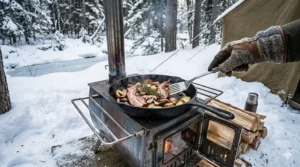
Multi-Fuel Stove for Winter: Why Flexibility Matters in Canada
Canada’s vastness presents unique fuel availability challenges. White gas might be easy to find in Banff, but try locating it in a small northern community. This is where multi-fuel capability becomes invaluable.
Multi-fuel stoves like the MSR WhisperLite Universal, Primus OmniFuel, and MSR XGK let you burn:
- White gas (naphtha) – cleanest burning, best performance
- Kerosene – widely available in northern Canada, excellent cold performance
- Unleaded gasoline – available literally everywhere with vehicles
- Diesel – common in remote areas (trucks, generators)
According to Parks Canada winter camping guidelines, proper equipment selection is crucial for safe winter adventures. Multi-fuel capability provides a safety margin when you’re traveling in remote areas where specialized camping fuels aren’t stocked.
Fuel Availability Across Canada
Southern Canada (urban areas): Easy access to white gas, isobutane canisters, and all fuel types.
Northern territories: White gas becomes harder to find; kerosene and regular gasoline are more reliable options.
Remote fly-in locations: Whatever the locals use for generators and equipment—often automotive gasoline or diesel.
Having a stove that adapts to local fuel availability isn’t just convenient—it’s a safety consideration for serious wilderness travel.
Cold Weather Stove Performance: What Actually Matters
Marketing specs tell one story. Real-world winter performance tells another. Here’s what actually matters when temperatures plummet:
1. Ignition Reliability
A stove that won’t light when your fingers are numb is worse than useless. Piezo igniters on canister stoves tend to fail in extreme cold—the materials contract and the spark gap changes. Liquid fuel stoves require priming (pre-heating), which can be challenging with frozen hands.
Solution: Always carry backup lighters in an inside pocket. Waterproof matches as a final backup.
2. Wind Resistance
According to research on portable stove designs, wind can reduce stove efficiency by 40-60% without proper shielding. Canadian prairie winds and alpine gusts are no joke.
Integrated systems (Jetboil, MSR Reactor) inherently resist wind. Open-burner designs need proper windscreens—but careful placement to avoid overheating fuel canisters.
3. Snow Melting Capacity
In winter, your stove isn’t just cooking food—it’s your water source. Melting snow is energy-intensive; you need roughly 1.5 times the fuel you’d use just to boil the same volume of water.
High-output stoves (MSR XGK at 9000 BTU) excel here. Lower-output stoves work fine but require patience and more fuel.
4. Fuel Efficiency
Cold weather demands more fuel for the same tasks. Count on 30-50% higher fuel consumption in winter versus summer. This affects both weight (carrying more fuel) and planning (resupply frequency).
Regulated canister stoves and enclosed systems (Jetboil) maintain better efficiency in cold than unregulated designs.
Stove Fuel Efficiency Winter: Making Your Fuel Last
Fuel weight adds up fast on winter trips. Here’s how to maximize efficiency:
Use pot cozies and lids: Retain heat to reduce fuel consumption by 20-30%. Many integrated systems include insulated sleeves; add aftermarket cozies to open systems.
Melt snow in batches: Start with a small amount of water to prevent burning the pot, then add snow gradually. Never pack snow tightly—it reduces melting efficiency.
Block wind properly: Even a 10 km/h breeze can double your fuel consumption. Proper windscreen placement is crucial.
Pre-warm your fuel: Whether liquid or canister, cold fuel performs poorly. Keep fuel bottles/canisters in your sleeping bag overnight or inside your jacket during the day.
Cook inside your vestibule: When safe (good ventilation!), cooking in your tent vestibule shields your stove from wind and reduces heat loss.
Choose efficient cookware: Titanium is light but terrible for heat distribution. Aluminum pots with heat exchangers (like FluxRing) are most efficient.
Fuel Consumption Estimates
For proper trip planning in Canadian winter conditions:
- Boiling only: 30-40g white gas per person per day, or one 230g canister per person per 3-4 days
- Cooking + melting snow: 60-80g white gas per person per day, or one 230g canister per person per 2 days
- Group cooking: Scale up, but not linearly—larger volumes are more efficient
Always carry 25% more fuel than your calculation suggests. Getting stranded without fuel in -20°C is not a situation you want to experience.
Windproof Camping Stove: Engineering That Makes a Difference
Not all “windproof” claims are equal. Here’s what actually works:
Design Features That Matter
Enclosed burner systems (Jetboil, MSR Reactor): The pot sits directly on the burner with minimal gap. Wind simply can’t get at the flame. These are genuinely windproof up to gale-force winds.
Recessed burners (SOTO WindMaster): The concave burner head creates a protected flame pocket. Effective up to moderate winds (30-40 km/h).
Integrated windscreens (MSR liquid fuel stoves): The included reflector/windscreen wraps around the cooking area. Works well but requires proper setup.
Low-profile designs: Keeping everything close to the ground reduces wind exposure. Tall stove + canister + tall pot = stability and wind issues.
Real-World Testing
I’ve tested stoves in Chinook winds on the Alberta prairies (gusting to 80 km/h), on exposed alpine ridges in the Rockies, and on frozen Great Slave Lake. Here’s the reality:
Truly windproof: MSR Reactor, Jetboil systems (enclosed design wins)
Very wind-resistant: SOTO WindMaster, MSR liquid fuel stoves with proper windscreen setup
Needs help: Most basic canister stoves—require aftermarket windscreens and sheltered positions
Hopeless: Alcohol stoves, solid-fuel tablets (avoid for winter unless as emergency backup only)
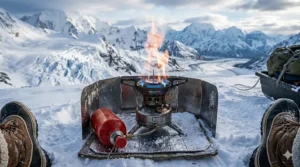
Simmer Control Winter Stove: Why It Actually Matters
“Just boil water for dehydrated meals” is fine for summer backpacking, but winter camping demands more from your food. You’re burning massive calories staying warm, and proper nutrition becomes crucial.
Why Winter Cooking Is Different
Cold temperatures mean:
- Your body needs 3000-5000 calories daily just to maintain core temperature
- Dehydrated meals alone often aren’t enough
- Fresh ingredients (cheese, cured meats, vegetables) don’t spoil in winter
- Hot, substantial meals boost morale on long, dark evenings
This means you want a stove that can actually cook, not just boil.
Stoves With Good Simmer Control
Excellent: Jetboil MiniMo, Primus OmniFuel II, MSR DragonFly
- Fine flame adjustment, stable low heat, can actually sauté
Adequate: SOTO WindMaster, MSR WhisperLite Universal (canister mode)
- Workable simmer, requires attention, fine for rice and pasta
Poor: MSR XGK, Jetboil Flash, most unregulated canister stoves
- Difficult to control, tendency to scorch food, better for boiling only
Winter Cooking Tips
Even with limited simmer control, you can cook well in winter:
- Use the “tower of power” technique: lift pot above burner using sticks or pot supports
- Partially de-pressurize liquid fuel bottles for lower output
- Cook with lids on to retain heat and reduce scorching
- Choose forgiving recipes (stews, soups) over delicate preparations
How to Choose Winter Camping Stove in Canada: 7-Step Decision Framework
Step 1: Define Your Winter Camping Style
Weekend warrior (car camping, ice fishing): Base camp stoves like Coleman Guide Series work great. Weight doesn’t matter; cooking capacity and convenience do.
Backcountry backpacker (multi-day trips): Every gram counts. Choose lightweight options like SOTO WindMaster or Jetboil systems.
Expedition traveler (week+ remote trips): Reliability trumps weight. Multi-fuel liquid options (WhisperLite Universal, Primus OmniFuel) provide fuel flexibility.
Alpine mountaineer (technical terrain): Integrated systems (MSR Reactor) excel in wind, altitude, and extreme cold.
Step 2: Assess Temperature Ranges
Mild winter (-5°C to +5°C): Regulated canister stoves work fine with proper technique.
Moderate winter (-15°C to -5°C): Premium canister stoves or dual-fuel systems are your best bet.
Severe winter (below -15°C): Liquid fuel stoves or committed winter systems (MSR Reactor) are most reliable.
Arctic conditions (below -30°C): Liquid fuel only. Don’t mess around with canister stoves.
Step 3: Consider Group Size
Solo: 0.8-1L capacity stoves suffice (Jetboil Flash, WindMaster with small pot)
Duo: 1-1.5L systems work well (Jetboil MiniMo, mid-size pots)
Groups (3-4): High-output stoves for faster cooking (MSR XGK, dual-burner base camp options)
Larger groups: Multiple stoves or proper base camp cooking systems
Step 4: Evaluate Fuel Availability
Urban/southern Canada: All fuel types readily available—choose based on preference.
Northern territories: Prioritize stoves that can burn automotive fuels (gasoline, kerosene).
Fly-in remote: Multi-fuel capability is essential insurance.
International travel: Multi-fuel stoves eliminate uncertainty about fuel availability.
Step 5: Calculate Weight vs. Capability
Weight penalty for different systems (including fuel and pot):
- Ultralight canister setup: 350-500g total
- Mid-weight regulated canister: 500-700g total
- Liquid fuel system: 700-1000g total
- Heavy-duty expedition: 1000-1500g total
Question: Is the capability worth the extra grams for your specific trip? Only you can answer this based on your fitness and objectives.
Step 6: Budget Realistically
Entry-level winter capable: $50-100 CAD (basic canister stoves, some winter technique required)
Mid-range reliable: $100-200 CAD (regulated canisters, integrated systems)
Premium expedition: $200-300 CAD (multi-fuel, high-end systems)
Professional grade: $300+ CAD (specialized high-altitude, extreme cold systems)
Remember: A stove is a long-term investment. Quality stoves last decades with proper maintenance.
Step 7: Test Before Committing
Before your big winter trip:
- Practice in your backyard at moderate temperatures
- Try snow melting to understand fuel requirements
- Practice priming liquid fuel stoves if that’s your choice
- Cook an actual meal, not just boiling water
- Test your backup ignition methods
Understanding your stove’s quirks in controlled conditions prevents surprises when you’re miles from anywhere.
Comparison Table: Canister vs. Liquid Fuel Winter Performance
| Factor | Canister Stoves | Liquid Fuel Stoves |
|---|---|---|
| Cold weather reliability | Moderate (regulated models better) | Excellent (all temperatures) |
| Ease of use | Excellent (screw and light) | Moderate (priming required) |
| Fuel weight efficiency | Good | Very good |
| Simmer control | Good to excellent | Variable (model dependent) |
| Wind resistance | Variable (design dependent) | Good with proper windscreen |
| Maintenance requirements | Minimal | Regular cleaning needed |
| Fuel availability Canada | Good (urban), Limited (remote) | Excellent (multiple options) |
| Initial cost | $50-200 CAD | $150-300 CAD |
| Operating cost per meal | Higher | Lower |
| Best temperature range | -10°C to +20°C | -40°C to +30°C |
Price Ranges & Value Analysis: What You’re Really Paying For
Budget Tier ($50-100 CAD)
What you get: Basic unregulated canister stoves, single burner designs, minimal features
Trade-offs: Limited cold-weather performance, no pressure regulation, basic construction
Best for: Fair-weather winter camping, learning the ropes, backup stove
Example: Coleman Classic 1-Burner (around $60-80 CAD)
Mid-Range Sweet Spot ($100-200 CAD)
What you get: Regulated canister stoves, entry-level integrated systems, better wind resistance
Trade-offs: Still temperature-limited compared to liquid fuel, good but not premium build quality
Best for: Most Canadian winter camping applications, weekend warriors, committed beginners
Examples: SOTO WindMaster ($95-119 CAD), Jetboil Flash ($139-159 CAD)
Premium Performance ($200-300 CAD)
What you get: Multi-fuel capability, expedition-grade construction, professional features, lifetime durability
Trade-offs: Higher initial cost, more complexity, slightly heavier
Best for: Serious winter expeditions, multi-week trips, professional guiding, extreme conditions
Examples: MSR WhisperLite Universal ($199-229 CAD), MSR XGK EX ($249-279 CAD), Primus OmniFuel II ($239-269 CAD)
Long-Term Value Calculation
A premium stove that costs $250 but lasts 15 years with minimal maintenance costs $16.67 per year.
A budget stove that costs $75 but needs replacing every 3 years costs $25 per year.
Add in the cost of failed trips, wasted fuel from inefficiency, and the peace of mind from reliable equipment—premium stoves often deliver better lifetime value despite higher upfront costs.
✨ Don’t Miss These Exclusive Deals!
🔍 Take your winter camping adventures to the next level with these carefully selected products available in Canada. Click on any highlighted item to check current pricing and availability on Amazon.ca. These tools will help you create authentic backcountry memories your family will love!
Frequently Asked Questions About Winter Camping Stoves
❓ What is the best stove for winter camping in Canada?
❓ Can I use a canister stove in winter camping below -15°C?
❓ How much does a good winter camping stove cost in Canada?
❓ What is the difference between liquid fuel and canister stoves for winter?
❓ Do I need a special permit for winter camping with a stove in Canadian parks?
Conclusion: Finding Your Perfect Winter Stove Match
After testing dozens of stoves across Canadian winters—from Ontario’s frozen lakes to Yukon’s extreme cold to the wind-hammered Rockies—I’ve learned that the “best” stove depends entirely on your specific winter camping style.
For the ultimate flexibility and reliability, the MSR WhisperLite Universal remains my top choice. Its dual-fuel capability means you’re never stuck without options, whether you’re backcountry skiing in Kananaskis or setting up a remote ice-fishing camp on Great Slave Lake.
But if you’re primarily doing weekend winter camping in moderate conditions, a regulated canister stove like the SOTO WindMaster or Jetboil MiniMo offers convenience without sacrificing too much cold-weather performance. And for those planning serious expeditions where failure simply isn’t acceptable, the MSR XGK EX delivers bombproof reliability at any temperature.
The key is honest assessment of your needs. Don’t buy an expedition-grade liquid fuel system if you’re only doing occasional winter camping near your vehicle. Conversely, don’t try to stretch a basic canister stove into extreme conditions it wasn’t designed for.
Winter camping in Canada is magical—the crisp air, pristine snow, peaceful solitude, and incredible beauty make it absolutely worth the extra gear considerations. Having a reliable stove that performs when temperatures drop transforms winter camping from survival mode into genuine enjoyment.
Whatever stove you choose, practice with it before your big trip. Understand its quirks, its limitations, and how to get the best performance in cold weather. This knowledge is just as important as the equipment itself.
Stay warm out there, and happy winter camping! 🍁❄️⛺
Recommended for You
- What Size Snowshoes Do I Need? Expert Guide for Canadians 2026
- 7 Best Women’s Snowshoes for Camping Canada 2026 Guide
- 7 Best Snowshoes for Winter Camping Canada 2026
Disclaimer: This article contains affiliate links to Amazon.ca. If you purchase products through these links, we may earn a small commission at no additional cost to you.
✨ Found this helpful? Share it with your friends! 💬
